Quick answer
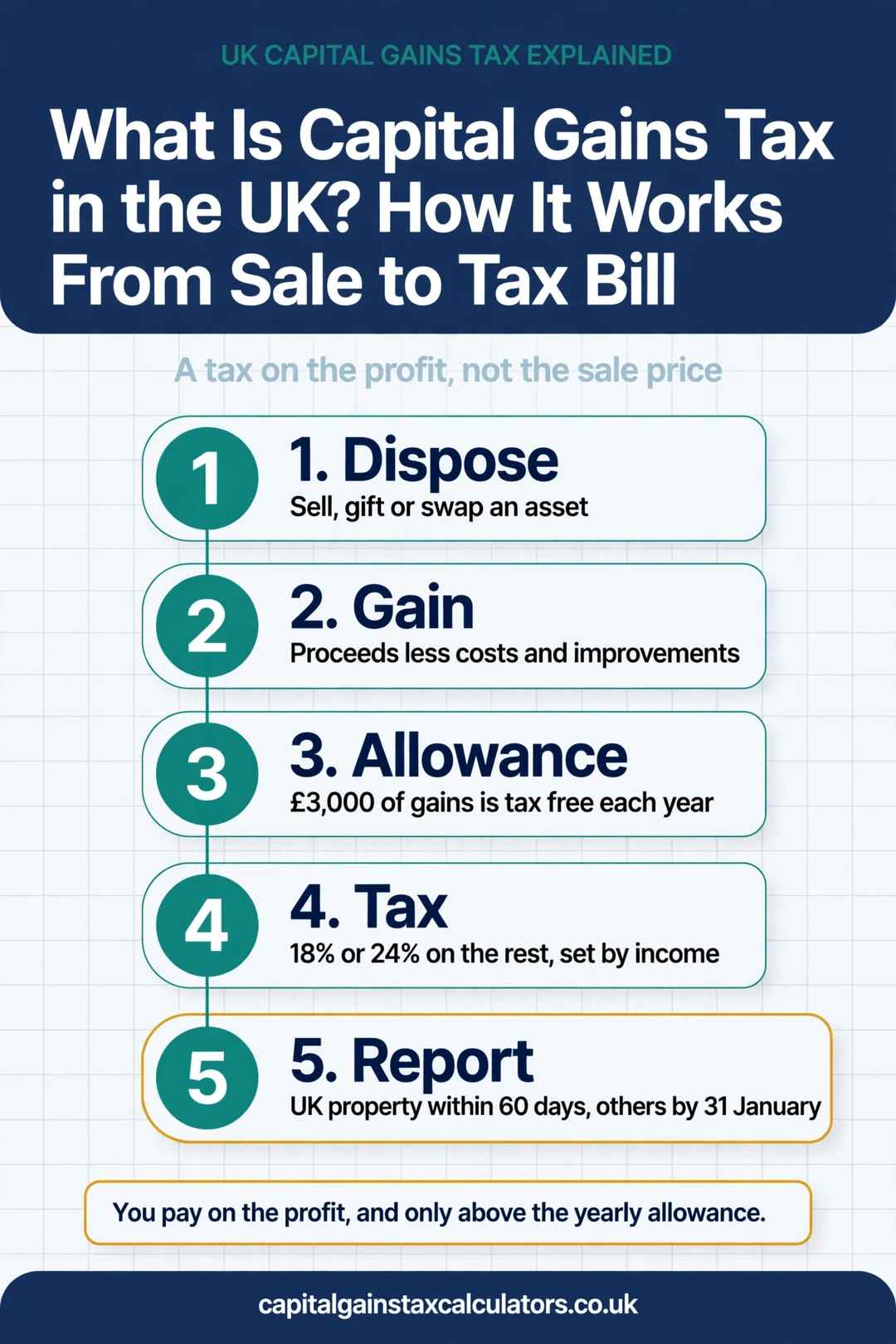
Capital Gains Tax is a UK tax on the profit you make when you sell, give away or otherwise dispose of something that has gone up in value. You pay tax on the gain, not on the whole sale price. The first £3,000 of gains each tax year is free of tax. Above that, gains are taxed at 18% or 24% in 2026/27, depending on your income.
Key facts
- Capital Gains Tax applies to the profit on a disposal, not to the value of what you own.
- The annual exempt amount is £3,000 for individuals in 2026/27.
- Rates are 18% inside the basic rate band and 24% above it.
- Your main home is usually free of the tax under Private Residence Relief.
- ISAs, pensions, cars and most personal items are exempt.
- A sale of UK residential property with tax due must be reported and paid within 60 days.
Good to know
Try the calculator
Not sure what your gain is? Use our free Capital Gains Tax calculator for shares, property, crypto and other assets. It shows the gain, the allowance used and the tax.
Capital Gains Tax in plain English
When you sell something for more than you paid, the profit is a capital gain. Capital Gains Tax, often shortened to CGT, is the tax on that profit. It is not a tax on owning an asset, and it is not a tax on the money you receive. If you buy shares for £10,000 and sell them for £12,000, the gain is £2,000, and that is the amount tax is worked out on.
The tax is separate from Income Tax. Income Tax applies to money you earn from work, pensions, interest and dividends. Capital Gains Tax applies to growth in the value of assets. The two taxes interact, though, because your taxable income decides whether your gains fall into the 18% or the 24% rate.
You only pay the tax when you dispose of the asset. Watching a property or share portfolio go up in value creates no tax until you sell, give it away, swap it or otherwise let it go.
What counts as a disposal
A disposal is more than selling. HMRC treats several actions as a disposal of an asset, and any of them can create a gain.
| Action | Counts as a disposal? | Notes |
|---|---|---|
| Selling an asset | Yes | The most common case |
| Giving it away | Yes | Except to a spouse, civil partner or charity |
| Swapping it for something else | Yes | Includes swapping one cryptoasset for another |
| Selling part of it | Yes | Only the part sold is a disposal |
| Receiving money for a lost or destroyed asset | Yes | For example, an insurance payout |
| Inheriting an asset | No | But the later sale can create a gain |
| Transferring to a spouse or civil partner | No | No gain, no loss while you live together |
Our guide to gifts and Capital Gains Tax explains why giving something away can still create a tax bill.
What assets can create a gain
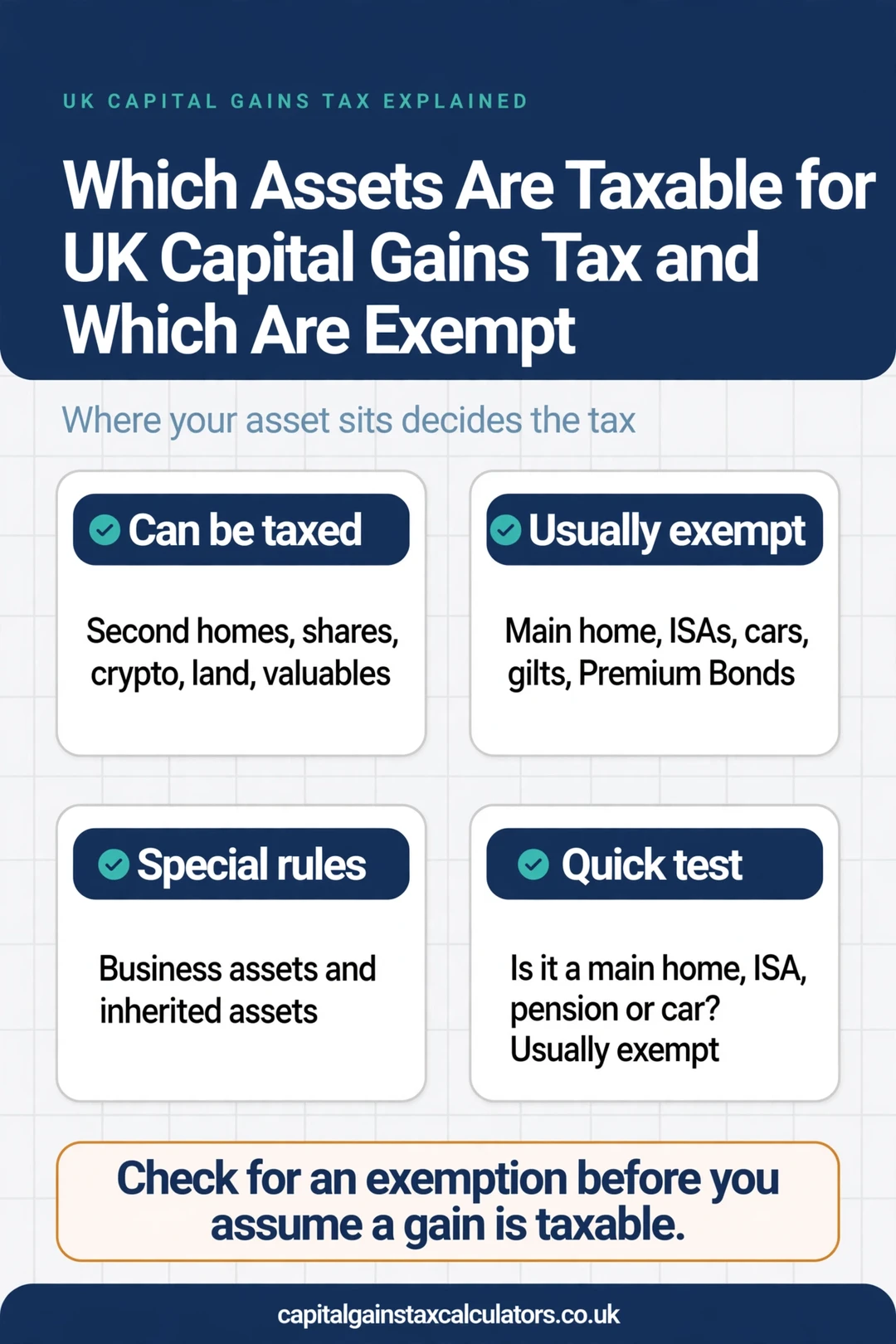
Almost anything of value can be a chargeable asset. The most common ones are:
- Property that is not your main home, such as a second home, a buy-to-let or land.
- Shares, funds and investment trusts held outside an ISA or pension.
- Cryptoassets such as Bitcoin.
- Business assets, including shares in your own company.
- Valuable personal possessions worth £6,000 or more each, such as art, antiques or jewellery.
Some things are exempt, including your main home in most cases, ISAs, Premium Bonds, UK government gilts, cars and your personal belongings worth less than £6,000. See our full list of exemptions.
How the gain is worked out
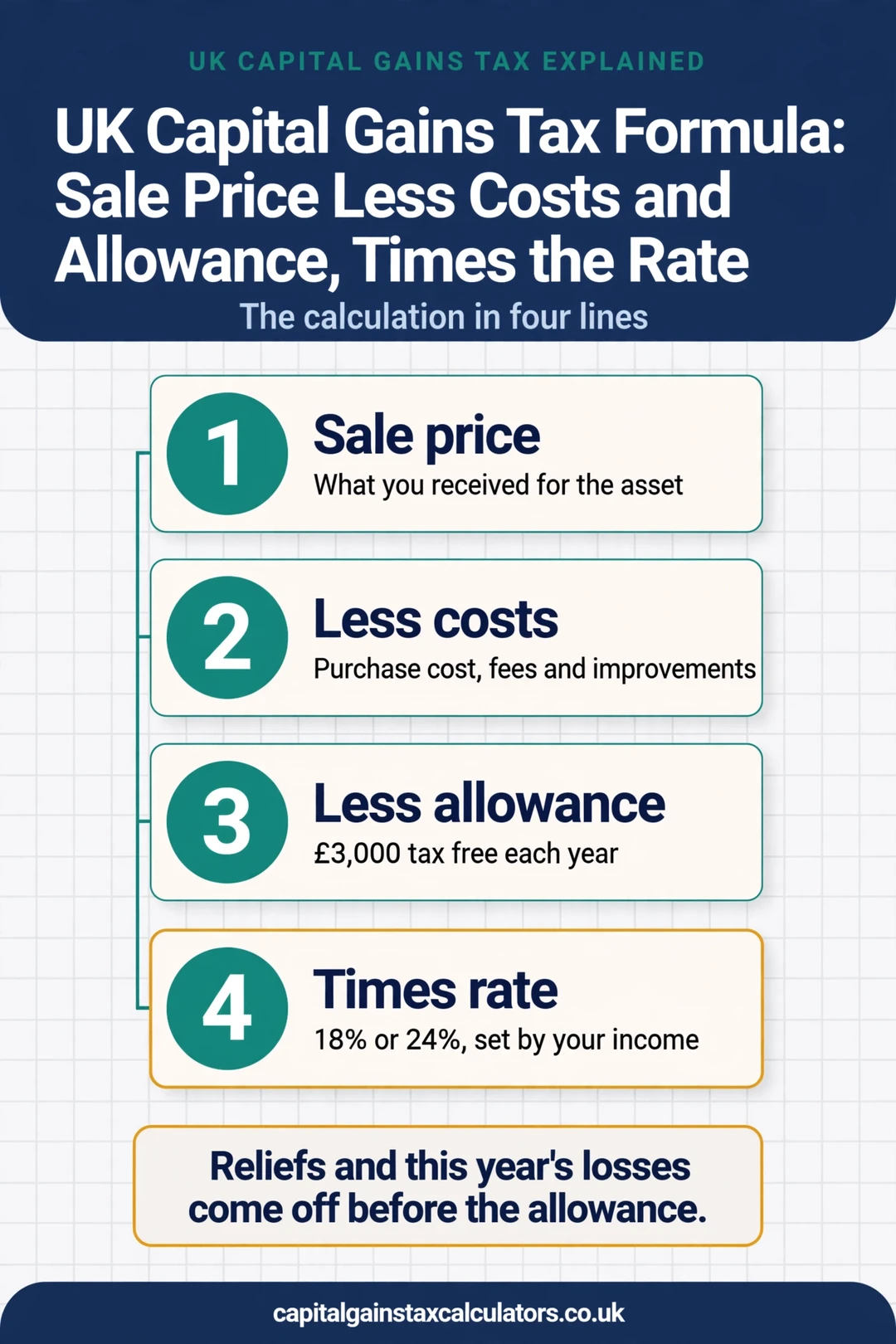
The gain is the amount you received for the asset, minus what it cost you and the costs of buying, selling and improving it. If the answer is positive, you have a gain. If it is negative, you have a loss that can be used against other gains.
Worked example
Selling shares for £45,000
- Sale price: £45,000.
- Less cost: £22,000, plus buying fees of £40 and selling fees of £60.
- Gain: £22,900.
- Less the annual exempt amount: £3,000, leaving £19,900 taxable.
- Tax at 24%: because the person earns £52,000, all the taxable gain is in the higher band. The tax is £4,776.
If the same person earned only £20,000, some of the gain would be taxed at 18% and the tax would be £3,582. If they sold the shares for £12,000 after paying £10,000, the gain of £2,000 would be inside the allowance and the tax would be £0. Our step-by-step guide on how to calculate Capital Gains Tax goes through every stage.
The rates and the allowance
Two figures decide how much tax you pay on a gain: the annual exempt amount and the rate.
| Item | 2026/27 figure | Who it applies to |
|---|---|---|
| Annual exempt amount | £3,000 | Individuals and personal representatives |
| Annual exempt amount for most trusts | £1,500 | Trustees |
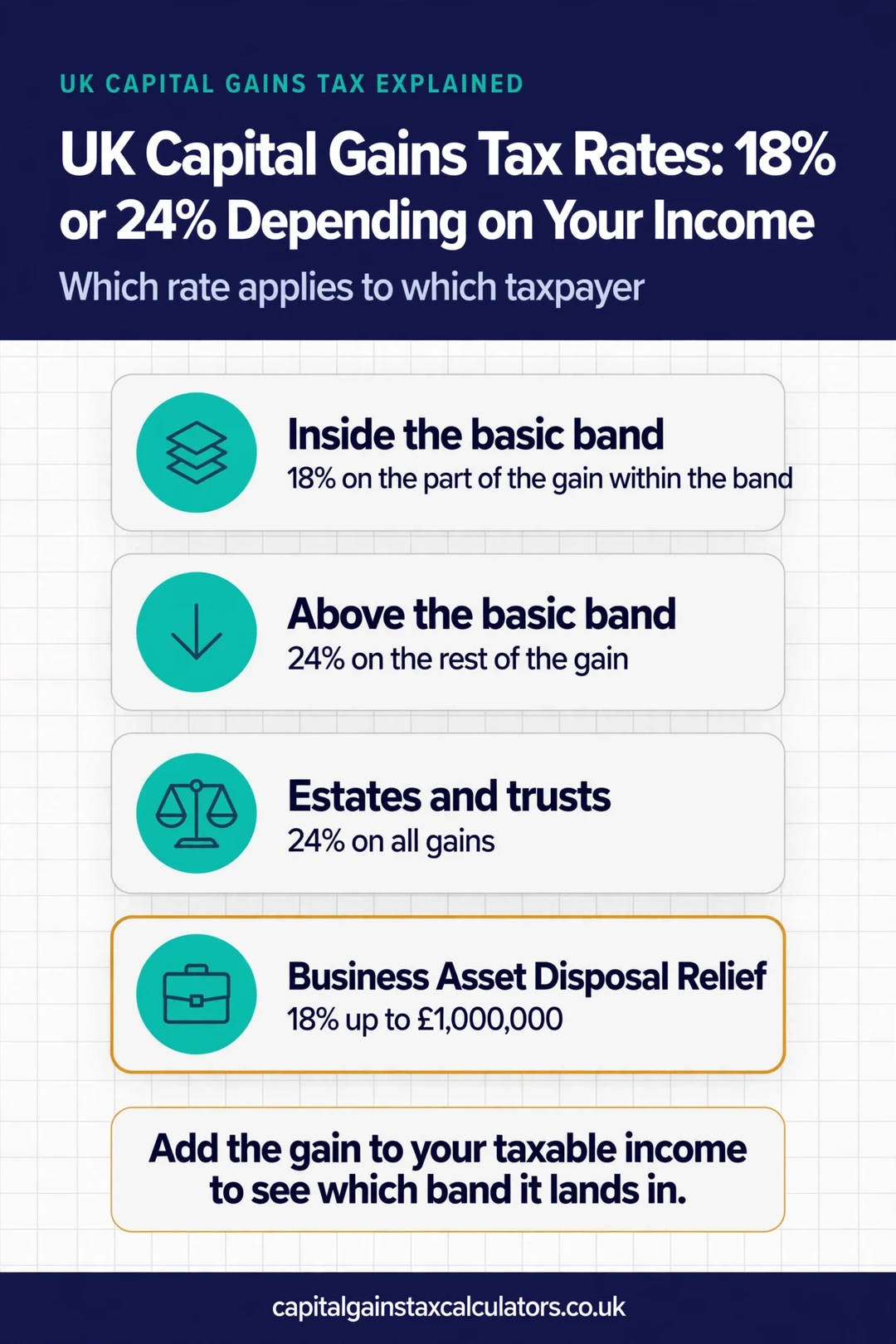
| Lower rate | 18% | Gains inside your basic rate band |
| Higher rate | 24% | Gains above the basic rate band |
| Rate for trustees and personal representatives | 24% | Estates and most trusts |
| Business Asset Disposal Relief rate | 18% | Qualifying business disposals up to £1,000,000 |
Your rate depends on your total taxable income. After the personal allowance of £12,570, the basic rate band is £37,700. Your gain is added on top of your income. The part of the gain that falls inside the remaining basic band is taxed at 18%, and anything above that is taxed at 24%. Read more in our guide to the rates and the allowance.
How the tax year works
Capital Gains Tax runs on the tax year, which starts on 6 April and ends on 5 April. The date of a disposal decides which tax year the gain belongs to. For a sale of property, that is the date of the contract, not the date of completion, unless the contract is conditional. Each tax year has its own annual exempt amount, and an unused allowance is lost at the end of the year. This is why some investors sell a little each year, and why a sale just before 5 April can be reported a year earlier than one just after 6 April. Our sell now or wait calculator shows the effect of splitting a sale across two tax years.
Capital Gains Tax compared with other taxes
People often mix up the taxes that can apply to the same asset. They are separate, and more than one can arise on the same transaction.
| Tax | What it is charged on | When it arises |
|---|---|---|
| Capital Gains Tax | The profit when you dispose of an asset | On sale, gift or swap |
| Income Tax | Earnings, rent, interest and dividends | As the income arises |
| Inheritance Tax | The value of an estate or a large gift | On death, or gifts within seven years of death |
| Stamp Duty Land Tax | The price paid for property in England and Northern Ireland | On buying property |
| Stamp Duty on shares | The price paid for UK shares | On buying shares |
For example, selling an inherited house can create a Capital Gains Tax charge on the growth since death, even though Inheritance Tax may already have been paid on the value at death. Rent from a buy-to-let is Income Tax, while the profit when you sell the property is Capital Gains Tax.
Who has to pay
You pay Capital Gains Tax if you are a UK resident and make a gain above the allowance on a chargeable asset. Non-residents pay tax on UK property and land. Personal representatives pay for an estate, and trustees pay for trusts. Companies do not pay Capital Gains Tax. They pay Corporation Tax on gains.
You do not need to pay anything if your total gains in the tax year are within the allowance. You may still have to report them if your total sale proceeds are over £50,000, or if you want to claim a loss. Read about the special rules in our guides to non-residents and trusts and estates.
Reliefs that can reduce or remove the tax
Several reliefs exist so that the tax is not charged in every case. The biggest are:
| Relief | What it does | Where to read more |
|---|---|---|
| Private Residence Relief | Removes the gain on your main home | Private Residence Relief |
| Business Asset Disposal Relief | Lower rate on qualifying business sales | Business Asset Disposal Relief |
| Spouse transfers | No gain, no loss between spouses | Spouse transfers |
| Gift Hold-Over Relief | Postpones the gain on some gifts | Reliefs |
| Losses | Cancel gains, now or in future | Losses |
When and how to report and pay
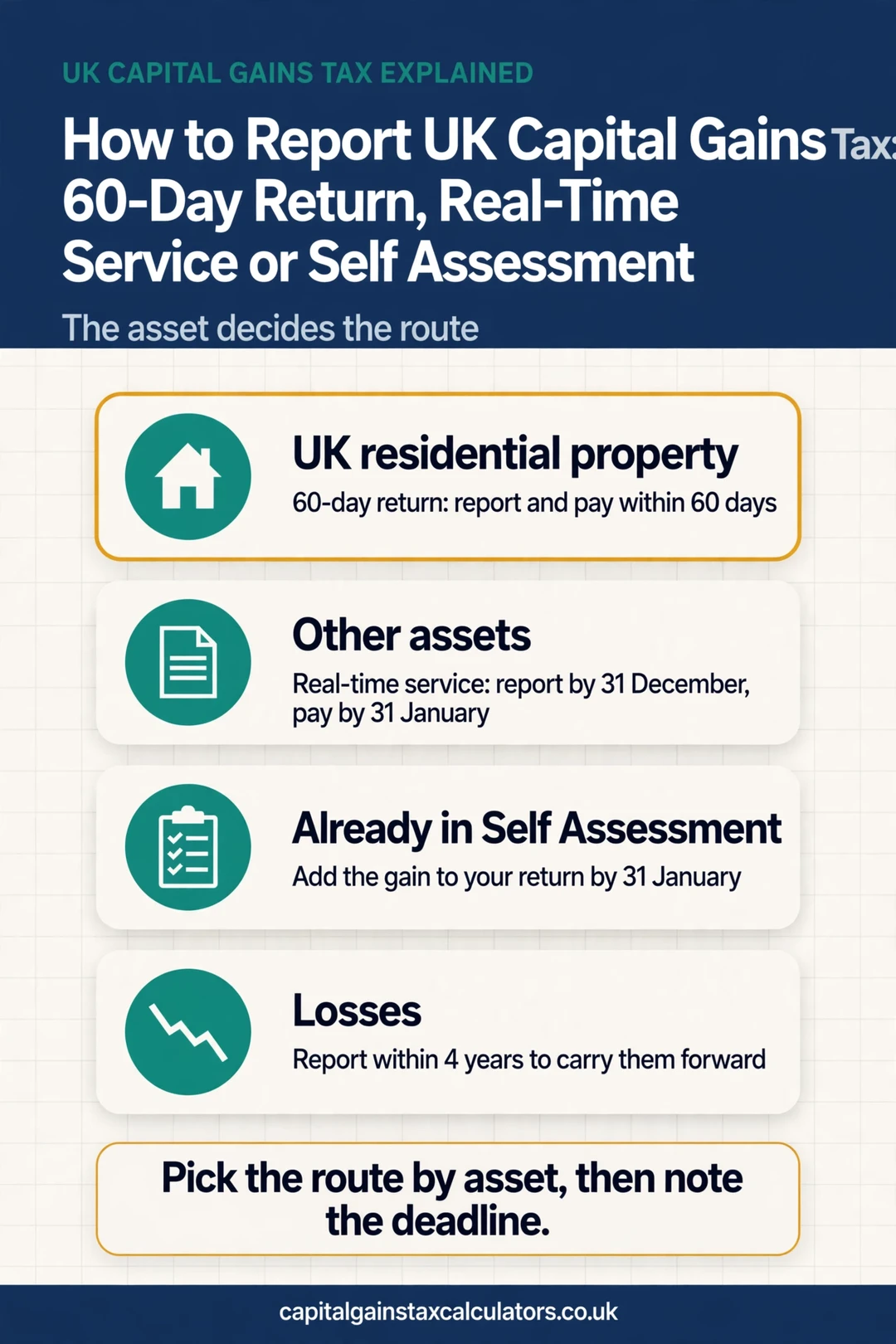
You report gains in one of three ways, depending on what you sold. UK residential property with tax to pay must be reported and paid within 60 days of completion. Other gains can be reported through your Self Assessment tax return, or through the real-time Capital Gains Tax service for some gains. The deadline for the tax return is 31 January after the end of the tax year. Our reporting guide shows which route to use.
Records you should keep
Good records make the calculation simple and protect you if HMRC asks questions. Keep the contract notes and completion statements showing what you paid and received. Keep invoices for improvements and for buying and selling fees. For shares, keep the dealing history. For crypto, keep a record of every trade in pounds. Keep them at least until the 31 January that falls a year after the filing deadline, and longer if you carry forward a loss.
Common mistakes people make
- Assuming the tax applies to the whole sale price. It applies to the gain.
- Forgetting to deduct costs. Fees and improvements reduce the gain.
- Missing the 60-day deadline for UK property. It is separate from your tax return.
- Treating a gift as tax free. Only gifts to a spouse, civil partner or charity are.
- Not reporting losses. Unreported losses cannot be used later.
- Assuming a second home is exempt. Only your main home qualifies for Private Residence Relief.
What to do next
- Decide which asset you sold or plan to sell.
- Use the calculator or one of the specialist tools to estimate the gain and tax.
- Check the exemptions and reliefs that might apply.
- Report and pay using our reporting guide.
Frequently asked questions
What is Capital Gains Tax in simple terms?
It is a tax on the profit you make when you sell, give away or swap something that has risen in value. You pay it on the gain, not on the full amount you receive.
Who has to pay Capital Gains Tax in the UK?
UK residents who make gains above the £3,000 annual exempt amount on assets that are not exempt. Non-residents pay on UK property and land. Trustees and personal representatives pay for trusts and estates.
What is the Capital Gains Tax rate for 2026/27?
18% for gains inside your basic rate band and 24% for gains above it. Trustees and personal representatives pay 24%.
Do I pay Capital Gains Tax when I sell my house?
Usually not on your main home, because of Private Residence Relief. You may pay on a second home, a buy-to-let or land, or if part of your home was let or used for business.
Do I pay Capital Gains Tax on inheritance?
No tax arises when you inherit an asset. A later sale can create a gain, measured from its value at the date of death.
Is Capital Gains Tax the same as Income Tax?
No. Income Tax applies to earnings, pensions, interest and dividends. Capital Gains Tax applies to profit from selling assets. Your income decides which Capital Gains Tax rate applies.
Are gains in an ISA taxable?
No. Gains on investments held in an ISA or a pension are free of Capital Gains Tax. You do not need to report them.
How do I know if I need to report a gain?
You must report UK property sales with tax due within 60 days. For other assets, report if your gains are above the allowance or your total proceeds are over £50,000.
Can I reduce Capital Gains Tax legally?
Yes. Use your allowance each year, claim reliefs, offset losses, transfer assets to a spouse before selling, and use ISAs and pensions. Our guide to reducing the tax lists the options.
Where can I check the official rules?
On GOV.UK. The links at the bottom of this page go to the official Capital Gains Tax pages, which are the authority if our summary and the official pages differ.
Official sources
- GOV.UK: Capital Gains Tax
- GOV.UK: Capital Gains Tax rates and allowances
- GOV.UK: What you pay Capital Gains Tax on
- GOV.UK: Report and pay your Capital Gains Tax
Related guides and calculators
This page gives general information for UK taxpayers and is not tax advice. Capital Gains Tax rules can change and your own circumstances matter. Check the latest rules on GOV.UK or with a qualified tax adviser before you act.