Quick answer
Trustees and personal representatives pay Capital Gains Tax at 24% on gains above their allowance, with no lower rate band. Personal representatives have a £3,000 allowance for the tax year of death and the next two tax years. Most trustees have £1,500. Passing assets from an estate to a beneficiary is not a disposal, but a trustee transferring assets to a beneficiary usually is. The rules differ for bare trusts, where the beneficiary is taxed.
Key facts
- Trustees and personal representatives pay 24% on gains. There is no 18% band.
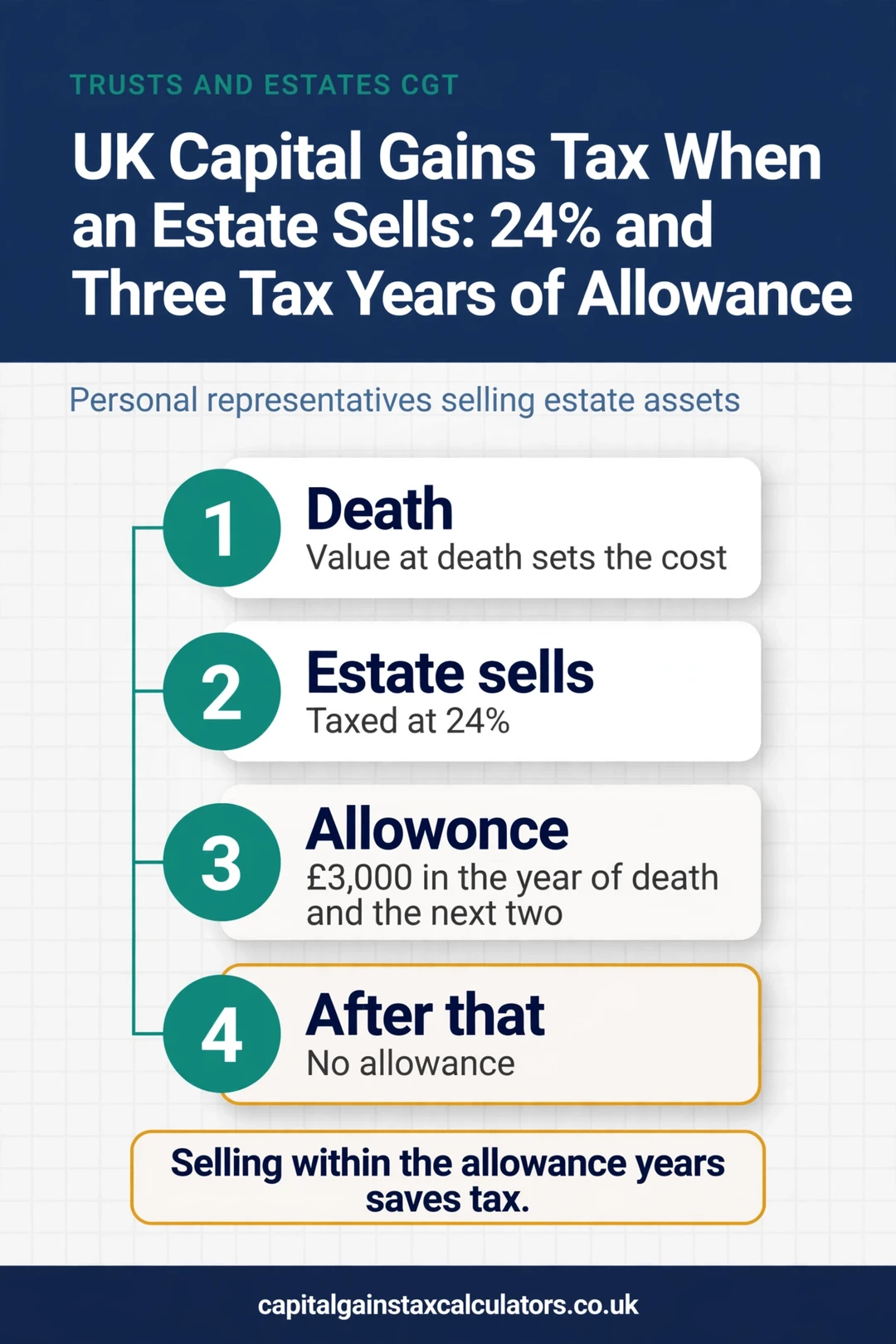
- Personal representatives have £3,000 for the tax year of death and the next two tax years.
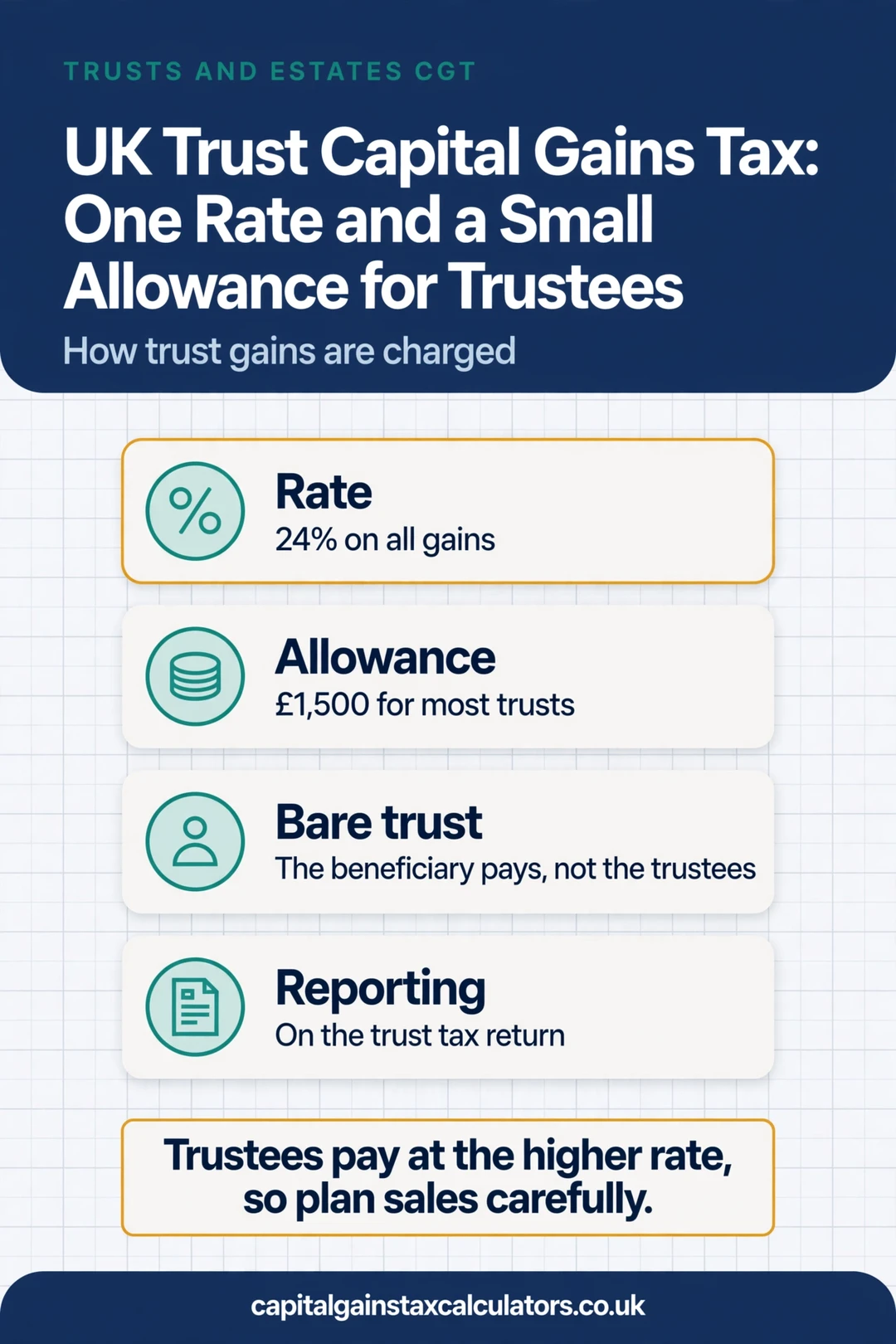
- Most trustees have £1,500, and trusts for vulnerable beneficiaries can have £3,000.
- Assets passing from an estate to a beneficiary are not a disposal. The beneficiary takes the probate value as their cost.
- Assets passing from a trust to a beneficiary are normally a disposal at market value.
- For a bare trust, the beneficiary reports the gains.
Good to know
Estimate an estate sale
Use our inherited property calculator and choose “estate” to see the personal representative rate and allowance.
Personal representatives and estates
When someone dies, their personal representatives, who are executors or administrators, deal with the estate. The assets are treated as acquired by the personal representatives at their market value on the date of death. If the personal representatives sell an asset during the administration, any gain from that value is taxed on them. The rate is 24%. They have the annual exempt amount of £3,000 for the tax year of death and the following two tax years.
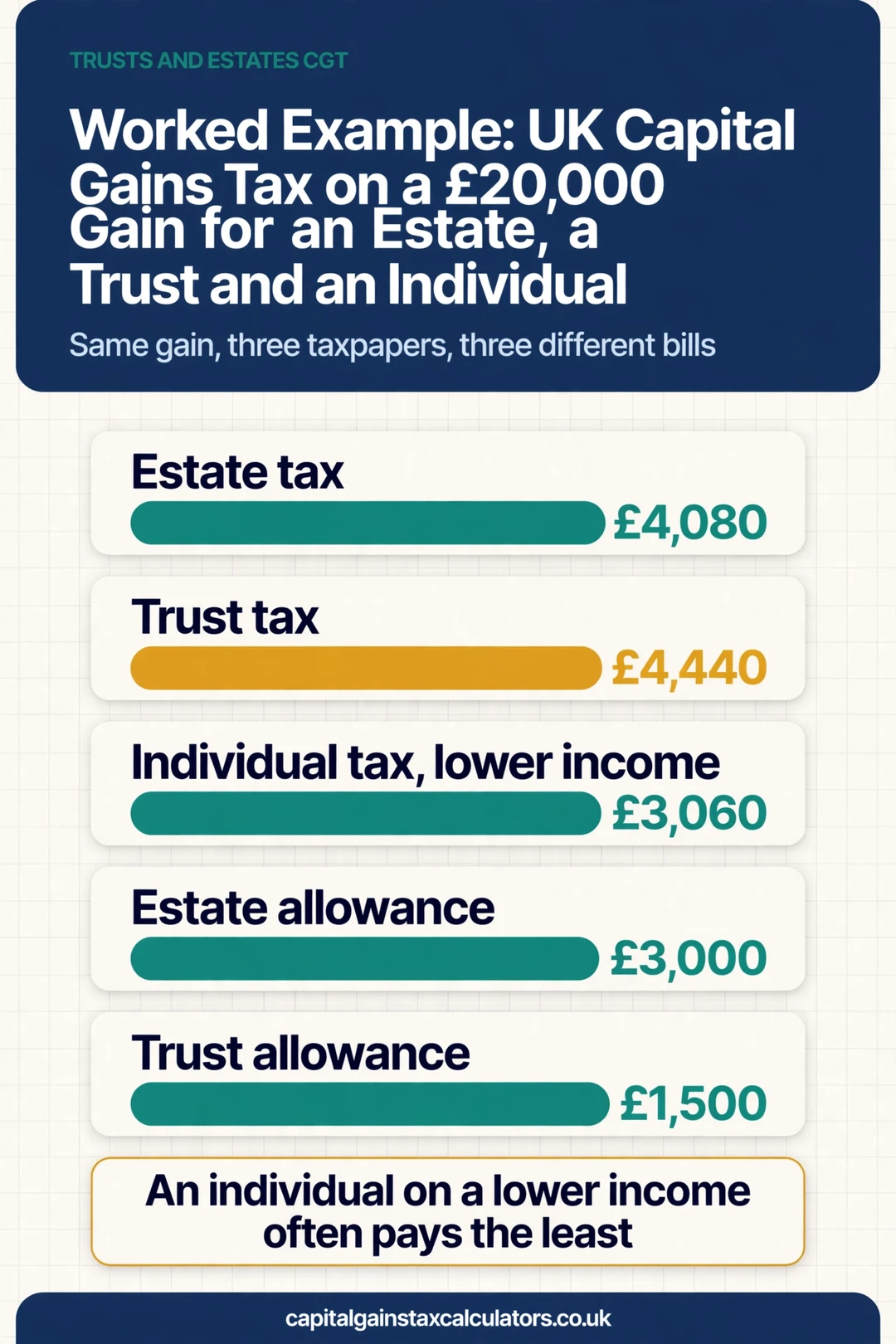
On a gain of £20,000, the estate pays £4,080 within the allowance window and £4,800 outside it. The same gain for an individual earning £20,000 would cost £3,060, because part of the gain would be taxed at 18%. That is why it can be worth transferring an asset to a beneficiary with lower income before it is sold.
Passing assets to beneficiaries
When personal representatives transfer an asset from the estate to a beneficiary, they do not make a disposal for Capital Gains Tax. The beneficiary is treated as acquiring the asset at its market value on the date of death. They pay no tax when they receive it, and the gain on a later sale is measured from the probate value. The beneficiary reports the later sale themselves, using their own allowance and rates.
If a beneficiary receives cash instead, there is no Capital Gains Tax for them, because cash has no gain. The personal representatives are responsible for any tax on assets they sold during the administration. The records of the estate should say clearly which assets were sold and which were transferred. See our guide to inherited property.
Trusts and trustees
Trustees are treated as one continuing person who acquires the trust assets and pays the tax. The rate is 24%. Most trustees have half the individual allowance, £1,500. A gain of £20,000 in a trust costs £4,440.
| Type of trust | Who pays Capital Gains Tax | Rate | Allowance |
|---|---|---|---|
| Bare trust | The beneficiary | Beneficiary’s own rates | Beneficiary’s own allowance |
| Interest in possession trust | The trustees | 24% | £1,500 |
| Discretionary trust | The trustees | 24% | £1,500 |
| Trust for a vulnerable beneficiary | The trustees, with a claim | Beneficiary’s rates if a claim is made | £3,000 |
| Estate during administration | The personal representatives | 24% | £3,000 for three tax years |
If the same person settles more than one trust, the allowance is shared between them, subject to a minimum for each. A trust that holds UK residential property must report a disposal within 60 days of completion, if there is tax to pay.
Putting assets into a trust
A gift of an asset into a trust is a disposal at market value, so the person making the gift may owe tax on the gain. In many cases, the gift is a chargeable lifetime transfer for Inheritance Tax, which allows hold-over relief to postpone the gain. The trustees then take the asset at market value less the held-over gain. The conditions are technical. If you are considering a trust, take advice on both Capital Gains Tax and Inheritance Tax.
Taking assets out of a trust
When trustees give assets to a beneficiary, it is generally a disposal at market value, and the trustees may owe tax on any gain. Again, hold-over relief may be available if the transfer is to a beneficiary and certain conditions are met. If the trust ends and the beneficiary becomes absolutely entitled to the assets, there is a deemed disposal and re-acquisition at market value. Trustees should plan the timing of such transfers so that the gains are taxed at the best rate and within the allowance.
Worked example: who should sell?
Worked example
An estate with a gain of £20,000
An estate holds shares that rose by £20,000 since the date of death. The personal representatives could sell them, or pass them to a beneficiary who earns £20,000 and sells them later.
- Estate sells inside the allowance window: the £3,000 allowance leaves £17,000 taxable at 24%, so the tax is £4,080.
- Estate sells after the window: the whole gain is taxable, and the tax is £4,800.
- Beneficiary sells with a lower income: part of the gain is taxed at 18%, and the tax is £3,060.
| Route | Rate used | Allowance | Tax on the gain |
|---|---|---|---|
| Estate sells inside three tax years | 24% | £3,000 | £4,080 |
| Estate sells later | 24% | None | £4,800 |
| Trust sells | 24% | £1,500 | £4,440 |
| Beneficiary sells with a lower income | 18% and 24% | £3,000 | £3,060 |
The right route depends on the wishes of the beneficiaries, the terms of the will and the market. A beneficiary with a high income may prefer the estate to sell inside the allowance window. A beneficiary with a low income, or one who has unused allowance, may do better if the asset is passed to them first. It is worth modelling the numbers before the asset is sold, because an asset that has been sold cannot be moved.
The deceased person’s final tax year
The person who has died is also treated as a taxpayer up to the date of death. Any gains they made in the tax year of death, before they died, are taxed on them at the individual rates, with their own allowance. The personal representatives report those gains on a final return. If the person made losses in that year, the losses can be set against gains in the previous three tax years. A final return can therefore produce a refund, and it is worth checking. Our losses guide has more on this special rule.
Reporting for trusts and estates
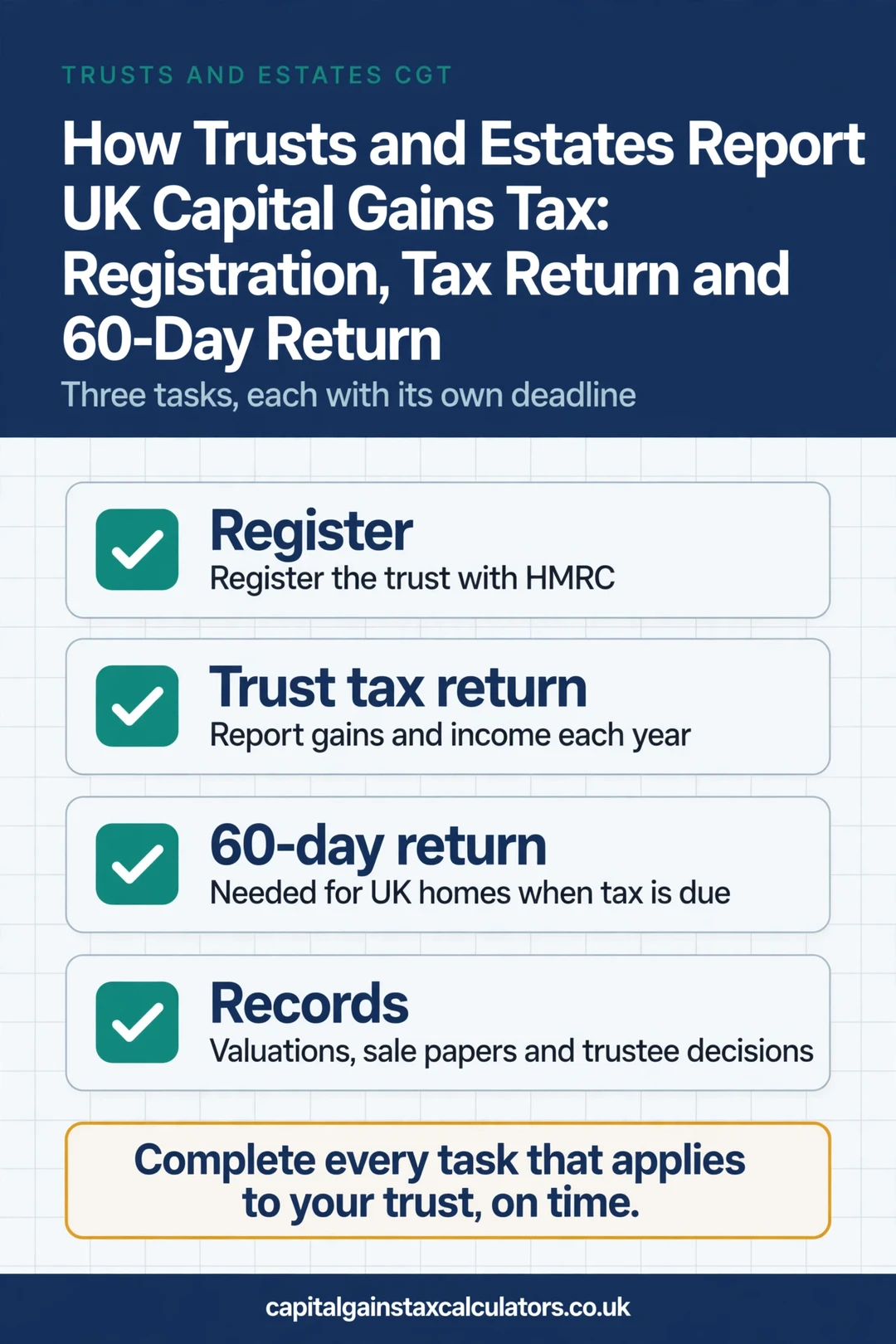
Trustees must register the trust with HMRC’s Trust Registration Service and report gains on a trust and estate tax return. Personal representatives report gains for the estate and may need to file returns for the tax years in which the estate is administered. Sales of UK residential property with tax due must be reported within 60 days of completion. Payment methods for estates and trusts differ from those for individuals, so follow the instructions on GOV.UK. See our reporting guide.
Common mistakes with trusts and estates
- Using the individual rate. Trustees and personal representatives pay 24%.
- Missing the estate’s allowance window. It ends after the second tax year following death.
- Treating a transfer to a beneficiary as a sale. From an estate, it is not a disposal.
- Forgetting the trust is a taxpayer. Trustees must report gains.
- Ignoring bare trusts. The beneficiary reports the gains.
- Not planning timing. A sale by the beneficiary may cost less than a sale by the estate.
What to do next
- Identify whether you are dealing with an estate, a bare trust or another trust.
- Estimate the tax with the inherited property calculator.
- Compare a sale by the estate with a sale by the beneficiary.
- Report and pay as set out in our reporting guide.
Frequently asked questions
What rate do trustees pay on Capital Gains Tax?
24% for 2026/27. Trusts do not have a lower rate band.
What rate do personal representatives pay?
24% on gains above their allowance.
How long does an estate have an allowance?
For the tax year of death and the next two tax years, it has £3,000. After that it has none.
What is the allowance for a trust?
£1,500 for most trusts, and £3,000 for trusts for vulnerable beneficiaries.
Is it a disposal when an estate gives an asset to a beneficiary?
No. The beneficiary takes the asset at its value on the date of death, with no tax at the time.
Is it a disposal when a trust gives an asset to a beneficiary?
Usually yes, at market value, although hold-over relief may postpone the gain.
Who pays tax on a bare trust?
The beneficiary. The trustees hold the asset, but the beneficiary is treated as the owner for tax.
Do trustees need to report a sale of UK property within 60 days?
Yes, where there is tax to pay on UK residential property, they report and pay within 60 days of completion.
Can beneficiaries use their own allowance on an estate sale?
Only if the asset passes to them first and they sell it. If the estate sells, the estate’s allowance applies.
Should trustees take advice?
Yes, in most cases. The rules interact with Inheritance Tax, Income Tax and trust law.
Official sources
- GOV.UK: Trusts and Capital Gains Tax
- HMRC helpsheet HS294: Trusts and Capital Gains Tax
- GOV.UK: Tax on property you inherit
- GOV.UK: Capital Gains Tax rates
Related guides and calculators
This page gives general information for UK taxpayers and is not tax advice. Capital Gains Tax rules can change and your own circumstances matter. Check the latest rules on GOV.UK or with a qualified tax adviser before you act.