Quick answer
If you are not UK resident, you pay UK Capital Gains Tax on gains from selling UK property and land, including residential and commercial property. You must report every sale to HMRC within 60 days of completion, even if there is no tax to pay. The rates are 18% and 24% for 2026/27, with a £3,000 allowance. Gains that arose before the legal start date for the charge are generally outside it.
Key facts
- Non-residents pay UK Capital Gains Tax on UK property and land, and on some indirect disposals.
- Every disposal must be reported within 60 days of completion, even with no tax due.
- The rates are 18% and 24%, and non-residents have the £3,000 allowance.
- Only gains arising after 5 April 2015 are charged for UK residential property, using rebasing or time apportionment.
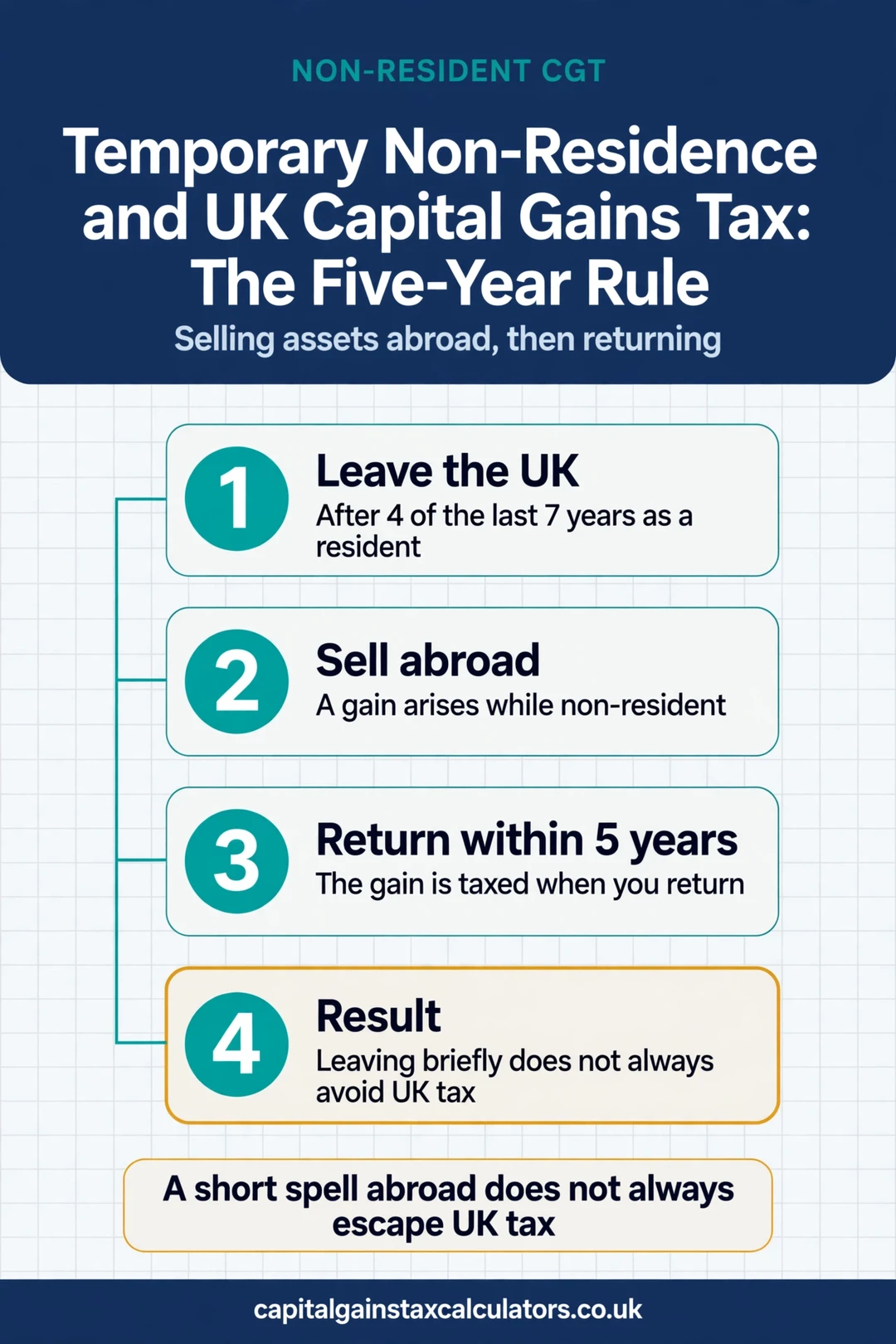
- Leaving the UK for a short time does not always avoid tax on assets you sold on return.
Good to know
Estimate your gain
Use our property Capital Gains Tax calculator with your UK income, which may be nil, and your gain.
Who counts as non-resident
Whether you are UK resident for tax depends on the Statutory Residence Test, which looks at the days you spend in the UK, your ties to the UK and whether you work here. It is not decided by your nationality or by where you are domiciled. Your residence status can change from one tax year to the next, and in the year of arrival or departure the year can be split into a UK part and an overseas part. If you are unsure, check GOV.UK or take advice. This guide assumes you are non-resident in the tax year in which you sell the property.
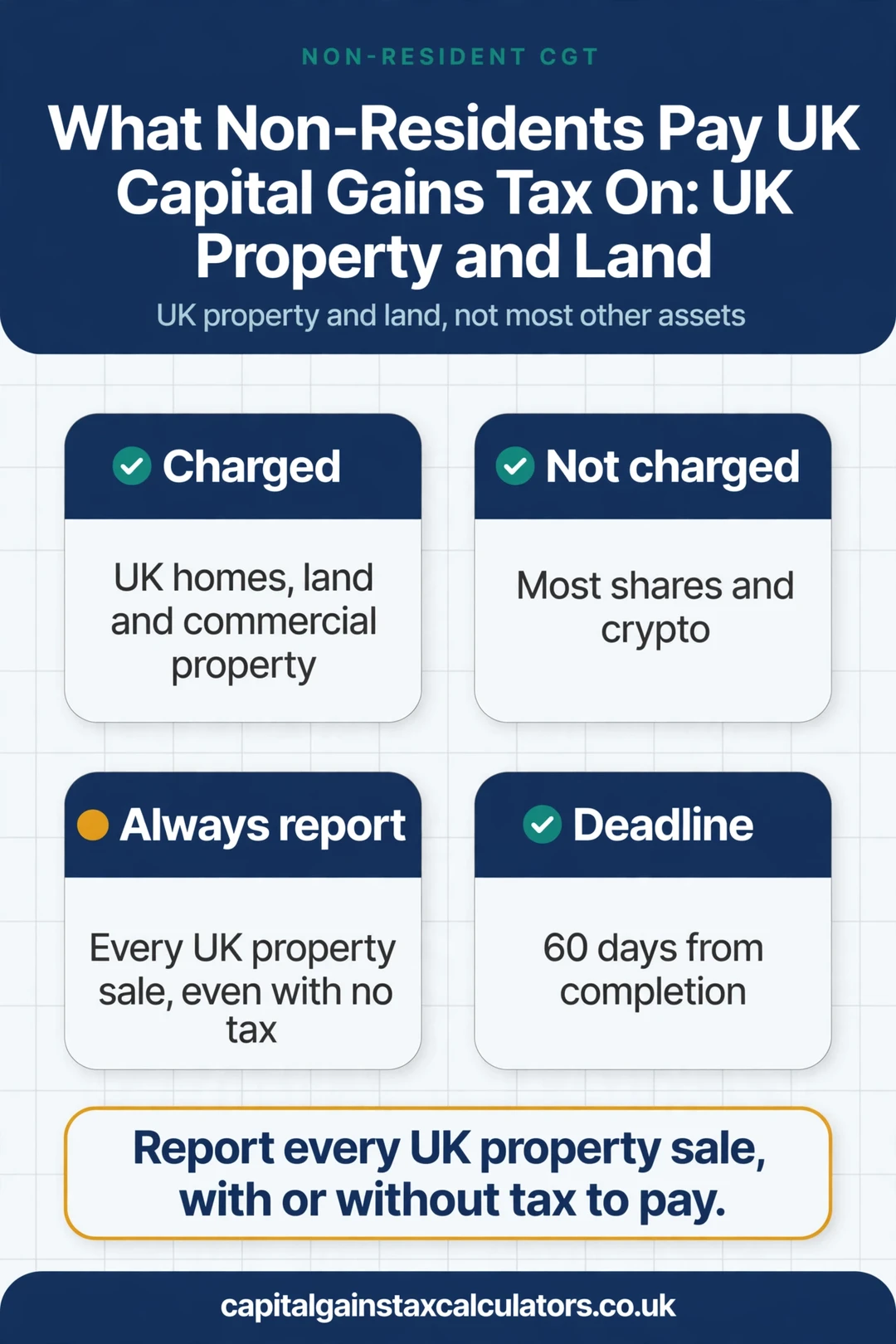
UK residents are normally taxed on their worldwide gains, including gains on property outside the UK. Non-residents are generally taxed only on UK property and land, plus gains that arise on certain shares in property-rich companies. That is the focus of this guide.
What is chargeable for non-residents
| Disposal | Charged to UK Capital Gains Tax? | Notes |
|---|---|---|
| UK residential property | Yes | Gains arising after 5 April 2015 |
| UK commercial property and land | Yes | Gains arising after 5 April 2019 |
| Shares in a property-rich company | Yes, in some cases | Where you hold a 25% or greater interest |
| Shares in a normal company | No | Unless you return within the temporary non-residence period |
| Cryptoassets and other assets | No | Unless the temporary non-residence rules apply |
| Property outside the UK | No UK charge while you are non-resident | May be taxed in the country where it is located |
Residential property was brought into the charge for non-residents in the 2015/16 tax year, and other UK property and land followed in the 2019/20 tax year. Only the gain that accrued after those dates is charged.
| Item | Residential property | Other UK property and land |
|---|---|---|
| Charge began | The 2015/16 tax year | The 2019/20 tax year |
| Rebasing date | 5 April 2015 | 5 April 2019 |
| Report within | 60 days of completion | 60 days of completion |
| Report if no tax is due | Yes | Yes |
| Rates | 18% and 24% | 18% and 24% |
If you cannot find a valuation for the starting date, a retrospective valuation by a surveyor is the usual route. HMRC accepts reasonable valuations that are supported by evidence of comparable sales. Make sure the valuer confirms that the figure is the market value at the relevant date, and keep the report with your records. If you improved the property after the starting date, the improvement costs are added to the rebased figure.
Working out the gain: rebasing
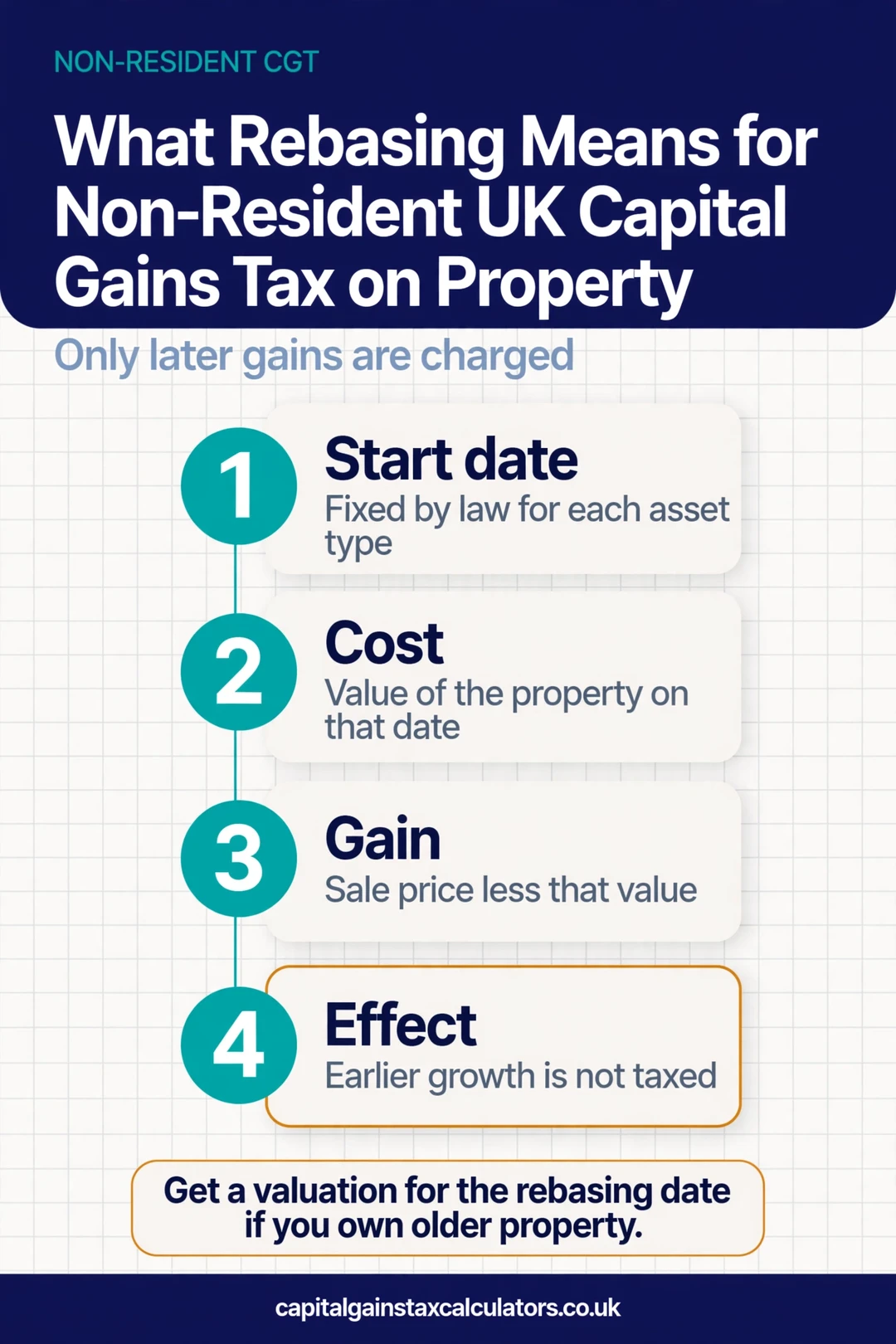
For a UK property that you owned before the charge began, you can use the market value at the starting date as your cost, instead of the original cost. This is called rebasing. The starting date is 5 April 2015 for residential property, and 5 April 2019 for other property. You can also choose to calculate the gain on the full period of ownership and then apportion it by time, or to use the original cost, if that gives a smaller gain. The default for most people is rebasing.
Worked example
A non-resident sells a UK flat
The flat was worth £300,000 on 5 April 2015. It is sold for £400,000, with £8,000 in selling costs. The seller has no other UK income.
- Gain using the rebased value as cost: £400,000 less £8,000 less £300,000 = £92,000.
- After the allowance: £89,000 is taxable.
- Tax: £37,700 at 18% and £51,300 at 24% = £19,098.
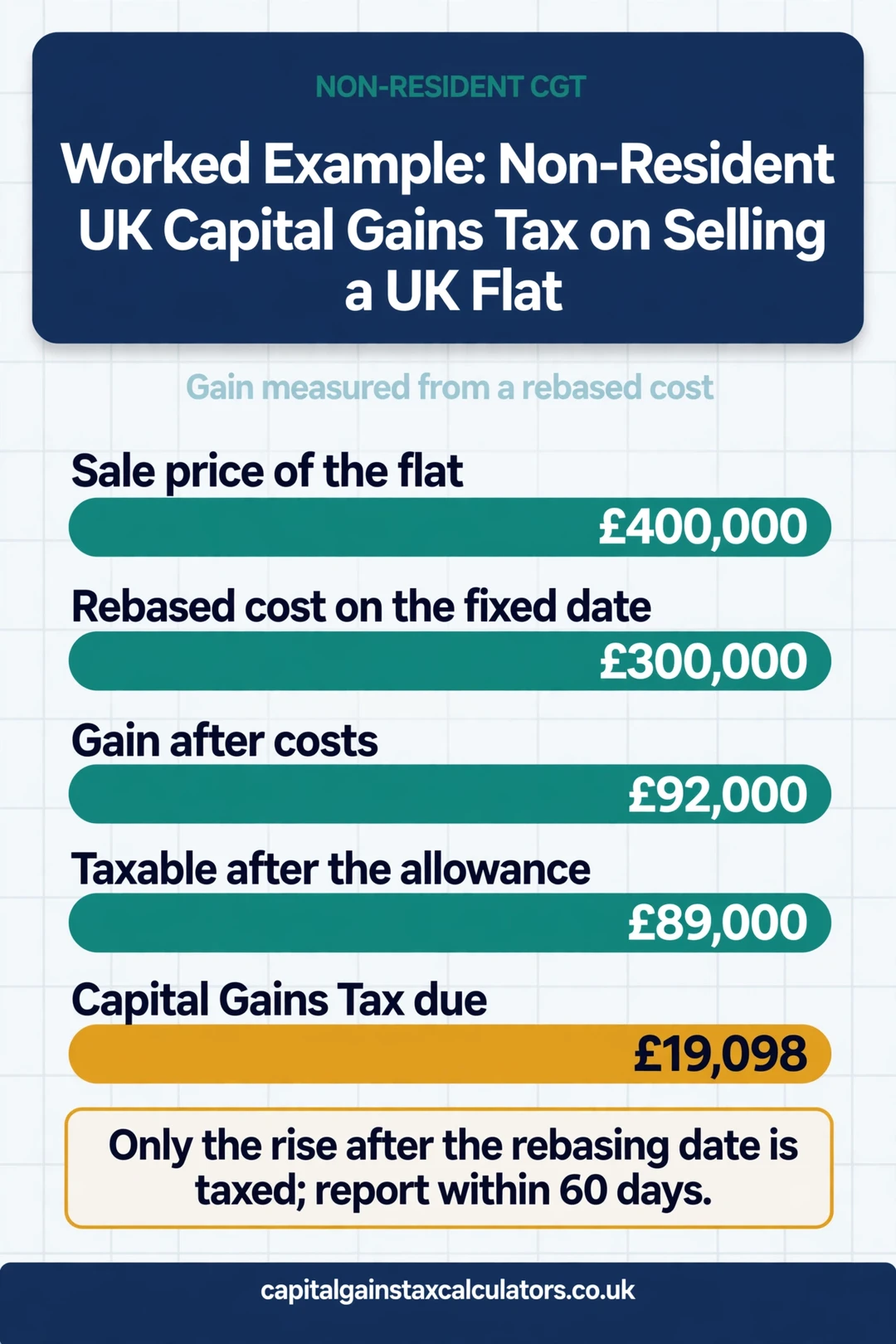
If the seller had other UK income of £60,000, the tax would be £21,360, because less of the basic rate band is available. If the flat sold for £310,000, the gain would be only £2,000, and the tax would be £0. You still need to report the sale.
The 60-day report: always required
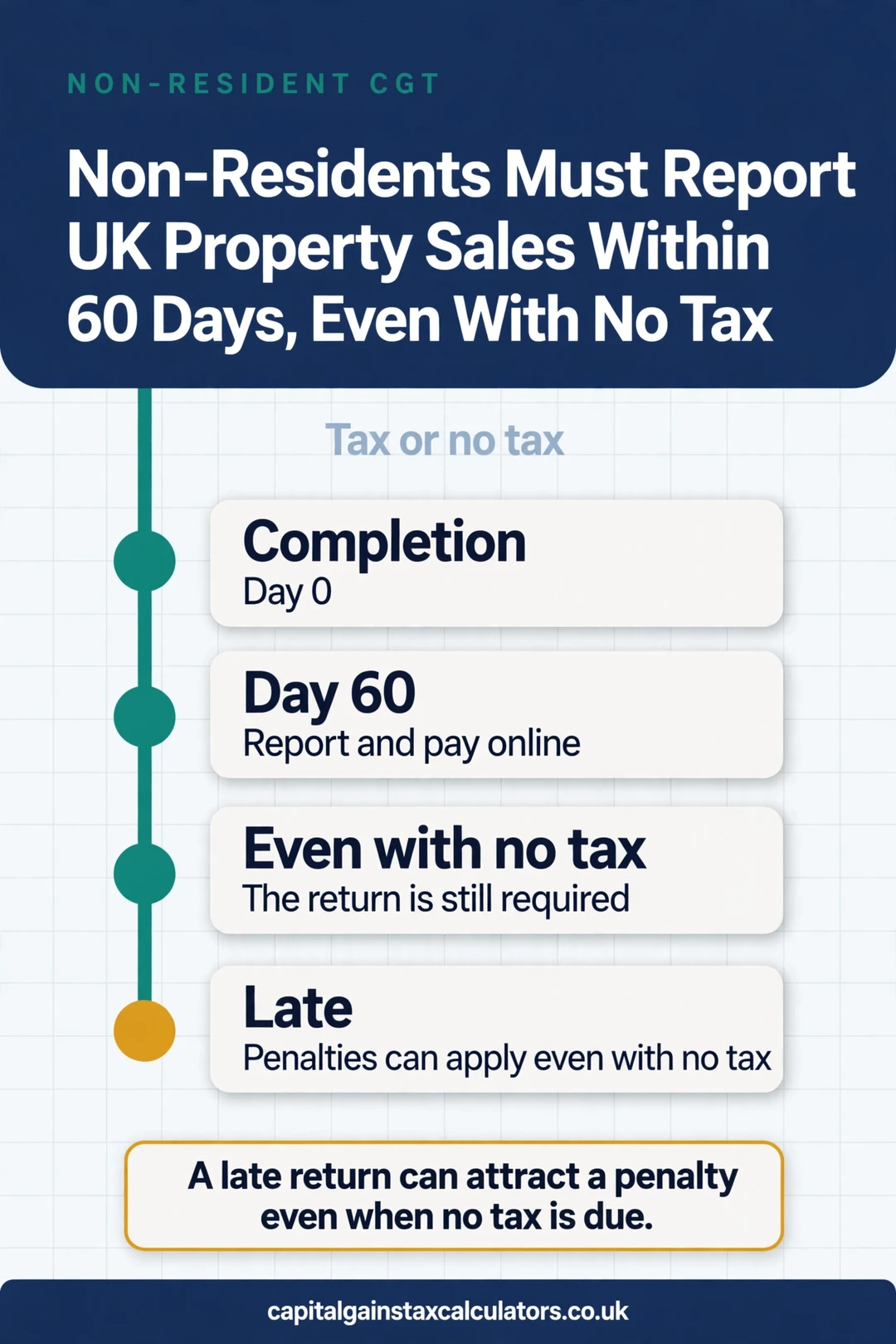
For UK residents, the 60-day return only applies when there is tax to pay on UK residential property. For non-residents, the rule is stricter. You must report every disposal of UK property or land to HMRC within 60 days of completion, even if there is no gain, a loss, or the gain is covered by the allowance. You must also pay any tax due within the same time. If you are in Self Assessment, you must also include the sale on your tax return.
Failing to report on time can lead to penalties and interest even when there is no tax to pay. This is the most common mistake. Use our 60-day deadline calculator to find the date, and our step-by-step reporting guide to file.
Private Residence Relief for non-residents
A non-resident can claim Private Residence Relief for a UK home, but the conditions are stricter. A tax year only counts towards the relief if the home is in the same country as where you are resident, or you spend a minimum number of nights in it. If you have lived abroad for years and let the UK property, you may have little or no relief for those years. The rules are detailed. Check GOV.UK or take advice before relying on relief. Our Private Residence Relief guide explains the basics.
Temporary non-residence
If you leave the UK for a short period and sell assets while you are away, you may still be taxed. If you were UK resident for at least four of the seven tax years before you left, and you return within five years, some gains on assets you held when you left are taxed in the year you come back. The rule stops people leaving temporarily to sell an asset free of tax. It applies to assets you owned before you left, not to those you bought while away. Treaty rules may affect the result.
Double tax and other countries
A property in the UK may also be taxable in the country where you live. Where that happens, there are usually rules or double tax treaties to prevent you being taxed twice, such as a credit for UK tax against the tax in your country of residence. HMRC cannot advise on the other country’s rules. Use a tax adviser who knows both systems if the amount is large.
Common mistakes by non-residents
- Not reporting a sale with no tax. Non-residents must always report.
- Missing the 60-day deadline. Penalties can apply.
- Using the original cost without checking rebasing. The rebased value may give a smaller gain.
- Assuming no UK tax applies. UK property gains are taxable.
- Forgetting the allowance. The £3,000 is available.
- Ignoring temporary non-residence. Gains on return can be charged.
What to do next
- Confirm your residence status for the tax year of the sale.
- Get a valuation as at 5 April 2015 for rebasing.
- Estimate the tax with the property calculator.
- Report within 60 days using the reporting guide.
Frequently asked questions
Do non-residents pay UK Capital Gains Tax?
Yes, on gains from UK property and land. They do not usually pay UK tax on shares, crypto and other assets while non-resident.
Do I need to report a UK property sale if there is no tax?
Yes. Non-residents must report every UK property disposal within 60 days of completion, even with no tax to pay.
What rate do non-residents pay?
18% or 24% for 2026/27, depending on UK income and the gain.
Do non-residents get the annual exempt amount?
Yes. The £3,000 allowance applies to gains on UK property that are charged.
What is rebasing?
Using the property’s value on 5 April 2015 for residential property, or 5 April 2019 for other property, as the cost instead of the original purchase price.
Is commercial property included?
Yes, since the 2019/20 tax year. Only gains after 5 April 2019 are charged on non-residential property.
Can I claim Private Residence Relief while living abroad?
Possibly, but the conditions are stricter. A tax year may count only if the home is in your country of residence or you spend enough nights there.
What is temporary non-residence?
If you leave the UK for a short time and return within five years, some gains made while away are taxed on your return.
Do I also pay tax in my country of residence?
You may. A double tax treaty or credit often prevents double taxation. Take advice for the other country’s rules.
What happens if I report late?
HMRC can charge interest and a penalty that grows with the delay, even if there is no tax due.
Official sources
- GOV.UK: Work out your tax if you are a non-resident selling UK property or land
- GOV.UK: Report and pay Capital Gains Tax on UK property
- GOV.UK: Capital Gains Tax rates
- GOV.UK: Tax when you sell property
Related guides and calculators
This page gives general information for UK taxpayers and is not tax advice. Capital Gains Tax rules can change and your own circumstances matter. Check the latest rules on GOV.UK or with a qualified tax adviser before you act.