Quick answer
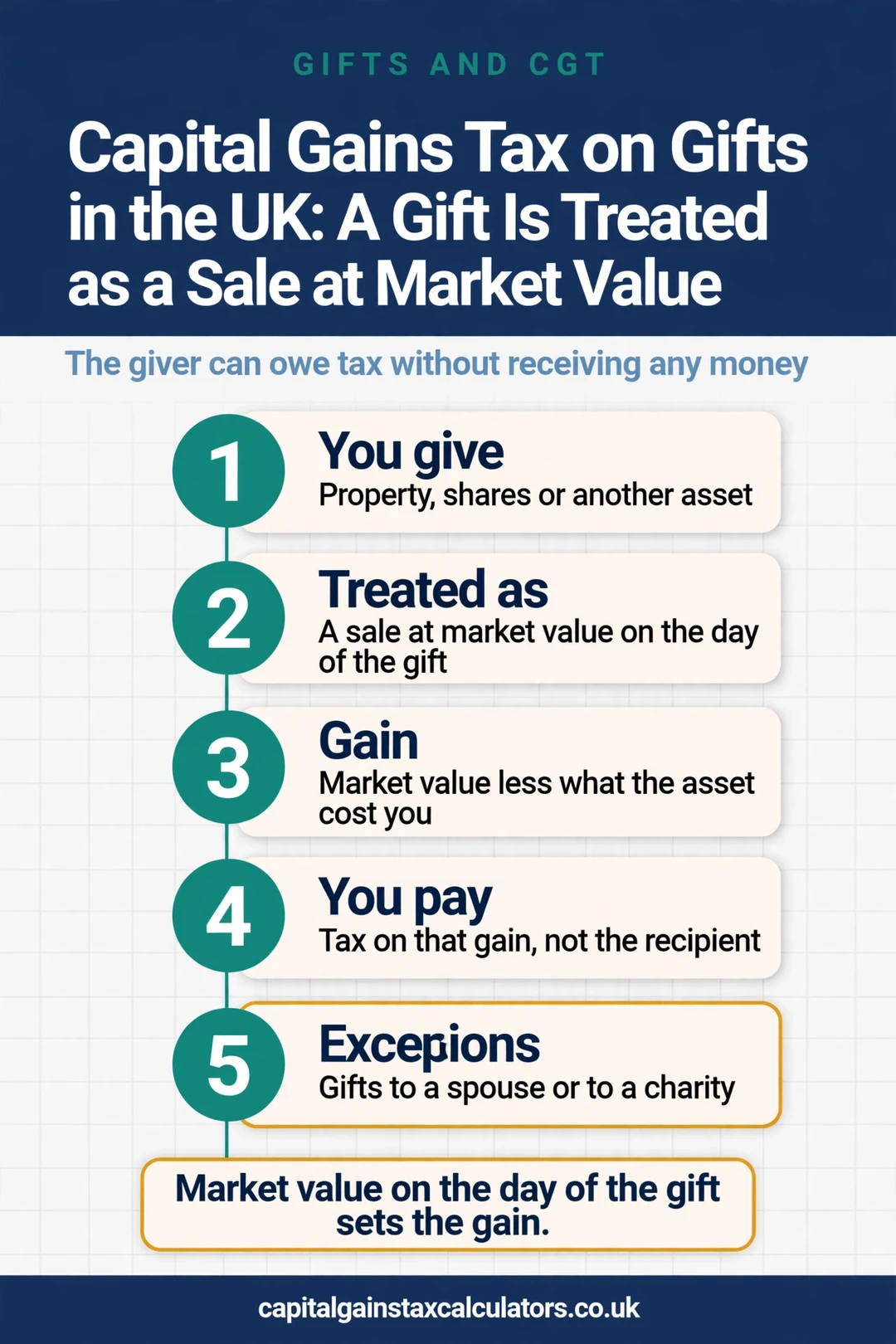
A gift of property, shares or another asset counts as a disposal for Capital Gains Tax, as if you had sold it at its market value on the day. You pay tax on the gain above your £3,000 allowance, at 18% or 24% for 2026/27, even though you receive no money. Gifts to a spouse, civil partner or charity are not taxed. A gift of money is not an asset gain, because cash has no gain.
Key facts
- A gift is treated as a sale at market value on the day of the gift.
- The giver pays the tax, and the recipient takes the market value as their cost.
- Gifts to a spouse or civil partner you live with are no gain, no loss.
- Gifts to charities are not taxed.
- Gift Hold-Over Relief can postpone the gain on business assets and some other gifts.
- A gift of UK residential property with tax due must be reported within 60 days.
Good to know
Calculate the tax on a gift
Use our gifted property calculator to enter the market value and your cost and see the gain, the tax and the recipient’s base cost.
Why a gift can trigger tax
HMRC could not let people avoid Capital Gains Tax by giving assets to relatives instead of selling them. For that reason, a gift is treated as if you had sold the asset for its market value. The “sale price” is not what you actually received, which is nothing, but what the asset would fetch on the open market. The tax is then worked out in the normal way.
The same rule applies when you sell an asset to a connected person, such as a child, a sibling or a company you control, for less than it is worth. HMRC substitutes the market value for the price actually paid. This is true even if the price you agreed seems fair to you. A written valuation near the date of the gift is the best evidence.
Working out the gain on a gift
The calculation is the same as for a sale. Take the market value, deduct the cost of the asset, the costs of buying and any improvements, and deduct the costs of the gift, such as a valuation or legal fees.
Worked example
Giving a property to a child
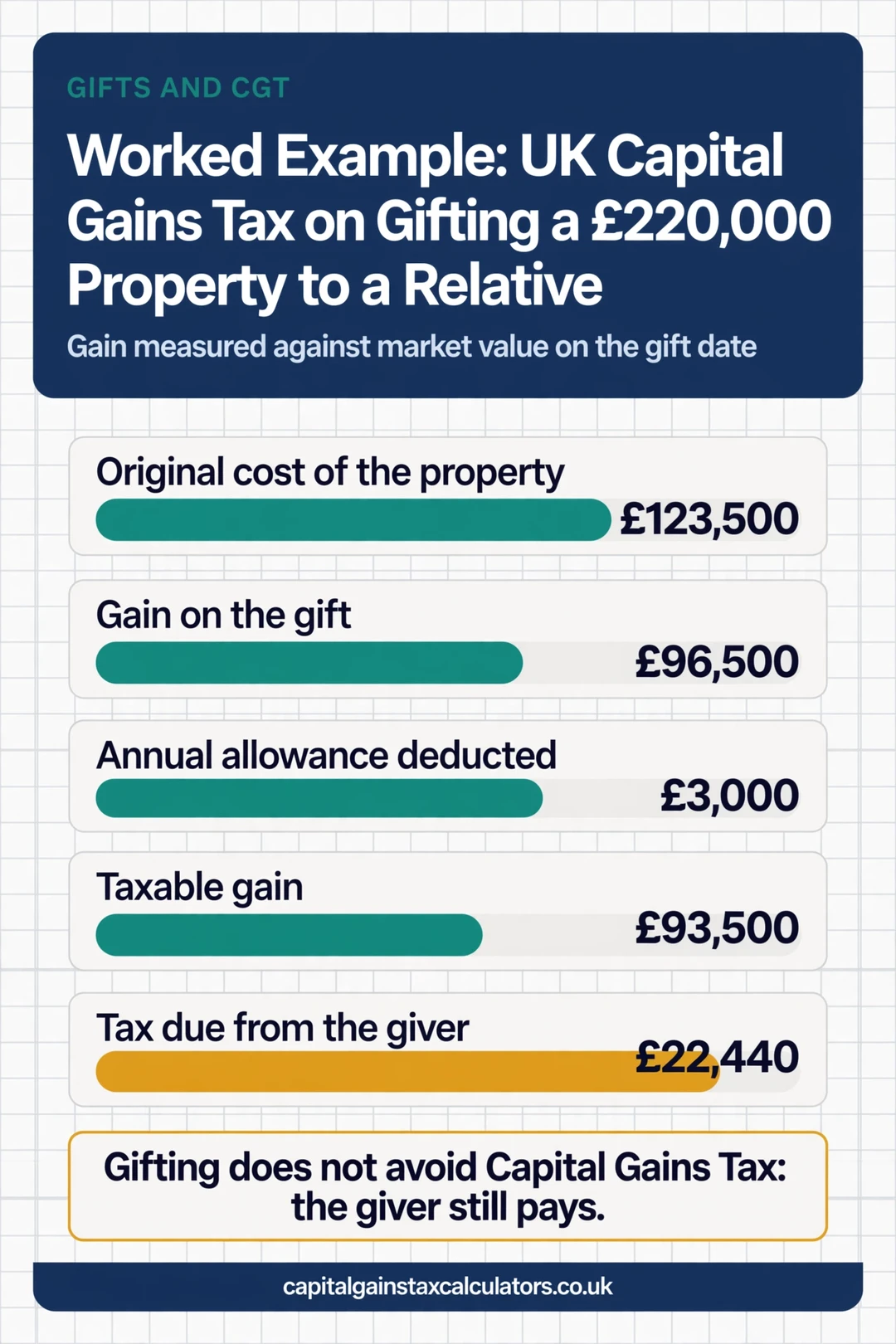
You give a property worth £220,000 to your child. You bought it for £120,000, plus £3,500 in costs. Your income is £70,000.
- Market value: £220,000.
- Gain: £220,000 less £123,500 = £96,500.
- After the allowance: £93,500 is taxable, all at 24%.
- Tax payable by you: £22,440.
- Your child’s cost: £220,000, used for any later sale.
If your income was only £22,000, the tax would be £20,744. A gift of shares worth £40,000 that cost £15,000 would give a gain of £25,000, and tax of £5,280.
Who you give to
| Recipient | Capital Gains Tax for the giver | Recipient’s cost |
|---|---|---|
| Spouse or civil partner (living together) | None, no gain no loss | Your original cost and date |
| Registered charity | None | Not applicable |
| Child, parent or other relative | Gain at market value | Market value on the day |
| Friend or other person | Gain at market value | Market value on the day |
| Trust you create | Gain at market value, with hold-over available in some cases | Market value, less any gain held over |
| Company | Gain at market value | Market value |
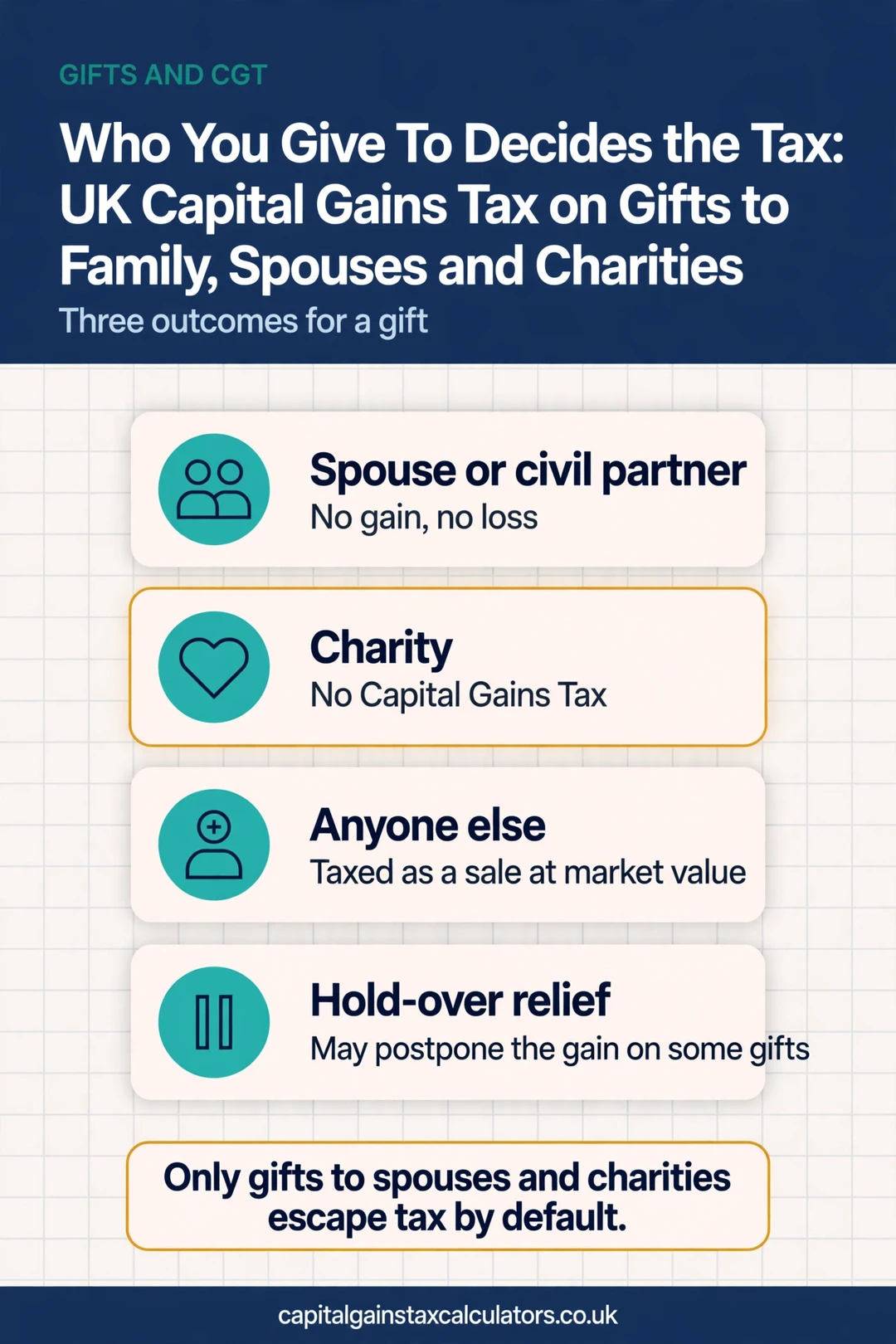
For a gift to a spouse, the transfer is made at a price that gives no gain and no loss, so there is no tax. The spouse takes over your original cost and the date you acquired the asset. If the spouse later sells, the gain is measured from your cost. Our spouse transfer guide explains the conditions, such as living together.
Gift Hold-Over Relief
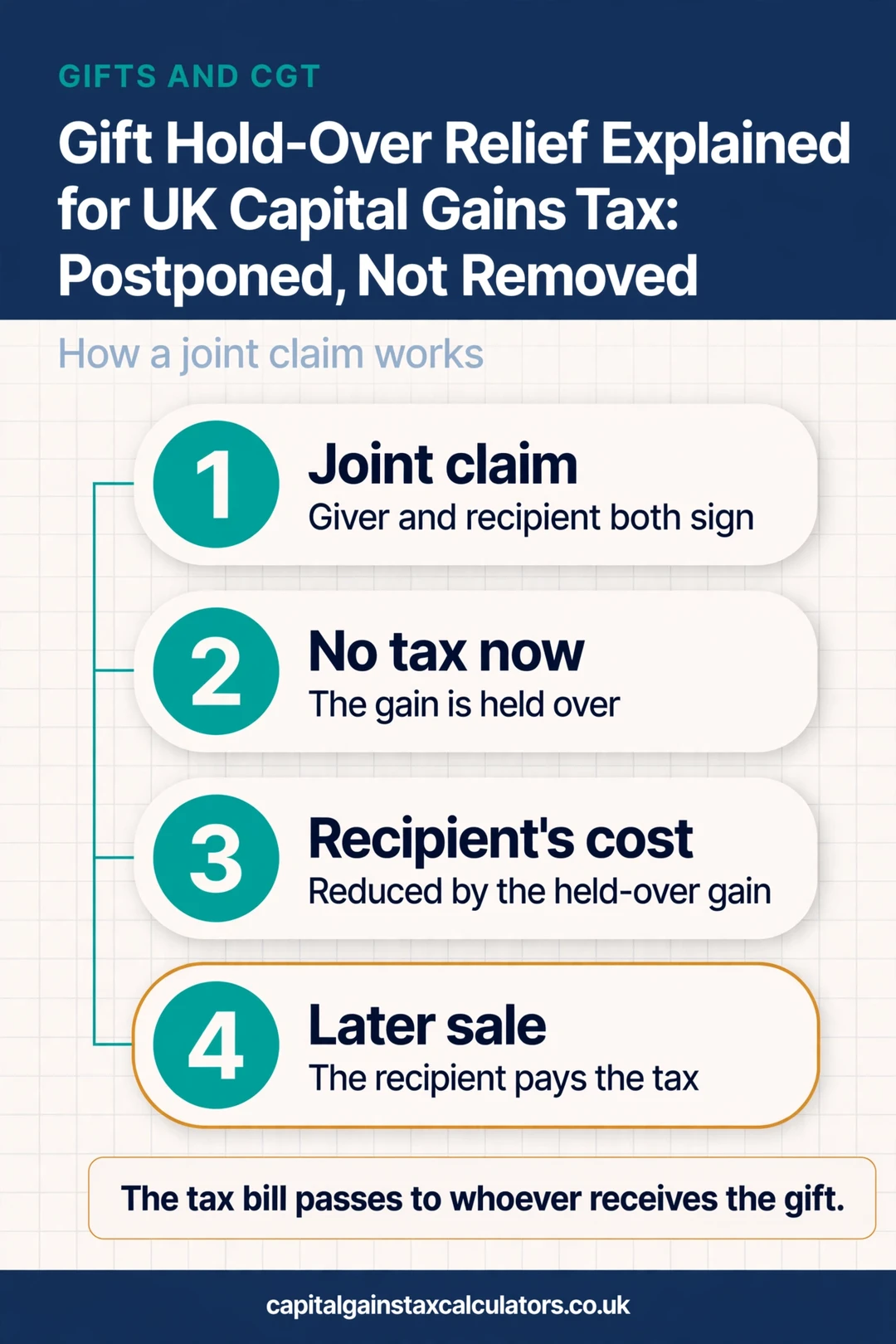
Gift Hold-Over Relief lets you and the recipient jointly claim to postpone the gain. You pay no tax now, and the recipient takes over the asset at its market value less the held-over gain. They pay tax on the full gain when they eventually sell. In the example above, the gain of £96,500 would be held over, and the immediate tax would be £0.
The relief is limited. It applies to gifts of business assets, such as shares in an unlisted trading company, the assets of a business, and agricultural property. It also applies to gifts that are immediately chargeable to Inheritance Tax, such as gifts into most trusts. It does not apply to a gift of ordinary residential property to a family member, or to shares in a company listed on a stock exchange unless special conditions are met. You must make the claim jointly, in writing, and the time limit is four years from the end of the tax year of the gift.
Gifts of money, possessions and shares
- Cash gifts: Giving money does not create a Capital Gains Tax charge. There is no gain on money in sterling. Inheritance Tax rules may apply to large gifts.
- Valuable possessions: Items worth less than £6,000 are exempt. Above that, a gain on a painting, antique or jewellery is a chargeable gain.
- Shares: The market value is the mid-market price on the day of the gift. The cost is the pooled cost, using the share matching rules.
- Part of an asset: Adding a name to the title deeds of a property is a gift of a share and can create a gain on that share.
| What you give | Capital Gains Tax effect | Value used |
|---|---|---|
| Cash | None | Not applicable |
| Shares | Gain or loss on the shares | Mid-market price on the day |
| Property or land | Gain or loss | Open market value, ideally valued in writing |
| Valuable possessions worth £6,000 or more | Gain or loss | Open market value |
| Possessions worth less than £6,000 | Exempt | Not applicable |
| Part share of a home | Gain on that share | Market value of the share |
Gifts to a charity
A gift of an asset to a registered charity is free of Capital Gains Tax. You may also qualify for Income Tax relief if you give shares or land to a charity. This can be a tax-efficient way to give, because you avoid the gain and reduce your income tax. The charity must be registered as a charity for tax purposes. Keep a copy of the gift documents.
Gifts and Inheritance Tax
Capital Gains Tax and Inheritance Tax are separate. A large gift to an individual is usually a potentially exempt transfer for Inheritance Tax, which becomes tax-free if you live for seven years. The gift can trigger Capital Gains Tax immediately, even if the Inheritance Tax is never due. A gift into most trusts is a chargeable lifetime transfer for Inheritance Tax, and may allow hold-over relief for Capital Gains Tax. If you plan a significant gift, take advice that considers both taxes together.
Reporting a gift
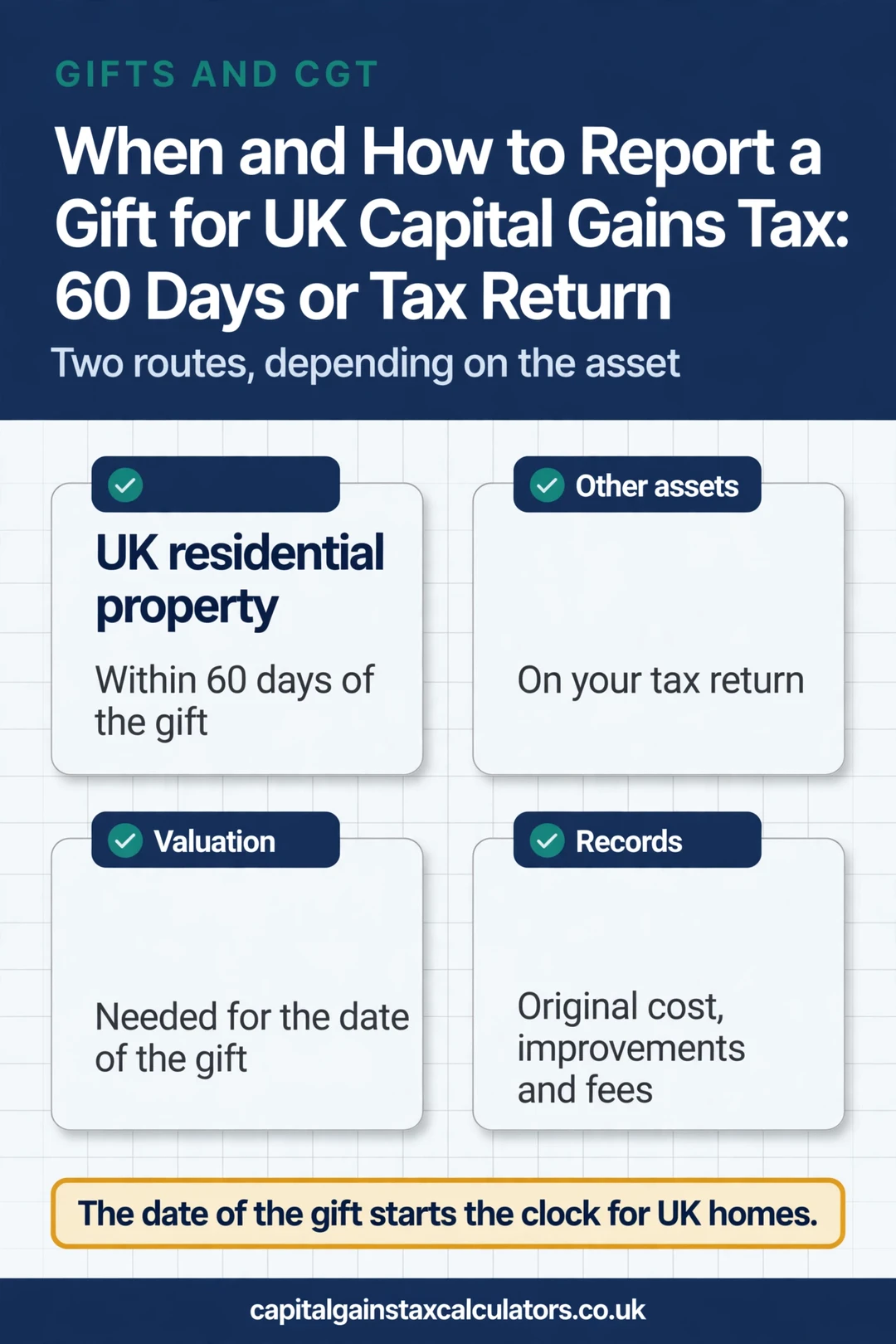
For a gift of UK residential property where there is a gain and tax to pay, you must report and pay within 60 days of the date of the gift. For other assets, report the gain on your Self Assessment tax return for the tax year of the gift. Keep the valuation, the cost evidence and the gift documents. See our reporting guide and our guide to reporting a property sale.
Common mistakes with gifts
- Believing a gift has no tax. Only gifts to a spouse or charity are exempt.
- Using the wrong value. HMRC uses market value, not your price.
- No valuation. A written valuation protects you.
- Missing the deadline. 60 days applies to residential property.
- Using hold-over where it is not available. It is limited to certain gifts.
- Forgetting Inheritance Tax. The seven-year rule is separate.
What to do next
- Get a valuation of the asset at the date you plan to give it.
- Run the numbers in the calculator.
- Check reliefs and whether a spouse gift is possible.
- Report and pay on time.
Frequently asked questions
Do I pay Capital Gains Tax on a gift?
Yes, if the asset has risen in value and the gift is not to your spouse, civil partner or a charity. The gift is treated as a sale at market value.
Who pays the tax when I give someone a property?
The giver pays the Capital Gains Tax on the gain. The recipient pays nothing when they receive the gift.
What cost does the recipient use?
The market value on the day of the gift, unless the gain was held over, in which case it is reduced by the held-over gain.
Is a gift to a child taxable?
Yes. A gift to a child is a disposal at market value, so the giver may pay tax on the gain.
Is a gift to my spouse taxable?
No, if you are living together. The transfer is no gain, no loss, and the spouse takes over your cost.
What is Gift Hold-Over Relief?
A joint claim to postpone the gain on certain gifts, such as business assets. The recipient pays when they eventually sell.
Do I pay Capital Gains Tax on a cash gift?
No. There is no gain on money. Large gifts may matter for Inheritance Tax.
When must I report a gift of property?
Within 60 days of the date of the gift, if there is a gain and tax to pay on UK residential property.
What if I sell something to a relative for less than it is worth?
HMRC treats the sale as being at market value for the gain, not the price you charged.
Does the seven-year Inheritance Tax rule affect Capital Gains Tax?
No. They are separate taxes. A gift can be free of Inheritance Tax after seven years but still create a Capital Gains Tax charge.
Official sources
- GOV.UK: Capital Gains Tax: gifts
- HMRC helpsheet HS295: Relief for gifts and similar transactions
- GOV.UK: Report and pay Capital Gains Tax on UK property
- GOV.UK: Inheritance Tax
Related guides and calculators
This page gives general information for UK taxpayers and is not tax advice. Capital Gains Tax rules can change and your own circumstances matter. Check the latest rules on GOV.UK or with a qualified tax adviser before you act.