Quick answer
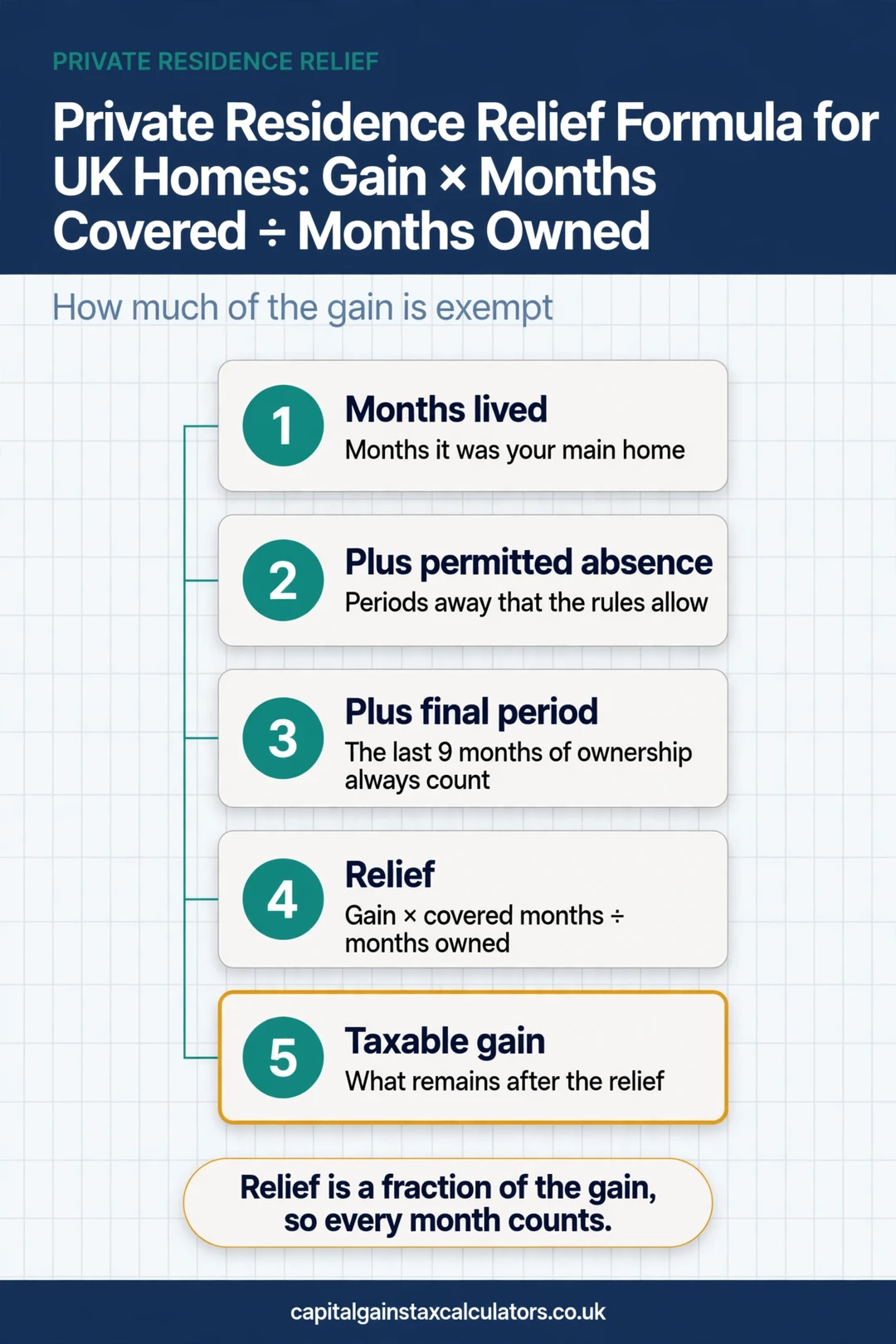
Private Residence Relief removes the part of your gain that matches the time the property was your only or main home. It covers the months you lived there, certain periods of absence, and always the final 9 months of ownership. The relieved fraction is those months divided by the months you owned the property, applied to the gain. The rest is taxed at 18% or 24%.
Key facts
- Relief needs the property to have been your only or main home at some point while you owned it.
- The final period is 9 months, or 36 months if you are disabled or in long-term care.
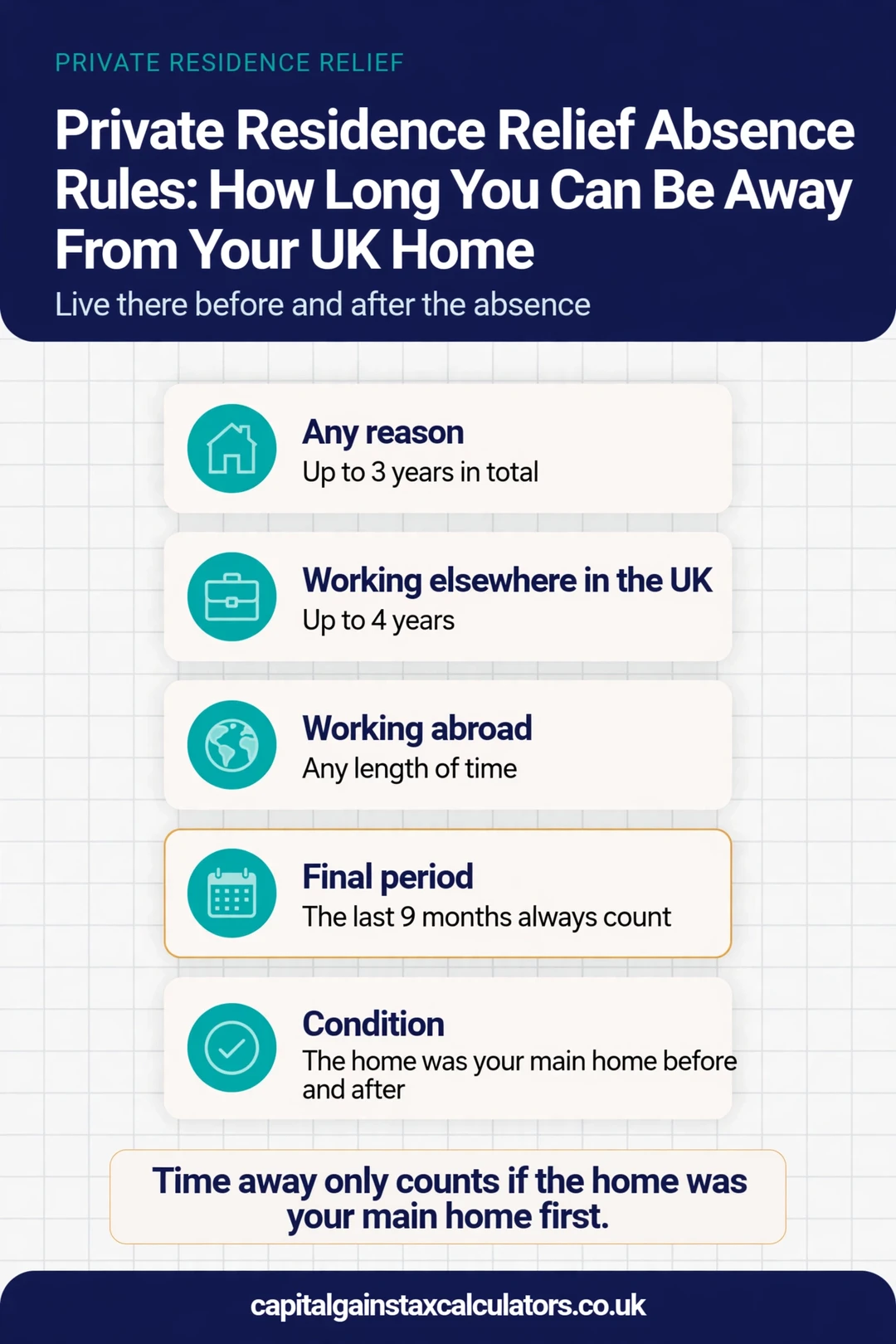
- Permitted absence: any reason up to 3 years, up to 4 years working elsewhere in the UK, and any length working abroad.
- Gardens up to 5,000 square metres are included, and a lodger does not count as letting.
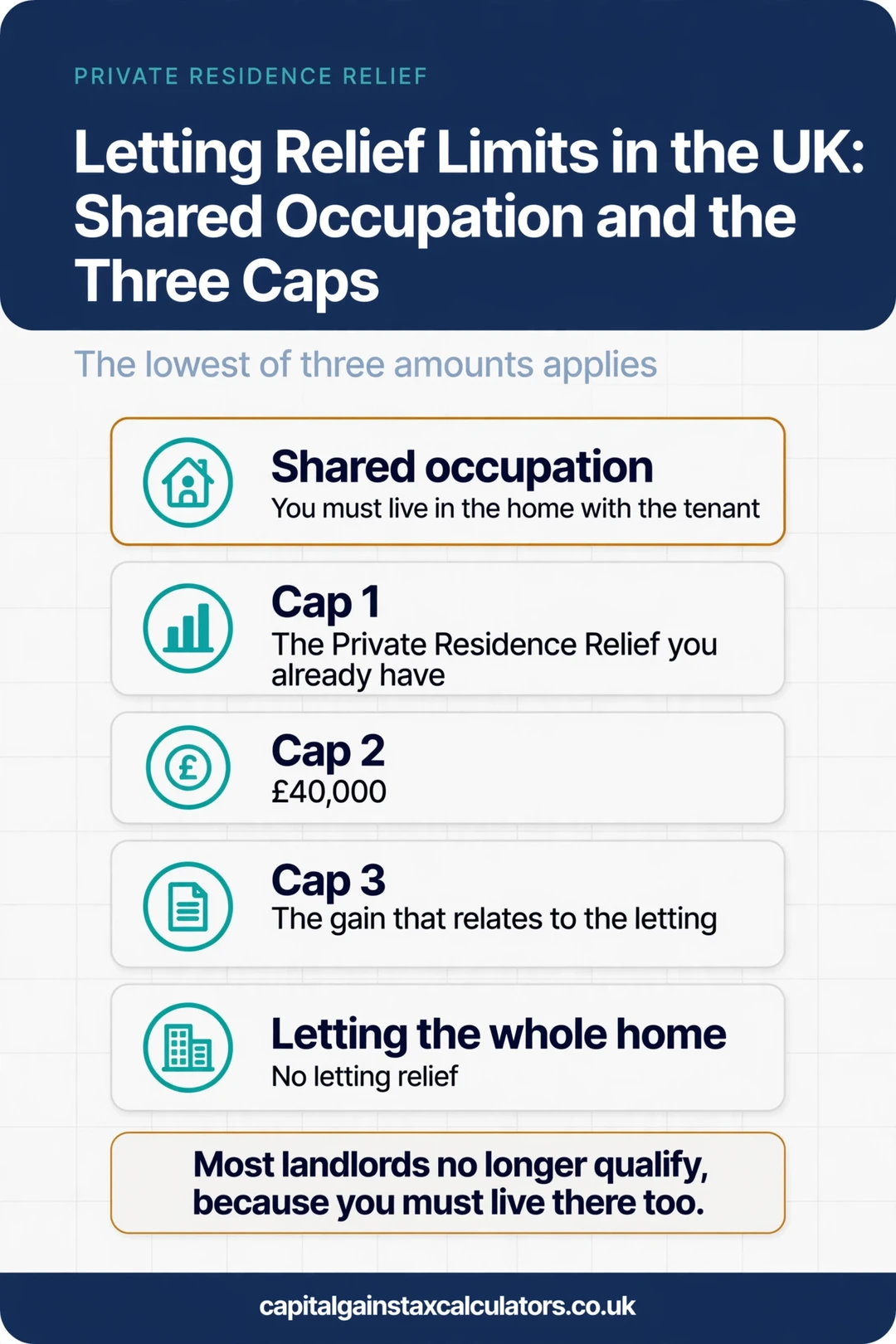
- Letting relief now applies only where you shared the home with your tenant, capped at £40,000.
How this calculator works
You enter the sale price, what you paid, your costs, the total months you owned the home and the months you lived in it. You can add months of permitted absence, switch on the longer final period and add details about letting. The calculator works out the gain, applies the relief fraction and then taxes what is left using your income. The results show the months covered, the relief and the tax saved.
For a home you have never lived in, the relief is nil. Use the property calculator for second homes and buy-to-lets.
| Input | What to enter | Tip |
|---|---|---|
| Months owned | From completion of purchase to completion of sale | Count whole months |
| Months lived in | Time it was your main home | Include periods when you were temporarily away |
| Permitted absence | Months away within the rules | Only counts if you lived there before and after |
| Final period | Automatic, 9 months | Choose the longer period for disability or care |
| Share of the gain | Your ownership percentage | Use 50% for equal joint owners |
Worked example: lived in half of the time
You buy a home for £190,000 and sell it 120 months later for £360,000. Your buying costs were £6,500 and selling costs £5,800. You lived there for 60 months, then moved out and let it. Your income is £55,000.
Worked example
Relief with 60 months lived in
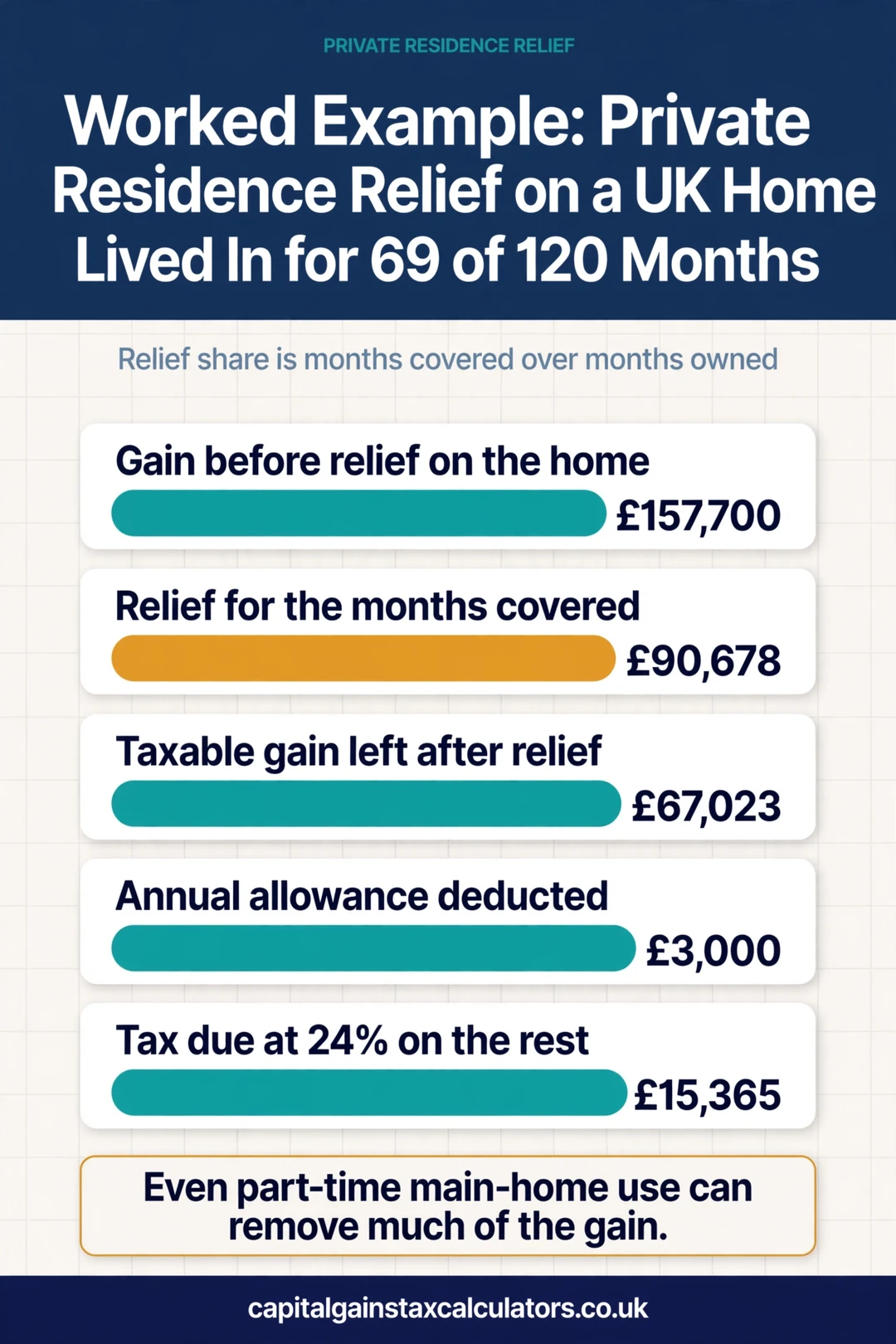
- Gain: £157,700.
- Months covered: 60 lived in plus 9 for the final period = 69 of 120.
- Relief: £157,700 x 69 / 120 = £90,678.
- Gain left to tax: £67,023.
- Capital Gains Tax: £15,365, compared with £37,128 with no relief.
If you had lived in the home throughout, the relief would cover the whole gain and the tax would be £0. If you never lived there, the relief is nil and the tax is £37,128.
Permitted absences
Some periods away count as if you lived in the home, as long as you lived there before and after them. If work prevented you from returning, you may still qualify.
| Reason | Maximum period | Notes |
|---|---|---|
| Any reason | 3 years in total | Can be one period or several |
| Working elsewhere in the UK | 4 years in total | Must be employed or self-employed |
| Working abroad | Any length | Must be an employee, not self-employed |
| Final ownership period | 9 months (or 36) | Applies in every case |
Adding 24 months of permitted absence to the example above raises the months covered to 93 and cuts the tax to £7,796. The calculator accepts the absence you enter, so check it against the rules first.
Letting and letting relief
Letting part of the home can reduce your relief, because those months are no longer your main home. Letting relief now only applies if you shared the property with your tenant as part of your own living space. In that case, the relief is the smallest of three amounts: the relief you already have, £40,000, or the gain from the letting. Renting out a whole property while you live elsewhere does not qualify.
A lodger who lives with you is treated as part of your household, and a single lodger does not stop relief. Taking in several lodgers, or turning most of the home into a business, can. With 40% of the home let for 36 months, the example gives letting relief of £18,924.
Disabled or in long-term care
The final period is extended to 36 months if you are disabled, or if you are in long-term residential care and moved there before selling. In the example above, the longer period lifts the months covered from 69 to 96 and lowers the tax to £6,850. Tick the longer final period box in the calculator to see the effect.
Reporting the sale
If part of the gain is taxable and the property is UK residential, you must report it and pay the tax within 60 days of completion. If the relief covers the whole gain, there is no tax to report on the 60-day return, though you might still include it on your tax return if your total proceeds are over £50,000. Our guide to reporting property gains has the details.
Common mistakes with Private Residence Relief
- Assuming relief is automatic. It only applies if the home was your main residence at some point.
- Counting the wrong dates. Use the dates of completion, not exchange or moving in.
- Overstating absence. Gaps without a qualifying reason are not covered.
- Forgetting the final period. It adds 9 months even if you had already moved out.
- Claiming letting relief for a whole property. It needs shared occupation.
- Ignoring a second home election. Having two homes means you may need to elect which is your main one.
What to do next
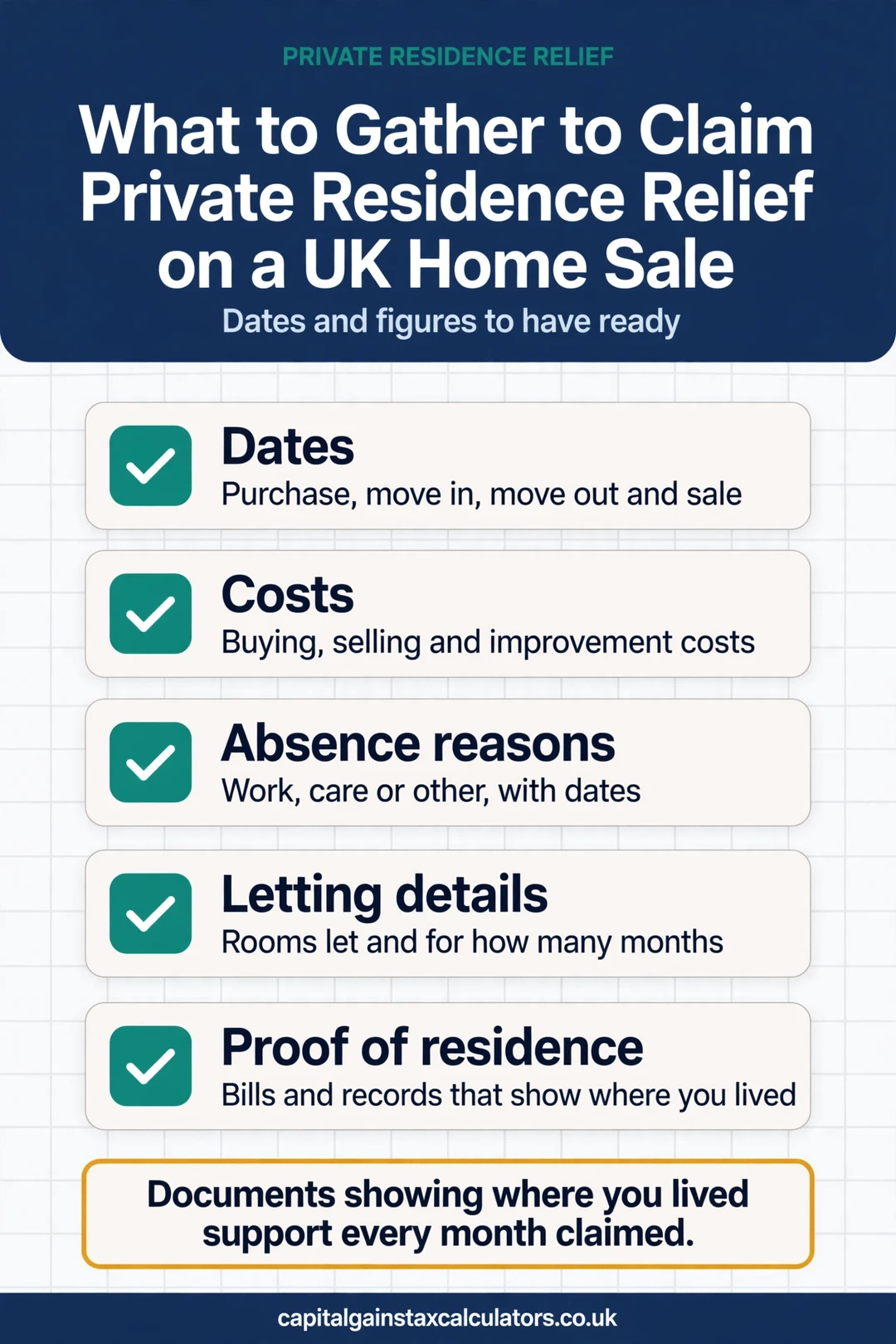
- Write down your dates of purchase, moving in, moving out and sale.
- Enter them above and check the months covered.
- Read the Private Residence Relief guide for absence and garden rules.
- Use the property calculator to compare with no relief at all.
- Report any tax within 60 days using our step-by-step guide.
Frequently asked questions
What is Private Residence Relief?
It is a Capital Gains Tax relief for a home that was your only or main residence. It covers all or part of the gain on the sale, depending on how long the property was your main home.
Do I pay Capital Gains Tax when I sell my main home?
Usually not. If the property was your main home for the whole time you owned it, and the garden is under 5,000 square metres, the gain is fully relieved.
How is Private Residence Relief calculated?
Divide the months that count as your main home, including the final period, by the months you owned it. Multiply that fraction by the gain. The result is the relief, and the rest of the gain is taxable.
What is the final period exemption?
The last 9 months of ownership are treated as time lived in the home, even if you had already moved out. It is 36 months for disabled owners or those in long-term care.
How long can I be away and still claim relief?
Up to 3 years for any reason, up to 4 years for work elsewhere in the UK, and any length for work abroad as an employee. You must live there before and after, unless your work prevented it.
Can I still claim letting relief?
Only if you shared the home with your tenant. The relief is capped at the lowest of the PRR you already have, £40,000, or the gain from the letting.
Does a lodger affect my relief?
A single lodger who lives in your home as part of the household does not usually affect it. Letting rooms as a business, or using a large part of the home exclusively for business, can reduce it.
What if I own two homes?
You can choose which is your main residence for tax. You must make the election within two years of owning both, and you can change it later with notice to HMRC.
Do I need to report the sale if there is no tax?
A UK resident with no tax to pay does not need the 60-day return. You may still need to declare it on Self Assessment if the total proceeds from all disposals are over £50,000.
How accurate is this estimate?
It is an estimate based on the months you enter and the standard rules. Complex cases, such as business use or an inherited home, need checking against the rules or by an adviser.
Official sources
- GOV.UK: Tax when you sell your home
- GOV.UK: Private Residence Relief
- HMRC Capital Gains Manual: Private residence relief
Related guides and calculators
This page gives general information for UK taxpayers and is not tax advice. Capital Gains Tax rules can change and your own circumstances matter. Check the latest rules on GOV.UK or with a qualified tax adviser before you act.