Quick answer
Several things are exempt from UK Capital Gains Tax, so a gain on them is never taxed. The main ones are your main home in most cases, investments in an ISA, UK government gilts, Premium Bonds, cars, betting winnings, and personal possessions worth £6,000 or less. Gifts to a spouse, civil partner or charity are also free of tax. Beyond the exemptions, the first £3,000 of your total gains each tax year is tax free through the annual exempt amount.
Key facts
- Your main home is usually exempt under Private Residence Relief.
- ISAs, pensions, Premium Bonds and UK gilts do not create a taxable gain.
- Cars are exempt, as are most personal items worth £6,000 or less.
- Betting, lottery and pools winnings are not subject to Capital Gains Tax.
- Gifts to a spouse, civil partner or charity are exempt.
- Everyone has a £3,000 annual exempt amount in 2026/27.
Good to know
Check your own gain
Use our Capital Gains Tax calculator to see whether your gain is covered by the allowance or an exemption.
The difference between exemptions, reliefs and the allowance
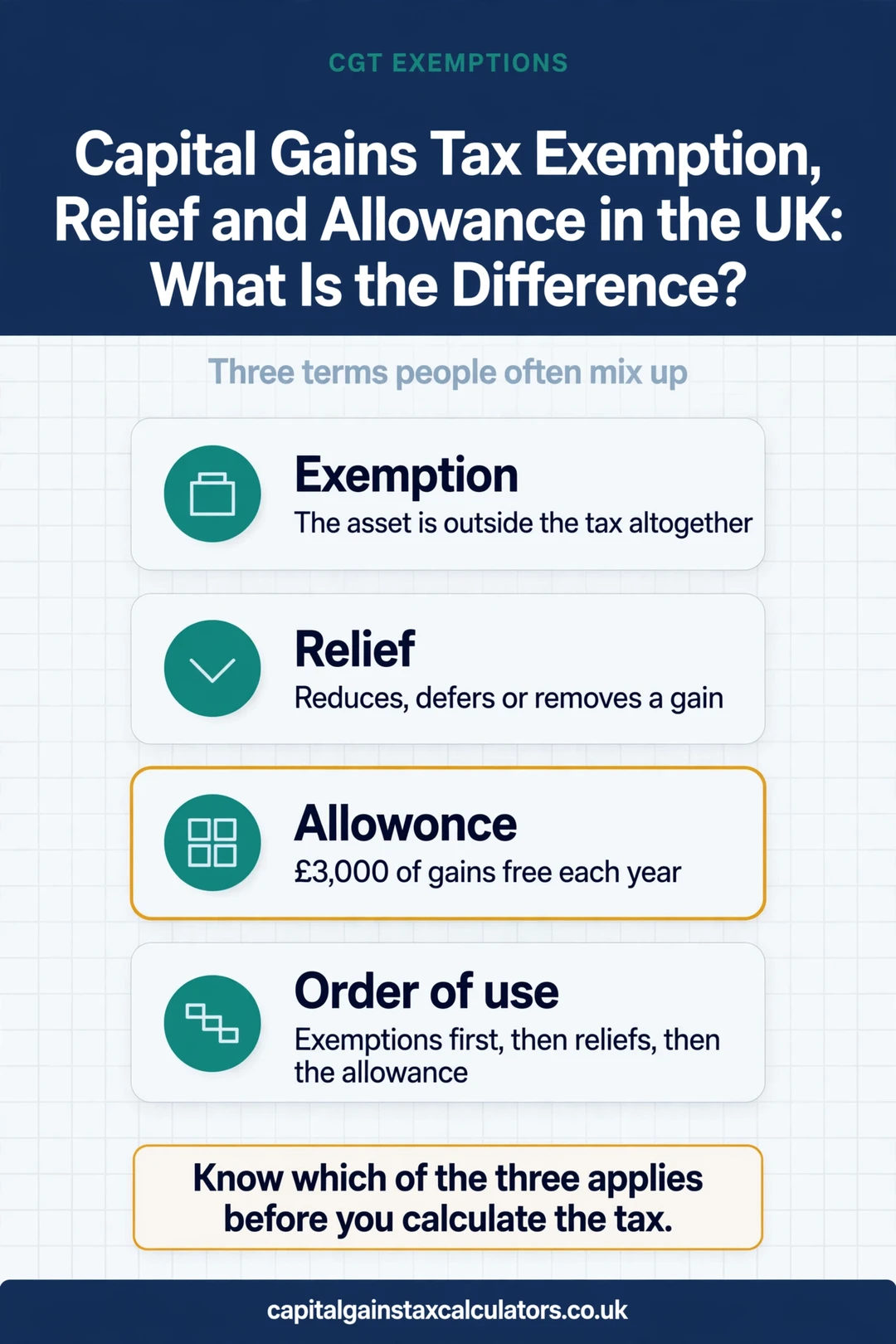
People often use the three terms loosely, but they work differently. An exemption means the asset or transaction is outside Capital Gains Tax altogether. A relief reduces or postpones a gain that would otherwise be taxed, usually with conditions and a claim. The annual exempt amount is a yearly allowance on your total gains. If an asset is exempt, it does not use the allowance and any loss on it cannot be claimed. If a relief applies, you may still need to report the sale.
The main exempt assets and transactions
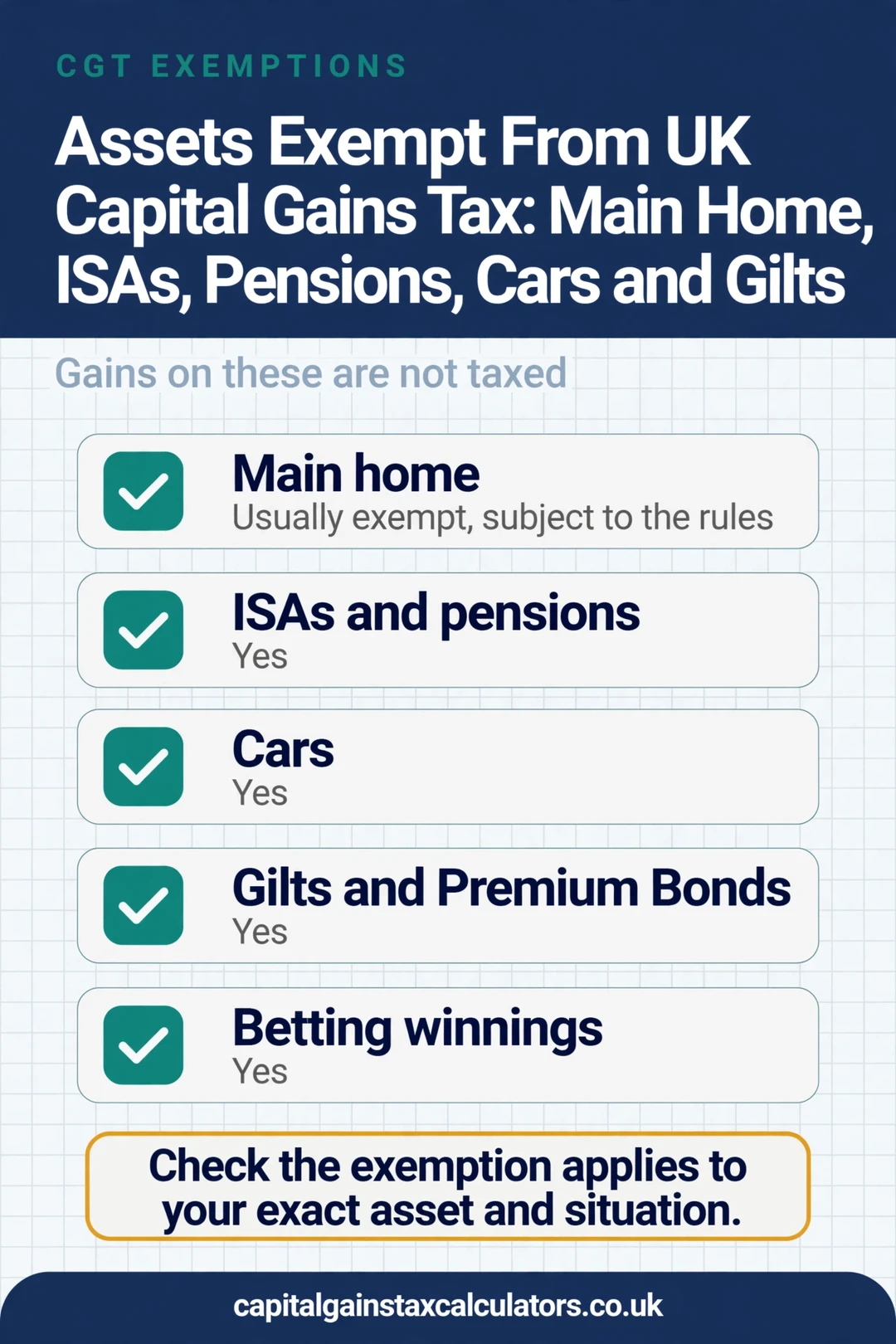
| Item | Exempt? | Conditions or limits |
|---|---|---|
| Your only or main home | Usually | Garden up to 5,000 square metres, no business use, and see the relief rules |
| Stocks and shares ISAs and other ISAs | Yes | Gains inside the ISA wrapper |
| Pensions | Yes | Growth inside the pension is not charged to Capital Gains Tax |
| UK government gilts | Yes | Held directly |
| Qualifying corporate bonds | Yes | Check the bond’s status |
| Premium Bonds | Yes | National Savings and Investments |
| Cars | Yes | Private cars and most other vehicles |
| Betting, lottery and pools winnings | Yes | Not a taxable gain |
| Personal possessions of £6,000 or less | Yes | Per item or set, see the chattels rules |
| Gifts to a spouse or civil partner | Yes | Living together, no gain no loss |
| Gifts to charities | Yes | Registered charities |
| Foreign currency for personal use | Yes | Not held as an investment |
| Life insurance policy proceeds | Yes | For the original owner |
| Venture Capital Trust shares | Yes | Qualifying shares, held within limits |
Some of these exemptions need a closer look. The tax treatment of pensions, Enterprise Investment Scheme shares and similar assets depends on the scheme rules, and you should check the official guidance on GOV.UK if you hold them.
Personal possessions and the £6,000 limit
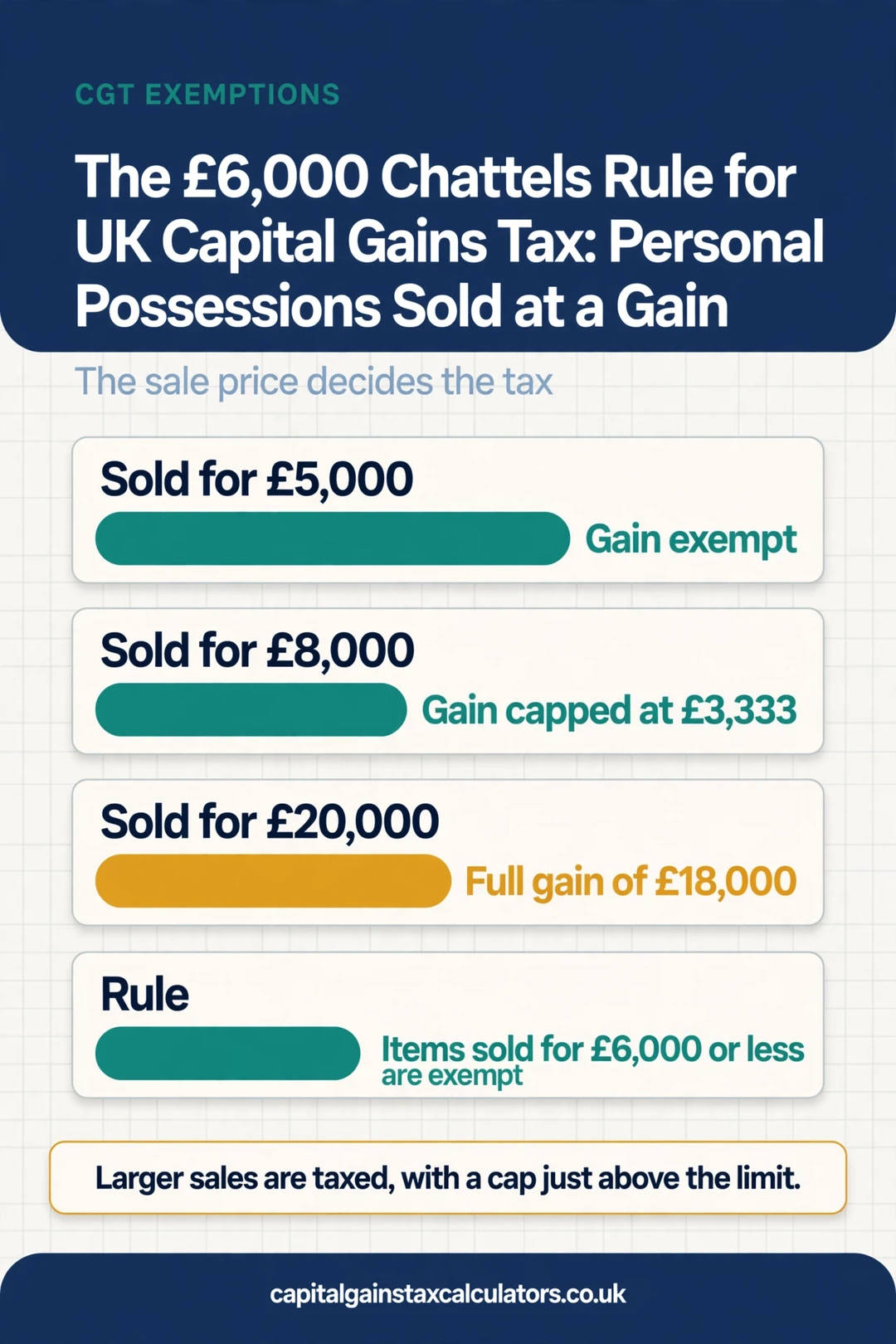
A “chattel” is a tangible movable item, such as a painting, antique, jewellery, furniture or a coin. If you sell a chattel for £6,000 or less, any gain is exempt. If you sell it for more, the gain is chargeable, but there is a limit on the gain. The gain cannot be more than five thirds of the amount by which the sale price exceeds £6,000. This stops a sale for slightly more than the limit from producing a large charge.
Worked example
Selling a painting
You sell a painting you bought for £2,000.
- Sold for £5,000: the proceeds are under £6,000, so the gain is exempt. The gain figure is £0.
- Sold for £8,000: the actual gain is £6,000, but the limit is 5/3 x (£8,000 less £6,000) = £3,333. The gain is £3,333.
- Sold for £20,000: the limit does not bite, and the gain is £18,000.
A loss on a chattel is also limited. If you sell for less than £6,000, the proceeds are treated as £6,000 when working out the loss. A painting that cost £9,000 and sold for £4,000 gives an allowable loss of £3,000, not £5,000. If a set of items is sold to the same buyer, they may be treated as a single item for the limit, so you cannot split a set to stay under it. Wasting assets with a life of 50 years or less, such as a boat or a racehorse, are exempt. A car is not a chattel but is separately exempt.
ISAs, pensions and tax-free savings
Money held in an ISA is free of Capital Gains Tax and Income Tax, and you do not need to report gains inside it. Pension funds also grow free of Capital Gains Tax, although withdrawals are subject to Income Tax rules. Premium Bonds and most National Savings products are exempt. These wrappers are the simplest way to avoid the tax on investments. You can move investments from a general account to an ISA by selling and rebuying inside the ISA, but the sale may trigger a gain in the general account, and the ISA has a yearly limit. See our guide on how to reduce the tax.
Your main home
The main home exemption is Private Residence Relief. It applies fully only if the property was your only or main home for the whole time you owned it, within the permitted area for the garden and with no business use. Part use as a home gives part relief. The rules are more complex for second homes, absences and letting. Read our Private Residence Relief guide for the full rules.
Gifts that are exempt
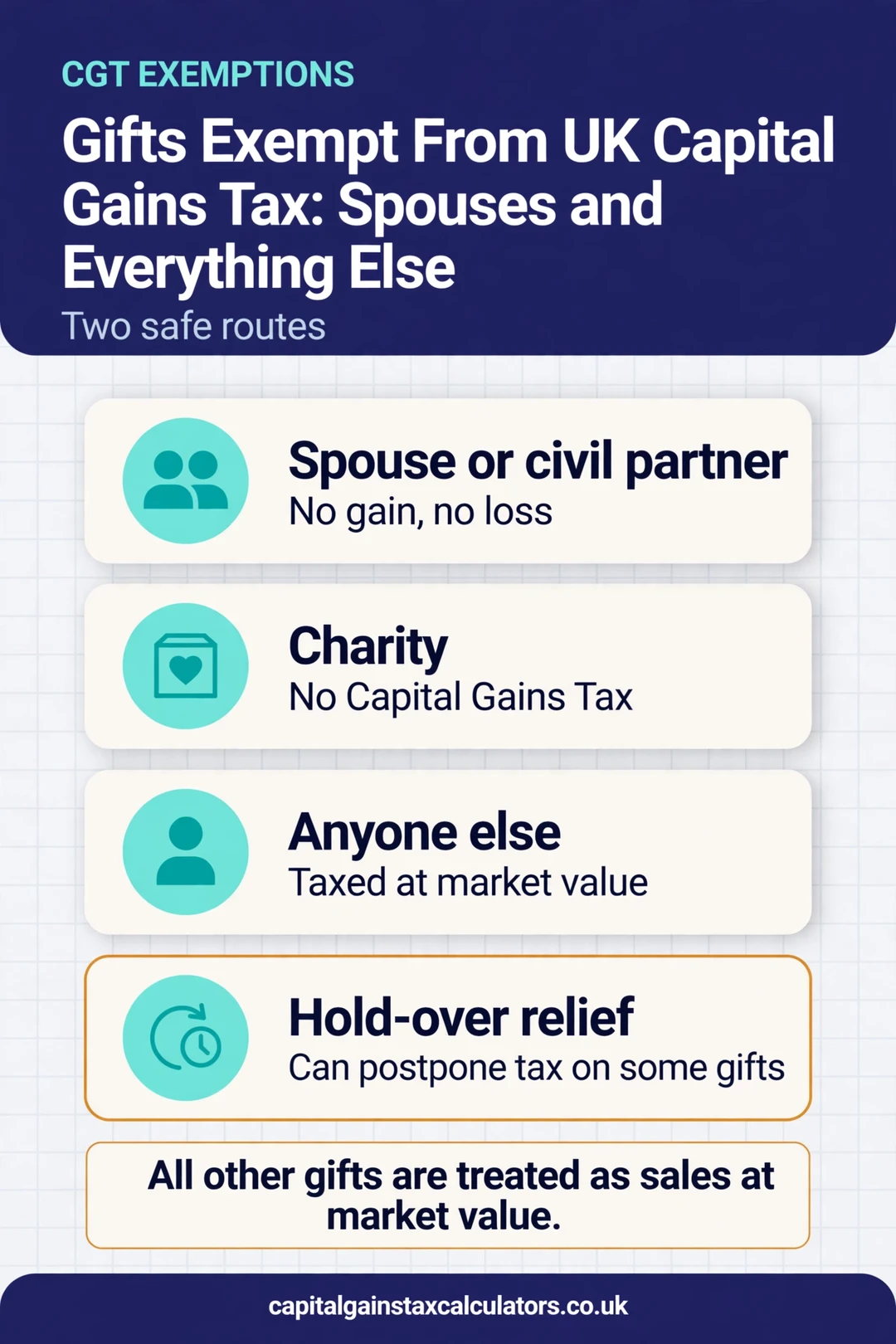
Giving an asset to a spouse or civil partner you live with is no gain, no loss. Giving to a registered charity is also exempt. You may be able to claim Income Tax relief on a gift to charity of shares or land. A gift to anyone else is a disposal at market value. See our guides to spouse transfers and gifts.
Exemptions and reporting
An exempt gain does not need to be reported for Capital Gains Tax, and it does not count towards the proceeds limit of £50,000 that triggers reporting for people in Self Assessment. The same goes for a sale of your main home that is fully covered by relief. The picture changes if only part of the gain is covered, because the taxable part must be reported. If you are unsure whether an asset is exempt, check the official guidance before you decide not to report, because an asset that looks exempt can be chargeable in a particular case, for example a set of items that HMRC treats as one asset. Keep evidence of the value and the date of each sale in case HMRC asks. If you make a gain on something exempt and a loss on something that is not, only the chargeable loss can be used.
What is not exempt
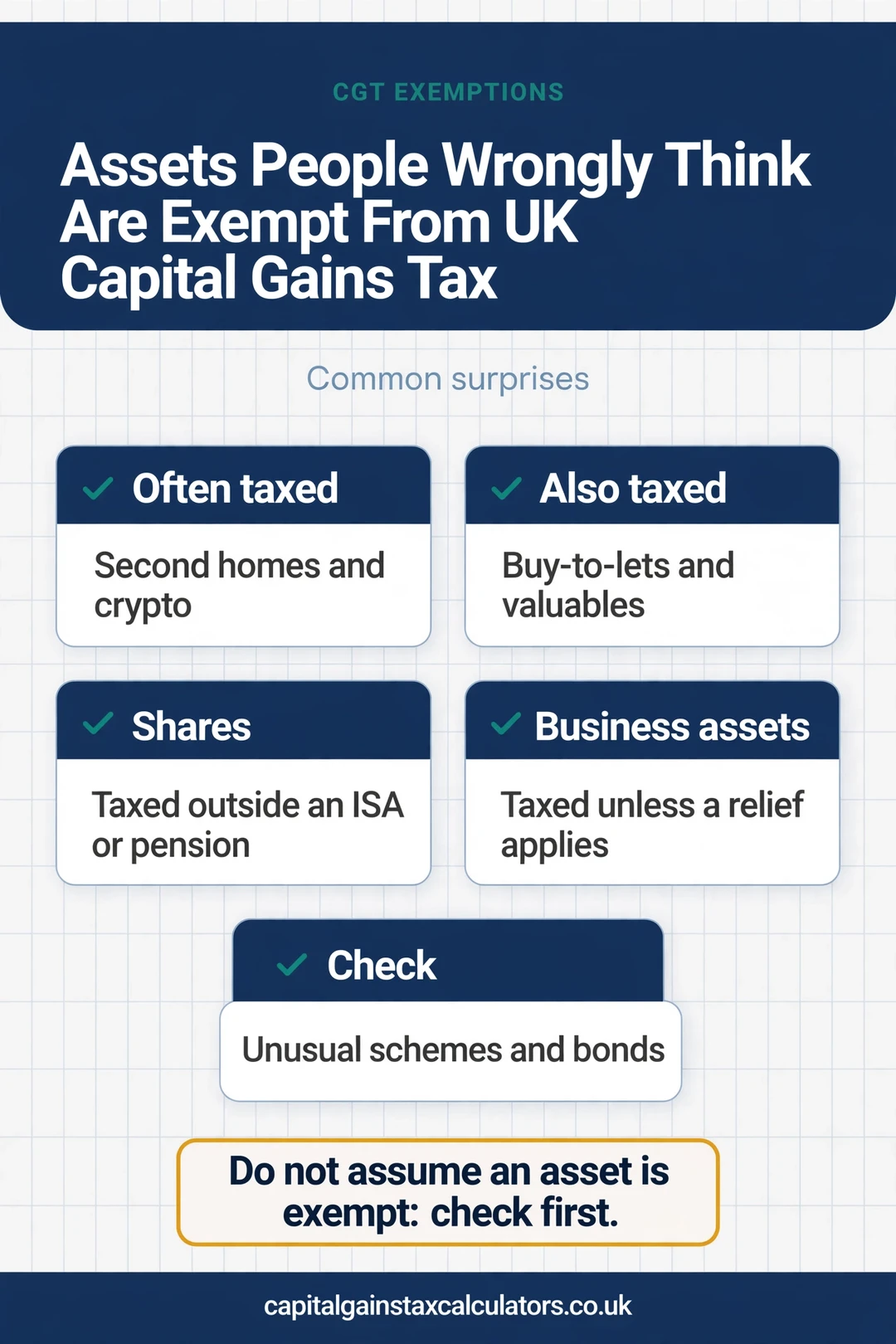
| Asset | Why people think it is exempt | The reality |
|---|---|---|
| Second home or holiday home | “It is a home” | Only your main home qualifies |
| Buy-to-let property | “It is a house” | Chargeable, report within 60 days |
| Shares in a general account | “I only reinvested dividends” | Gains above the allowance are taxed |
| Crypto | “It is not real money” | Treated as a capital asset |
| Valuable art and antiques | “They are personal” | Chargeable above £6,000 |
| Inherited property | “It was a gift” | A later sale can create a gain |
Common mistakes about exemptions
- Assuming a second home is exempt. Only the main home is.
- Splitting a set to stay under £6,000. HMRC treats sets as one item.
- Claiming a loss on an exempt asset. It is not allowable.
- Forgetting the allowance. The £3,000 is separate from exemptions.
- Treating relief as an exemption. Reliefs may need a claim.
- Not checking an unusual asset. Check GOV.UK for schemes like EIS.
What to do next
- List the assets you have sold or plan to sell.
- Check each against the exemptions above.
- Use the calculator for any asset that is not exempt.
- Read our guide to reliefs for assets that qualify for a relief rather than an exemption.
Frequently asked questions
What is exempt from Capital Gains Tax?
Your main home in most cases, ISAs and pensions, Premium Bonds, UK gilts, cars, betting winnings, personal possessions worth £6,000 or less, and gifts to a spouse, civil partner or charity.
Are cars exempt from Capital Gains Tax?
Yes. Private cars are exempt, so you do not pay tax on a gain when you sell one.
Is my main home exempt?
Usually, under Private Residence Relief, if it was your only or main home throughout and the garden is within the permitted area.
Are ISA gains taxable?
No. Gains inside an ISA are exempt and do not need to be reported.
What is the limit for personal possessions?
Items sold for £6,000 or less are exempt. Above that, the gain is chargeable, but limited to five thirds of the excess over £6,000.
Are pensions exempt?
Growth inside a pension is not subject to Capital Gains Tax. Withdrawals have their own Income Tax rules.
Are gifts to my spouse exempt?
Yes, if you live together. The transfer is no gain, no loss.
Is crypto exempt?
No. Crypto is a chargeable asset. Gains above the allowance are taxed.
Does an exempt asset use my allowance?
No. An exempt asset does not create a gain, so it does not use the £3,000 allowance, and a loss on it cannot be claimed.
Where can I check the official list?
On GOV.UK, in the Capital Gains Tax guidance. The links are listed below.
Official sources
- GOV.UK: Capital Gains Tax
- GOV.UK: What you pay Capital Gains Tax on
- GOV.UK: Tax when you sell personal possessions
- GOV.UK: Individual Savings Accounts
Related guides and calculators
This page gives general information for UK taxpayers and is not tax advice. Capital Gains Tax rules can change and your own circumstances matter. Check the latest rules on GOV.UK or with a qualified tax adviser before you act.