Quick answer
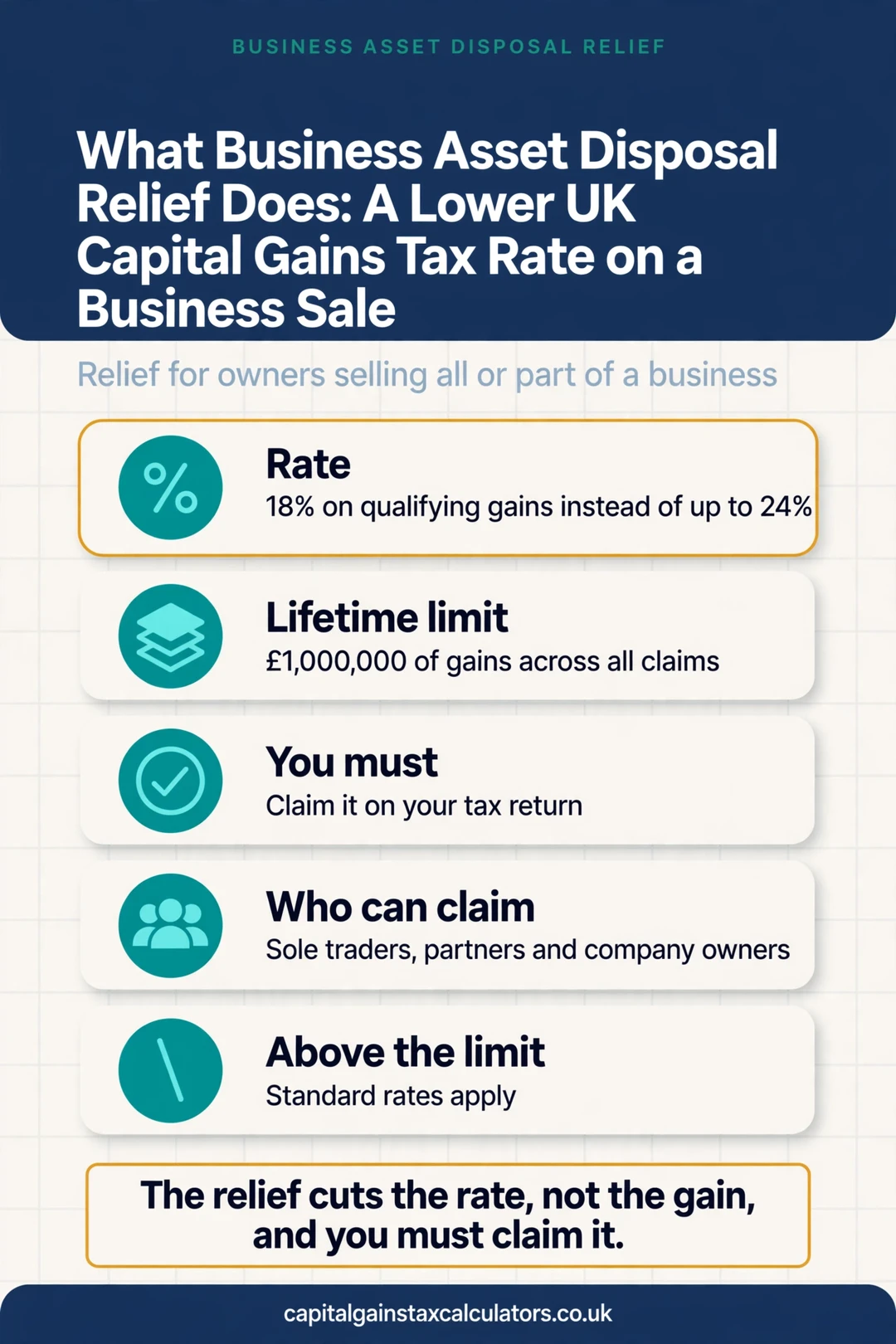
Business Asset Disposal Relief (BADR) reduces the Capital Gains Tax rate on gains from selling all or part of a business, or shares in your own company, to 18% in 2026/27. It applies up to a lifetime limit of £1,000,000 of gains. To qualify you must meet ownership and role tests for two years before the sale, and you must claim the relief. Without it, the gain is taxed at 18% or 24%.
Key facts
- The BADR rate is 18% in 2026/27. It was lower in earlier tax years.
- The lifetime limit is £1,000,000 of qualifying gains.
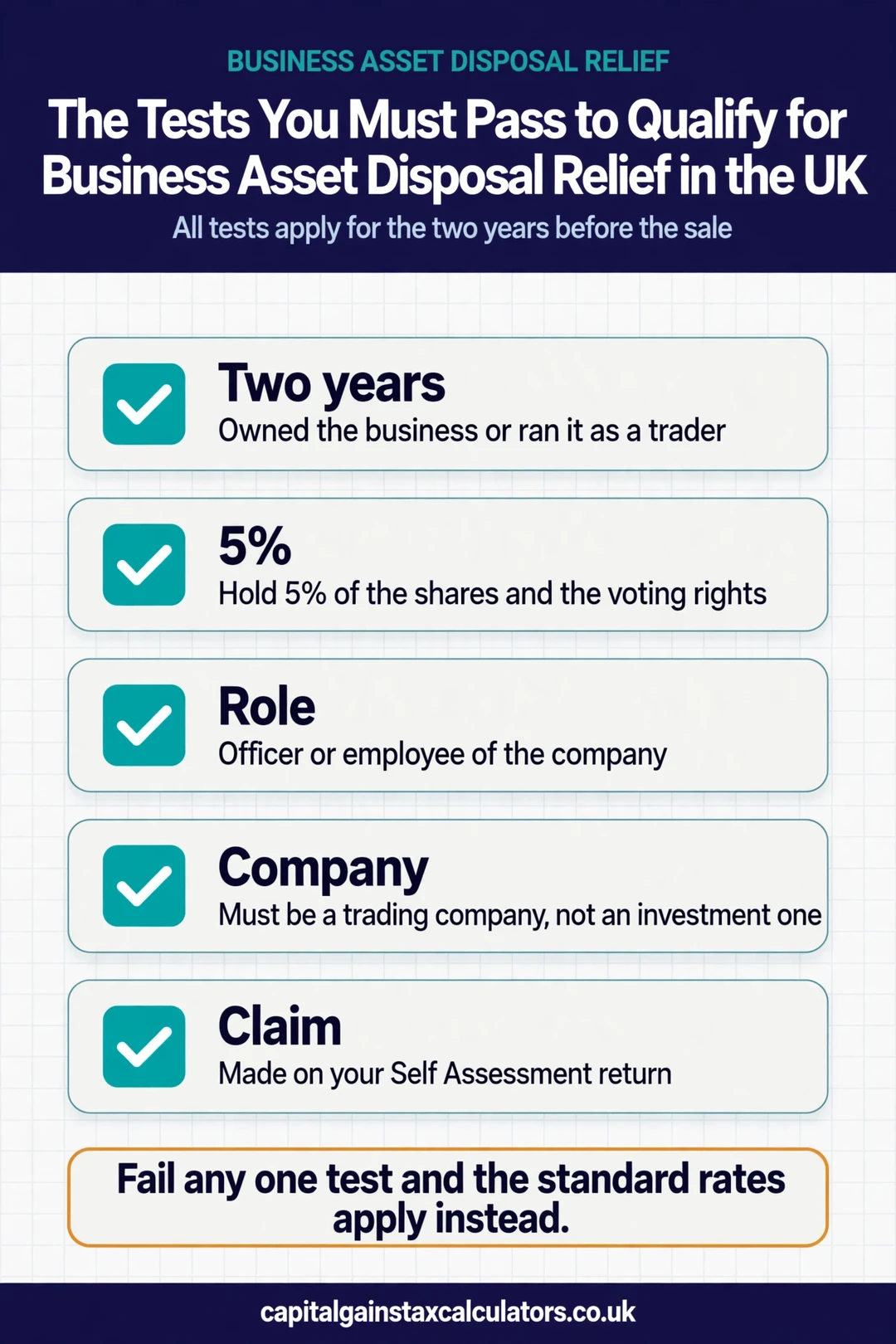
- For shares, you normally need at least 5% of the shares and voting rights, and to be an officer or employee, for two years.
- The relief now matches the lower normal rate, so it mainly saves tax on gains that would be taxed at 24%.
- You must claim it. It is not automatic.
Good to know
Estimate your saving
Use our Business Asset Disposal Relief calculator to compare the tax with and without the relief.
What the relief is for
BADR was designed to help people who build a business and sell it. It was called Entrepreneurs’ Relief until it was renamed and the lifetime limit was cut. The idea is that a founder or owner-manager who sells a business pays a lower rate than an investor selling shares. Over time the relief rate has risen, and it is now the same as the lower normal rate of 18%.
That change matters. If your taxable income is low, so that most of your gain would fall into the 18% band anyway, the relief saves little. It saves the most when your gain would otherwise be taxed at 24%, because the relief caps the rate on the qualifying gain at 18%. Our worked example shows the effect.
Who qualifies
The conditions depend on what you sell. All of them must be met throughout the two years before the date of sale, or before the date the business ceased, if it did.
| What you sell | Main conditions |
|---|---|
| All or part of a sole trader business | Owned and traded for at least 2 years before the sale |
| Your share of a partnership business | A partner in the business for at least 2 years |
| Shares in your personal company | At least 5% of the shares and voting rights, an officer or employee, and a trading company, all for 2 years |
| Business assets after the business closed | Sold within 3 years of the business ceasing |
| Assets you own personally and used in a business | Sold as part of a withdrawal from the business, and used in it for 2 years |
| Employee share options | Meeting the same tests, measured from the grant of the option |
A “personal company” is one where you hold at least 5% of the ordinary share capital and at least 5% of the voting rights, and you are entitled to at least 5% of the profits and the assets on a winding up, or of the proceeds if sold. The company must be a trading company or the holding company of a trading group. A company that mainly holds investments, such as rental property, does not qualify.
How the tax is worked out
The qualifying gain is taxed at 18%, up to the lifetime limit. Gains above the limit, and any gain that does not qualify, are taxed at the normal rates. Your basic rate band is used against the relief gains first, and the annual exempt amount is used against the gains taxed at the highest rate first.
Worked example
Selling a company
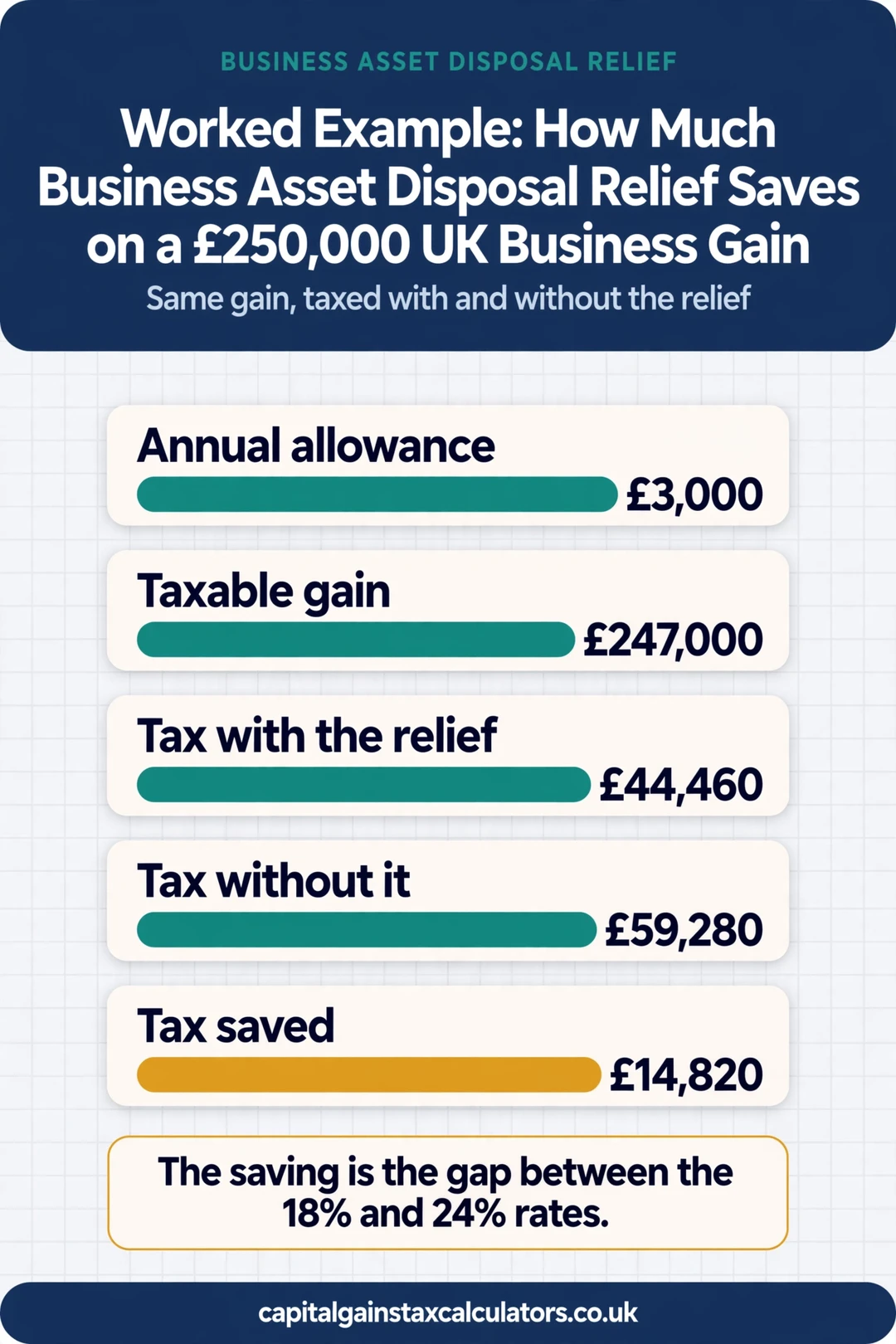
You sell your shares in a trading company for a qualifying gain of £250,000. Your other income is £60,000.
- Gain: £250,000.
- Allowance: £3,000 is set against the gain.
- Taxable: £247,000 at 18%.
- Tax with BADR: £44,460.
- Tax at normal rates: £59,280.
- Saving: £14,820.
The saving depends on income and on the size of the gain. On an income of £30,000, a gain of £600,000 is fully inside the limit and costs £107,460. If you have already used £750,000 of your limit, a new gain of £400,000 has only £250,000 left to qualify, and £150,000 is taxed at normal rates, so the tax is £80,280.
The lifetime limit
The limit is £1,000,000 of qualifying gains across your lifetime, not each year or each business. Gains that got Entrepreneurs’ Relief or BADR earlier count towards it. Keep a record of the amounts you claimed, because you will need them for the next claim. If your gain would exceed the limit, the excess is taxed at the standard rates, but you still get the lower rate on the first part.
Employees, options and associated disposals
Employees who hold share options under certain schemes can qualify for BADR if they meet the tests, but the period is counted from the date of the grant of the option rather than the date they became a shareholder. If you own a property or asset personally and let your business use it, you can claim BADR on its sale if you sell it as part of the withdrawal from the business, but the relief can be reduced if you charged rent. These are called associated disposals. The conditions are detailed, and it is wise to check them with the official guidance before you rely on the relief.
How to claim
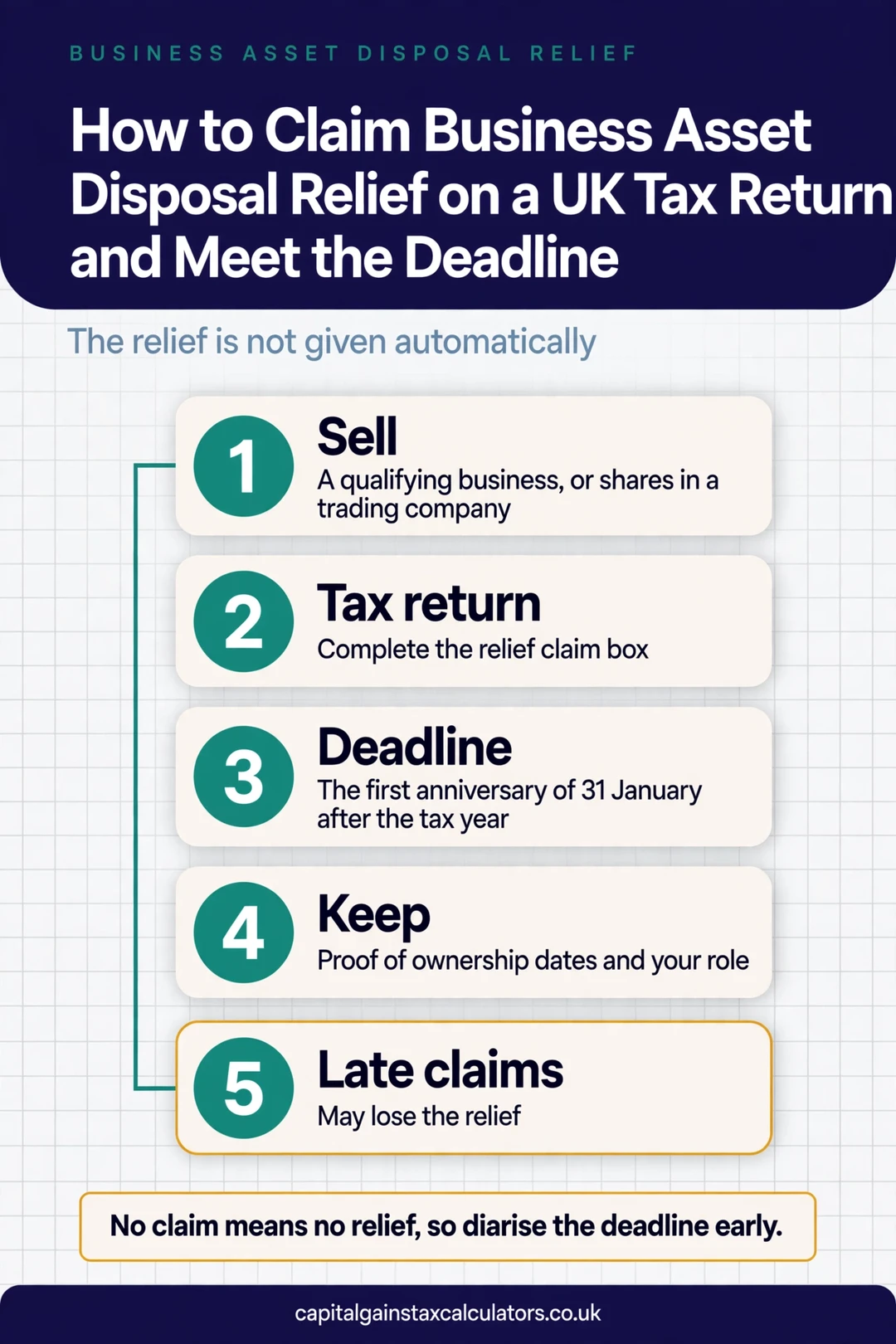
BADR is not automatic. You must make a claim, usually on your Self Assessment tax return for the tax year of the sale, or by completing the relevant box on the return. The deadline is the first anniversary of the 31 January following the end of the tax year in which the disposal took place. If the sale involves UK residential property, you do not use BADR for the property itself, because it is not a business asset. Keep the evidence of your shareholding, your role as officer or employee, and the trading status of the company. Our reporting guide shows how to complete the return.
Common situations and how BADR applies
| Situation | How the relief usually applies |
|---|---|
| Selling the whole company to a buyer | The gain on your shares can qualify if you meet the tests |
| Selling only some of your shares | Relief can apply to the shares sold if you met the tests for the two years before the sale |
| Being diluted below 5% by new investors | Can break the test, although an election may preserve it in some cases |
| Closing the business and selling its assets | Qualifies if the sale is within 3 years of closing |
| Payments that depend on future results | Each part is taxed in the year you receive it, and the relief may be claimed on each part |
| Selling to a family member | Possible, but the price must be a market price, or HMRC may substitute market value |
In each case the qualifying tests are measured at the point of sale. A company that has stopped trading, or that holds large amounts of cash or investments, may fail the trading test. It is therefore worth getting a view from an accountant before the sale, not after, because some problems can be fixed in advance.
Related reliefs
| Relief | What it does | Where to read |
|---|---|---|
| Investors’ Relief | Lower rate for outside investors in unlisted companies | Reliefs |
| Rollover relief | Defer the gain by reinvesting in business assets | Reliefs |
| Gift Hold-Over Relief | Postpone the gain on a gift of business assets | Reliefs |
| Employee ownership trust sales | Special relief when selling to an employee trust | Check the official conditions |
Common mistakes with BADR
- Not claiming. You pay the higher rate if you forget.
- Failing the 5% test. A holding below 5% does not qualify.
- Missing the two-year period. The tests run for the full two years.
- Assuming a property company qualifies. An investment company does not.
- Forgetting earlier claims. They count towards the £1,000,000 limit.
- Using an old rate. The rate has changed in recent tax years.
What to do next
- Check the conditions in the table above against your situation.
- Estimate the tax with the calculator.
- Compare other reliefs.
- Make the claim on your tax return, using our reporting guide.
Frequently asked questions
What is Business Asset Disposal Relief?
A Capital Gains Tax relief that charges a reduced rate, 18% in 2026/27, on qualifying gains from selling a business or shares in your own company, up to a lifetime limit of £1,000,000.
What is the BADR rate for 2026/27?
18%. It was 14% in the previous tax year and 10% before that.
Who qualifies for BADR?
Sole traders, partners and owner-managers of companies, who meet the two-year tests. For shares you normally need 5% of the shares and voting rights and to be an officer or employee.
What is the lifetime limit?
£1,000,000 of qualifying gains in your lifetime. Gains above it are taxed at the standard rates.
Is Entrepreneurs’ Relief the same thing?
It is the old name. Gains that got Entrepreneurs’ Relief count towards the current lifetime limit.
How do I claim BADR?
Claim it on your Self Assessment return for the tax year of the sale. The claim deadline is normally the first anniversary of the 31 January that follows that tax year.
Can I use BADR on rental property?
Not normally. Letting property is generally an investment, not a trading business. Furnished holiday lets and other cases need careful checking.
Does BADR apply to shares I hold as an investor?
No. You need to be an officer or employee as well as a 5% shareholder. Investors in unlisted companies may qualify for Investors’ Relief instead.
Is BADR still worth claiming?
It still saves tax on gains that would otherwise be taxed at 24%. Use the calculator to see your saving.
Is the annual exempt amount used first?
The allowance is set against the gains that would be taxed at the highest rate first, which is normally the non-relief gains.
Official sources
- GOV.UK: Business Asset Disposal Relief
- HMRC helpsheet HS275: Business Asset Disposal Relief
- GOV.UK: Capital Gains Tax rates
Related guides and calculators
This page gives general information for UK taxpayers and is not tax advice. Capital Gains Tax rules can change and your own circumstances matter. Check the latest rules on GOV.UK or with a qualified tax adviser before you act.