Quick answer
In the UK, crypto is a capital asset, so Capital Gains Tax applies when you sell, swap, spend or give away tokens. The gain is the pound value you received less the pooled cost of the tokens and your fees. You can make £3,000 of gains in 2026/27 before paying tax, and the rates are 18% and 24%. Mining, staking and rewards may also be Income Tax when you receive them.
Key facts
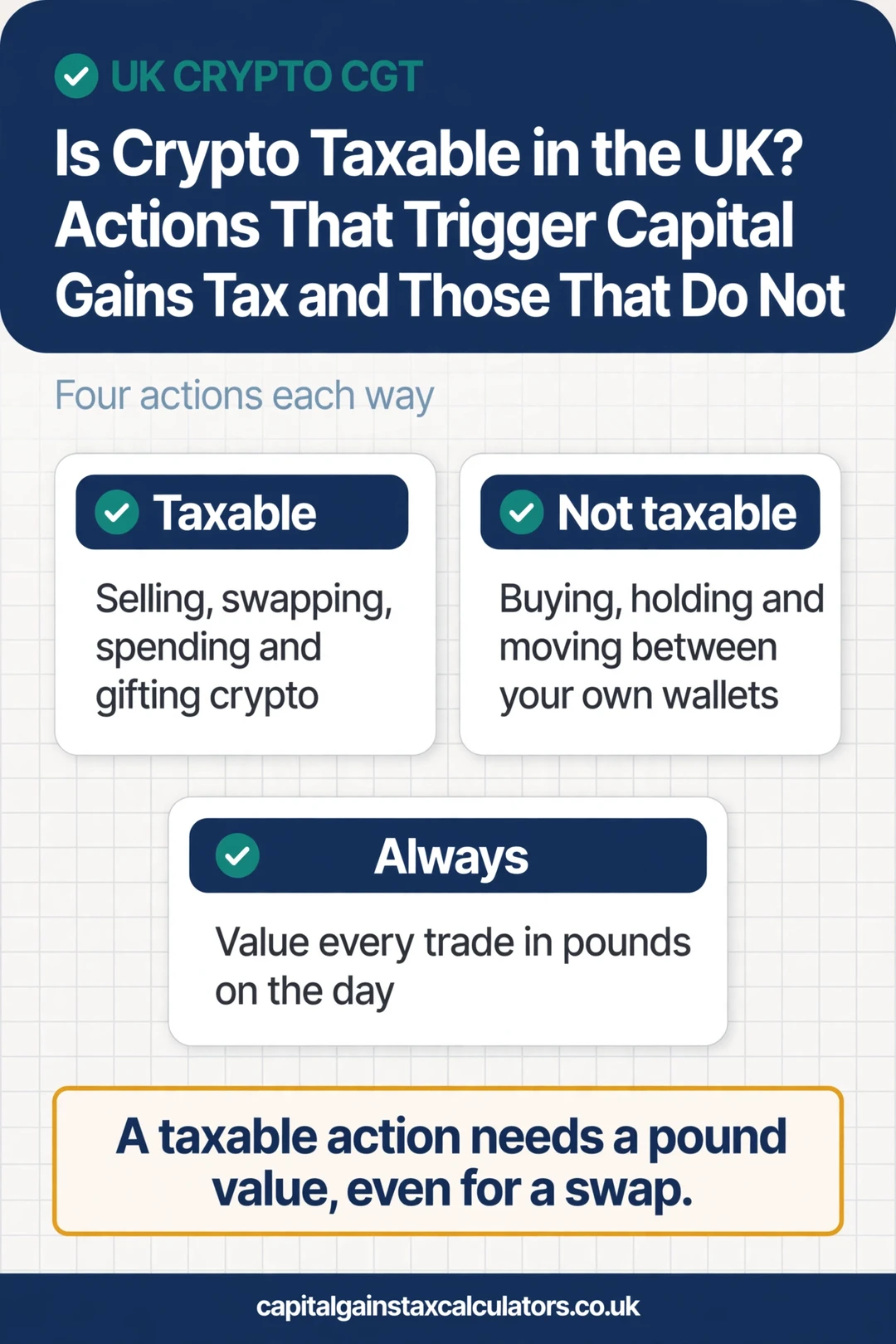
- Selling, swapping, spending and giving away crypto are disposals. Buying and holding are not.
- Moving crypto between your own wallets is not a disposal.
- Cost is pooled per token, with same-day and 30-day rules applying first.
- Every trade must be valued in pounds on the day, including swaps between tokens.
- Gains are taxed at 18% or 24% after the £3,000 allowance.
- Rewards from mining, staking or work are usually Income Tax first.
Good to know
Add your trades
Use our crypto Capital Gains Tax calculator to enter your trades and see each gain, your pool and the tax.
How HMRC treats cryptoassets
HMRC does not treat crypto as money. It treats it as a capital asset, like shares, unless you are carrying on a trade of buying and selling it, which is rare. For most individuals, crypto gains are Capital Gains Tax gains. Mining, staking and payments for work are generally income. Whether a token is Bitcoin, a stablecoin, a utility token or a non-fungible token, the starting point is the same: look at what you did with it and work out the pound value.
HMRC publishes a manual that sets out its view, and it receives information about your activity from exchanges. It is sensible to report your crypto gains accurately and to keep full records.
What counts as a disposal
| Action | Disposal? | Tax value |
|---|---|---|
| Selling crypto for pounds | Yes | The pounds received |
| Swapping one token for another | Yes | The pound value of what you receive |
| Spending crypto on goods or services | Yes | The pound value of what you bought |
| Giving crypto to someone other than your spouse | Yes | Market value on the day |
| Paying a fee in crypto | Yes | The pound value of the fee |
| Buying crypto with pounds | No | Adds to your pool |
| Holding crypto | No | Nothing to report |
| Moving between your own wallets | No | Not a change of ownership |
| Giving to your spouse or civil partner | No | No gain, no loss |
Working out the gain with pooling
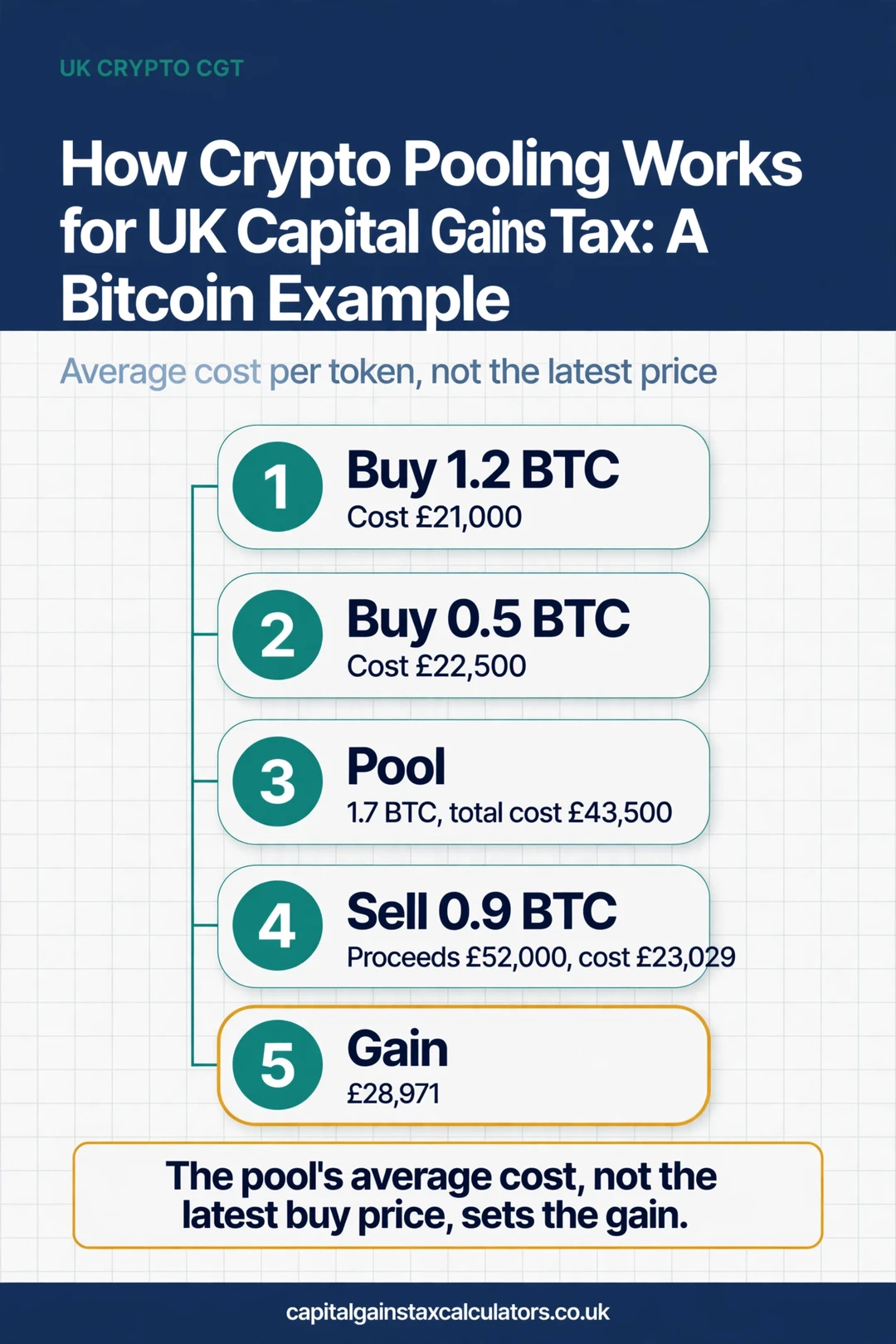
Crypto uses the same share identification rules as shares. The cost of each token is pooled, so you do not choose which coin you sold. Sales are matched first with purchases on the same day, then with purchases in the next 30 days, and then with the Section 104 pool at average cost. Each type of token has its own pool.
Worked example
Selling 0.9 BTC
You bought 1.2 BTC for £21,000 and later 0.5 BTC for £22,500. You sell 0.9 BTC for £52,000.
- Pool before the sale: 1.7 BTC at a total cost of £43,500.
- Cost of 0.9 BTC: £23,029.
- Gain: £52,000 less £23,029 = £28,971.
- Pool afterwards: 0.8 BTC with a cost of £20,471.
- Tax on an income of £38,000: £5,497.
You can sell a fraction of a token too. Selling 0.04 BTC for £2,000 from a holding of 0.1 BTC that cost £3,000 gives a cost of £1,200 and a gain of £800. The number of decimal places does not matter, but you should record the exact quantity.
Swaps, spending and DeFi
A swap from one token to another is a disposal of the first token. Its value is the pound value of the token you receive at the time. You also acquire the new token at that same pound value. For example, swapping 1 ETH, from a holding that cost an average of £2,000, for tokens worth £3,500 gives a gain of £1,500.
Spending crypto in a shop or online is a disposal, valued at the pound price of what you bought. Paying network fees in crypto is also a disposal of the small amount used. Fees paid to buy tokens are part of their cost, and fees paid to sell reduce the proceeds. Fees for moving crypto between your own wallets are generally not allowable.
Lending, staking pools and decentralised finance can involve more complex treatment. Whether you have disposed of tokens, and when income arises, depends on the arrangement. HMRC’s manual explains common cases. If your activity is large or unusual, take advice before you file.
Mining, staking, airdrops and rewards
| Activity | Usual tax treatment | Cost for later gains |
|---|---|---|
| Mining as a hobby | Income Tax on the pound value received | The pound value taxed |
| Staking rewards | Income Tax when received | The pound value taxed |
| Payment in crypto for work | Income Tax at the pound value | The pound value taxed |
| Airdrop with no work done | Usually Capital Gains Tax only, at a nil cost | Nil |
| Airdrop in return for a service | Income Tax | The pound value taxed |
| Gift received | No tax on receiving | Market value at the date of the gift |
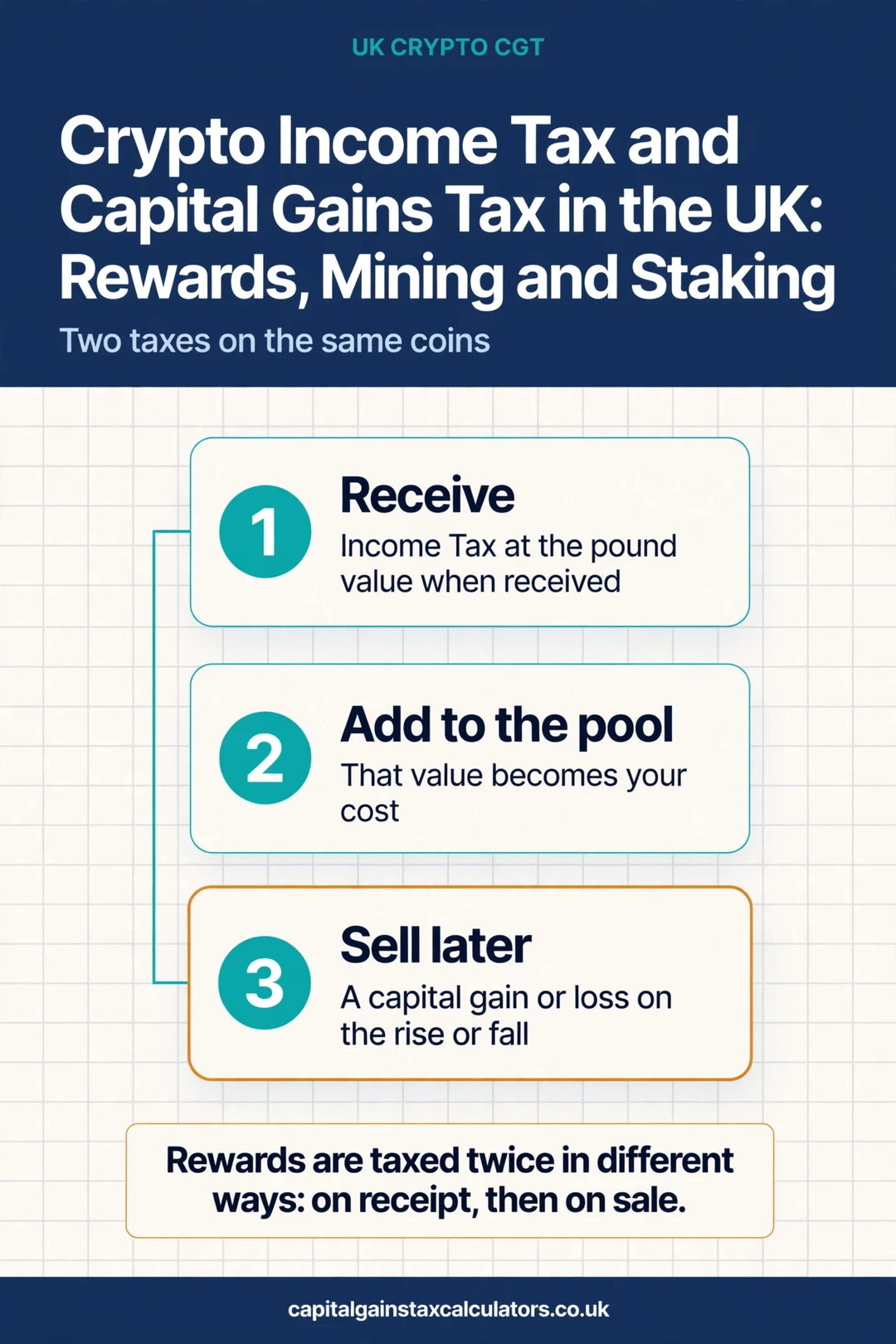
If you received tokens as income, add them to your pool at the pound value you were taxed on. When you sell them, the gain or loss compares the sale price with that cost.
Losses, lost keys and scams
Losses on crypto are capital losses. They can be set against other gains in the same tax year, and you can carry them forward if you report them to HMRC within 4 years of the end of the tax year in which they arose. If a token is lost because you lost the private key, HMRC does not usually accept it as a disposal. If a token has become worthless and has no market, you can make a negligible value claim. If you were a victim of a fraud, the loss may or may not be allowable, depending on the facts. Read our guide to Capital Gains Tax losses.
Records you need
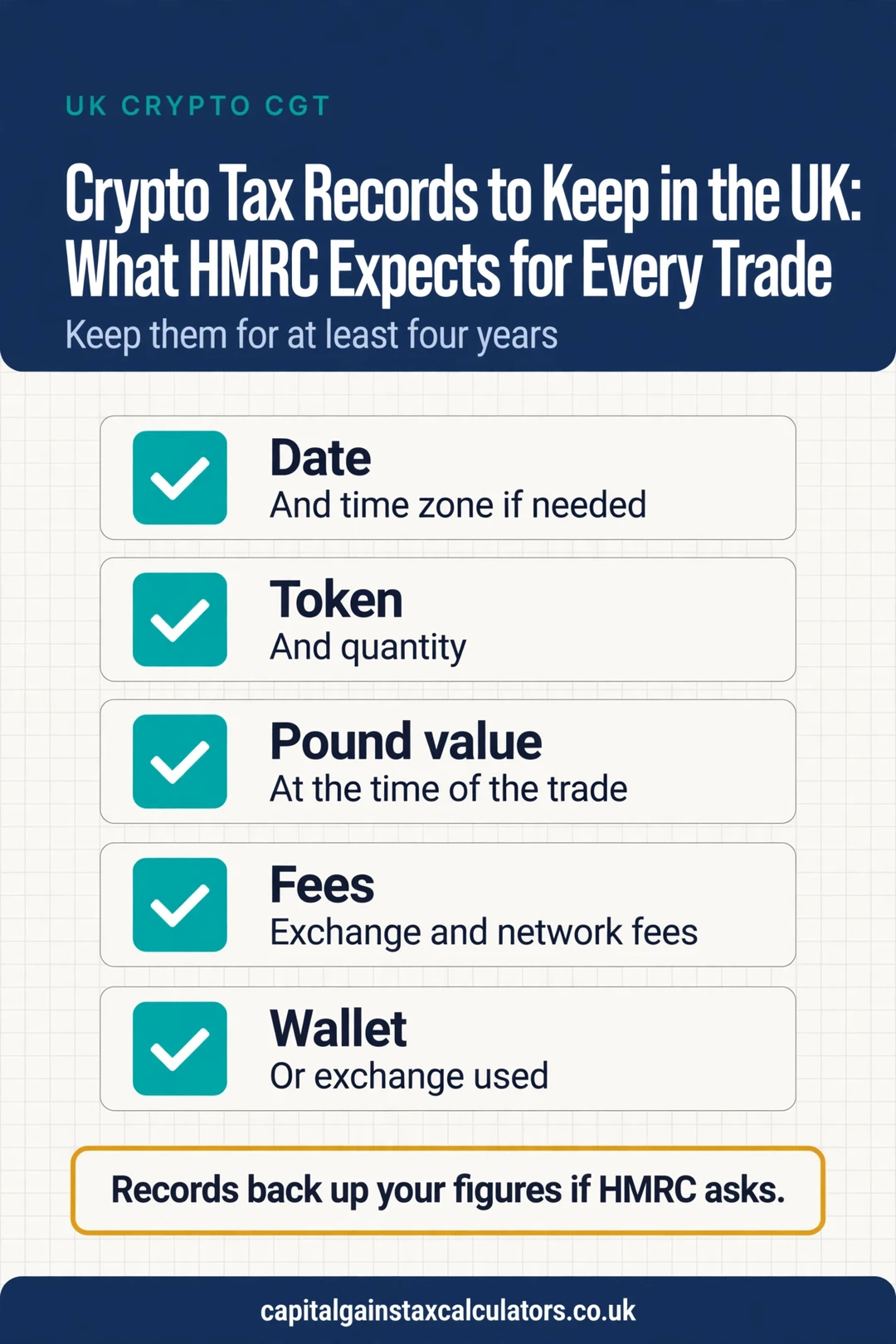
HMRC expects you to keep the following for each transaction: the date, the type of token, the number of tokens, the pound value at the time, the fees, the wallet or exchange used and what the transaction was for. Exchange statements can disappear when an exchange closes, so download them regularly. Convert any amounts shown in other currencies or stablecoins into pounds on the date of each trade and note the source of the exchange rate. Keep your records for at least four years after the end of the tax year, and longer if you carry forward losses.
Reporting crypto gains
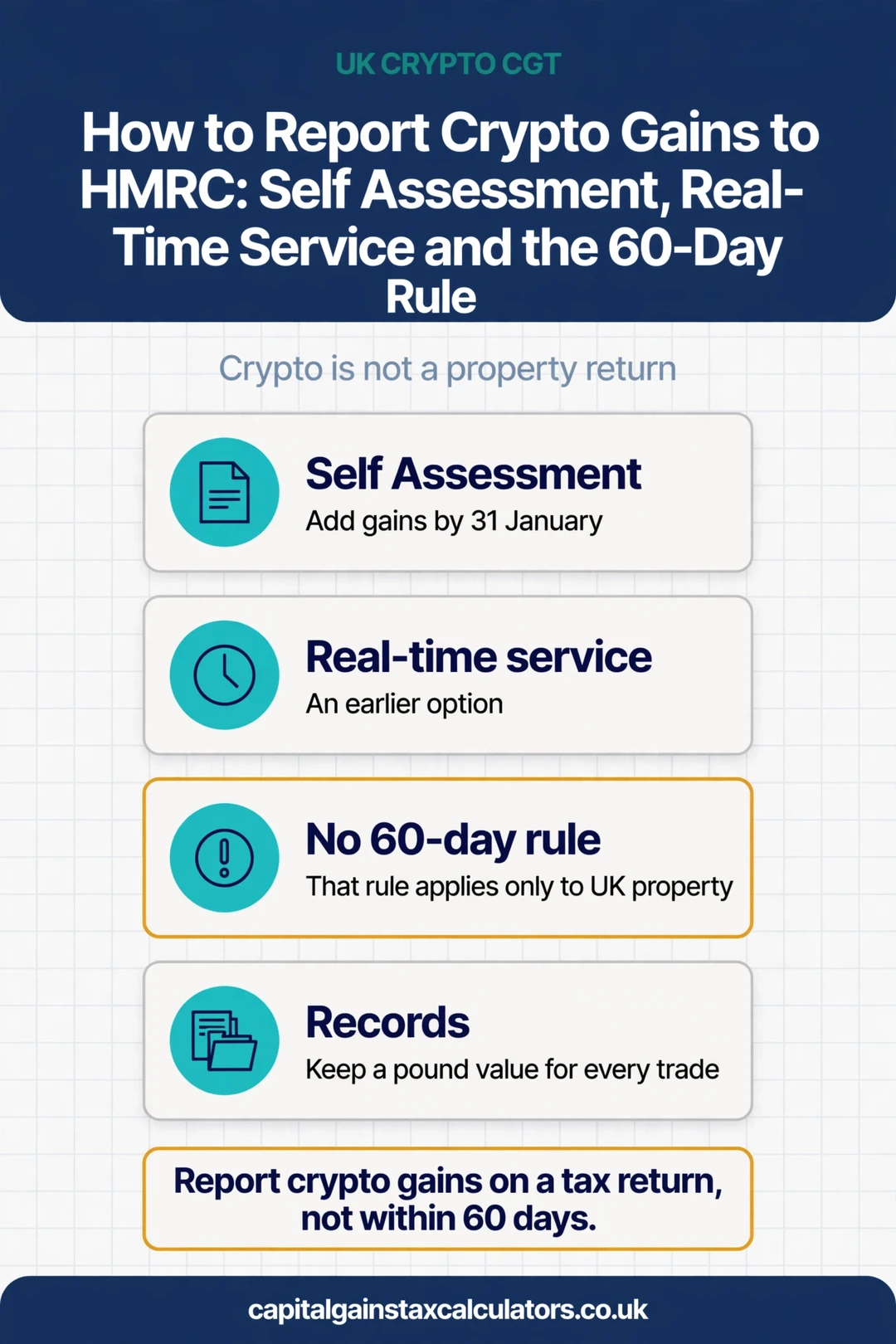
Crypto is not UK property, so the 60-day rule does not apply. You report gains on your Self Assessment tax return, or through the real-time Capital Gains Tax service, which lets some people report and pay before the return is due. You need to report if your gains are above the allowance or your total proceeds are over £50,000. See our reporting guide.
Common mistakes with crypto
- Treating swaps as tax free. Every swap is a disposal.
- Treating wallet transfers as sales. They are not disposals.
- Using other currencies. Convert to pounds on the day.
- Forgetting income. Staking and mining rewards are income first.
- Ignoring the 30-day rule. It applies to tokens, as to shares.
- Poor records. Missing exchange histories are hard to rebuild.
What to do next
- Download the full history from each exchange and wallet.
- Enter your trades in the crypto calculator.
- Check the pool balance against your wallets.
- Report using our reporting guide.
Frequently asked questions
Do I pay Capital Gains Tax on crypto in the UK?
Yes, if your total gains from all assets in a tax year are above £3,000 after losses. The rates are 18% and 24% for 2026/27.
Is swapping one crypto for another taxable?
Yes. A swap is a disposal of the token you give up, valued at the pound value of what you receive.
Do I pay tax if I only buy and hold crypto?
No. There is no Capital Gains Tax until you dispose of it.
How do I work out the cost of my crypto?
Use pooling. The cost of each token type is pooled and averaged, after the same-day and 30-day rules.
Is staking income or a gain?
Staking rewards are usually Income Tax when you receive them. Selling the rewards later can create a capital gain or loss.
Is moving crypto between my wallets a disposal?
No. Moving between your own wallets or exchanges is not a change of ownership, so there is no gain or loss.
What if I lost my crypto?
Losing a private key is not normally a disposal. If a token becomes worthless, you may be able to make a negligible value claim.
Do I need to report crypto if I made a loss?
You should report it if you want to carry it forward. Losses must be reported within 4 years of the end of the tax year.
Can HMRC see my crypto activity?
HMRC receives data from exchanges and can ask for records. It is best to report accurately.
Are NFTs taxed in the same way?
In general, yes. Selling or swapping an NFT is a disposal, and the gain is the pound value less the cost. The rules for creators and for income can differ.
Official sources
- GOV.UK: Tax on cryptoassets
- HMRC Cryptoassets Manual
- GOV.UK: Capital Gains Tax rates
- GOV.UK: Report and pay your Capital Gains Tax
Related guides and calculators
This page gives general information for UK taxpayers and is not tax advice. Capital Gains Tax rules can change and your own circumstances matter. Check the latest rules on GOV.UK or with a qualified tax adviser before you act.