Quick answer
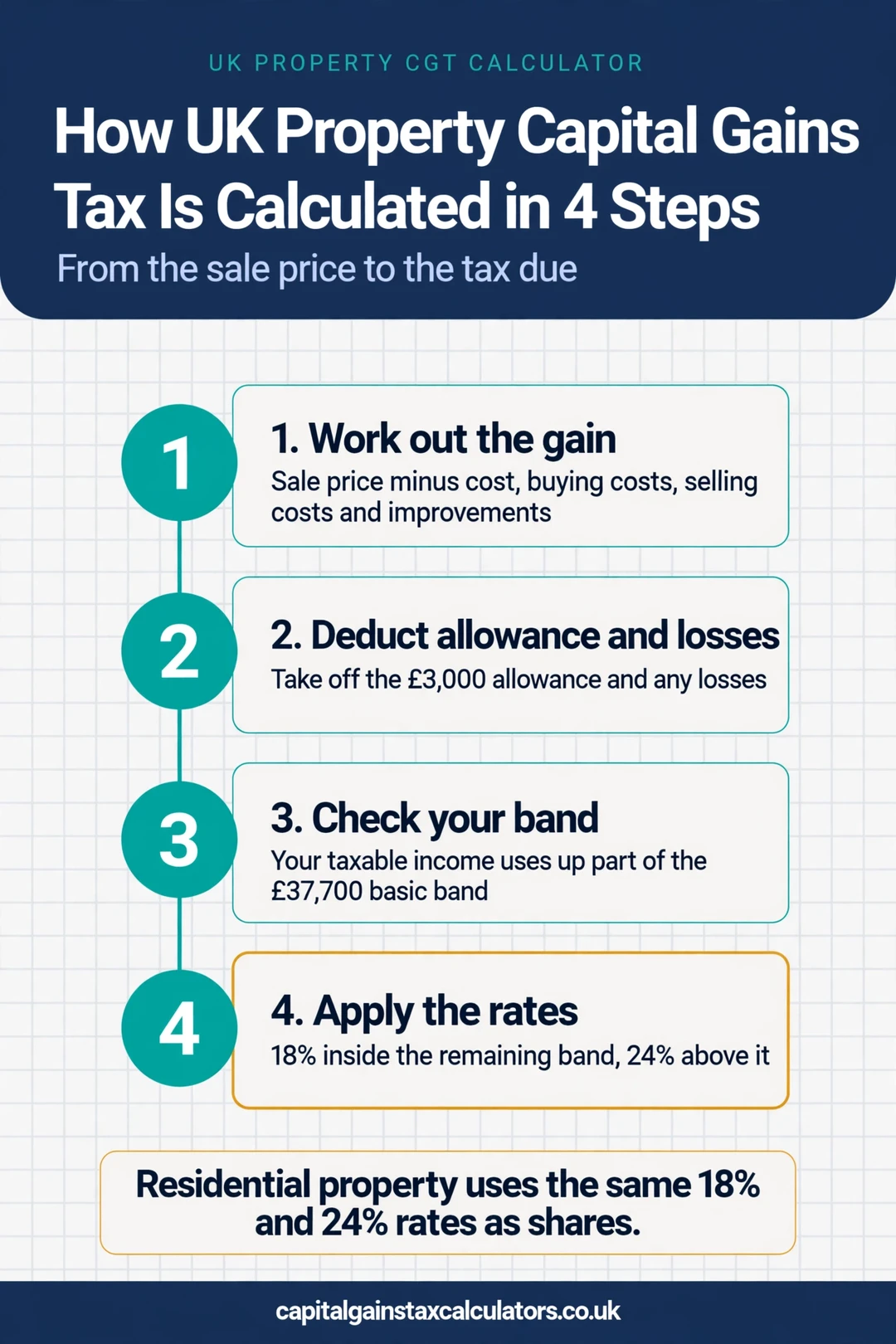
To work out Capital Gains Tax on a UK property, take the sale price and deduct what you paid, your buying and selling costs and any lasting improvements. Then deduct the £3,000 annual exempt amount. The remaining gain is taxed at 18% inside your basic rate band and 24% above it. Enter your figures in the calculator above, and add the months you lived there to include Private Residence Relief.
Key facts
- The same rates apply to property and shares: 18% and 24% for 2026/27.
- Buying costs, selling costs and improvements all reduce your gain. Mortgage interest and repairs do not.
- Joint owners each pay on their own share, using their own allowance and income.
- Tax on UK residential property must be reported and paid within 60 days of completion.
- Your only or main home is normally exempt, in full or in part, through Private Residence Relief.
What this property calculator does
The calculator estimates the Capital Gains Tax on a single sale of UK residential property, such as a second home, a buy-to-let flat or a house you inherited. It works out your gain, applies your allowance and any losses, and splits the taxable gain between the 18% and 24% rates using your income. The result updates as you type, and the breakdown shows every step.
| Input | What to enter | Where to find it |
|---|---|---|
| Sale price | The price you sold the property for | Completion statement from your solicitor |
| Purchase price | What you paid, or the probate value if you inherited it | Your purchase paperwork or probate valuation |
| Buying costs | Stamp duty, legal fees, survey fees | Your purchase completion statement |
| Selling costs | Estate agent and legal fees | Your sale completion statement |
| Improvement costs | Lasting improvements such as an extension or new roof | Invoices and receipts |
| Your share | 100% if you own it alone, 50% for equal joint ownership | Land Registry title or your deed of trust |
| Total income | All taxable income for the tax year | P60, tax return or payslips |
Costs you can and cannot deduct
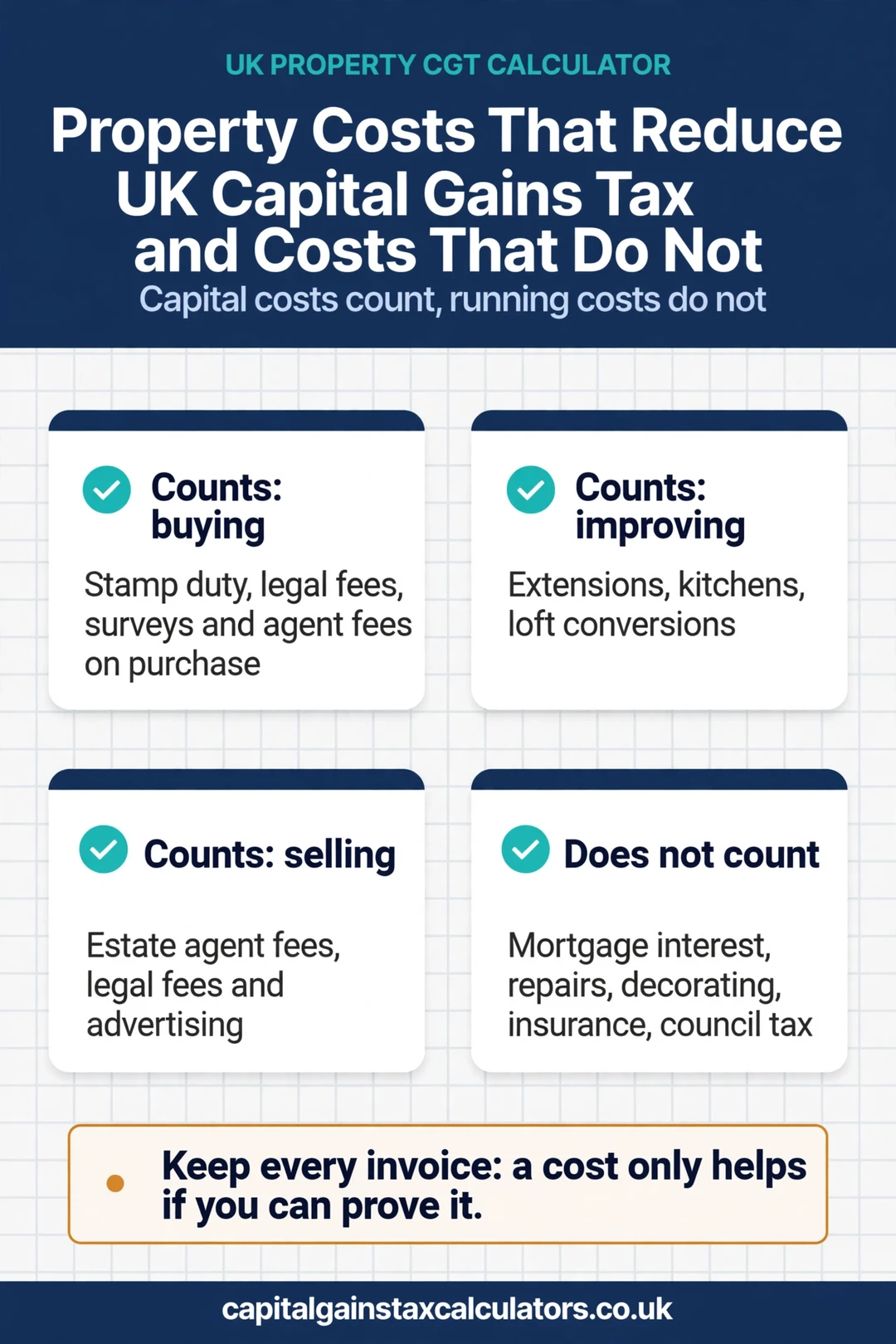
HMRC lets you deduct the costs of buying, selling and improving a property. It does not let you deduct the running costs of owning it. Getting this right is often worth more than any relief, because every pound of allowable cost reduces your taxable gain.
| Usually allowable | Not allowable |
|---|---|
| Stamp Duty Land Tax paid on purchase | Mortgage interest and arrangement fees |
| Solicitor and conveyancing fees, buying and selling | Repairs and normal maintenance, such as decorating |
| Estate agent fees on the sale | Insurance, ground rent and service charges |
| Survey and valuation fees | Costs already deducted against rental income |
| Extensions, conservatories, new kitchens and loft conversions | Costs of the same improvement that were later reversed |
| Costs of defending your legal title | Council tax and utility bills |
Keep every invoice. HMRC can ask for proof of costs for many years, and improvement work from a long time ago is easy to forget.
Worked example: selling a buy-to-let flat
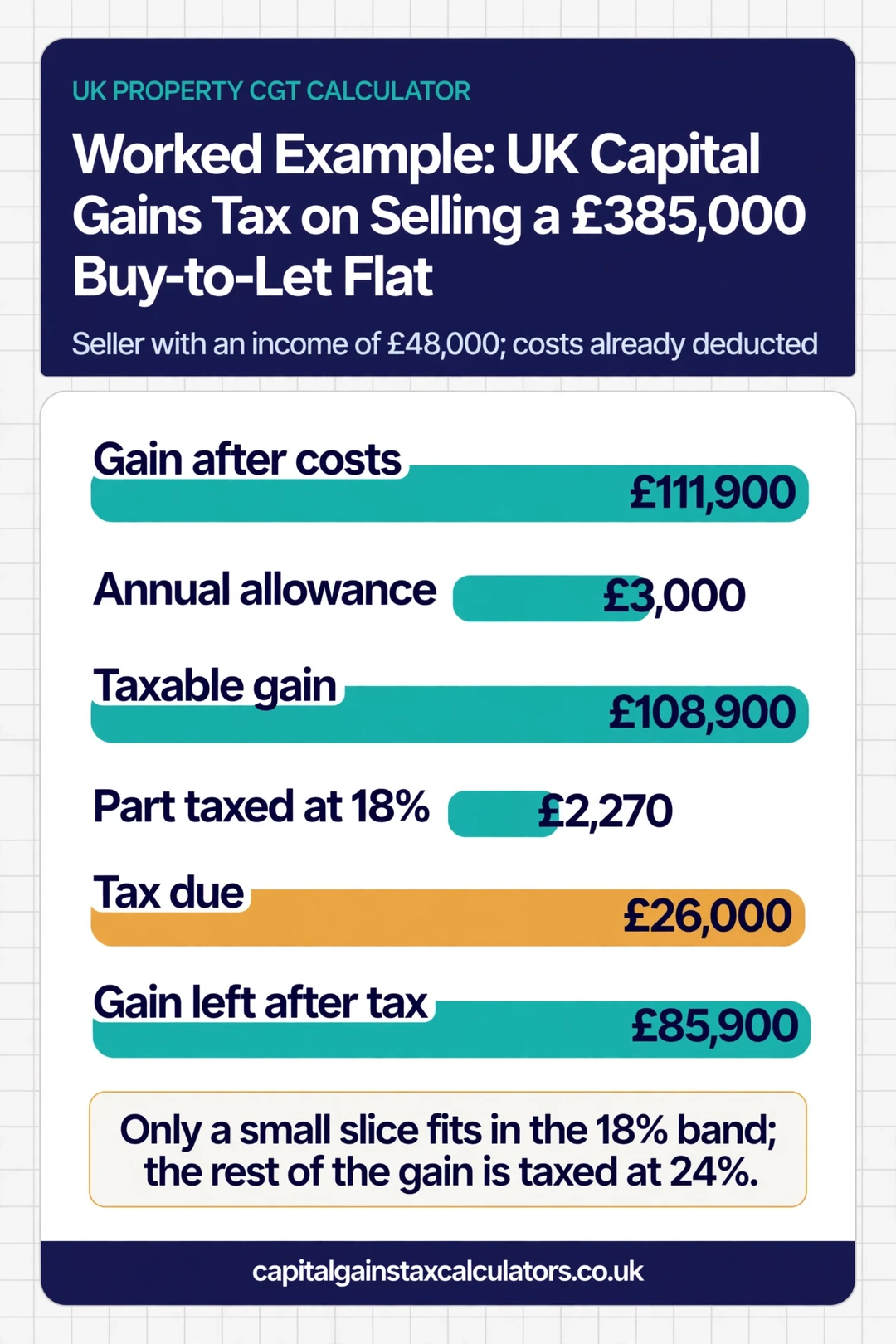
Imagine you bought a flat for £240,000, paid £8,200 in stamp duty and legal fees, spent £18,000 on a new kitchen and bathroom, and sold it for £385,000. Selling costs were £6,900. Your income is £48,000.
Worked example
Gain, allowance and rate on a £385,000 sale
- Gain: £385,000 less £6,900 selling costs, £240,000 purchase price, £8,200 buying costs and £18,000 improvements = £111,900.
- Allowance: £3,000 comes off, leaving a taxable gain of £108,900.
- Your taxable income is £35,430, so only £2,270 of the £37,700 basic rate band is left.
- £2,270 is taxed at 18% and £106,630 at 24%.
- Capital Gains Tax: £26,000, roughly 23.2% of the gain.
Your income changes the answer a lot. Selling the same flat on an income of £20,000 would cost £24,320, because more of the gain fits inside the cheaper band. On an income of £120,000 the bill would be £26,136, because none of the basic rate band is left.
Worked example: joint owners
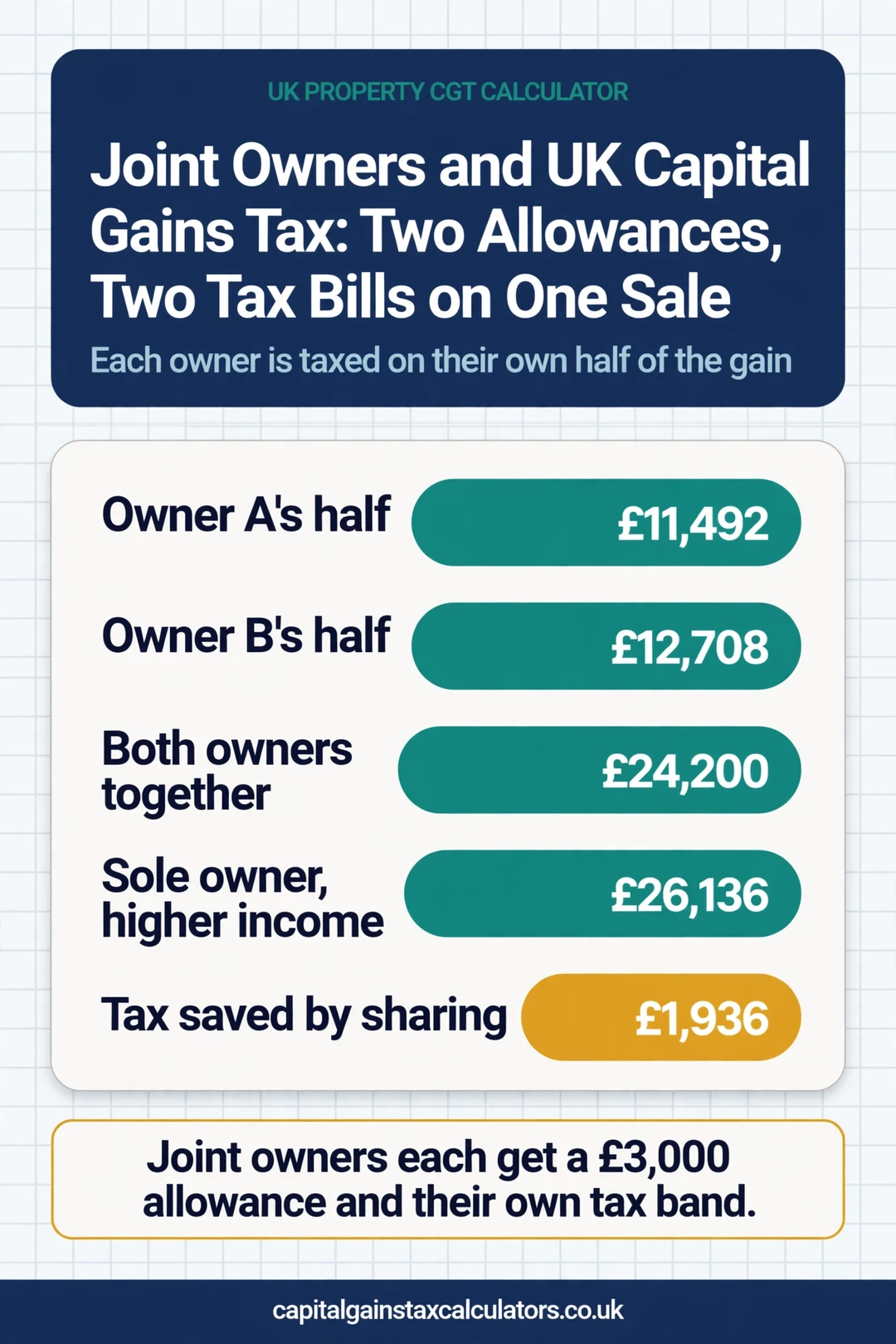
When two people own a property, each is taxed on their own share. Suppose the same flat is owned 50/50 by two people, one earning £30,000 and one earning £62,000.
| Owner | Share of gain | Income | Capital Gains Tax |
|---|---|---|---|
| Owner A | £55,950 | £30,000 | £11,492 |
| Owner B | £55,950 | £62,000 | £12,708 |
| Combined | £111,900 | £24,200 | |
| If Owner B owned it alone | £111,900 | £62,000 | £26,136 |
The couple pays £1,936 less than a sole owner on the higher income, because they use two allowances and the lower earner uses more of the 18% band. Our spouse transfer planner shows how much moving ownership before a sale could save.
Did you live in the property?
If the property was ever your only or main home, Private Residence Relief can wipe out part or all of the gain. Switch on “Did you ever live in it as your main home?” in the calculator, then enter the total months you owned it and the months you lived there. The relief covers the time you lived in the property plus the final 9 months of ownership.
For the example flat, living there for 48 of 120 months would cover 57 months once the final 9 are added, reducing the taxable gain and cutting the bill to £13,243. For absences, lettings relief and the 36-month final period, use the dedicated Private Residence Relief calculator.
Reporting the sale within 60 days
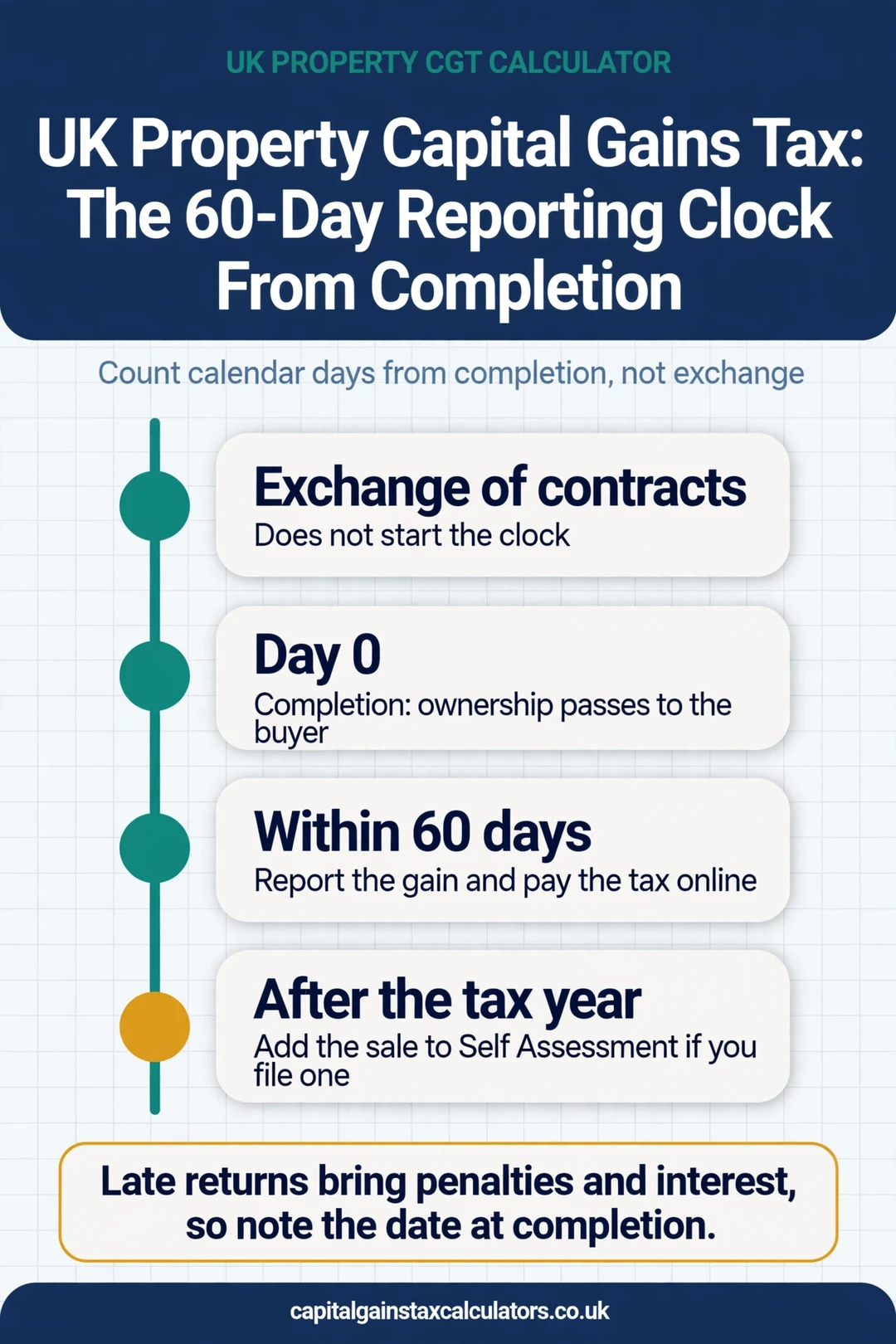
If you owe Capital Gains Tax on UK residential property, you must report it to HMRC and pay within 60 days of completion. The clock starts at completion, not at exchange of contracts. If you also file Self Assessment, the sale goes on your tax return as well. Residents with no tax to pay do not need to send the 60-day return, but non-residents must always report. Use the 60-day deadline calculator for your exact date, and our step-by-step reporting guide for the process.
What this calculator does not cover
The tool is built for a typical sale, so some cases need extra care or professional advice:
- Properties owned by a company, which pay Corporation Tax instead of Capital Gains Tax.
- Part disposals, such as selling off a garden, which use a part-disposal formula.
- Non-residents, who report every UK property sale and have different rules for relief.
- Properties sold in a trust or by personal representatives (see the inherited property calculator).
- Gifts and sales below market value, where market value replaces the price.
- Complicated reliefs such as holdover, rollover or incorporation relief.
Common mistakes with property gains
- Forgetting stamp duty. It is part of your purchase cost and is often thousands of pounds.
- Deducting mortgage interest. It never reduces a Capital Gains Tax gain.
- Using the wrong income. Use your total income for the same tax year as the sale.
- Ignoring joint ownership. Enter only your share, and let the co-owner calculate theirs.
- Missing the 60-day deadline. The return is separate from Self Assessment.
- Using the valuation instead of the sale price. Only the real sale price, or market value for gifts, counts.
What to do next
- Run your figures and note the taxable gain and the tax.
- Check whether Private Residence Relief applies, using the relief calculator.
- Work out your report-and-pay date with the 60-day calculator.
- Read the full guide to Capital Gains Tax on property if the property was let or inherited.
- Report and pay within the deadline using the reporting guide.
Frequently asked questions
How do I calculate Capital Gains Tax on a property sale?
Deduct the purchase price, buying costs, selling costs and improvements from the sale price. Take off your £3,000 allowance and any losses. Tax the rest at 18% up to your remaining basic rate band and 24% above it.
What is the Capital Gains Tax rate on property in 2026/27?
18% or 24%, depending on your income. Residential property used to have higher rates than other assets, but the rates are now the same.
Can I deduct stamp duty when selling a property?
Yes. Stamp Duty Land Tax you paid when you bought the property is an allowable cost and reduces your gain, along with solicitor and survey fees.
Do I pay Capital Gains Tax on my main home?
Not usually. Private Residence Relief makes your main home exempt if you lived in it throughout, did not let it, and the grounds are under 5,000 square metres. Partial relief applies if you only lived there for part of the time.
How is Capital Gains Tax split between joint owners?
Each owner is taxed on their share of the gain. Each has a separate £3,000 allowance and basic rate band, so two owners often pay less combined than one owner.
Do I have to report a property sale if there is no tax to pay?
UK residents with no Capital Gains Tax to pay do not need to send the 60-day return. If you file Self Assessment and your total proceeds are over £50,000, you still report it on your return. Non-residents must always report.
Can I use the calculator for an inherited property?
Yes. Enter the probate value as the purchase price. For a sale by the estate rather than a beneficiary, use the dedicated inherited property calculator.
What if I made a loss on the property?
The calculator shows a loss and flags it. A loss can be set against gains in the same tax year or carried forward, but you must report it to HMRC within 4 years of the end of the tax year of sale.
Does my income matter for property gains?
Yes. Your taxable income uses up the basic rate band first, so higher earners pay 24% on more of their gain. Gift Aid and pension contributions can widen the band, which you can add under “More options”.
Is the result a final tax bill?
No. It is an estimate based on the figures you enter and the 2026/27 rules. Check it against your completion statement and the HMRC reporting service before you pay.
Official sources
- GOV.UK: Tax when you sell property
- GOV.UK: Capital Gains Tax rates
- GOV.UK: Report and pay Capital Gains Tax on UK property
- GOV.UK: Tax when you sell your home
Related guides and calculators
This page gives general information for UK taxpayers and is not tax advice. Capital Gains Tax rules can change and your own circumstances matter. Check the latest rules on GOV.UK or with a qualified tax adviser before you act.