Quick answer
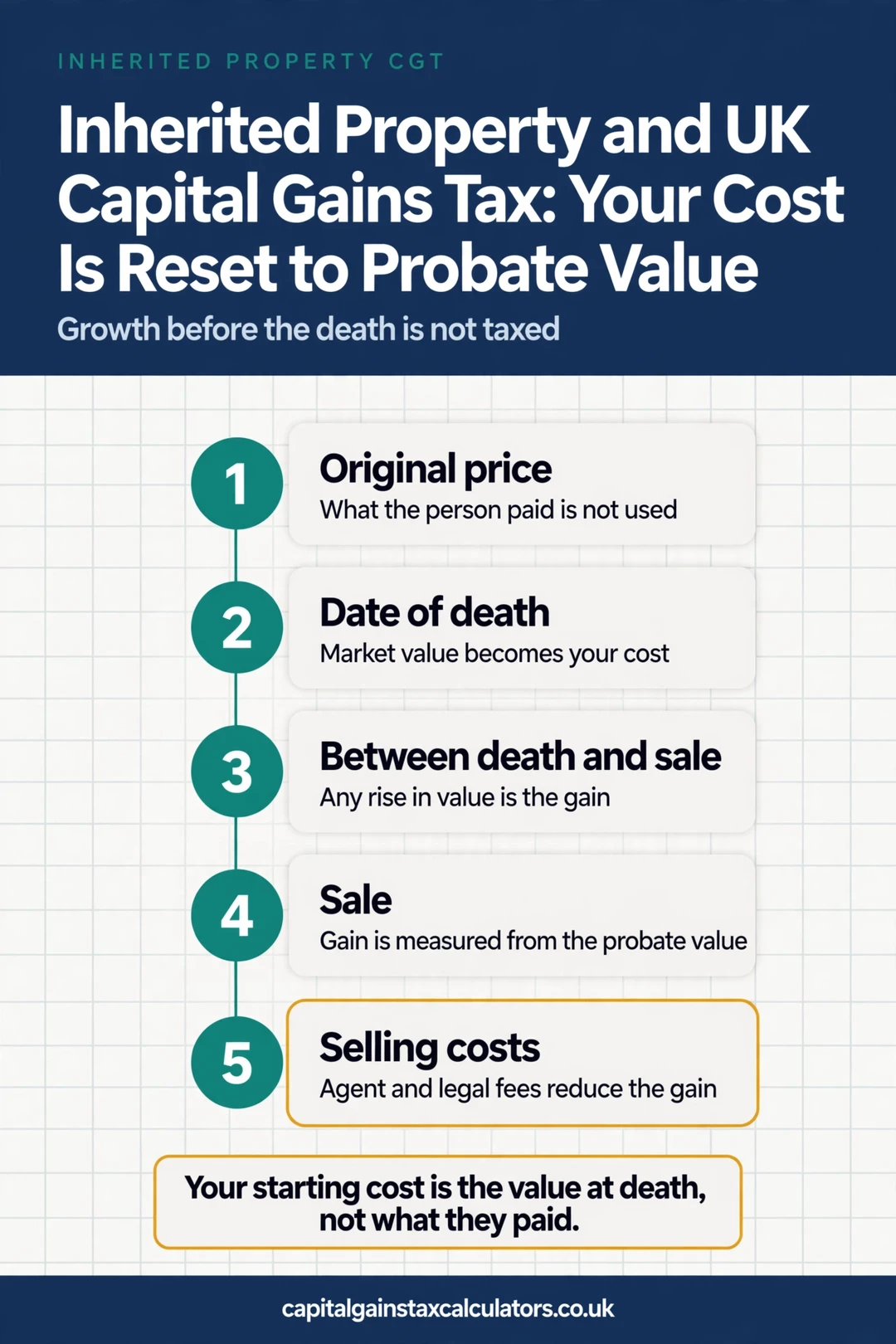
You do not pay Capital Gains Tax simply for inheriting a property. Tax arises when you sell it. Your cost is the probate value, which is the value used for Inheritance Tax at the date of death, not what the person originally paid. The gain is the sale price less selling costs and that value. Gains above your £3,000 allowance are taxed at 18% or 24%.
Key facts
- There is no Capital Gains Tax on inheriting an asset. Tax only arises when you or the estate sell it.
- Your cost is the value at the date of death, normally the probate value, so earlier growth is not taxed.
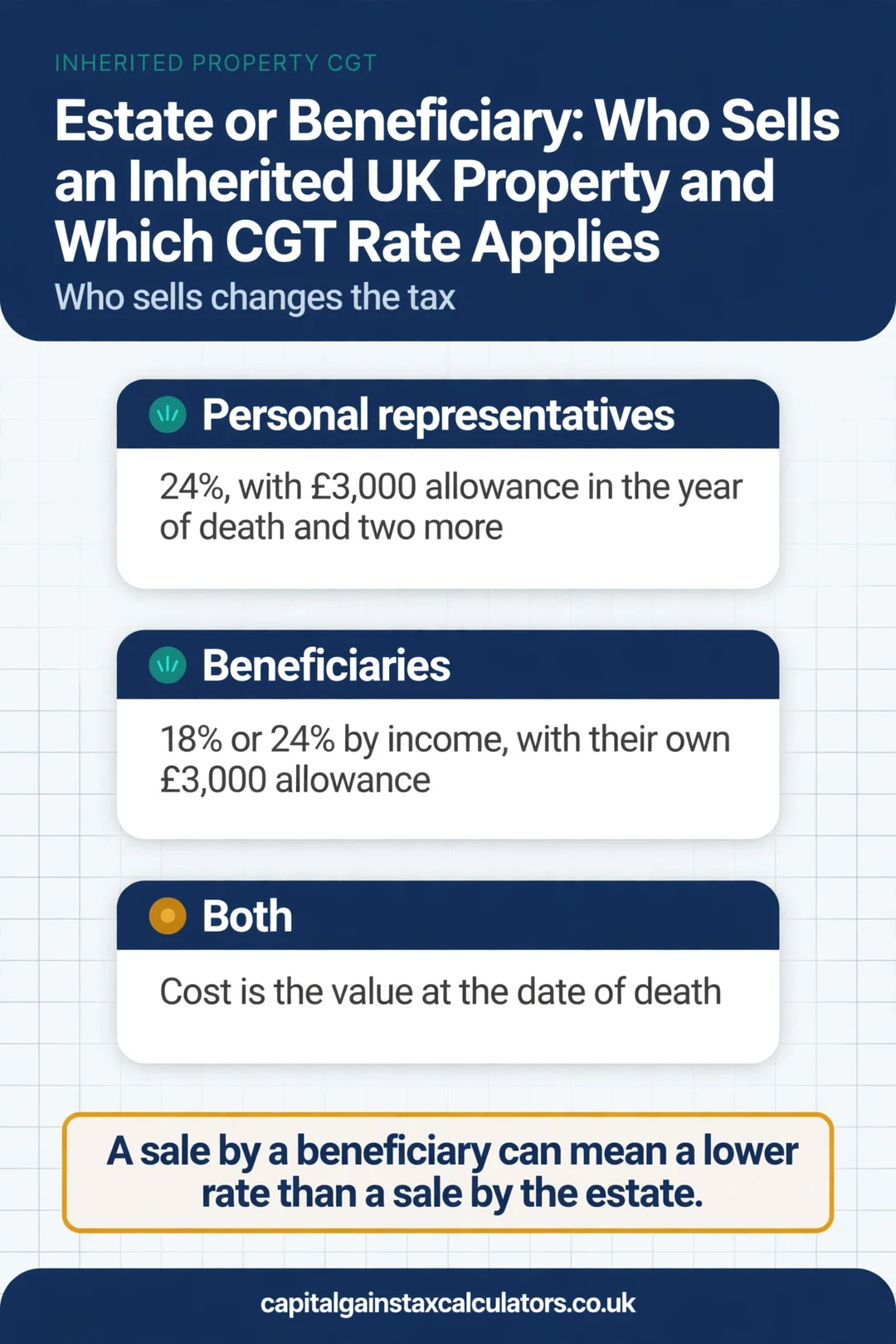
- Beneficiaries use their own £3,000 allowance and pay 18% or 24%.
- Personal representatives pay 24% and have an allowance for the tax year of death and the next two.
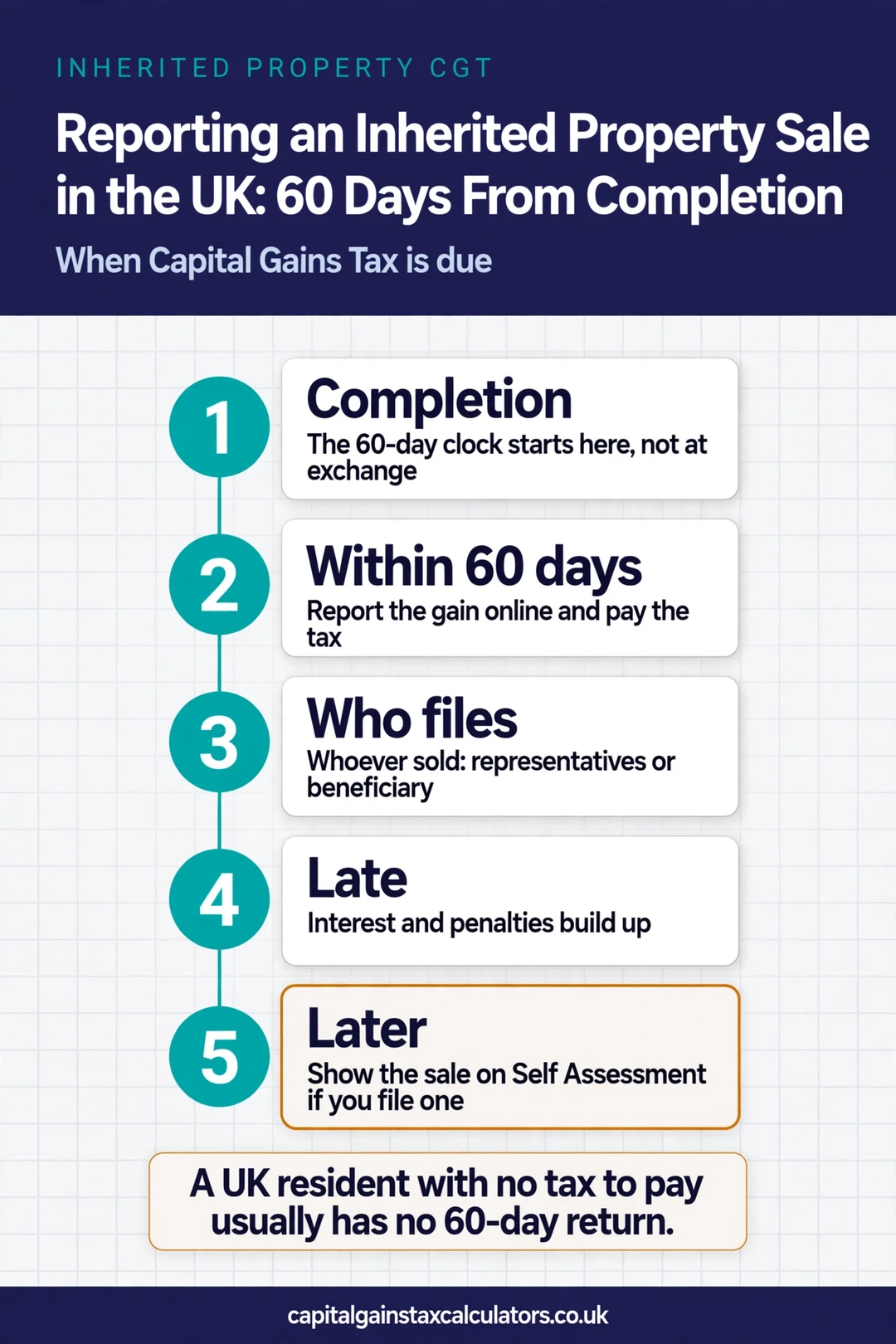
- A UK residential property sale with tax due must be reported and paid within 60 days of completion.
How this calculator works
Choose whether you are selling as a beneficiary (after the property has been passed to you) or as the personal representative, selling on behalf of the estate. Enter the probate value, the sale price, your selling costs and any improvements you made after you inherited it. If you share the property with others, enter your ownership percentage. Beneficiaries should add their income so the calculator picks the right rate.
If you inherited a property and have not yet sold it, the calculator can still show what a sale at a given price would cost. For estate sales it ignores your income and applies the personal representative rate of 24%.
| Input | What to enter | Tip |
|---|---|---|
| Probate value | Value at the date of death | Find it on the Inheritance Tax paperwork or the probate valuation |
| Sale price | What the property sold for | Use the completion figure |
| Selling costs | Agent, legal and similar fees | Keep the invoices |
| Improvements | Capital works after inheriting | Repairs and decoration do not count |
| Your share | Your percentage of ownership | Use 25% for four equal beneficiaries |
Worked example: a beneficiary selling a house
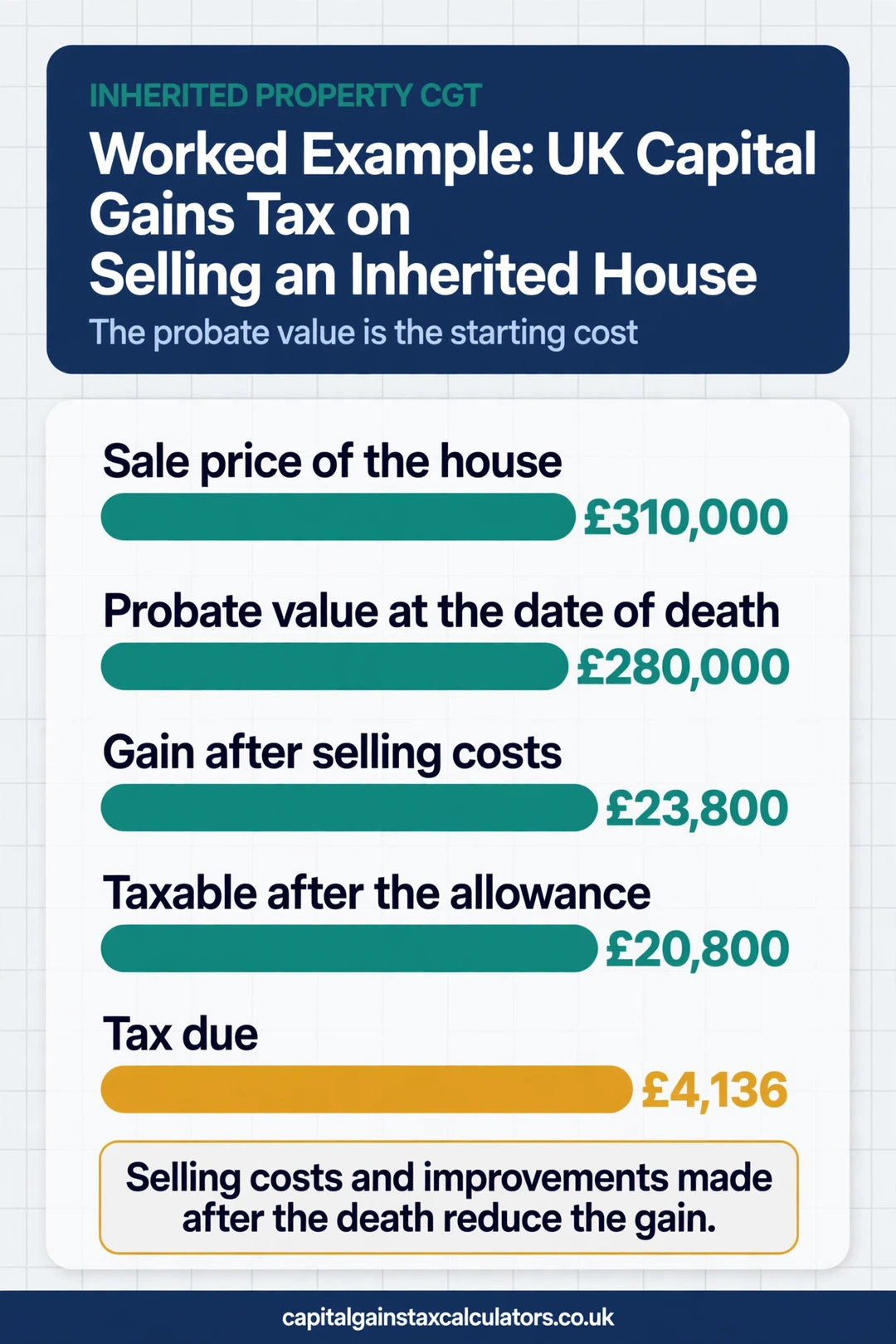
A parent dies and leaves you a house. The probate value is £280,000. You sell for £310,000 and pay £6,200 in costs. Your income is £36,000.
Worked example
Gain on an inherited house
- Sale price less costs: £310,000 less £6,200 = £303,800.
- Cost: the probate value of £280,000.
- Gain: £23,800.
- After the allowance: £20,800 is taxable.
- Tax: £14,270 at 18% and £6,530 at 24% = £4,136.
With an income of £90,000, the whole taxable gain would be charged at 24% and the tax would be £4,992. If the property was sold for less than the probate value, you have a loss. Selling for £262,000 gives a loss of £24,200, which you can report and use against later gains.
Improvements and selling costs
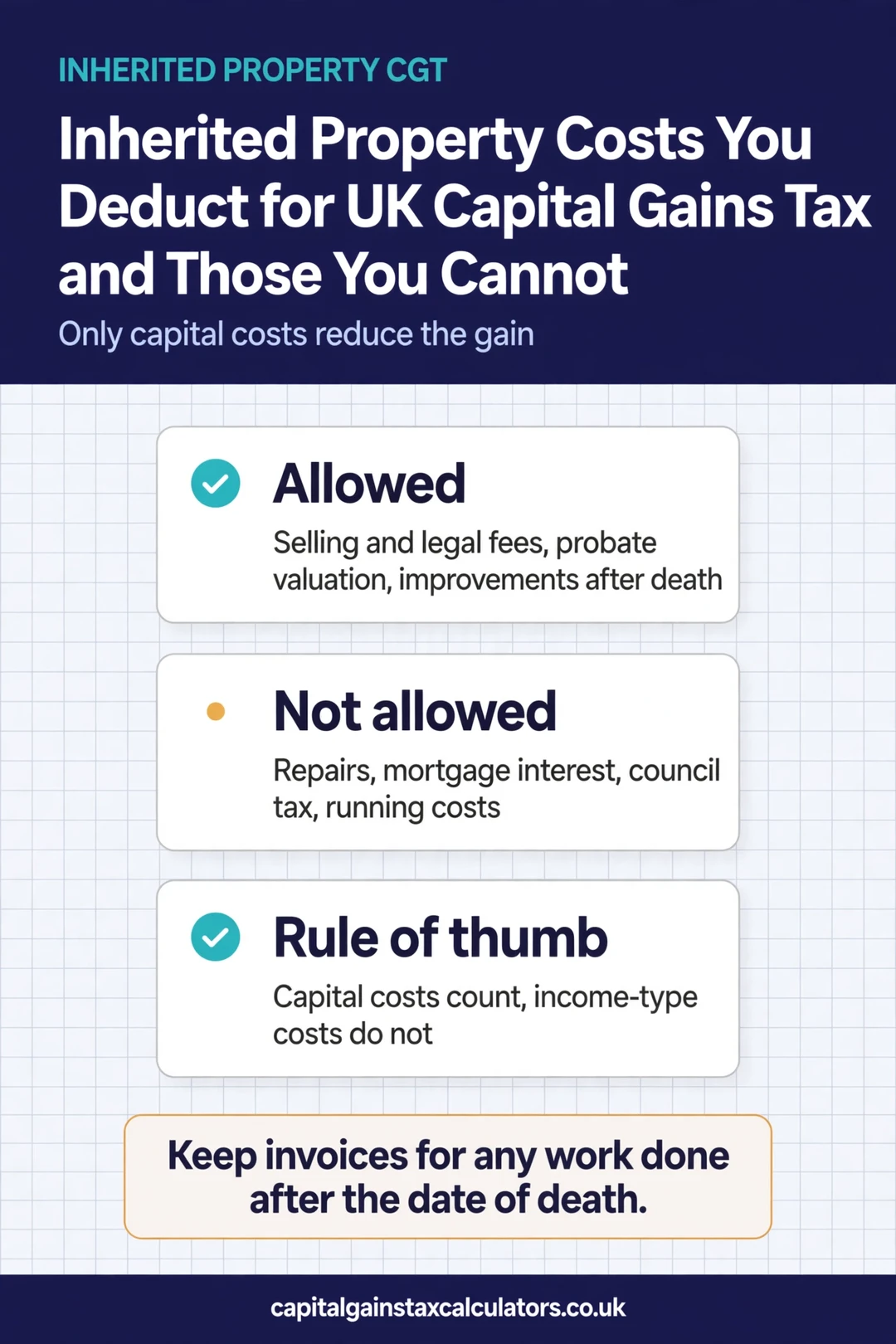
Capital improvements you pay for after inheriting, such as an extension or a new roof, add to your cost. Ordinary repairs and decoration do not. Selling costs such as the agent’s fee and legal costs reduce the gain. Selling for £340,000 after spending £15,000 on an extension gives a gain of £38,800 instead of £53,800, because of the improvement cost.
| Cost | Allowable? | Why |
|---|---|---|
| Probate valuation fee | Yes | Cost of establishing the value |
| Estate agent and legal fees on sale | Yes | Selling costs |
| Extension or new roof after inheriting | Yes | Capital improvement |
| Mortgage interest | No | Financing cost |
| Redecorating or repairs | No | Revenue expense |
| Council tax and utilities while empty | No | Running costs |
When the estate sells: personal representatives
If the personal representatives sell the property before it is passed to a beneficiary, the estate pays the tax. The rate is 24%. The estate has the £3,000 allowance for the tax year of death and the following two tax years. After that it has no allowance. On the same sale, the estate tax is £4,992 inside the allowance window and £5,712 outside it.
Personal representatives report and pay the tax for the estate. Beneficiaries who sell later report their own gain, using the probate value as their cost. Our guide to trusts and estates covers the rules for each role.
Sharing the property with other beneficiaries
If several people inherit a property, each is treated as owning a share. Each person reports their own share of the gain, uses their own allowance and pays at the rate set by their own income. With a 50% share, the gain in our example is £11,900 and the tax is £1,602. Equal shares usually mean more allowances and lower tax than one person selling alone.
The 60-day report and payment
If a UK resident sells UK residential property and there is tax to pay, the gain must be reported and the tax paid within 60 days of completion. Personal representatives follow similar rules for the estate. Non-residents must report all UK property sales, even without tax. See our 60-day deadline calculator and the reporting guide.
What this calculator does not cover
- Property that you lived in as your main home after you inherited it, where Private Residence Relief may apply. Use the relief calculator.
- Inheritance Tax, which is a separate tax that may be due on the estate.
- Property left to a spouse, who takes over the original cost under the no gain, no loss rule.
- Assets held in a trust with their own cost rules.
- Property that stays in the estate and is sold under a deed of variation.
Common mistakes on inherited property
- Using the price the person originally paid. The probate value is the cost.
- Forgetting the sale costs. Agent and legal fees reduce the gain.
- Missing the estate’s allowance window. It only lasts to the end of the second tax year after death.
- Ignoring joint ownership. Each beneficiary reports their own share.
- Not reporting within 60 days. Late reporting can lead to interest and penalties.
- Claiming Private Residence Relief without living there. The home must be your main residence.
What to do next
- Get the probate value from the estate paperwork.
- Use the calculator above to estimate the gain and tax.
- Check the guide to inherited property for who reports and what to keep.
- Report and pay within 60 days using our step-by-step guide.
Frequently asked questions
Do I pay Capital Gains Tax on an inherited property?
Not for inheriting it. You pay Capital Gains Tax on any gain when you sell it, measured from the probate value at the date of death.
What is the cost of an inherited property for CGT?
The market value at the date of death, normally the probate value used for Inheritance Tax. You add improvement costs and deduct selling costs. The original purchase price is not used.
What rate is Capital Gains Tax on an inherited house?
Beneficiaries pay 18% or 24% depending on their income. Personal representatives selling for the estate pay 24%.
How long do I have to sell an inherited property without paying tax?
There is no fixed limit, but the longer you wait, the more the property may rise above the probate value. Personal representatives only have an allowance for the tax year of death and the next two tax years.
Do I need to tell HMRC if I sell and make no gain?
Residents with no tax to pay do not need the 60-day return. You may still need to report it on your tax return if the total proceeds are over £50,000.
Can I live in an inherited property to avoid tax?
You can claim Private Residence Relief for the time it is your main home, plus the final 9 months. Moving in only to claim relief is likely to be challenged.
What if there are several beneficiaries?
Each is treated as owning a share. Each reports their share of the gain, uses their own allowance and pays at their own rates.
What if the sale price is lower than the probate value?
You have a loss. Report it to HMRC and carry it forward to set against future gains. A loss on a sale to a connected person is restricted.
Is Inheritance Tax the same as Capital Gains Tax?
No. Inheritance Tax is charged on the estate at death. Capital Gains Tax is charged on a gain when you sell. Both can apply to the same property.
Is this estimate enough to file my return?
It gives you the gain and tax for a straightforward sale. Check it against your valuation, sale documents and costs, and take advice if the estate is complex.
Official sources
- GOV.UK: Tax on property you inherit
- GOV.UK: Capital Gains Tax on UK property
- GOV.UK: Capital Gains Tax rates
Related guides and calculators
This page gives general information for UK taxpayers and is not tax advice. Capital Gains Tax rules can change and your own circumstances matter. Check the latest rules on GOV.UK or with a qualified tax adviser before you act.