Quick answer
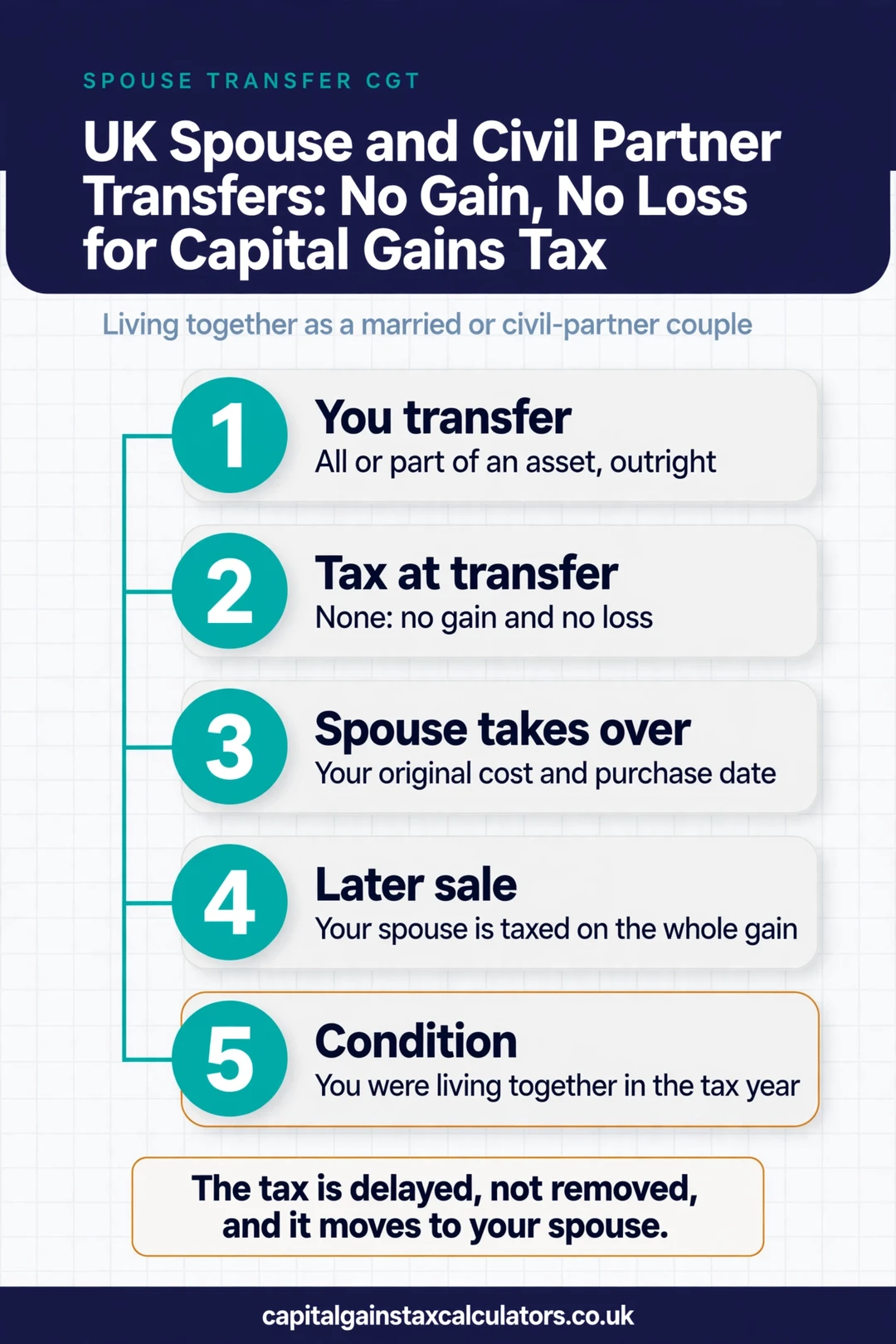
Transfers between spouses and civil partners who live together are no gain, no loss, so you can move part of an asset to your partner without tax. Each of you then has your own £3,000 allowance and your own basic rate band. If one of you has a lower income, sharing the gain can cut the tax, because more of it is taxed at 18% instead of 24%. The transfer must be genuine and unconditional.
Key facts
- A transfer to a spouse or civil partner you live with is no gain, no loss. They take over your cost and date of purchase.
- Each of you has a separate £3,000 allowance, which a joint sale can use twice.
- The lower earner may have more of the 18% band available.
- The gift must be outright. You cannot keep control of the asset or the proceeds.
- Transfer the asset before you have a binding contract to sell it.
How this calculator works
Enter the total gain you expect to make, your income and your spouse’s income. Then choose the share you would give your spouse. The calculator compares the tax if you sell alone with the tax if each of you sells your share. It also tests every split from 0% to 100% and shows the best one for your figures.
Income means your total taxable income for the year, not the gain. Use the estimate for the whole tax year. If your spouse has losses or other gains, adjust the gain you enter to reflect that. The calculator assumes 2026/27 rates and allowances for both of you.
| Input | What to enter | Tip |
|---|---|---|
| Total gain | The gain on the whole asset | Use the property or shares calculator first |
| Your income | Taxable income in the tax year | Include salary, pensions and rental profit |
| Spouse’s income | Their taxable income in the tax year | Include dividends and interest |
| Spouse’s share | The percentage you transfer | Try 50% first, then the suggested best split |
Worked example: a higher earner and a lower earner
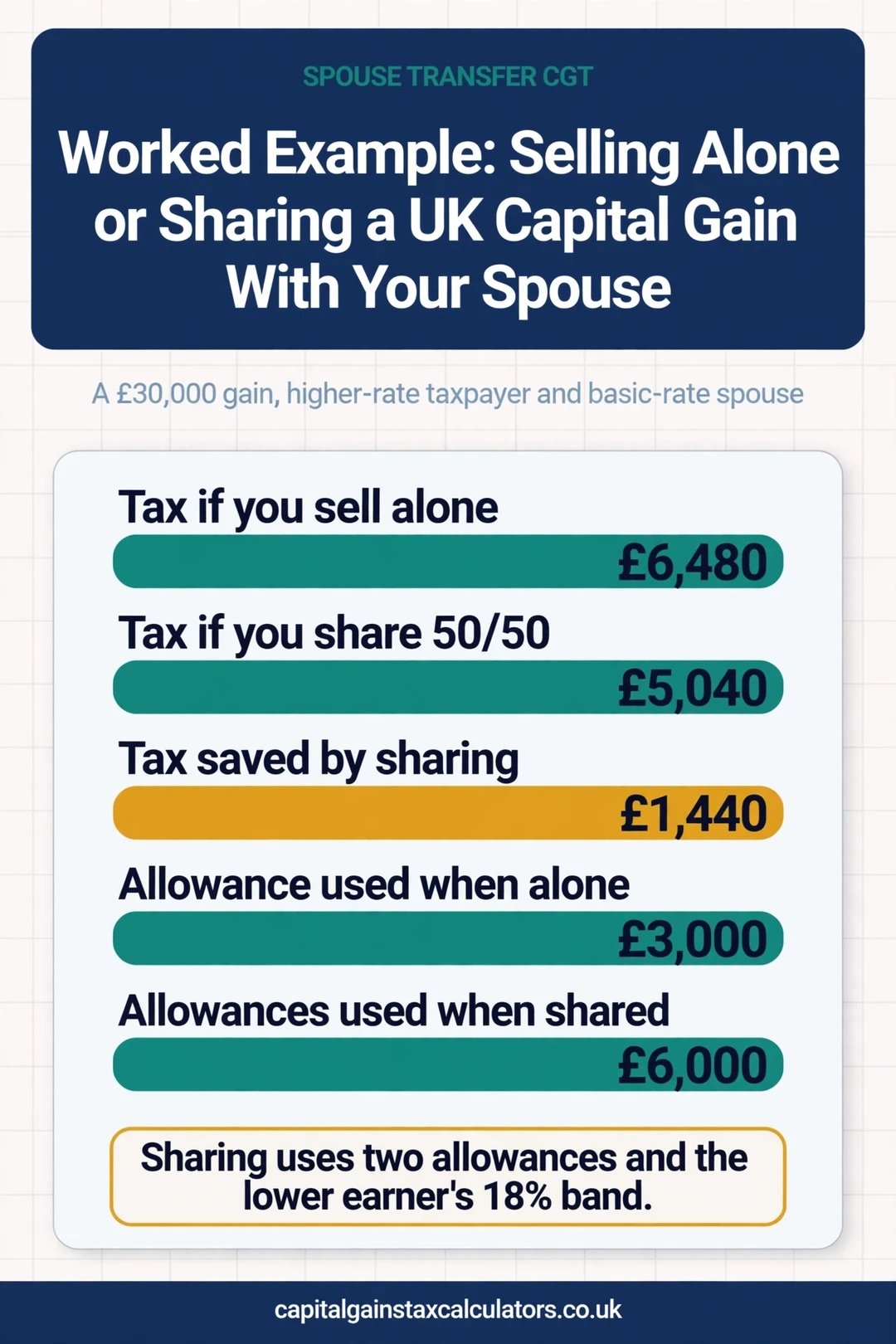
You expect a gain of £30,000 on an investment. Your income is £80,000, and your spouse’s income is £10,000. You compare selling alone and sharing the asset equally.
Worked example
Selling alone or sharing
- Selling alone: £6,480 of tax, all at 24%.
- Sharing 50/50: £15,000 gain each. After the £3,000 allowance, you pay tax on £12,000 and your spouse pays tax on £12,000.
- Combined tax after sharing: £5,040.
- Saving: £1,440.
- Best split found: 10% to you and 90% to your spouse, with a combined tax of £4,320, saving £2,160.
The saving grows as the gain gets larger and the incomes get further apart. With a gain of £100,000, an income of £90,000 and a spouse on £20,000, an equal split saves £2,536. If your incomes are the same, such as £80,000 each, the saving from sharing is only £720, which comes from the second allowance.
Where the saving comes from
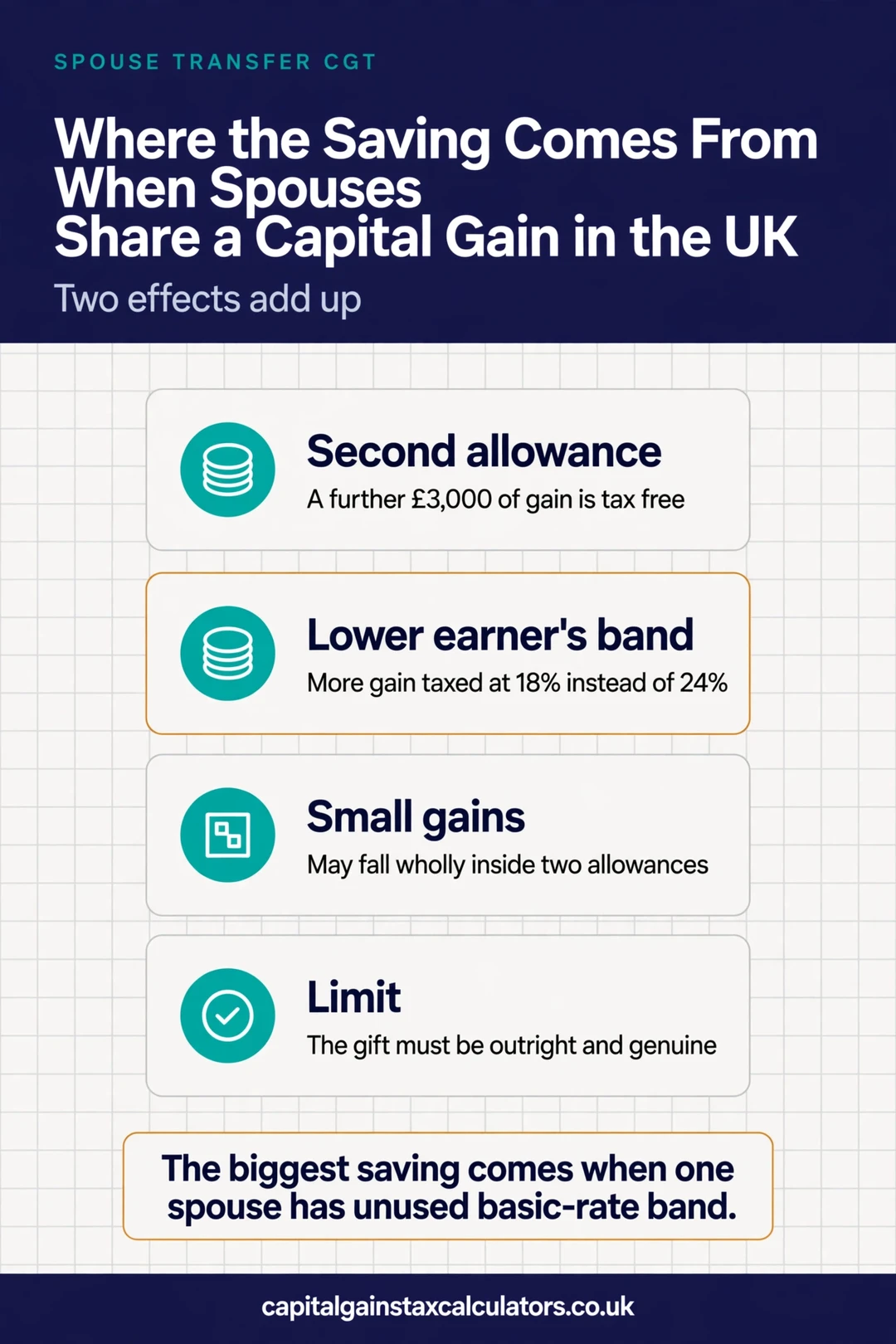
There are two separate effects. The first is the second £3,000 allowance, which exists whenever a gain is shared. The second is the basic rate band of the lower earner, which lets more of the gain be taxed at 18%. When both of you pay the higher rate, only the second allowance helps. When both gains are small enough to be covered by two allowances, sharing removes the tax entirely. A gain of £6,000 shared equally leaves each of you with £3,000, exactly the allowance, so the tax is £0.
| Situation | Effect of sharing | Typical saving |
|---|---|---|
| Both pay the higher rate | Second allowance only | Up to £720 |
| One pays the higher rate, one pays the basic rate | Allowance and lower rate on some gain | Often hundreds to thousands of pounds |
| One has no income | Allowance and full basic rate band | Largest saving |
| Gain is under two allowances | Whole gain is covered | Whole tax bill |
Rules you must follow
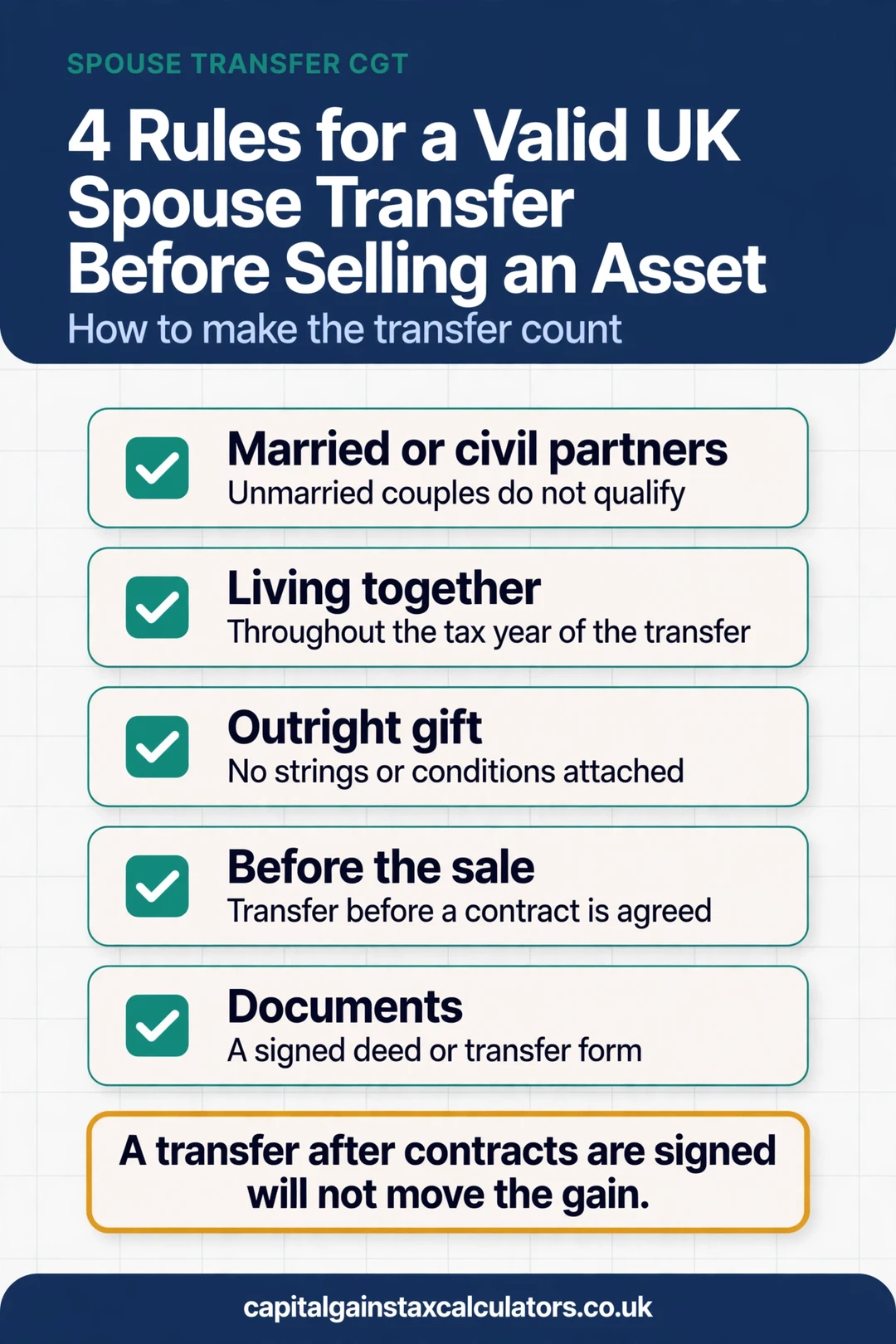
HMRC accepts transfers between spouses as no gain, no loss if you are living together and the gift is genuine. It will not accept an arrangement where the spouse is only a nominee, or where you keep the benefit of the money. The transfer must happen before you agree the sale terms. A paper trail, such as a deed of gift for property or a stock transfer form for shares, supports the transfer.
Transferring property also has other effects. You must consider Stamp Duty Land Tax if the property has a mortgage that your spouse takes on, and the effect on the mortgage lender’s consent. If the asset produces income, such as rent or dividends, the income follows the ownership, which can change your Income Tax and any means-tested benefits. For rental property, the default is an equal split of income for jointly owned property, unless you make a declaration.
When the transfer does not help
Sharing does not help much when you both pay the higher rate and have already used your allowances on other gains. It also does not help when your spouse has large losses that are better used elsewhere or when you do not intend to give up ownership. It can be counterproductive if the relationship is under strain, because the asset is then legally theirs. If you are separating, see our divorce guide, which explains the extra time you have for no gain, no loss transfers.
What this calculator does not cover
- Transfers that are not outright, such as a gift with strings attached.
- Gains by couples who are not married or in a civil partnership.
- Income Tax changes on the asset’s income after the transfer.
- Stamp Duty Land Tax on transfers with a mortgage.
- Gains where one spouse has losses brought forward.
Common mistakes with spouse transfers
- Transferring after agreeing a sale. HMRC can treat the transfer as ineffective.
- Keeping the money. The proceeds must belong to the spouse who sold.
- Forgetting the income effect. Rent and dividends move with ownership.
- Not recording the transfer. A deed or transfer form is evidence.
- Assuming it works for partners who are not married. Only spouses and civil partners qualify.
- Ignoring the 60-day deadline. Each of you must report your own share.
What to do next
- Work out the gain with the property calculator or the shares calculator.
- Enter both incomes above and look at the best split.
- Read our spouse transfer guide for the legal steps.
- Complete the transfer before you agree the sale, and keep the paperwork.
- Each of you should report your own share and pay any tax due, as shown in our reporting guide.
Frequently asked questions
Is a transfer to my spouse taxable?
No. If you are married or in a civil partnership and living together, the transfer is no gain, no loss. Your spouse takes over your original cost and date of purchase.
Can I use both of our allowances on one asset?
Yes, if you each own a share when it is sold. You each have a £3,000 allowance and can set it against your share of the gain.
How does a spouse transfer reduce tax?
It lets a gain be split, so two allowances are used, and more of the gain can be taxed at 18% if one of you has a lower income.
Does the transfer have to be before the sale?
Yes. You should complete the transfer before you agree to sell, because HMRC may disregard a transfer made after a binding contract.
Can I keep control of the asset after transferring it?
No. The gift must be outright and unconditional. If you keep the benefit of the asset or the sale money, the transfer may not be effective for tax.
Does it work for unmarried couples?
No. The no gain, no loss rule only applies to spouses and civil partners. A gift to a partner who is not your spouse is a disposal at market value.
What about Stamp Duty Land Tax?
A transfer of a mortgaged property may trigger Stamp Duty Land Tax if your spouse takes on the debt. Check this before you transfer.
What is the best split?
It depends on your incomes. Often it is to give the lower earner enough of the gain to fill their basic rate band and use their allowance. The calculator tests every percentage.
What happens to the cost after the transfer?
Your spouse takes over your original cost and the date you acquired the asset. Their gain on a later sale is measured from that cost.
Is this tax avoidance?
Using the spouse exemption and both allowances is standard tax planning when the transfer is genuine. It becomes a problem if the arrangement is a sham or the asset is not really given away.
Official sources
- GOV.UK: Capital Gains Tax: spouses and civil partners
- HMRC Capital Gains Manual: Transfers between spouses
- GOV.UK: Capital Gains Tax rates
Related guides and calculators
This page gives general information for UK taxpayers and is not tax advice. Capital Gains Tax rules can change and your own circumstances matter. Check the latest rules on GOV.UK or with a qualified tax adviser before you act.