Quick answer
You do not pay Capital Gains Tax when you inherit a property. Tax can arise when you, or the estate, sell it. The cost is the property’s market value at the date of death, normally the probate value, so growth before death is not taxed. Gains above the £3,000 allowance are taxed at 18% or 24% for beneficiaries, and 24% for personal representatives. A UK residential sale with tax due must be reported within 60 days.
Key facts
- Inheriting a property is not a taxable event for Capital Gains Tax.
- Your cost is the value at the date of death, not the original purchase price.
- Beneficiaries pay 18% or 24%. Personal representatives pay 24%.
- Personal representatives have the £3,000 allowance for the tax year of death and the next two tax years.
- Report and pay within 60 days of completion if there is tax on UK residential property.
- Inheritance Tax is separate and may also apply to the estate.
Good to know
Estimate the tax
Use our inherited property calculator with the probate value to work out the gain and the tax.
When tax arises on inherited property
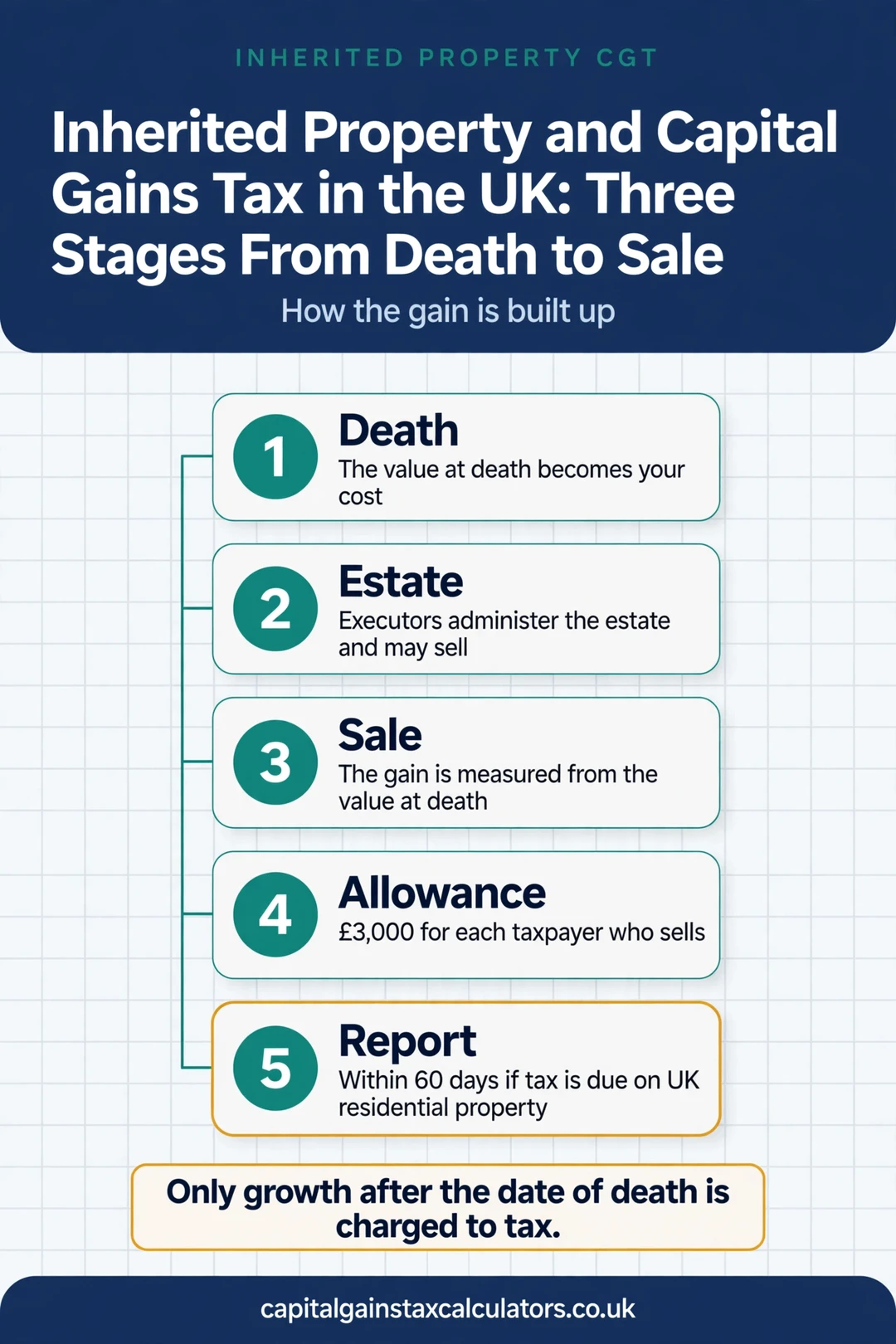
The tax is not charged because you inherited something. It is charged when someone sells or otherwise disposes of the property for more than its value at the date of death. If the property is sold by the personal representatives before it passes to the beneficiaries, the estate pays the tax. If it is transferred to a beneficiary first, the beneficiary pays when they later sell.
There are three common stages: the date of death, the period when the estate is being administered, and the sale. Each affects the tax. Understanding who owns the property at the time of sale tells you who reports and who pays.
The cost of an inherited property
The cost of the property for Capital Gains Tax is its market value on the date of death. That figure is usually the probate value used for Inheritance Tax. If the estate was an excepted estate and no formal valuation was filed, you need a valuation as at the date of death, from a surveyor or by comparing sales of similar homes. Keep a copy of the valuation as evidence.
The original purchase price that the person paid is not relevant. If the deceased bought the house for £60,000 many years ago, the gain before death is not taxed, whether or not Inheritance Tax applied. This is often called the “uplift” in value. It is one of the most valuable rules for inherited assets.
Worked example
A beneficiary sells an inherited house
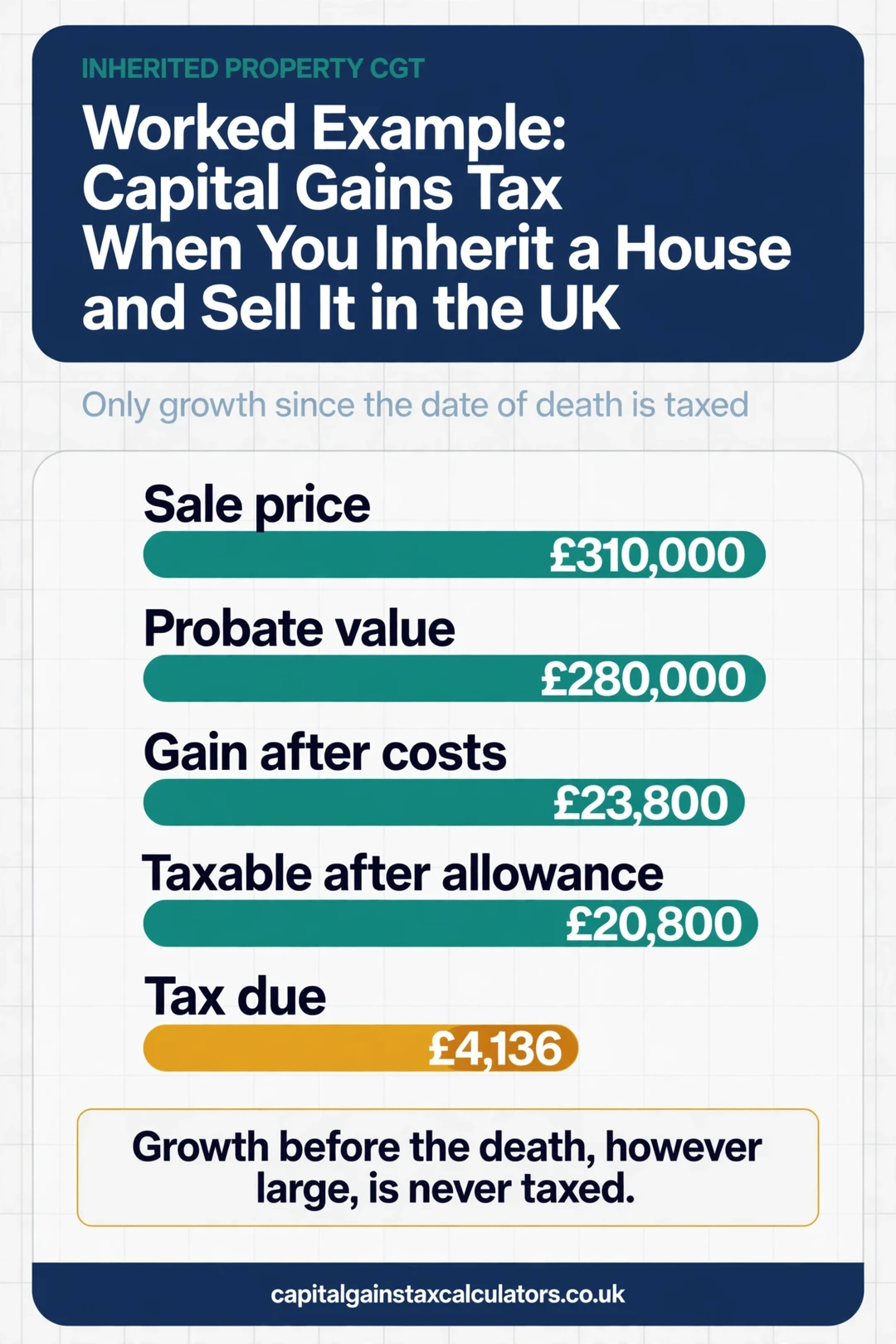
The probate value is £280,000. You sell for £310,000 with £6,200 of selling costs. Your income is £36,000.
- Gain: £310,000 less £6,200 less £280,000 = £23,800.
- After the allowance: £20,800 is taxable.
- Tax: £14,270 at 18% and £6,530 at 24% = £4,136.
If the property is sold for less than the probate value, there is a loss. A sale for £255,000 gives a loss of £31,200, which you can report and use against future gains.
Personal representatives versus beneficiaries
| Point | Personal representatives | Beneficiaries |
|---|---|---|
| Who sells | The executor or administrator | The person who inherited |
| Rate | 24% | 18% or 24% |
| Allowance | £3,000 for the tax year of death and the next two | £3,000 each year |
| Cost | Value at date of death | Value at date of death, passed to them |
| Who reports | The personal representatives | The beneficiary |
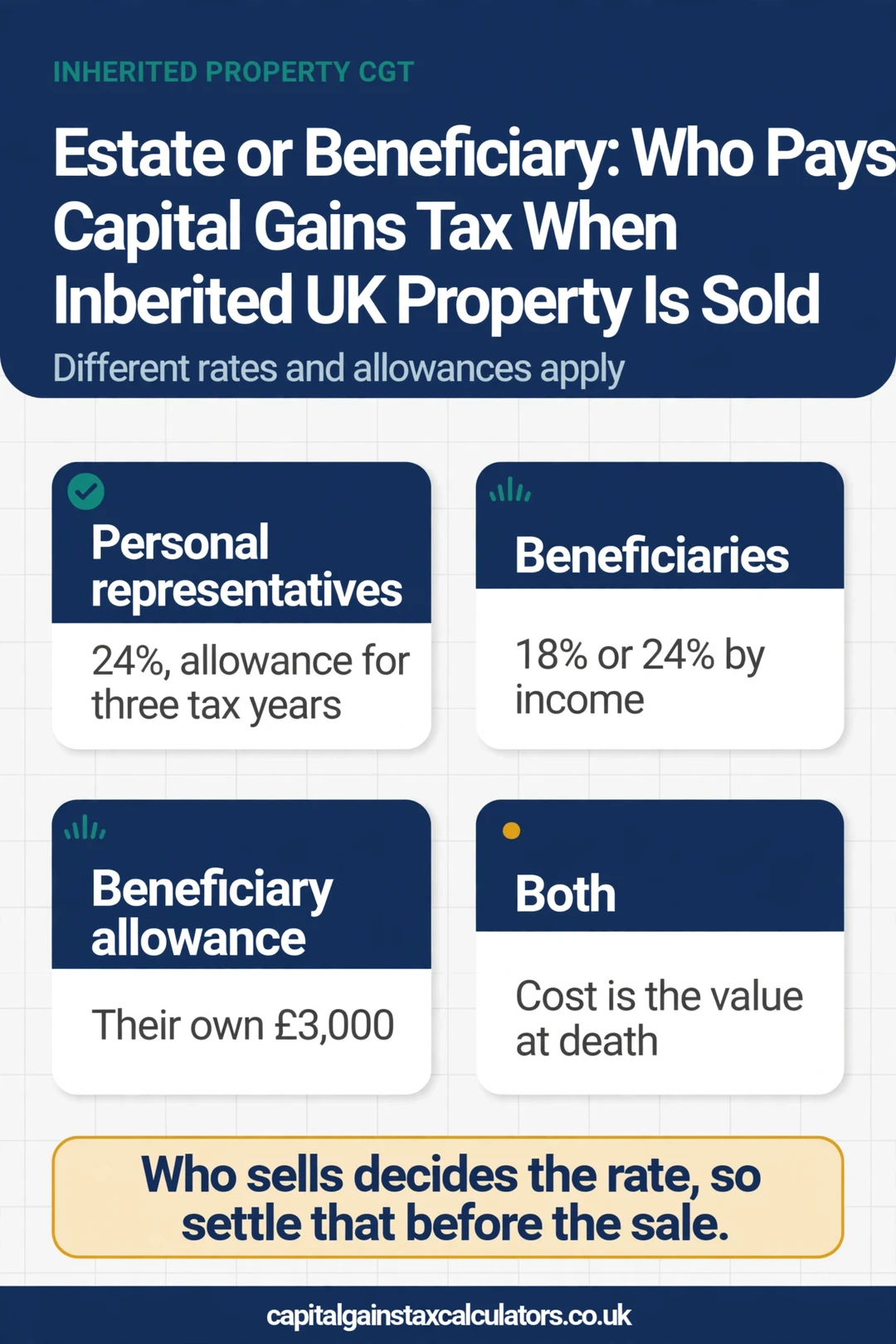
On the same sale, the estate would pay £4,992 within the allowance window and £5,712 outside it. The beneficiary pays £4,136 on an income of £36,000. Which route is better depends on the other income of the beneficiaries, so it can be worth discussing with the executor and an adviser before the property is sold. For more, see our guide to trusts and estates.
Several beneficiaries
If the property is left to more than one person, each is treated as owning a share. Each reports their share of the gain, uses their own allowance and pays at the rate set by their own income. If three siblings sell an inherited house, a gain of £23,800 is split three ways, and each has a gain of about £7,933. With one allowance each, much of the gain may be covered. If one sibling has a high income, they may pay at 24% on their share while the others pay at 18%.
Costs you can deduct from an inherited property gain
You can reduce the gain with the costs of valuing, improving and selling the property. Costs of running the property while it was empty are not deductible.
| Cost | Deductible? | Notes |
|---|---|---|
| Probate or date-of-death valuation | Yes | Needed to set your cost |
| Estate agent and legal fees on the sale | Yes | Disposal costs |
| Capital improvements after the death | Yes | Extension, new roof or similar |
| Repairs and redecoration | No | Treated as running costs |
| Council tax, insurance and utilities while empty | No | Running costs |
| Mortgage or loan interest | No | Financing costs |
Planning the timing matters too. If the property is likely to rise in value, a quick sale by the personal representatives uses the estate’s allowance but pays 24% on the gain. A sale after the property has passed to the beneficiaries may use their lower rate bands. If it is likely to fall in value, selling quickly may reduce a loss, but you should weigh the tax against the market risk. Holding the property through the estate for a long time can also lose the estate’s allowance after the second tax year following death.
Living in the inherited property
If you move into an inherited property and make it your main home, Private Residence Relief covers the time you live there, plus the final 9 months. Moving in purely to avoid tax is unlikely to satisfy HMRC, but a genuine move is fine. If you let it out, you pay tax on the gain for the period it is not your main home. Read our Private Residence Relief guide.
The 60-day rule and reporting
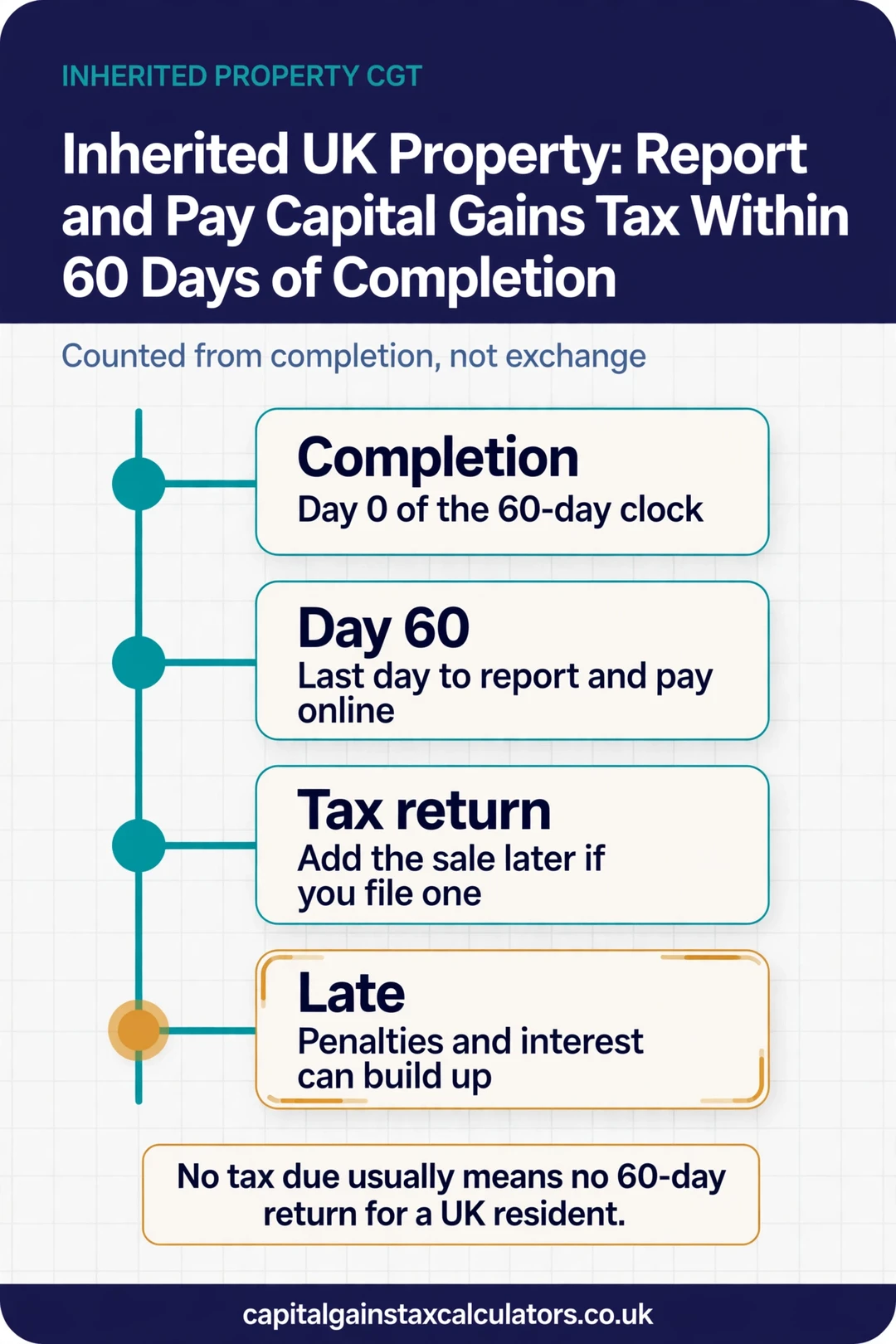
If you or the estate sell UK residential property and there is tax to pay, the gain must be reported and the tax paid within 60 days of completion. Personal representatives use the same return, but they cannot pay through the online account for the estate and should follow the payment instructions provided. If you are a beneficiary and file Self Assessment, you must also report the gain on your return. Residents with no tax to pay do not need the 60-day return. Our reporting guide for property sales has the steps, and our 60-day deadline calculator shows the date.
Inheritance Tax and Capital Gains Tax together
Inheritance Tax is charged on the estate at death and is separate from Capital Gains Tax. A property can be subject to both. The value taken for Inheritance Tax becomes the cost for Capital Gains Tax, so there is no double charge on the same growth. If Inheritance Tax was paid on the property, the amount of tax is not deductible from the gain. If property is left to a spouse or civil partner, no Inheritance Tax arises, and no Capital Gains Tax arises, but the spouse takes the property at its value at the date of death.
Records to keep
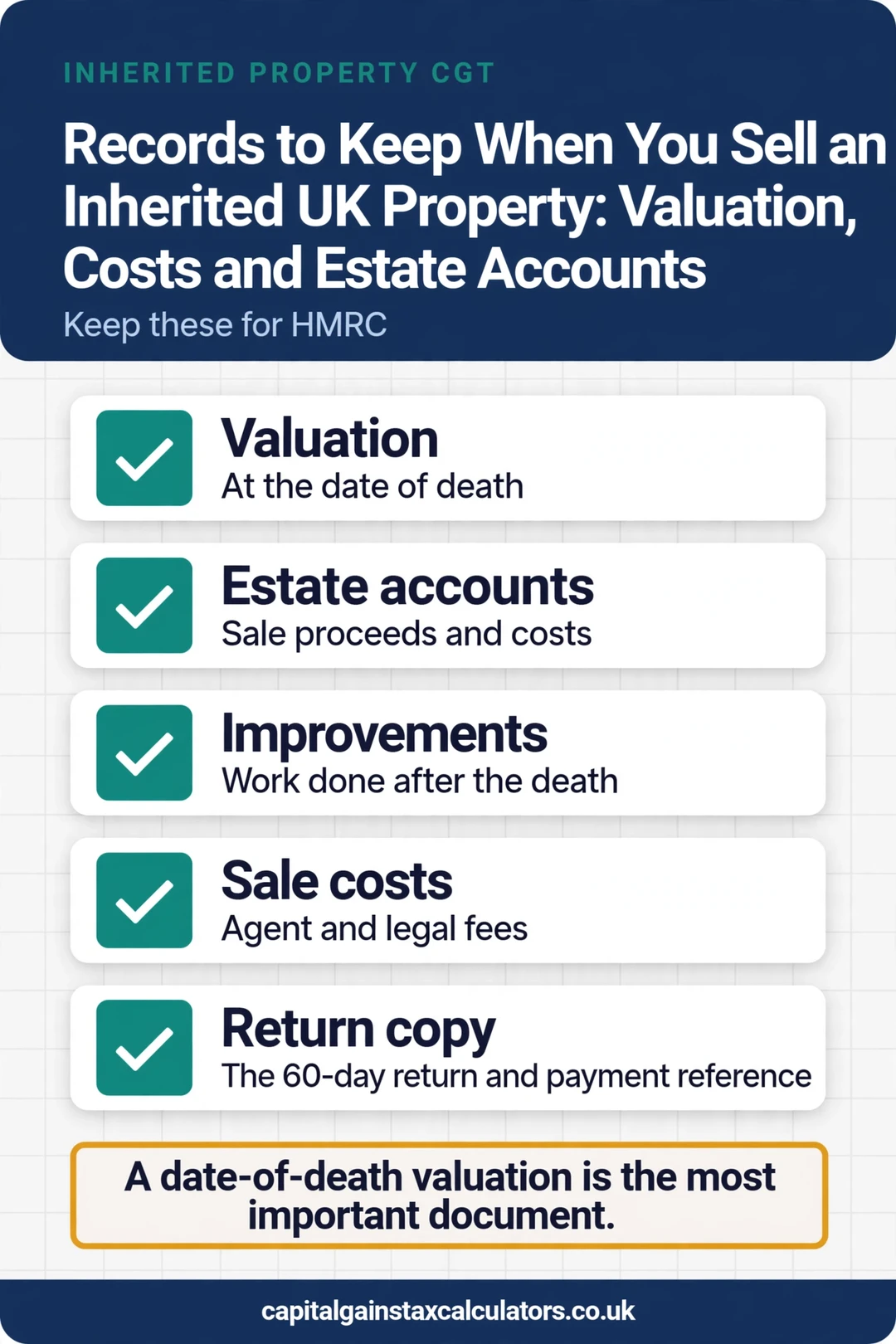
- The probate valuation or a date-of-death valuation.
- The estate accounts showing the sale and the costs.
- Invoices for improvements made after the death.
- Sale documents and legal and agent invoices.
- Evidence of the dates you lived in the property, if you claim relief.
Common mistakes with inherited property
- Using the original purchase price. The cost is the value at death.
- Forgetting the estate’s allowance window. It lasts three tax years.
- Not reporting a taxable sale within 60 days. Late reporting brings penalties.
- Ignoring shared ownership. Each beneficiary reports their own share.
- Mixing up Inheritance Tax and Capital Gains Tax. They are different taxes.
- Claiming relief without living there. The home must be your main residence.
What to do next
- Find the probate or date-of-death value.
- Estimate the gain and tax in the calculator.
- Decide with the executor whether the estate or the beneficiaries should sell.
- Report and pay within 60 days using our reporting guide.
Frequently asked questions
Do I pay Capital Gains Tax if I inherit a house?
No. You pay only when you sell it, and only on the gain above its value at the date of death.
What is the cost of an inherited property?
Its market value on the date of death, normally the probate value. The price the deceased originally paid is not used.
What rate applies to an inherited property sale?
Beneficiaries pay 18% or 24%, depending on income. Personal representatives pay 24%.
How long does an estate have its allowance?
For the tax year of death and the next two tax years, the estate has the £3,000 allowance. After that it has none.
Do I have to report an inherited property sale?
Yes, within 60 days if there is Capital Gains Tax to pay on UK residential property. Otherwise, report on Self Assessment if your total proceeds are over £50,000.
What if I sell for less than the probate value?
You have a loss. Report it to HMRC within 4 years of the end of the tax year to carry it forward.
Can I deduct the costs of the probate?
The costs of valuing the property and selling it can be deducted. General estate administration costs are not usually a cost of the property.
What if the inherited property was my parents’ main home?
Their relief does not pass to you. You can claim relief only for the time it is your own main home.
What if there are several beneficiaries?
Each is treated as owning a share, reports their own gain, and uses their own allowance and rate.
Is Inheritance Tax deductible from the gain?
No. The Inheritance Tax value sets your cost, but the tax paid is not a deduction.
Official sources
- GOV.UK: Tax on property you inherit
- GOV.UK: Report and pay Capital Gains Tax on UK property
- GOV.UK: Capital Gains Tax rates
Related guides and calculators
This page gives general information for UK taxpayers and is not tax advice. Capital Gains Tax rules can change and your own circumstances matter. Check the latest rules on GOV.UK or with a qualified tax adviser before you act.