Quick answer
You pay Capital Gains Tax on shares, funds and investment trusts when you sell them outside an ISA or pension and your total gains for the tax year are above £3,000. The gain is the sale proceeds less the cost of the shares and your dealing costs. If you bought at different times, HMRC uses pooled average cost, with special same-day and 30-day rules. The rates are 18% and 24% for 2026/27.
Key facts
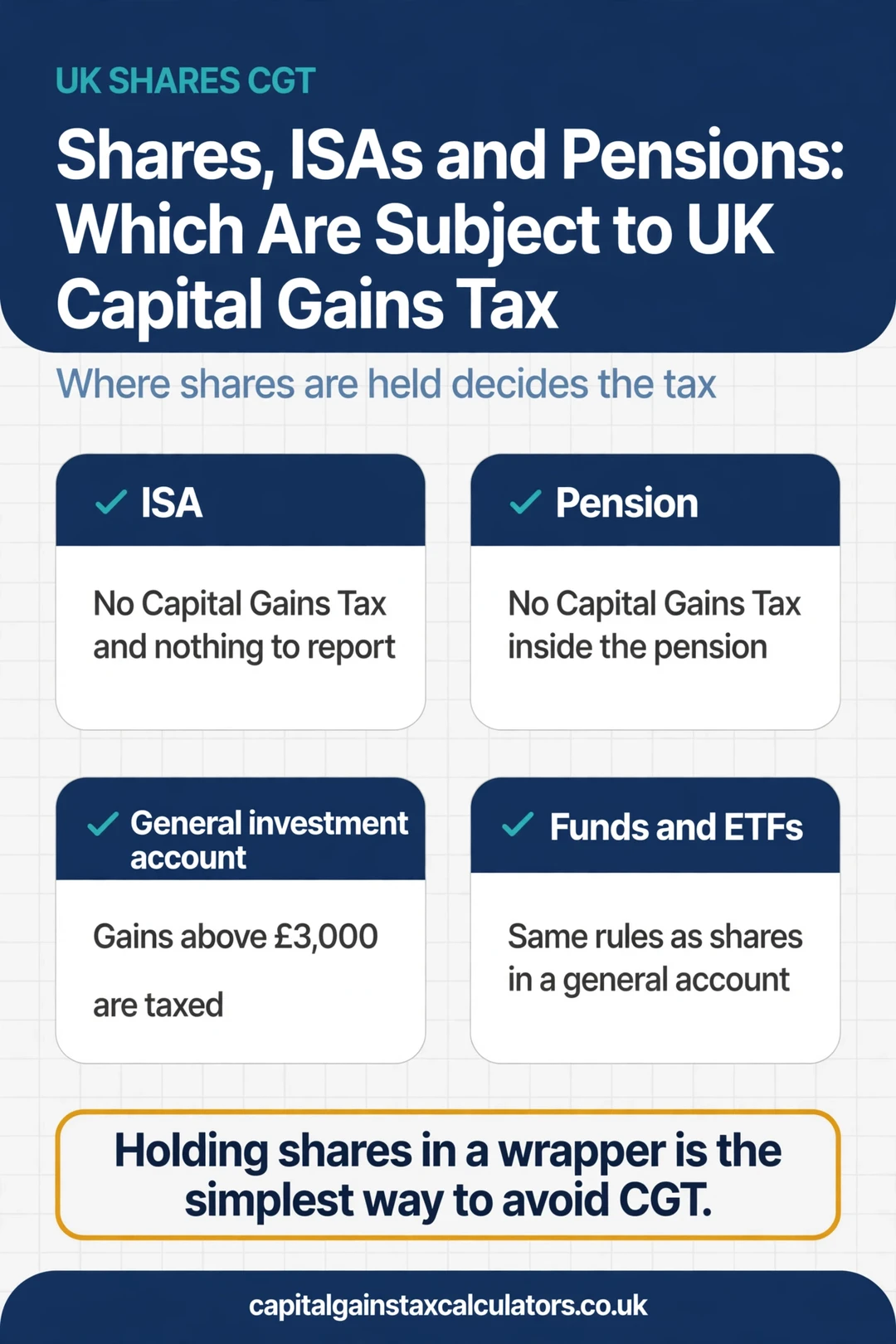
- Shares in an ISA or pension are free of Capital Gains Tax. Shares in a general investment account are not.
- The rates for 2026/27 are 18% and 24%, after a £3,000 allowance.
- Cost is pooled: HMRC uses the average cost of all your shares of the same type, not the last one you bought.
- Buying back within 30 days of a sale triggers the 30-day rule.
- Dividends are Income Tax, not Capital Gains Tax.
- You must report share sales if your total proceeds are over £50,000 and you file Self Assessment.
Good to know
Run your numbers
Use our shares Capital Gains Tax calculator for a single sale, or the Section 104 pool calculator if you bought at different times.
When tax applies to shares
A gain arises when you sell shares for more than they cost. Giving them away, swapping them for other shares in some cases, and receiving cash on a takeover can also be disposals. Holding shares, receiving dividends and reinvesting dividends do not create a Capital Gains Tax charge, although dividends are subject to Income Tax.
| Where the shares are held | Capital Gains Tax? | Notes |
|---|---|---|
| Stocks and shares ISA | No | Gains are exempt and not reported |
| Pension (SIPP or workplace pension) | No | Growth is not charged to Capital Gains Tax |
| General investment account | Yes | Gains above the allowance |
| Directly held shares (certificates) | Yes | Same rules |
| Employee share scheme shares | Depends | May have an Income Tax charge first |
| Shares in a company you own | Yes | Business Asset Disposal Relief may apply |
Funds and investment trusts follow the same rules as individual shares. Gilts and most corporate bonds that are qualifying corporate bonds are exempt, but some bonds and funds that hold them are not. Check the fund factsheet if you are unsure.
How the gain on shares is calculated
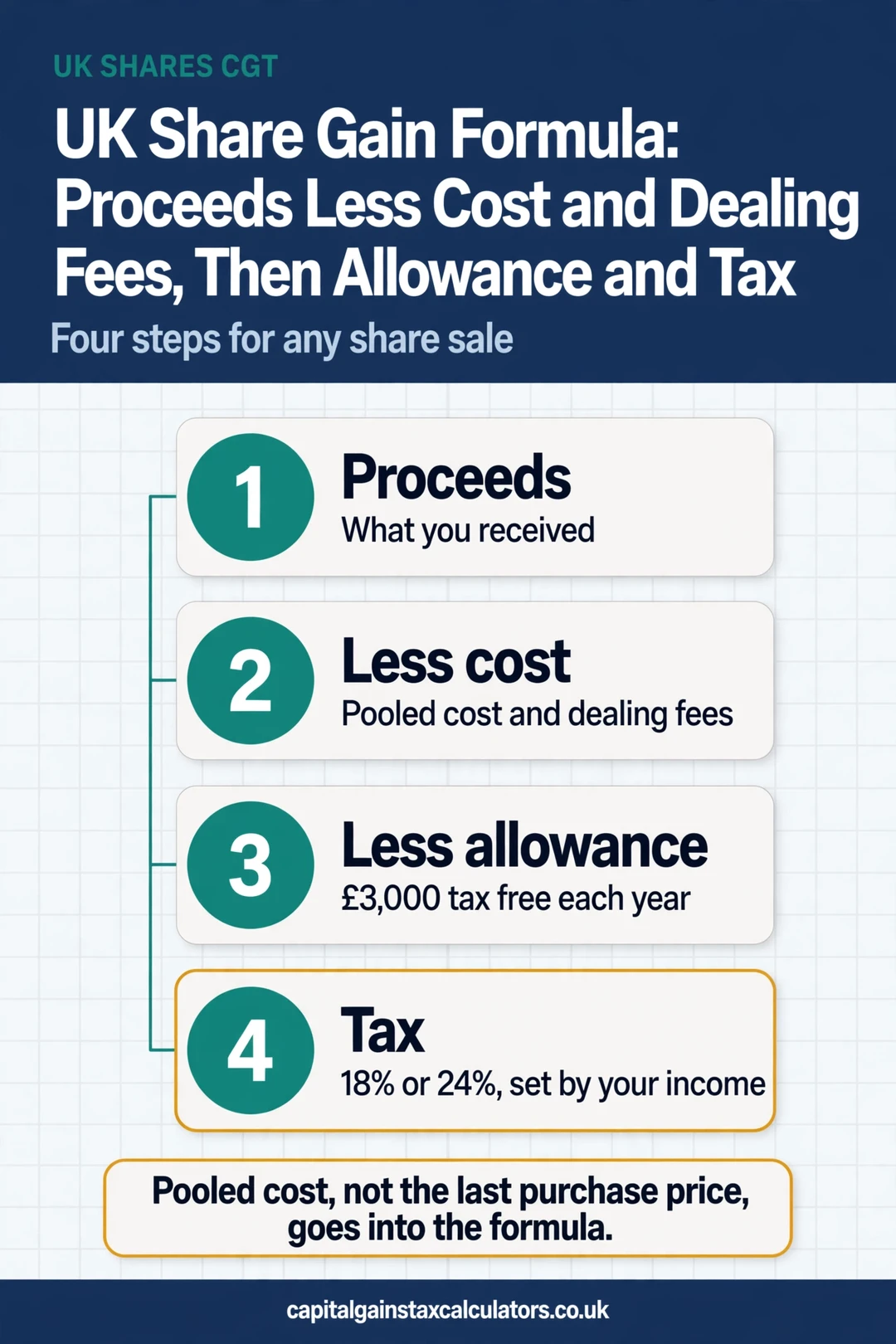
Take the sale proceeds, deduct the cost of the shares, and deduct the dealing costs on both the purchase and the sale. Stamp duty on UK shares is part of the cost. The result is the gain or loss. A sale for £60,000 of shares that cost £25,000, with £100 of dealing costs each way, gives a gain of £34,800. After the allowance, £31,800 is taxed. On an income of £40,000, the tax is £7,016. A sale for £8,000 of shares that cost £12,000 creates a loss of £4,000, which you can report and use against other gains.
Share pooling: which cost do you use?
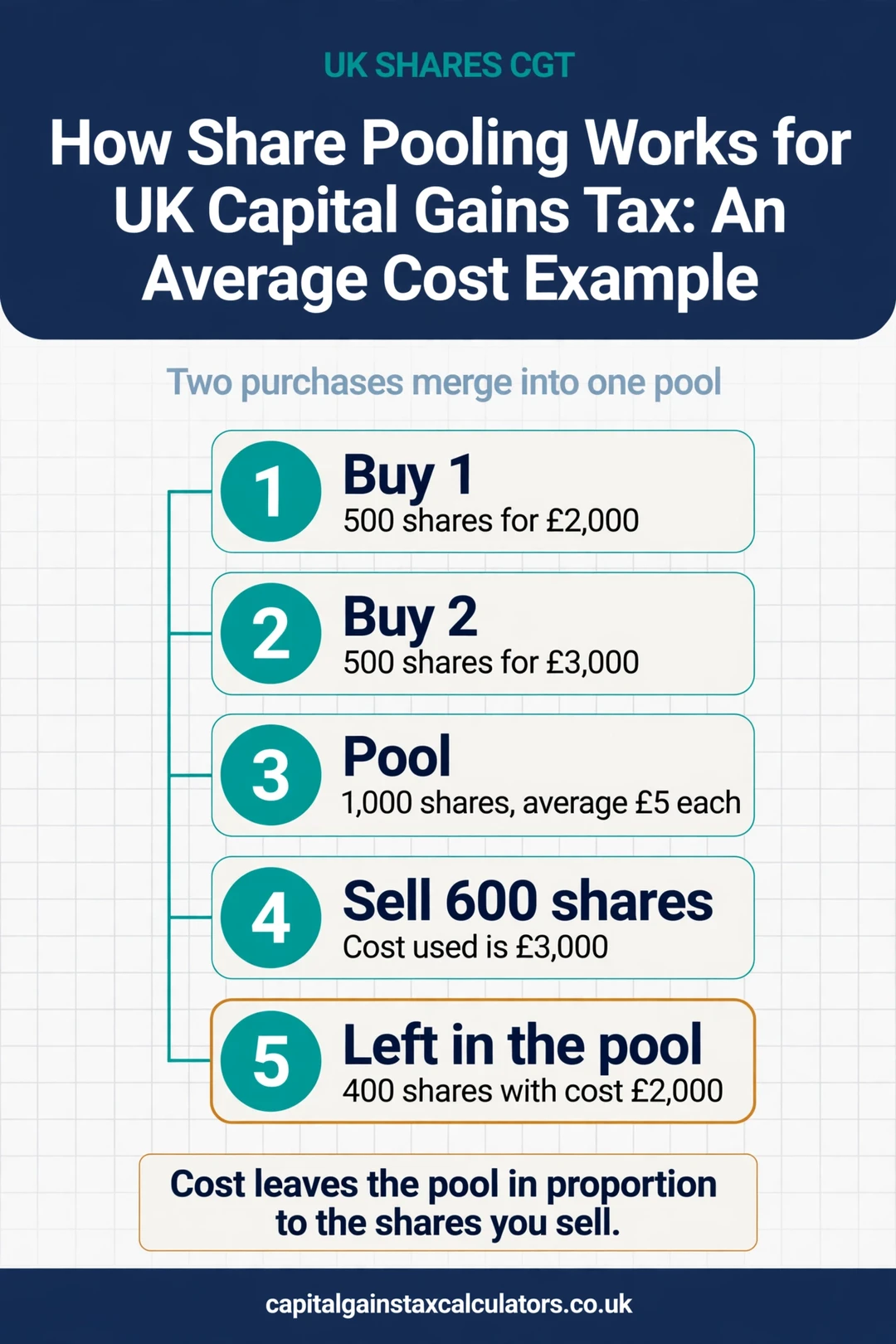
If you buy shares of the same company at different times, you cannot choose the cost of a particular purchase. HMRC combines them in a pool, known as the Section 104 holding, and uses the average cost. Before the pool applies, two special rules match a sale with purchases close in time. The same-day rule comes first, then the 30-day rule, and only then the pool.
Worked example
Selling from a pool
You bought 500 shares for £2,000 and later another 500 for £3,000. You sell 600 shares for £4,500.
- Pool before the sale: 1,000 shares with a cost of £5,000, which is £5 per share.
- Cost of 600 shares: £3,000.
- Gain: £4,500 less £3,000 = £1,500.
- Left in the pool: 400 shares with a cost of £2,000.
- Tax on an income of £40,000: £0, because the gain is inside the allowance.
Our Section 104 calculator builds the pool for you from a list of trades. The bed and breakfast rule guide explains the 30-day rule.
Dividends, reinvestment and accumulation units
Dividends are income and are taxed under the Income Tax dividend rules, not as gains. If your dividends are reinvested to buy more shares, the reinvested amount is a purchase and adds to your pool at the price paid. For accumulation units in a fund, the income the fund reinvests has already been taxed as income, so it is added to your cost and reduces the gain on sale. Keep the annual statement from the fund manager showing the reinvested amounts.
Corporate actions: splits, takeovers and rights issues
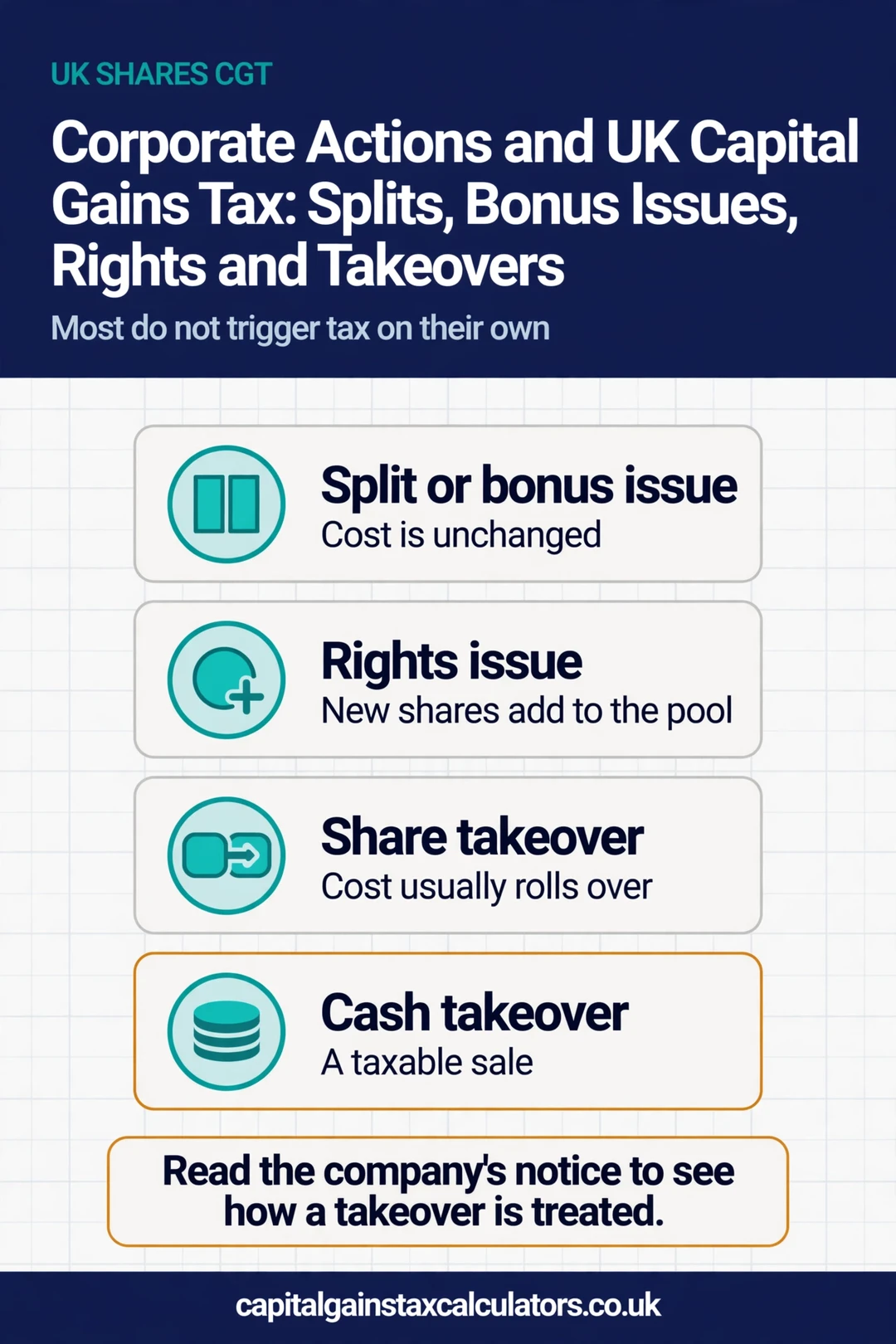
Companies sometimes change the structure of the shares you hold. The tax effect depends on the type of action.
| Event | Effect on your cost | Tax at the time? |
|---|---|---|
| Share split or consolidation | Total cost stays the same, spread over a new number of shares | No |
| Bonus (scrip) issue | Cost is spread over more shares | No |
| Rights issue | The cost of the new shares is added to the pool | No, unless you sell the rights |
| Takeover for shares in the new company | Cost passes to the new shares | Usually no |
| Takeover for cash | The cash is proceeds | Yes, gain or loss |
| Company becomes worthless | You can claim a loss | Negligible value claim |
Overseas shares and other currencies
For shares priced in another currency, convert the cost and the proceeds into pounds at the exchange rate on the date of each transaction. A gain or loss can arise partly from currency movements. Keep a record of the rate you used and its source. If you hold shares in a company outside the UK, remember that dividends may also have tax withheld at source, which affects your Income Tax, not the Capital Gains Tax calculation.
Reporting a share sale
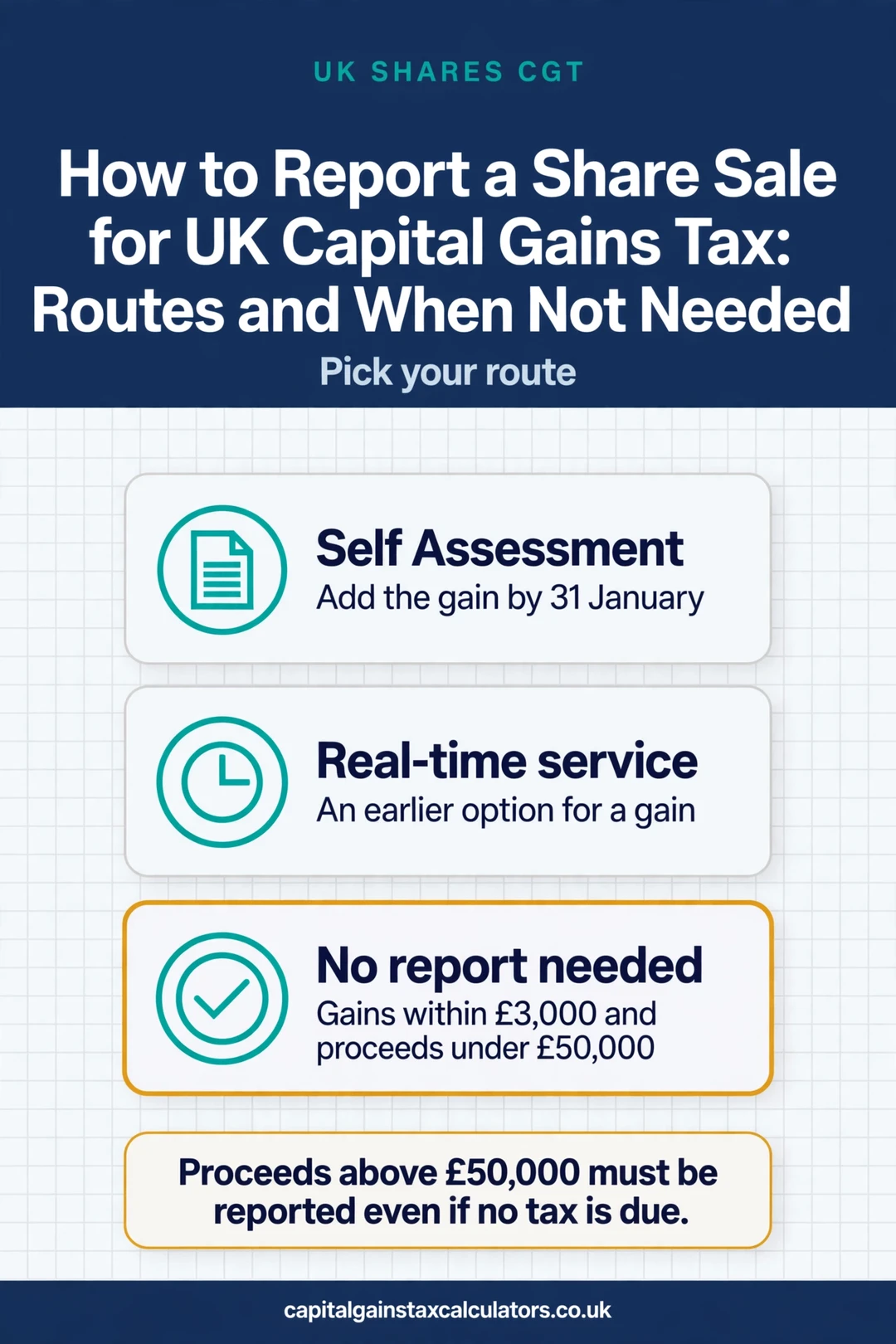
For residents, a share sale is not UK residential property, so the 60-day rule does not apply. You can report gains on your Self Assessment tax return, or you can use the real-time Capital Gains Tax service to report and pay earlier. You must report if your total proceeds are over £50,000 or if you have gains above the allowance. The deadline for the tax return is 31 January after the end of the tax year. Our reporting guide covers both routes.
Ways to reduce the tax on shares
- Hold investments in ISAs and pensions where gains are tax free.
- Use your allowance every year by selling a little at a time.
- Sell assets at a loss to offset gains, and report the loss.
- Transfer shares to your spouse before selling, to use two allowances.
- Avoid rebuying within 30 days if you want to realise a loss.
See our guide on how to reduce Capital Gains Tax.
Common mistakes with shares
- Using the cost of the last purchase. HMRC uses the pooled average.
- Ignoring the 30-day rule. A rebuy changes the matched cost.
- Not reporting losses. They can only be carried forward if reported.
- Treating dividends as gains. They are income.
- Forgetting reinvested income in funds. It can add to cost.
- Using the wrong currency. Convert to pounds on the date of each trade.
What to do next
- Download your transaction history from your broker.
- Use the Section 104 calculator or the shares calculator.
- Check losses and the allowance.
- Report using our reporting guide.
Frequently asked questions
Do I pay Capital Gains Tax on shares in the UK?
Yes, if the shares are outside an ISA or pension and your total gains for the tax year are above £3,000. The rates are 18% and 24% for 2026/27.
How do I work out my gain if I bought at different prices?
Use the Section 104 pool. The cost is the average cost of all the shares in the pool, unless the same-day or 30-day rules match the sale with a nearby purchase.
Are shares in an ISA taxable?
No. Gains inside an ISA are free of Capital Gains Tax. You do not need to report them.
Do I pay tax on dividends as Capital Gains Tax?
No. Dividends are taxed as income, with their own allowance and rates.
What is the 30-day rule?
If you buy the same shares within 30 days after selling them, the sale is matched with the purchase, not the pool, so the gain is based on the new cost.
Can I use a loss on shares?
Yes. A loss in the same tax year comes off your gains first. Losses from earlier years can be carried forward if you reported them within 4 years of the end of the tax year.
What if a company I own shares in goes bust?
You may be able to claim a negligible value loss if the shares have become worthless. The claim must be made to HMRC.
Do I need to report if my gain is under the allowance?
Only if you file Self Assessment and your total proceeds are over £50,000. You should also report a loss if you want to carry it forward.
How are overseas shares taxed?
In the same way, after converting costs and proceeds into pounds at the exchange rate on each date. Foreign tax on dividends is a separate matter.
Is there any way to avoid Capital Gains Tax on shares?
Use ISAs and pensions, your allowance, losses and your spouse’s allowance. Hiding gains is evasion, and HMRC receives data about share sales.
Official sources
- GOV.UK: Tax when you sell shares
- HMRC helpsheet HS284: Shares and Capital Gains Tax
- GOV.UK: Capital Gains Tax rates
- GOV.UK: Report and pay your Capital Gains Tax
Related guides and calculators
This page gives general information for UK taxpayers and is not tax advice. Capital Gains Tax rules can change and your own circumstances matter. Check the latest rules on GOV.UK or with a qualified tax adviser before you act.