Quick answer
When you sell a buy-to-let, you pay Capital Gains Tax on the gain, which is the sale price less what you paid and your allowable costs. The rates for 2026/27 are 18% and 24%, after the £3,000 allowance. You must report the sale and pay the tax within 60 days of completion. Mortgage interest is not a deductible cost, and the rental profit is taxed separately as income.
Key facts
- A buy-to-let is a chargeable asset, so a gain above £3,000 is taxed at 18% or 24%.
- Report and pay within 60 days of completion if tax is due.
- You can deduct buying costs, selling costs and capital improvements, but not mortgage interest or repairs.
- Private Residence Relief can cover any period when you lived there as your main home, plus the final 9 months.
- Each joint owner is taxed on their share of the gain.
Good to know
Calculate your landlord gain
Use the property Capital Gains Tax calculator and switch on the Private Residence Relief option if you ever lived in the property.
How Capital Gains Tax applies to landlords
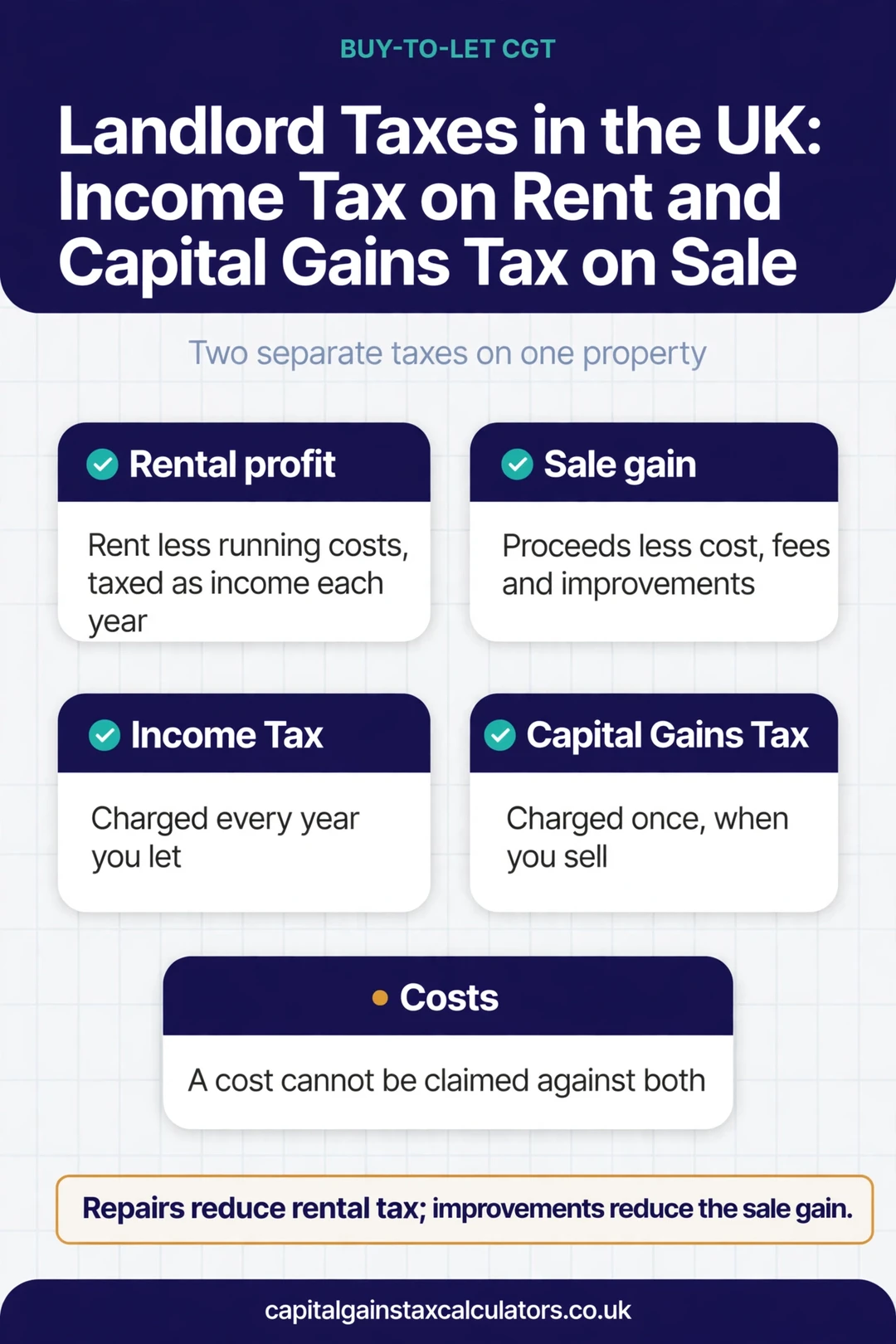
Rental profit and the sale gain are two different taxes. Income Tax is charged each year on the profit from letting. Capital Gains Tax is charged once, when you sell, on the increase in the property’s value. The two do not offset each other, although some costs of the sale are allowable against the gain.
A buy-to-let held for ten years may have risen significantly in price. Because the gain is only taxed when you sell, you control when the charge arises. That means you can plan the date of sale, the ownership between you and your spouse, and any costs you record.
Working out the gain on a buy-to-let
The calculation uses the purchase price, the costs of buying and selling, and any capital improvement.
Worked example
Selling a rental house
- Sale price: £310,000.
- Less selling costs: £5,600.
- Less purchase price: £175,000.
- Less buying costs: £7,200.
- Less capital improvements: £9,000.
- Gain: £113,200.
- After the allowance: £110,200 is taxable.
- Tax at an income of £45,000: £5,270 at 18% and £104,930 at 24%, which is £26,132.
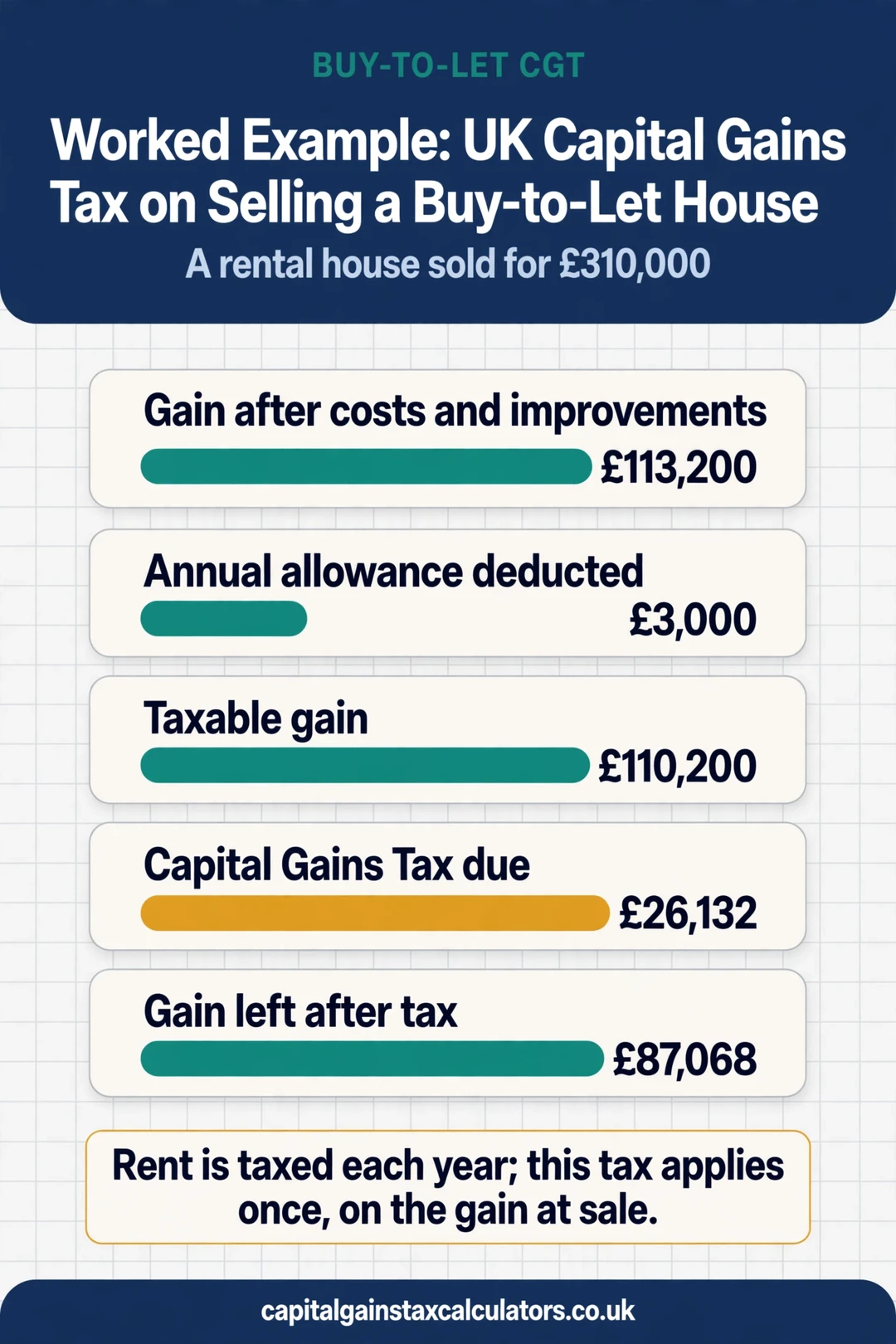
For a landlord with an income of £95,000, the entire taxable gain falls at 24%, so the tax rises to £26,448. If the property is owned equally with a spouse, each person has a gain of £56,600 and the tax falls to £12,548 for each.
What you can and cannot deduct
| Item | Deduct from the gain? | Why |
|---|---|---|
| Purchase price | Yes | Starting cost |
| Stamp Duty Land Tax, legal and survey fees on buying | Yes | Acquisition costs |
| Extension, loft conversion or new bathroom added | Yes | Capital improvement |
| Estate agent and conveyancing fees when selling | Yes | Disposal costs |
| Mortgage interest and arrangement fees | No | Not a capital cost |
| Letting agent fees, repairs, insurance | No | Claimed against rent as income expenses |
| Void periods and rental income lost | No | Income matters |
| Redecoration between tenants | No | Revenue expense |
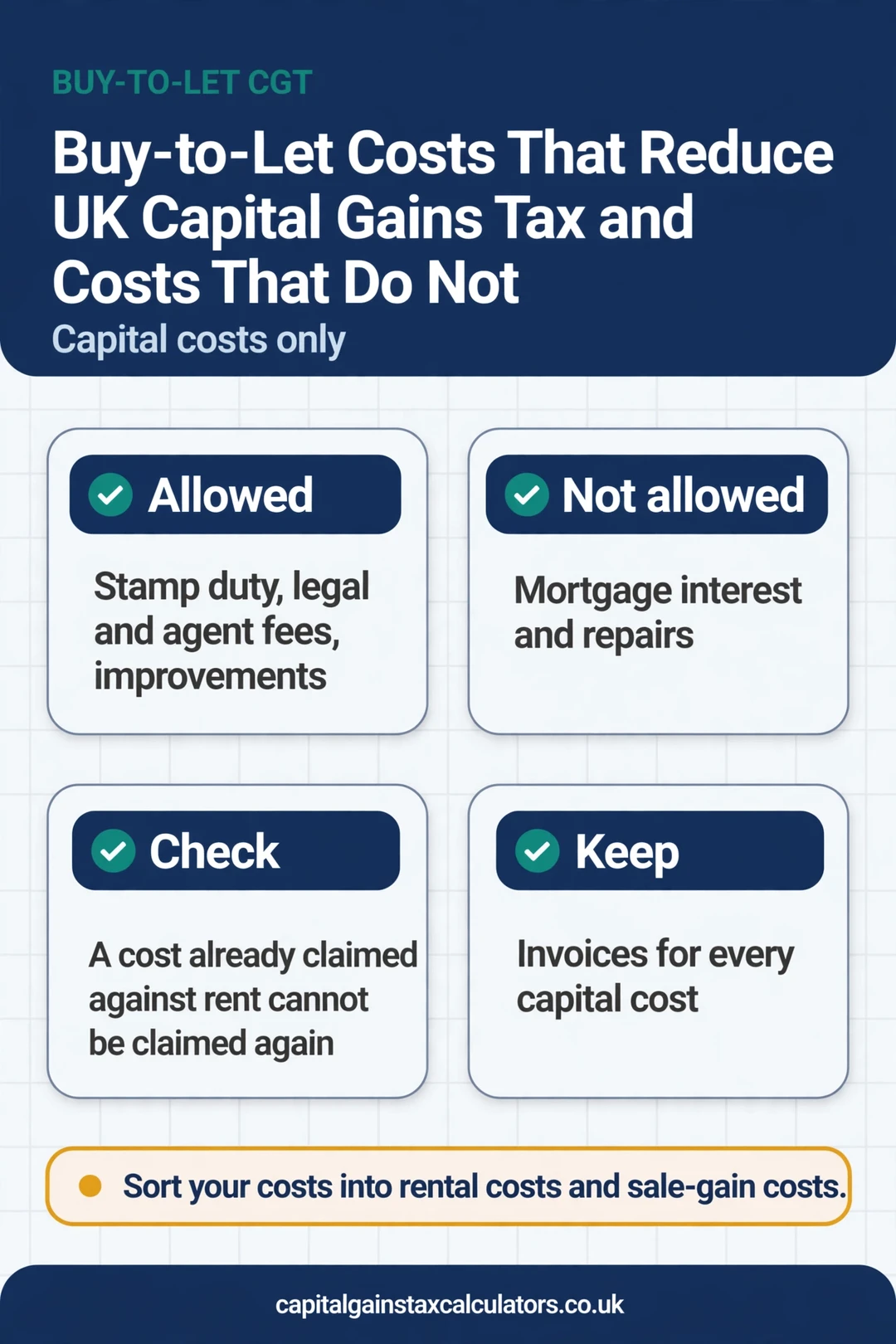
Costs that you have already claimed against rent cannot also be deducted from the gain. If you claimed a repair as an income expense, it is not also an improvement. Keep a clear record of which is which.
Relief if you once lived in the property
If you lived in the property as your main home at some point, Private Residence Relief can cover part of the gain. The relief covers the months you lived there plus the last 9 months of ownership. In our example, if the 120-month ownership included 24 months of living there, the tax falls to £18,661. Months when you were away and the property was let generally do not count unless they fall under a permitted absence. Use the Private Residence Relief calculator to test your figures.
The old letting relief has been restricted to cases where you shared the home with a tenant. A normal buy-to-let that you let out as a whole does not qualify for it.
Selling through a company or as a joint landlord
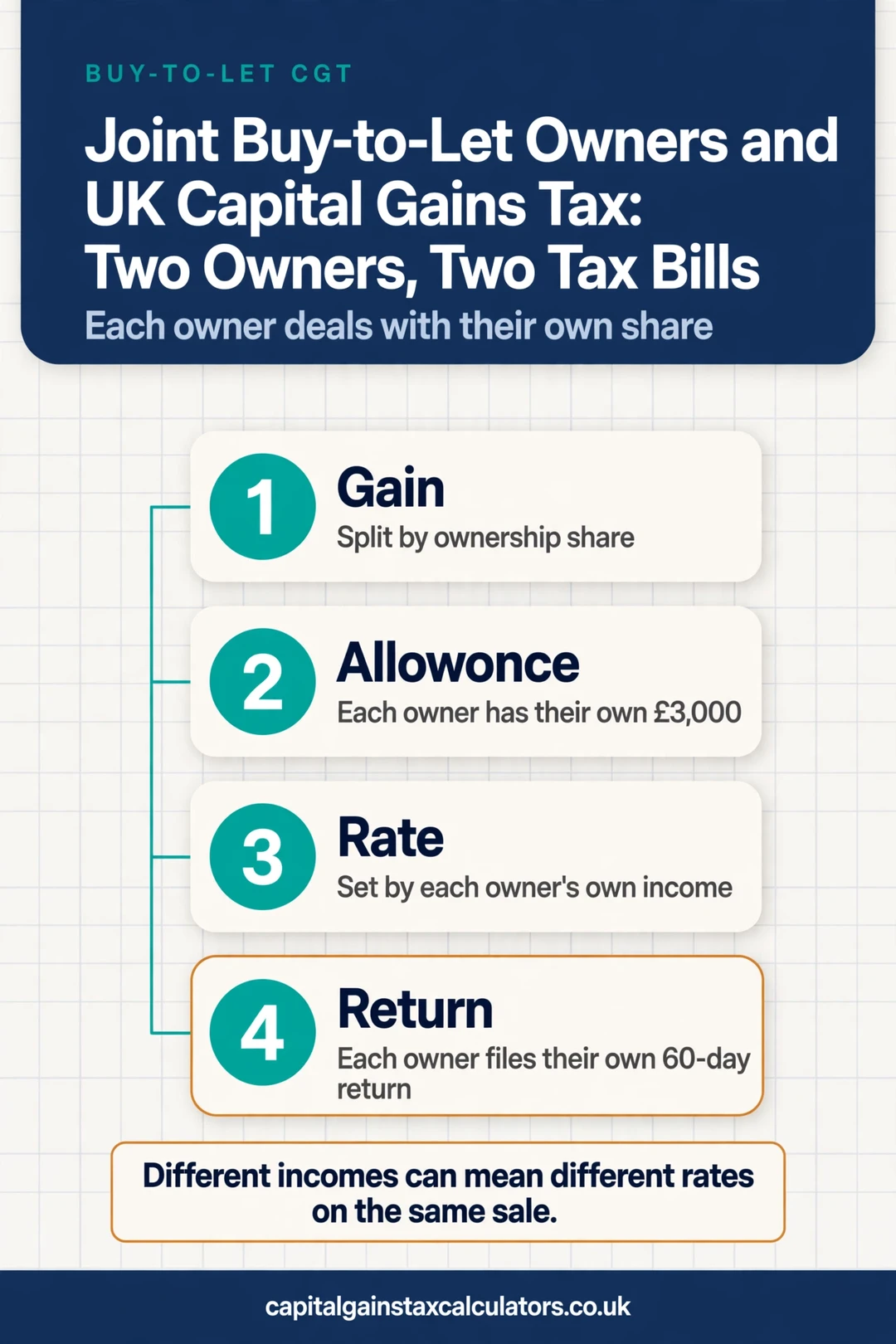
Rental properties held in a company are taxed differently. The company pays Corporation Tax on its gains, not Capital Gains Tax, and the rules are outside the scope of this guide. For properties held by individuals jointly, each owner reports their own share. Married couples and civil partners are treated as owning equal shares unless they hold the property in unequal shares and have made the appropriate declaration. This is useful where one of you earns less. Consider a transfer to a spouse before a sale to use both bands, as shown by our spouse transfer calculator.
Choosing when to sell
The tax year of a sale is set by the date of the contract, so you can decide whether the gain falls before or after 5 April. If your income will be lower in the next tax year, for example because you plan to retire or reduce your hours, more of the gain may fall inside the 18% band. If you own several properties, selling one in each tax year uses a separate allowance each time. Remember that selling with a tenant in place can affect the price, and that Income Tax on the final rent still applies. Use the sell now or wait calculator for a comparison.
Records landlords should keep
HMRC can ask for evidence of the figures you used. Keep the completion statement from the purchase and the sale, because it shows the price and the legal costs. Keep the invoices for every improvement, with a note of what was added. Keep a diary of any months you lived in the property, such as utility bills and council tax records. If you inherited the property or received it as a gift, keep the probate valuation or the market valuation on the date you received it. Keep everything for at least four years after the end of the tax year in which you report the sale, and for longer if you carry forward a loss.
What if you sell at a loss?
A buy-to-let can be sold for less than its total cost. In that case, the loss is a capital loss, and you can use it against other gains in the same tax year or carry it forward. You must report the loss to HMRC within 4 years of the end of the tax year of sale, or you lose the right to use it. A loss on a sale to a connected person, such as a relative, can only be set against gains on later sales to that same person. Our guide to Capital Gains Tax losses explains the rules.
Reporting a buy-to-let sale
Report the sale within 60 days of completion if there is tax to pay. Use a Capital Gains Tax on UK property account, enter the details of the property, the dates and the costs, and pay the tax by the same date. If you file Self Assessment, you also report the gain on your return and deduct the tax already paid. See our reporting guide.
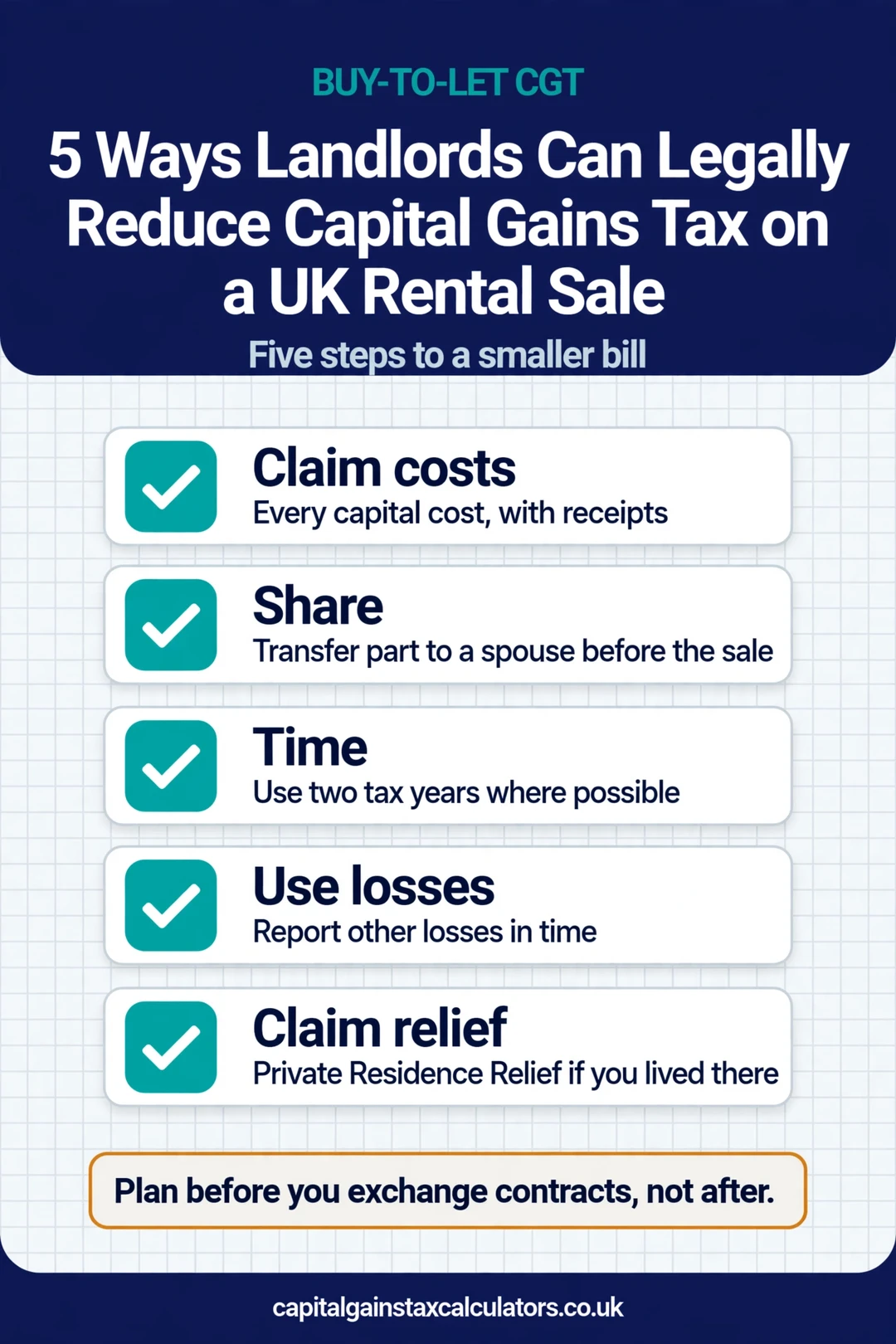
Ways landlords reduce the tax
| Method | How it helps | Watch out for |
|---|---|---|
| Claim all allowable costs | Lowers the gain | Keep receipts |
| Share ownership with a spouse | Two allowances and bands | Must be a genuine gift |
| Time the sale | Use two tax years, lower income year | Contract date decides the year |
| Offset losses | Cancel gains from other sales | Report losses within 4 years |
| Pension contributions | Widen the basic rate band | Check annual limits |
| Claim relief for time lived in | Cover part of the gain | Needs proof of dates |
Common mistakes by landlords
- Deducting mortgage interest. It is never allowable against the gain.
- Counting repairs as improvements. Only capital improvements count.
- Forgetting the deadline. Report within 60 days of completion.
- Losing records. You may need to prove costs from years ago.
- Ignoring a former home period. Relief may cover part of the gain.
- Assuming the company route is the same. Companies pay Corporation Tax.
What to do next
- Collect the purchase documents, improvement invoices and sale costs.
- Use the property calculator with your income.
- Check whether any period of owner occupation qualifies for relief.
- Report and pay within 60 days using our reporting guide.
Frequently asked questions
Do landlords pay Capital Gains Tax when they sell a buy-to-let?
Yes. You pay tax on the gain above your £3,000 allowance at 18% or 24%, depending on your income.
How long do I have to report the sale?
60 days from completion if there is tax to pay. You must report and pay in that time.
Can I deduct mortgage interest from the gain?
No. Mortgage interest is a financing cost and is not allowed. It may affect your rental Income Tax.
Can I use letting relief?
Only if you shared the home with your tenant. A normal buy-to-let that you let as a whole does not qualify.
What if I lived in the buy-to-let before renting it out?
Private Residence Relief covers the months you lived there and the final 9 months, which reduces the gain.
How do I split the gain with a spouse?
Married couples and civil partners usually own equal shares unless they have declared otherwise. Each reports their share and uses their own allowance and rate band.
Is Stamp Duty Land Tax a cost?
Yes. Stamp Duty Land Tax you paid on buying, including any higher rate for additional property, is added to the cost.
Can I reduce the tax by waiting?
You can plan around 5 April and your income. The tax year of the sale is decided by the date of the contract, so the timing can matter.
Is it different if my property is in a company?
Yes. A company pays Corporation Tax on gains, not Capital Gains Tax, and the rules are different.
What if I make a loss?
Report the loss to HMRC within 4 years of the end of the tax year of sale. You can use it against future gains.
Official sources
- GOV.UK: Tax when you sell property
- GOV.UK: Report and pay Capital Gains Tax on UK property
- GOV.UK: Private Residence Relief
- GOV.UK: Capital Gains Tax rates
Related guides and calculators
This page gives general information for UK taxpayers and is not tax advice. Capital Gains Tax rules can change and your own circumstances matter. Check the latest rules on GOV.UK or with a qualified tax adviser before you act.