Quick answer
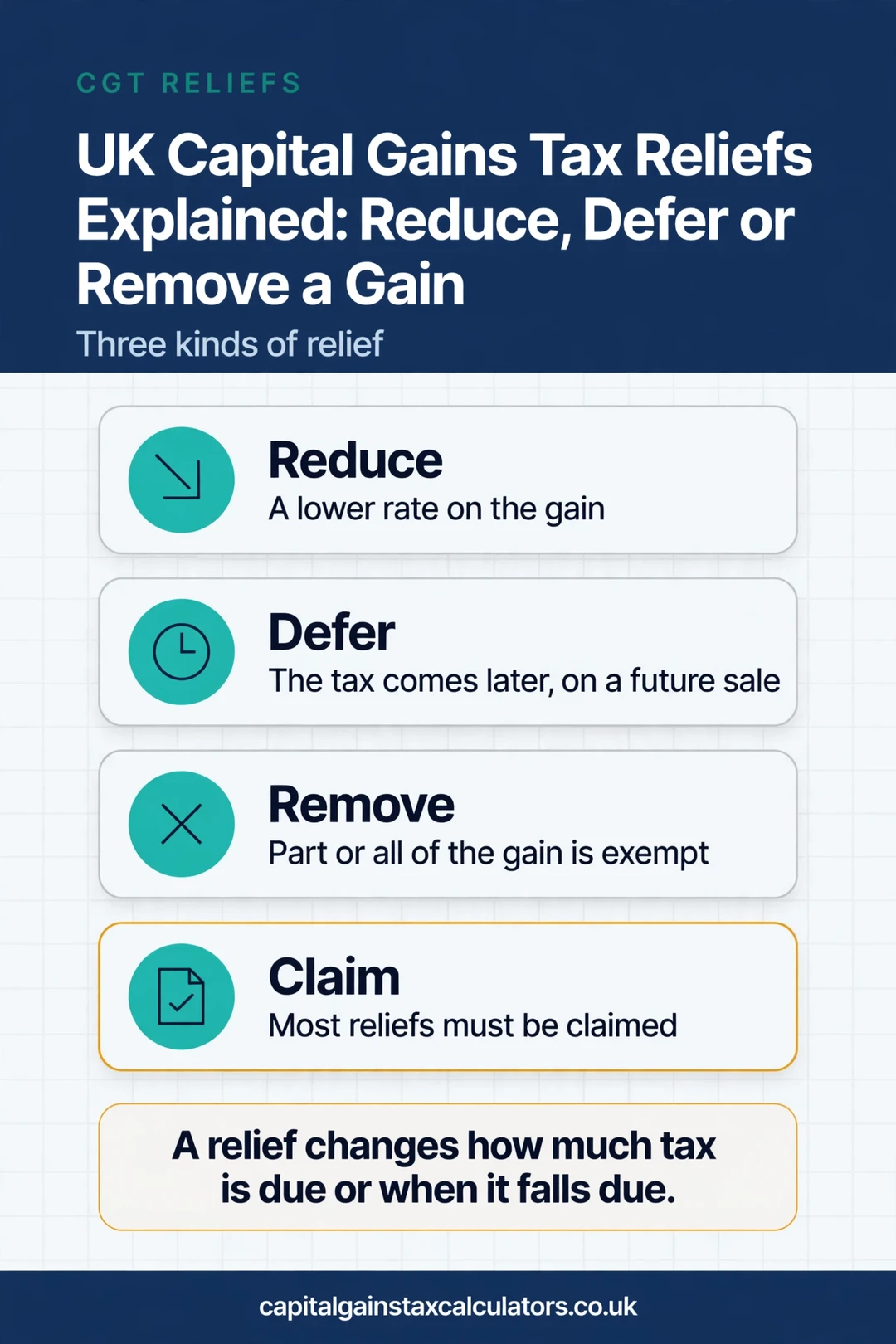
Capital Gains Tax reliefs reduce, defer or remove a gain that would otherwise be taxed. The main ones are Private Residence Relief for your main home, Business Asset Disposal Relief for selling a business at 18%, rollover relief for reinvesting business proceeds, Gift Hold-Over Relief for some gifts, and Enterprise Investment Scheme deferral. Most need conditions to be met and a claim. Reliefs are different from exemptions, which are outside the tax altogether.
Key facts
- A relief reduces, defers or removes a gain, and most need a claim.
- Private Residence Relief covers your main home. Business Asset Disposal Relief charges 18% on qualifying business gains.
- Rollover and hold-over reliefs defer the gain, so the tax may be paid later.
- Several reliefs have strict time limits for claims and reinvestment.
- Reliefs and the £3,000 allowance can be used together.
Good to know
See the effect of a relief
Use the Private Residence Relief calculator or the Business Asset Disposal Relief calculator to estimate the saving.
Relief or exemption: what is the difference?
An exemption takes an asset outside Capital Gains Tax. A relief applies to a gain that would otherwise be charged. The difference matters because most reliefs have conditions, time limits and claims, and some defer a gain rather than removing it. A deferred gain comes back into charge later, often when you sell the replacement asset. Check which kind of relief you have before you decide not to report or pay. Our guide to exemptions lists the assets that are outside the tax.
The main reliefs at a glance
| Relief | What it does | Who can claim | Claim needed? |
|---|---|---|---|
| Private Residence Relief | Exempts the gain on your main home | Anyone selling their only or main home | Usually automatic |
| Business Asset Disposal Relief | 18% rate on qualifying gains up to £1,000,000 | Owners selling a business or personal company shares | Yes |
| Investors’ Relief | Lower rate on gains on newly issued shares in unlisted companies | Outside investors | Yes |
| Rollover relief | Defers the gain on business assets by reinvesting | Business owners replacing qualifying assets | Yes |
| Gift Hold-Over Relief | Postpones the gain on a gift | Donor and recipient, jointly | Yes |
| Enterprise Investment Scheme deferral | Defers a gain by investing in qualifying companies | Investors in qualifying shares | Yes |
| Incorporation relief | Defers the gain when you transfer a business to a company for shares | Sole traders and partners | Automatic unless disapplied |
| Spouse transfers | No gain, no loss on transfers between spouses | Spouses and civil partners | No |
Private Residence Relief
This is the most common relief. It removes the gain on your only or main home, in whole or in part, depending on the months you lived there, plus the final 9 months. Read our Private Residence Relief guide and use the calculator.
Business Asset Disposal Relief and Investors’ Relief
Business Asset Disposal Relief charges a reduced rate of 18% on gains from selling a business, or shares in your personal company, up to £1,000,000 over your lifetime. You need to meet ownership and role tests for two years. Investors’ Relief is for people who invest in newly issued shares in unlisted trading companies and hold them for a set period. It has a separate lifetime limit. Both give a lower rate on qualifying gains, and both need a claim. See the Business Asset Disposal Relief guide.
Rollover relief
Rollover relief lets a business defer a gain when it sells a qualifying business asset, such as land and buildings used in the trade, and replaces it with another qualifying asset. The new asset must normally be bought in the period from one year before to three years after the sale. The gain is “rolled over”, which means it is deducted from the cost of the new asset. You pay the tax when you sell the new asset, unless you roll over again.
Worked example
Rolling over a business property gain
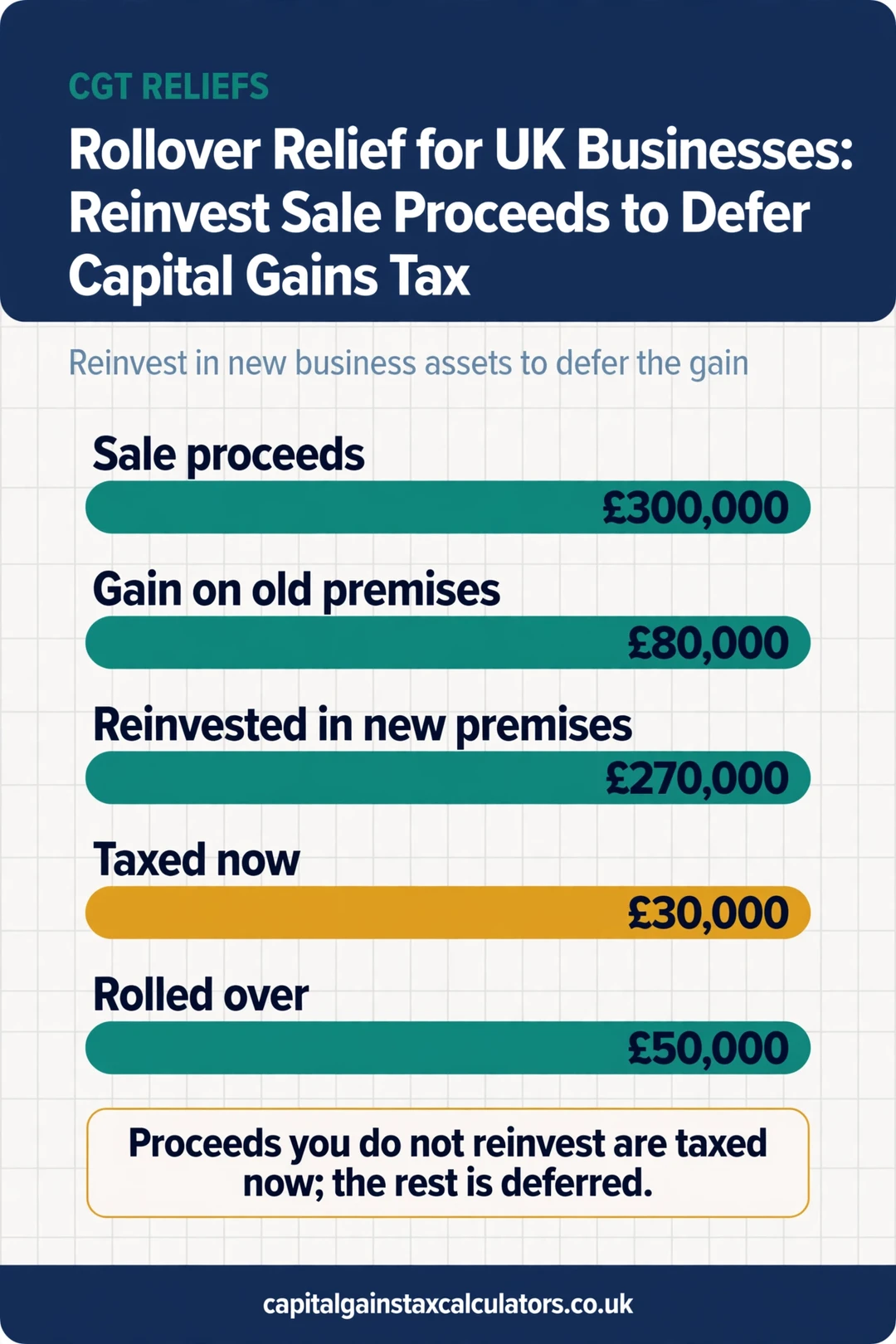
A business sells its premises for £300,000, making a gain of £80,000. It buys new premises for £270,000.
- Proceeds not reinvested: £300,000 less £270,000 = £30,000.
- Gain taxed now: the lower of the gain and the proceeds not reinvested = £30,000.
- Gain rolled over: £50,000, deducted from the cost of the new premises.
- Tax on the gain taxed now: £6,480 on an income of £60,000, compared with £18,480 if the whole gain were taxed.
Rollover relief needs the business to use the assets in its trade. It applies to land and buildings, fixed plant and machinery, and certain other classes. Check the conditions on GOV.UK, because relief can be reduced if part of the asset was used outside the business.
Gift Hold-Over Relief
If you give business assets, or make a gift that is a chargeable lifetime transfer for Inheritance Tax, you and the recipient can jointly claim to hold over the gain. You pay no tax at the time. The recipient takes the asset at market value less the held-over gain, so a later sale triggers the postponed tax. The claim must be made within four years of the end of the tax year of the gift. Our gifts guide explains the limits.
Enterprise Investment Scheme and Seed Enterprise Investment Scheme
If you reinvest a gain from any asset into shares that qualify under the Enterprise Investment Scheme, you can defer the gain. The investment must be made within a window of one year before to three years after the gain arose. The deferred gain becomes chargeable when you sell the EIS shares, or when certain events occur. Gains on EIS shares themselves are exempt if you meet the conditions and have claimed income tax relief and held them for three years. The Seed Enterprise Investment Scheme has a separate reinvestment relief that exempts part of a gain. These schemes are risky investments, and the tax reliefs should never be the only reason to invest. Check the conditions with an adviser.
Incorporation relief and other business reliefs
When you transfer a business to a company in exchange for shares, incorporation relief usually applies automatically. The gain is deferred and deducted from the cost of the shares. Other reliefs include relief on a share-for-share exchange in a takeover, and a relief for sales to an employee ownership trust. The rules for the employee ownership trust relief have been subject to change, so check the current conditions on GOV.UK before you rely on them.
Which relief might apply to you?
| Your situation | Relief to check |
|---|---|
| Selling your own home | Private Residence Relief |
| Selling your company or business | Business Asset Disposal Relief |
| Replacing business premises | Rollover relief |
| Giving business shares to a family member | Gift Hold-Over Relief |
| Investing a gain in a qualifying start-up | Enterprise Investment Scheme deferral |
| Moving a business into a limited company | Incorporation relief |
| Transferring assets to your spouse | No gain, no loss |

Claims and time limits
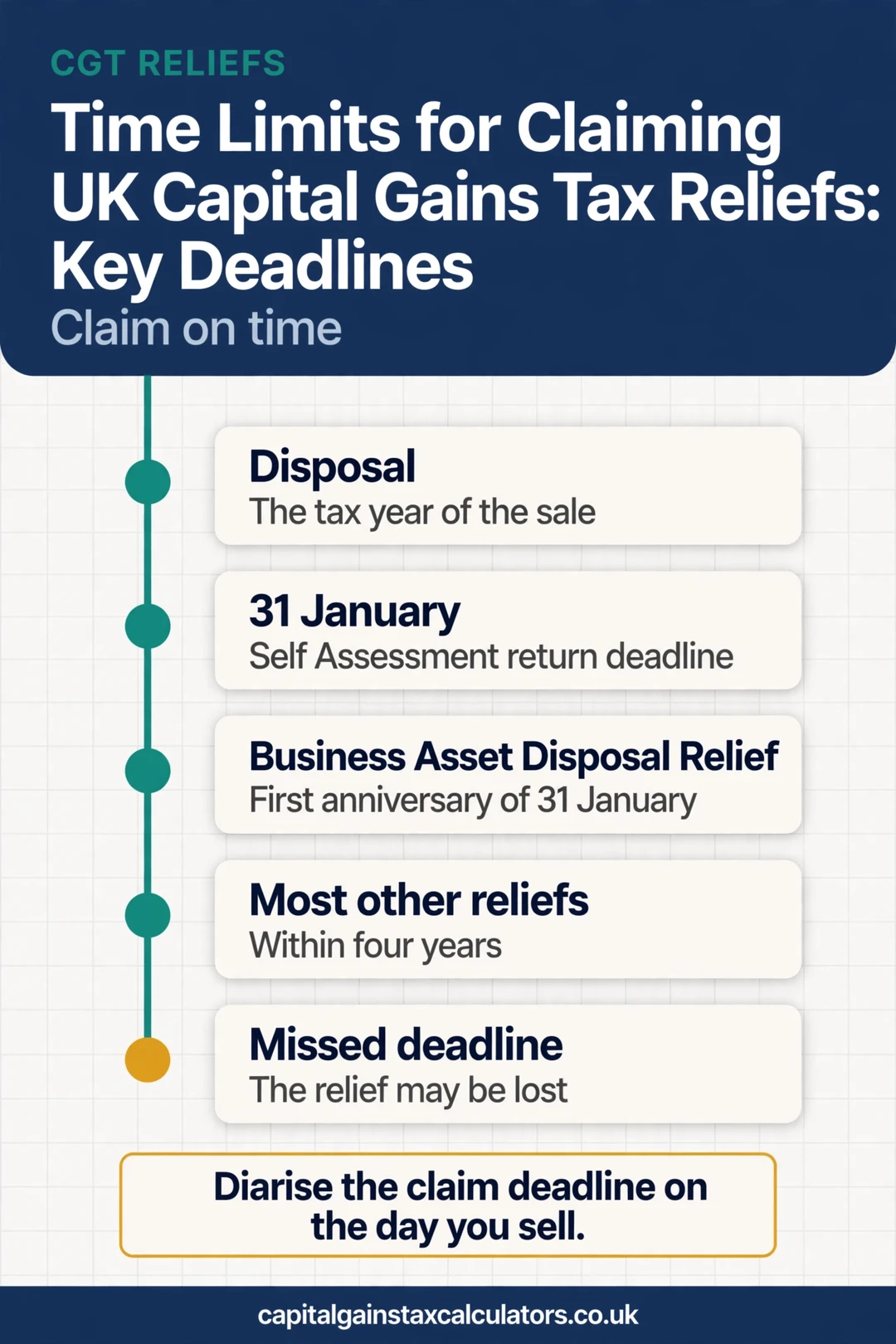
Different reliefs have different time limits. Business Asset Disposal Relief must be claimed by the first anniversary of the 31 January following the tax year of the disposal. Gift Hold-Over Relief and rollover relief have their own claim periods, normally four years from the end of the tax year. Reinvestment reliefs need the new investment to fall in a set window. Missing a time limit can cost you the relief, so make a note of the dates when you plan a sale.
Common mistakes with reliefs
- Assuming a relief is automatic. Many need a claim.
- Missing the reinvestment window. Rollover and EIS deferral have fixed periods.
- Forgetting the deferral comes back. The gain is taxed later.
- Not checking the conditions. Relief can be lost if they are not met.
- Relying on old rules. Rates and limits change, so check GOV.UK.
- Confusing reliefs with exemptions. An exempt asset needs no claim.
What to do next
- Identify the asset and the type of disposal.
- Use the table above to find the relief to check.
- Read the official conditions and the time limit.
- Estimate the tax with our calculators and take advice if the amounts are large.
Frequently asked questions
What Capital Gains Tax reliefs are available in the UK?
The main ones are Private Residence Relief, Business Asset Disposal Relief, Investors’ Relief, rollover relief, Gift Hold-Over Relief, EIS deferral and incorporation relief.
What is the difference between a relief and an exemption?
An exemption takes an asset outside Capital Gains Tax. A relief reduces or defers a gain that would otherwise be charged, and may need a claim.
Do I need to claim Private Residence Relief?
Usually not for a simple home sale. It applies automatically if the home was your main residence throughout. For more complex cases you may need to report.
What is rollover relief?
A relief that defers the gain on a business asset if you reinvest the proceeds in another qualifying business asset within the set period.
What is Gift Hold-Over Relief?
A joint claim that postpones the gain on certain gifts, so the recipient pays the tax when they sell.
Does EIS defer Capital Gains Tax?
Yes. Investing a gain in qualifying EIS shares within the time limits defers the gain until the shares are sold or other events occur.
What is Business Asset Disposal Relief?
A lower rate of 18% on gains from selling a qualifying business, up to a lifetime limit of £1,000,000.
Can I use more than one relief?
Often yes, if the conditions for each are met. The reliefs apply to different parts of a gain or to different disposals.
Where can I check the official conditions?
On GOV.UK and in the HMRC helpsheets. The links are in the sources below.
Should I take advice before relying on a relief?
For large gains or complex reliefs, yes. A missed condition or deadline can cost you the relief.
Official sources
- GOV.UK: Capital Gains Tax
- GOV.UK: Business Asset Disposal Relief
- GOV.UK: Self Assessment helpsheets for Capital Gains Tax
- GOV.UK: Tax when you sell your home
Related guides and calculators
This page gives general information for UK taxpayers and is not tax advice. Capital Gains Tax rules can change and your own circumstances matter. Check the latest rules on GOV.UK or with a qualified tax adviser before you act.