Quick answer
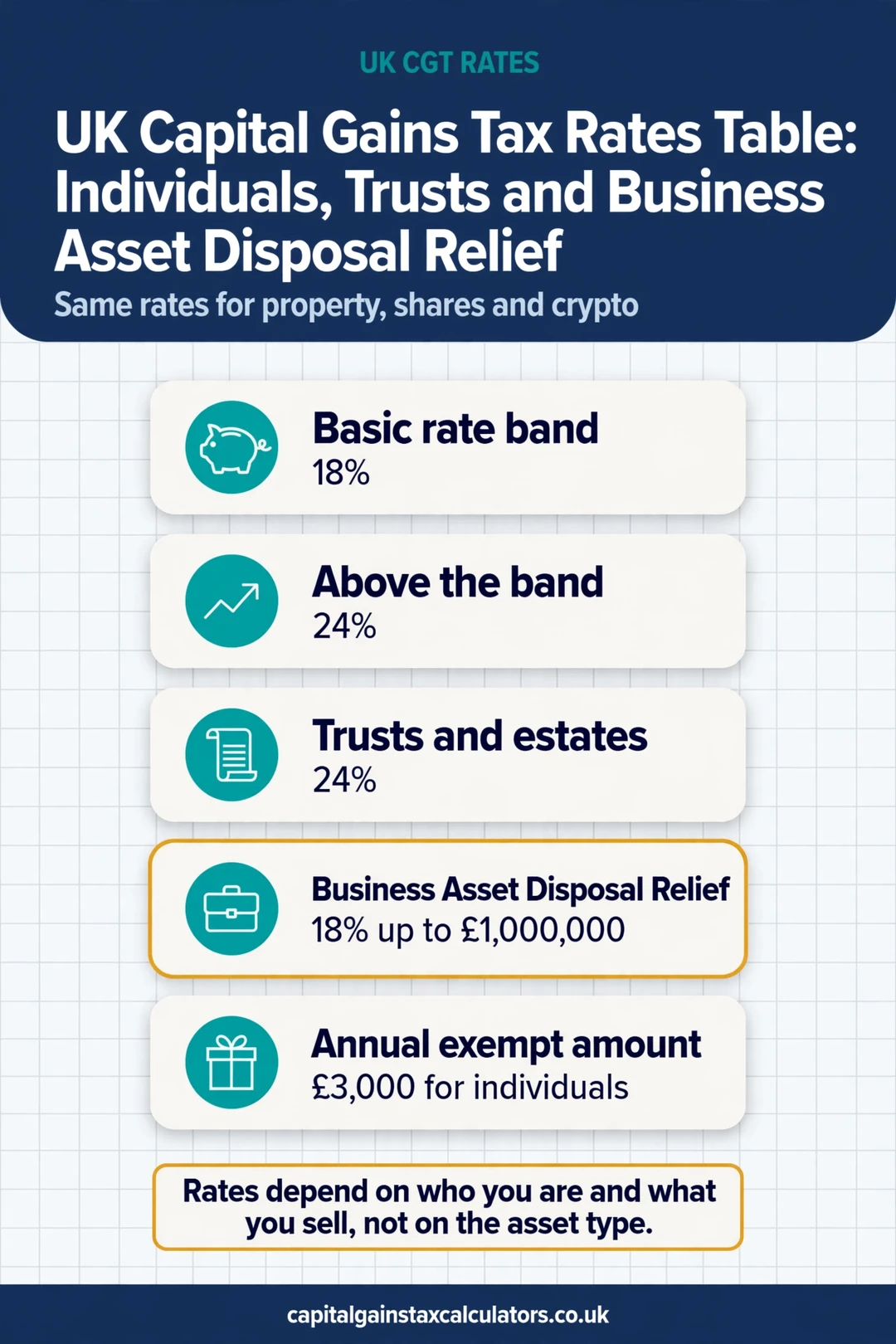
For 2026/27, Capital Gains Tax is charged at 18% on gains that fall inside your basic rate band and 24% on gains above it. The same two rates apply to property, shares, crypto and most other assets. Trustees and personal representatives pay 24%, and Business Asset Disposal Relief is 18%. Your taxable income decides how much of your gain is taxed at each rate.
Key facts
- Two main rates in 2026/27: 18% and 24%.
- The rates are the same for residential property and other assets.
- The basic rate band is £37,700, and your gain is added on top of your taxable income.
- The first £3,000 of gains is free of tax and is set against gains taxed at the highest rate first.
- Trustees and personal representatives pay 24% on gains.
Good to know
Work out your own rate
Enter your income and your gain in our Capital Gains Tax calculator to see how much of your gain is taxed at each rate.
The Capital Gains Tax rates for 2026/27
| Who | Rate | When it applies |
|---|---|---|
| Individuals | 18% | Gains within the unused part of your basic rate band |
| Individuals | 24% | Gains above your basic rate band |
| Trustees and personal representatives | 24% | All gains above their allowance |
| Qualifying business disposals | 18% | Gains within the £1,000,000 lifetime limit under Business Asset Disposal Relief |
| Qualifying Investors’ Relief gains | 18% | Subject to the relief limit and conditions |
Before part-way through the 2024/25 tax year, the rates for shares and most other assets were lower, at 10% and 20%, and residential property had its own rates. The rates for all assets are now the same, so you no longer need to check whether your asset is residential property when you choose the rate. Check the official page for the current figures if you are looking at an earlier tax year, because earlier years use the rates that applied when you made the disposal.
How your income decides the rate
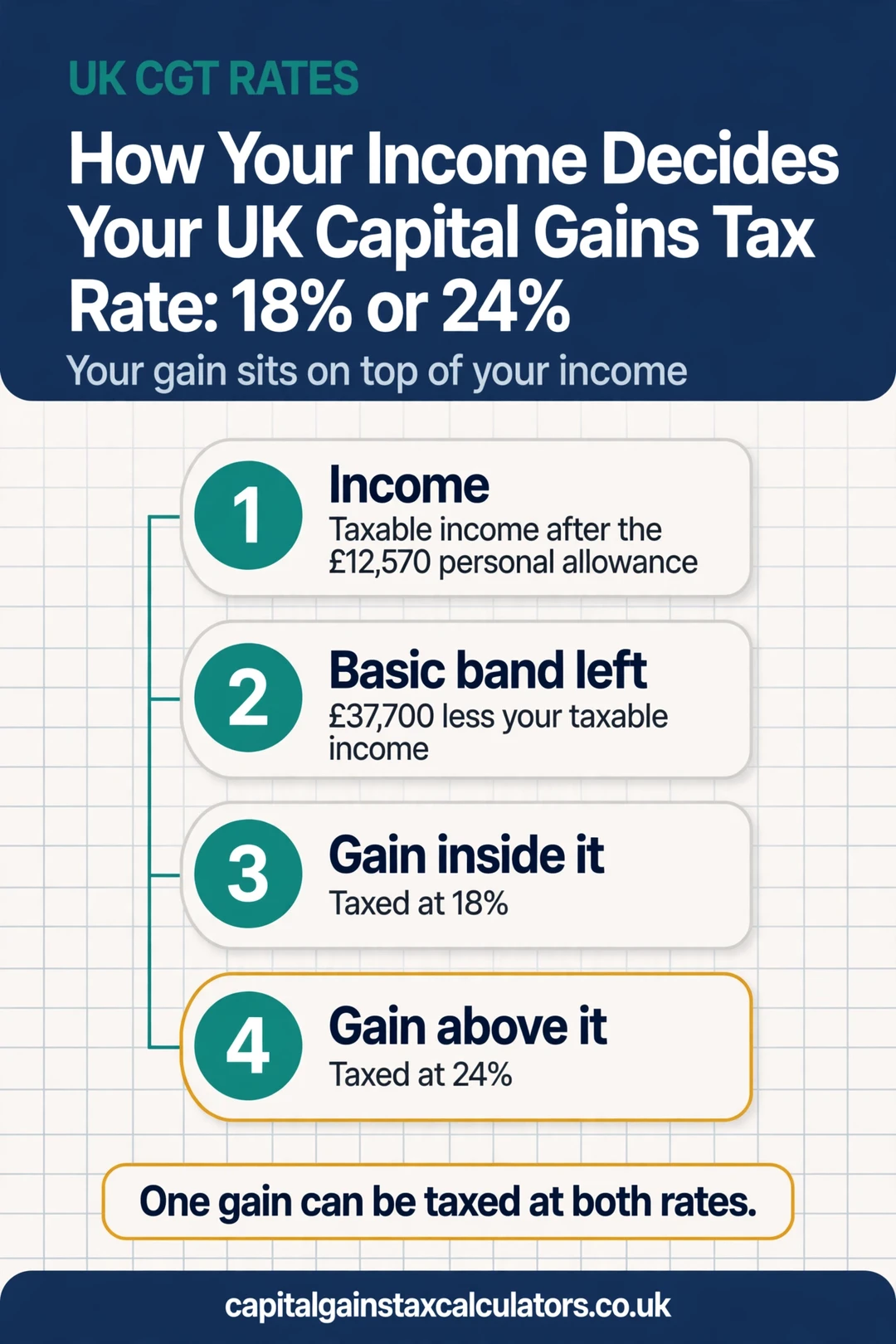
HMRC adds your taxable gain to your taxable income and then looks at where it sits against the basic rate band. The basic rate band is £37,700 in 2026/27. Taxable income is your income after the personal allowance of £12,570. If your taxable income is below £37,700, the unused part of the band is available for your gain at 18%. Anything above it is taxed at 24%.
Worked example
An income of £35,000
- Income after the personal allowance: £22,430.
- Basic rate band left: £37,700 less £22,430 = £15,270.
- A taxable gain of £20,000: £15,270 at 18% and £4,730 at 24%.
- Tax: £3,884.
The table below shows the tax on a gain of £23,000, which becomes £20,000 after the allowance, for different incomes.
| Taxable income before the gain | Gain at 18% | Gain at 24% | Capital Gains Tax |
|---|---|---|---|
| £20,000 | £20,000 | £0 | £3,600 |
| £35,000 | £15,270 | £4,730 | £3,884 |
| £50,000 | £270 | £19,730 | £4,784 |
| £75,000 | Nil | £20,000 | £4,800 |
| £125,000 | Nil | £20,000 | £4,800 |
How the basic rate band can grow
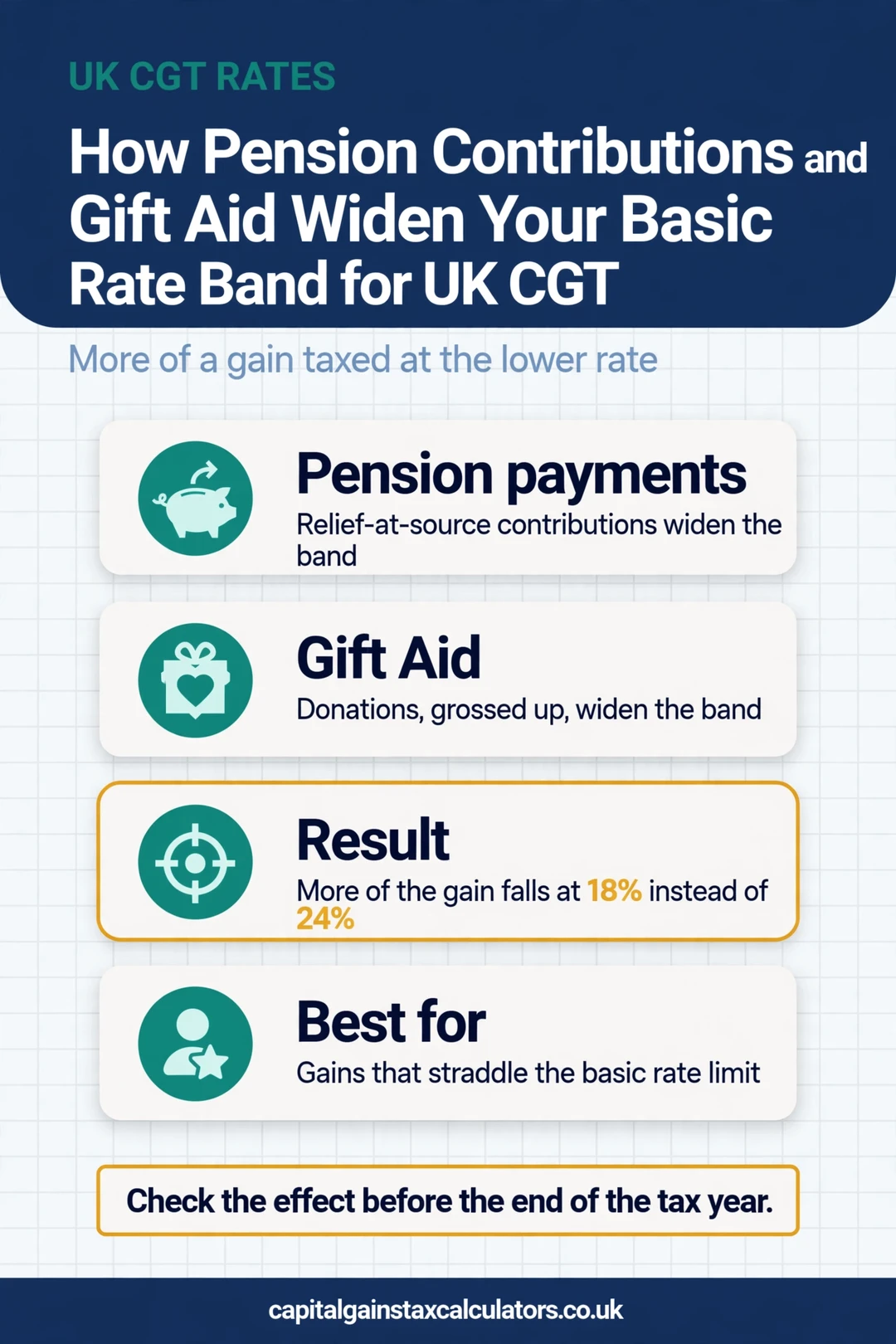
Some payments extend your basic rate band, which lets more of your gain be taxed at the lower rate. The main ones are personal pension contributions made through a relief at source scheme and Gift Aid donations. Each pound you pay, grossed up for basic rate relief, adds to the band. If you earn above £100,000, the personal allowance is reduced, so your taxable income is higher than you might expect. The Capital Gains Tax calculator handles these adjustments if you enter them under “More options”.
Allowance, losses and the rate
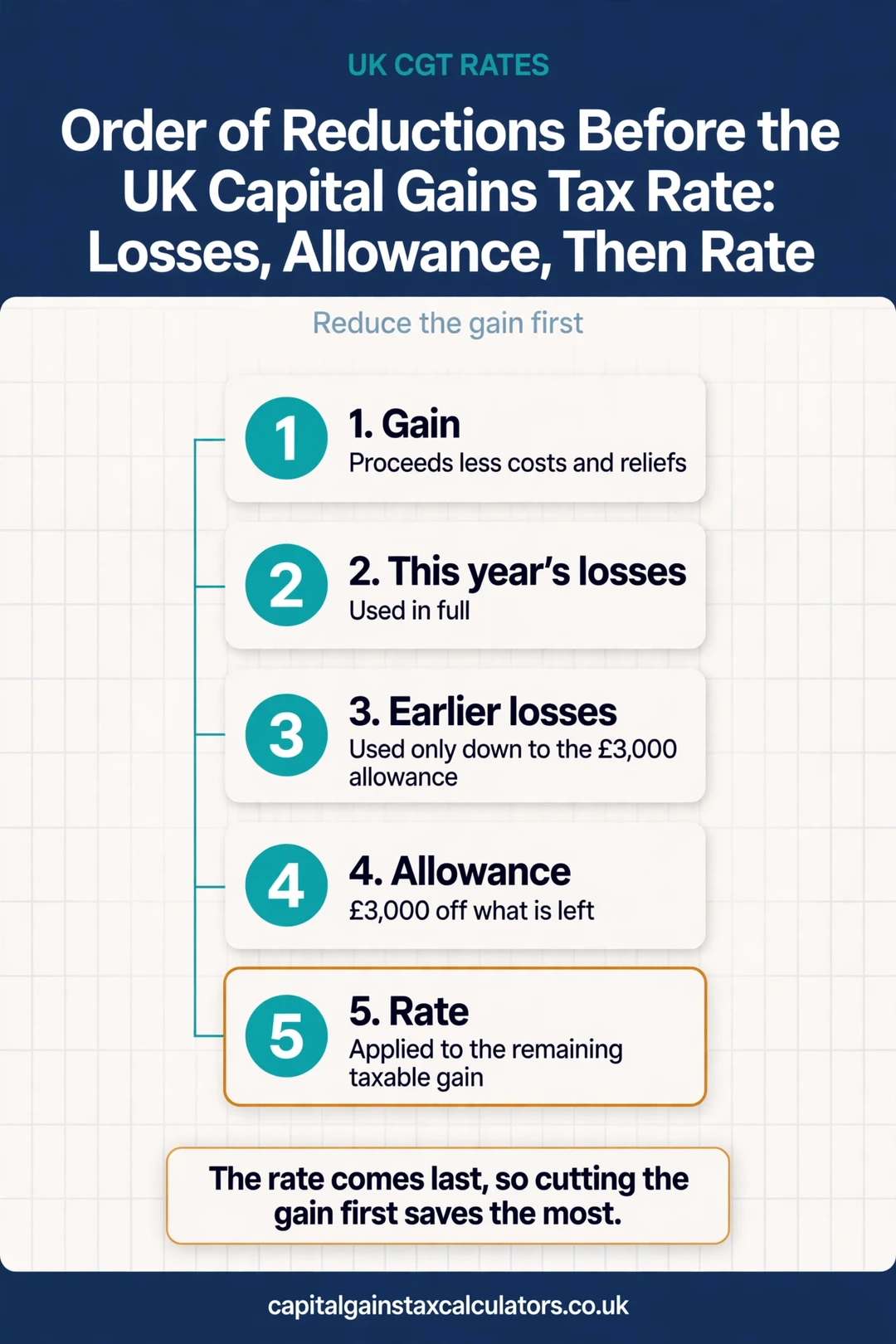
Before the rate is applied, your gains are reduced by losses and then by the annual exempt amount. Current-year losses come off first. Losses brought forward come off only until the gain is down to the allowance. The allowance is then set against the gains taxed at the highest rate first, which saves you the most. Read the Capital Gains Tax allowance guide for the order of set-off.
Special rates
Trustees and personal representatives
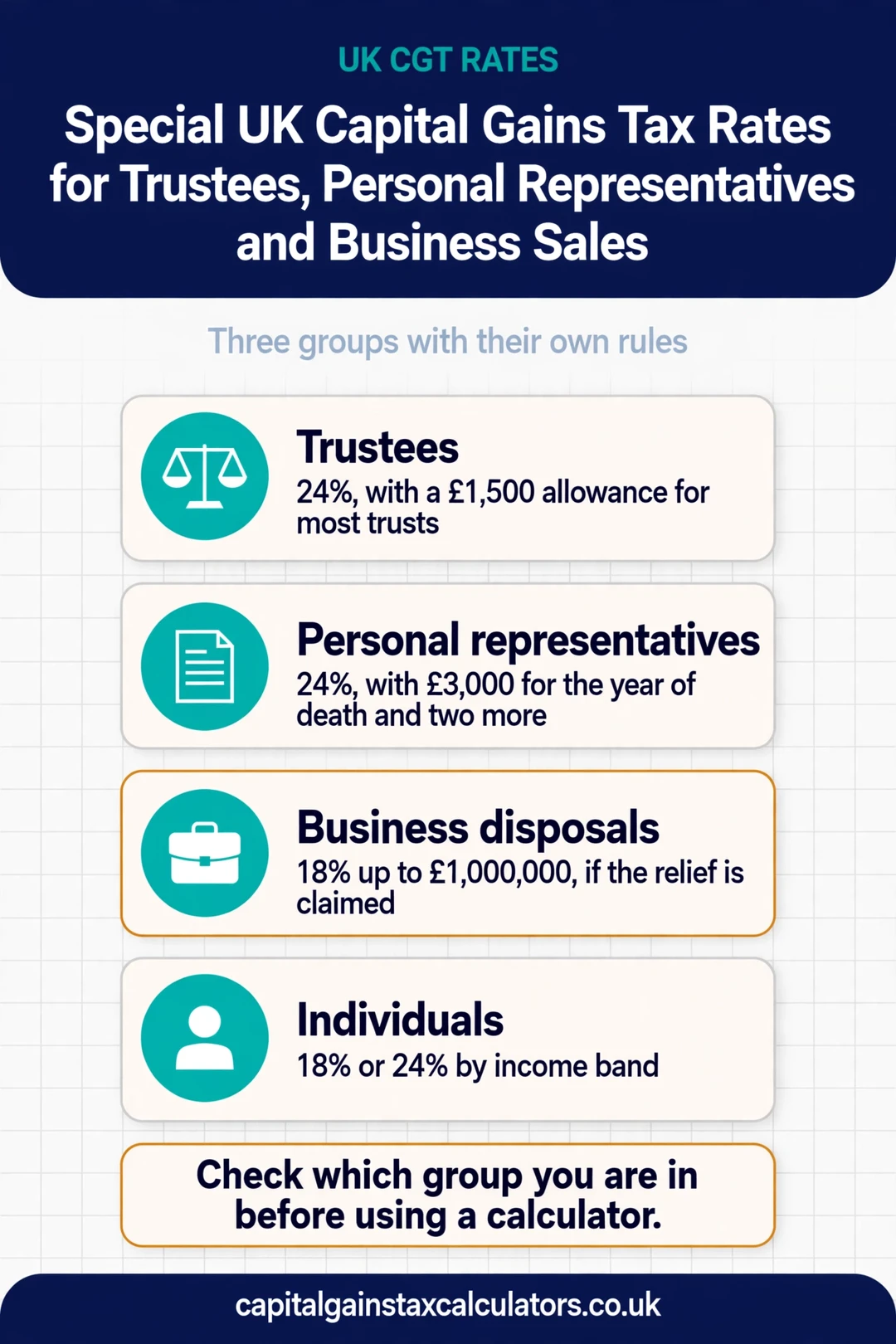
Trustees of most trusts and personal representatives of an estate pay 24% on gains. They do not have a basic rate band. They have an allowance of £1,500 for most trusts, or £3,000 for personal representatives in the year of death and the next two tax years. See our trusts and estates guide.
Business Asset Disposal Relief
Qualifying gains on selling a business or shares in your own company are taxed at 18%, up to a £1,000,000 lifetime limit. The rate was lower in earlier tax years. Our Business Asset Disposal Relief guide explains the conditions.
Scottish and Welsh taxpayers
Capital Gains Tax rates and bands are set at UK level. Scottish and Welsh Income Tax rates do not change the Capital Gains Tax rates or the basic rate band. Use the standard UK band of £37,700 for the calculation. Confirm the treatment of Scottish taxpayers on GOV.UK if you are in doubt.
The rates over time
The date of the disposal decides which rates apply, so a gain made in an earlier tax year is taxed at the rates for that year. The table gives the broad picture. Use the official GOV.UK page for exact dates and for any tax year not listed here.
| Period | Shares and most assets | Residential property |
|---|---|---|
| Before the 2024/25 tax year | 10% and 20% | 18% and 28% |
| Part of the 2024/25 tax year (before the Autumn Budget change) | 10% and 20% | 18% and 24% |
| Rest of the 2024/25 tax year onwards | 18% and 24% | 18% and 24% |
The practical effect is that the choice of asset no longer changes your rate. A gain of £20,000 on shares costs the same as the same gain on a buy-to-let. The allowance has also fallen sharply in recent years, from £12,300 to £3,000, which means more people now have a taxable gain. If you are catching up on an earlier tax year, use the rates and the allowance for that year. The calculators on this site are set up for 2026/27.
Which rate applies to different assets
For most taxpayers the answer is the same for every asset: 18% inside the basic rate band and 24% above it. The exceptions are all about who is selling or what is being sold.
| Asset or seller | Rate | Notes |
|---|---|---|
| Second home or buy-to-let | 18% or 24% | Report within 60 days |
| Shares, funds and crypto | 18% or 24% | Pooled cost rules apply |
| Shares in your own company | 18% with relief, otherwise normal | Needs a claim |
| Valuable personal items | 18% or 24% | Only if worth £6,000 or more |
| Estate sold by personal representatives | 24% | Allowance for three tax years |
Common mistakes with the rates
- Using your marginal Income Tax rate. The Capital Gains Tax rate depends on where the gain sits in the basic band.
- Ignoring the personal allowance. Taxable income is after the allowance.
- Taxing the whole gain at one rate. A gain can be split across two rates.
- Using last year’s rates. Check the rates for the tax year of the disposal.
- Forgetting the allowance. The £3,000 comes off before the rate applies.
- Applying BADR to a normal sale. The lower relief rate needs a qualifying disposal and a claim.
What to do next
- Estimate your taxable income for the tax year.
- Work out your gain with the Capital Gains Tax calculator.
- Check how the allowance and losses reduce the gain.
- Read how to calculate Capital Gains Tax for the full method.
Frequently asked questions
What are the Capital Gains Tax rates for 2026/27?
18% for gains within your basic rate band and 24% above it. Trustees and personal representatives pay 24%, and Business Asset Disposal Relief gains pay 18%.
Are Capital Gains Tax rates different for property and shares?
No. The same rates apply to residential property, shares, crypto and most other assets. Earlier tax years had separate rates, so check the year of your disposal.
How do I know whether I pay 18% or 24%?
Add your taxable gain to your taxable income. The part that fits inside the £37,700 basic rate band is taxed at 18%. The rest is taxed at 24%.
Does the gain push me into a higher Income Tax band?
No. The gain is not added to your income for Income Tax. It is only used to decide which Capital Gains Tax rate applies.
What rate do trustees pay?
24%, the same as the personal representative rate. Trusts have no basic rate band and a smaller allowance.
Is there a lower rate for selling a business?
Yes. Business Asset Disposal Relief charges 18% on qualifying gains up to £1,000,000 over your lifetime, if you meet the conditions and claim it.
Do Scottish rates change Capital Gains Tax?
Scottish Income Tax rates do not change the Capital Gains Tax rates. The UK-wide basic rate band is used to decide which rate applies.
Can I reduce the rate I pay?
You can raise your basic rate band with pension contributions and Gift Aid, use losses and the allowance, and claim reliefs. See our guide to reducing the tax.
Which tax year’s rate applies?
The rate for the tax year in which you disposed of the asset. For a sale, that is normally the date of the contract.
Where do I find the official rates?
GOV.UK publishes the current rates and allowances. The link is in the official sources below.
Official sources
- GOV.UK: Capital Gains Tax rates and allowances
- GOV.UK: Income Tax rates and Personal Allowances
- GOV.UK: Business Asset Disposal Relief
Related guides and calculators
This page gives general information for UK taxpayers and is not tax advice. Capital Gains Tax rules can change and your own circumstances matter. Check the latest rules on GOV.UK or with a qualified tax adviser before you act.