Quick answer
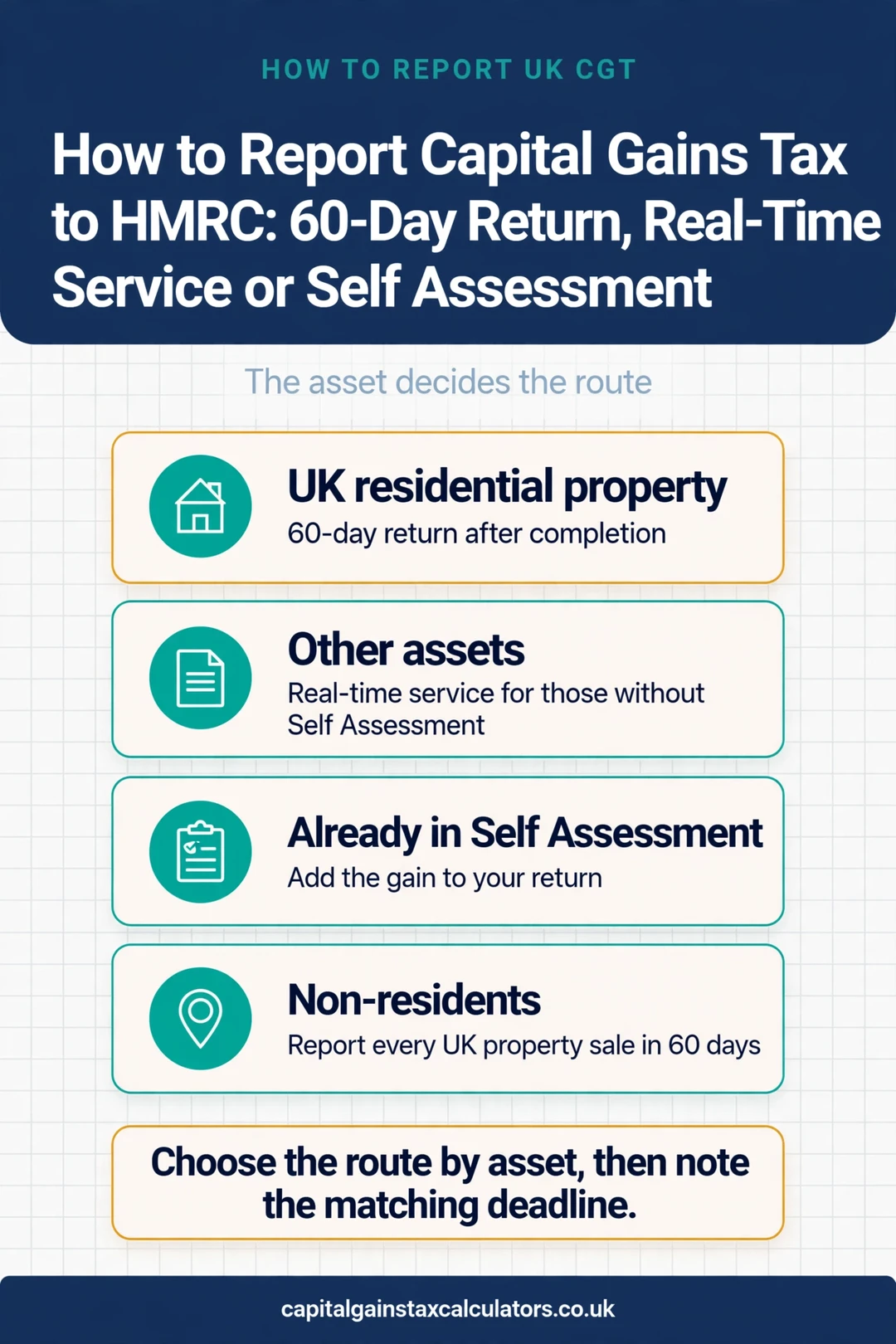
How you report Capital Gains Tax depends on the asset. If you are a UK resident and sell UK residential property with tax to pay, you must report and pay within 60 days of completion. For shares, crypto and most other assets, you report on a Self Assessment return or through HMRC’s real-time Capital Gains Tax service. You should report if your gains are above the £3,000 allowance, if your total proceeds are over £50,000, or if you want to claim a loss.
Key facts
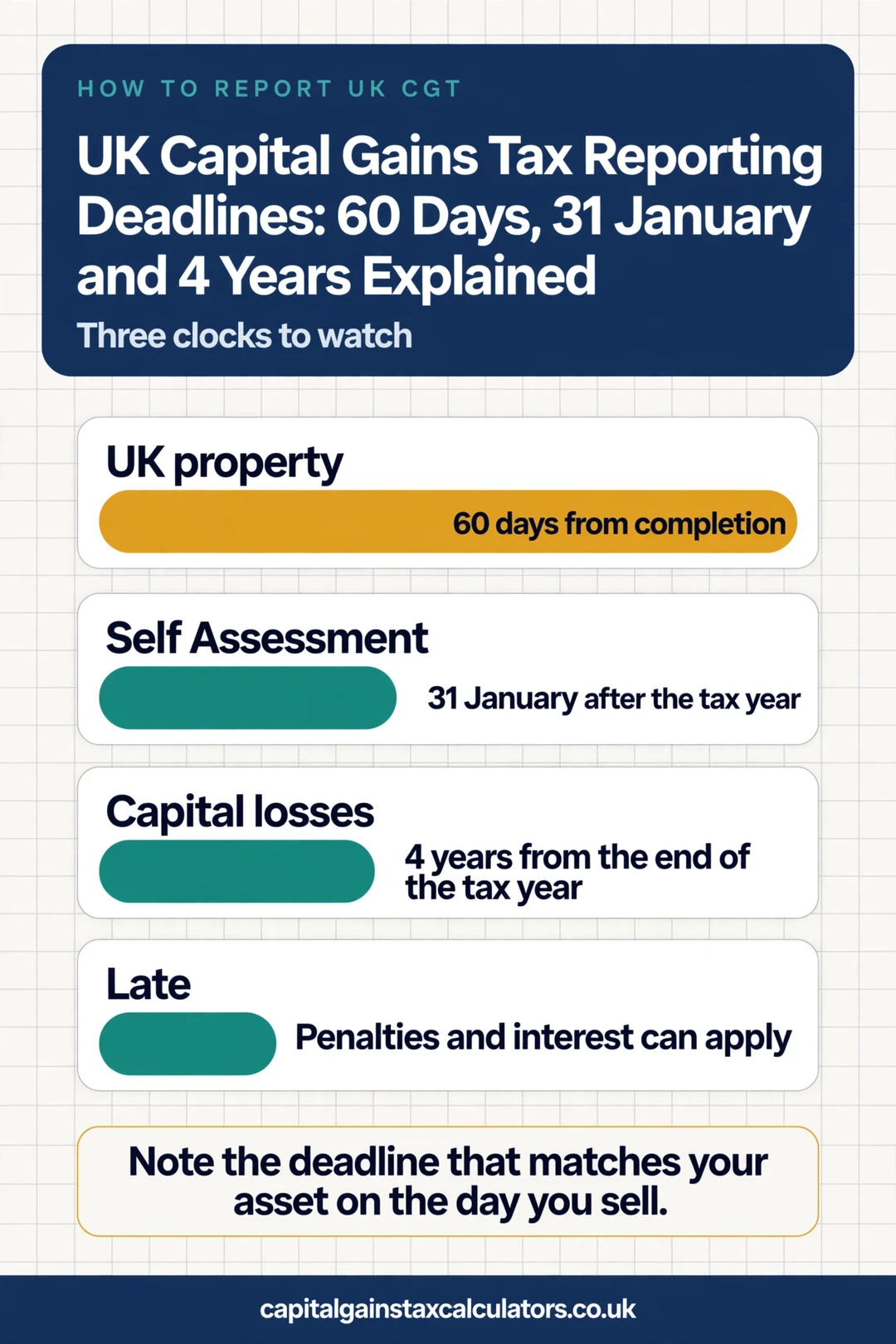
- UK residential property: report and pay within 60 days of completion if tax is due.
- Shares, crypto and other assets: Self Assessment or the real-time service.
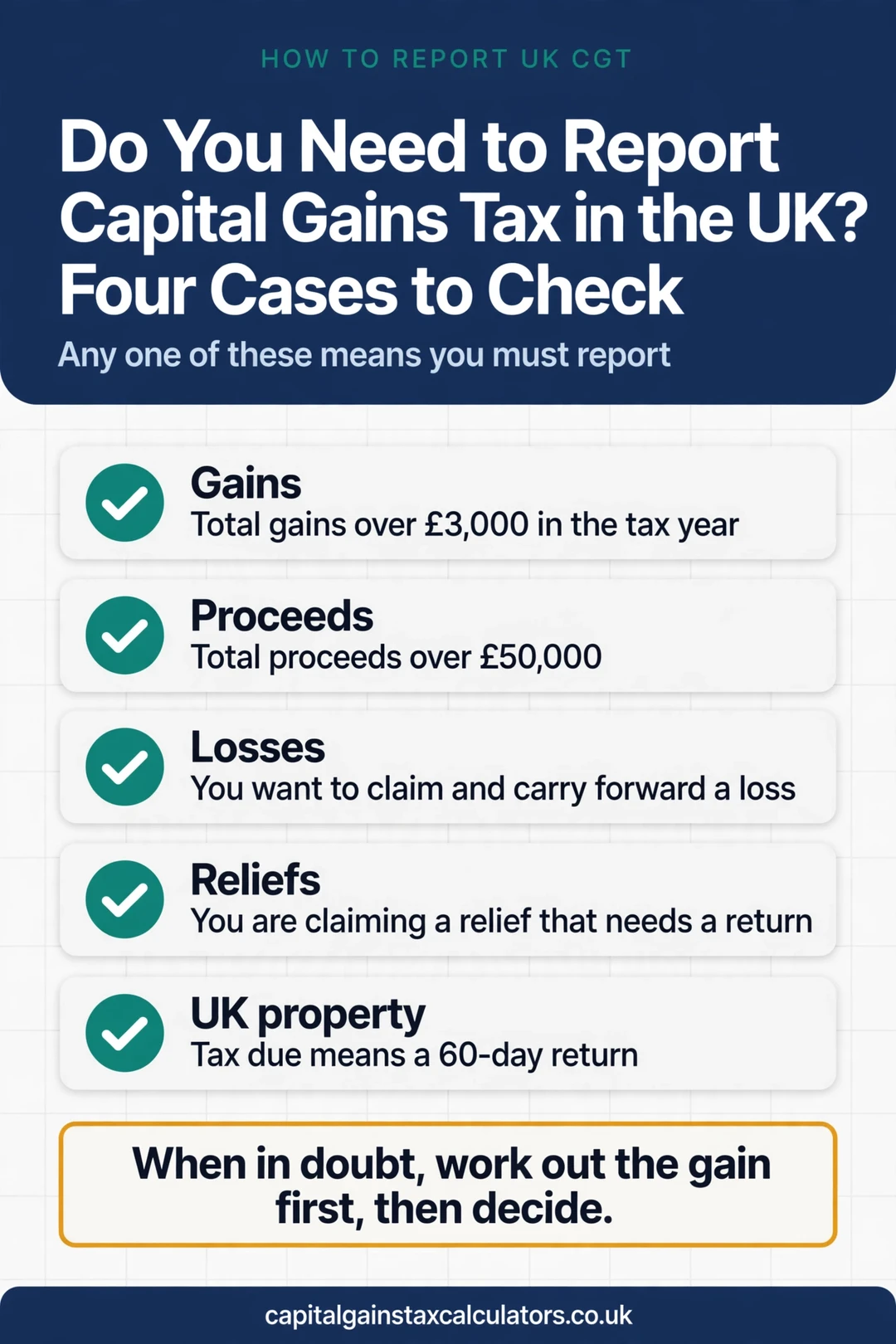
- Report if: gains are over £3,000, proceeds are over £50,000, or you are claiming a loss or relief.
- Non-residents: report every UK property or land disposal within 60 days, even with no tax.
- Self Assessment deadline: 31 January after the end of the tax year.
- Losses: tell HMRC within 4 years of the end of the tax year.
Good to know
Check your deadline
Use the 60-day deadline calculator to find your last day, and our property reporting guide for the step-by-step return.
The three ways to report
HMRC offers three routes, and which one you use depends on what you sold and whether you already file a tax return. You may use more than one in the same year, for example a 60-day return for a house and a Self Assessment return for shares.
| Route | Used for | Deadline | Who it suits |
|---|---|---|---|
| 60-day property return | UK residential property with tax due | 60 days from completion | Anyone selling a second home or buy-to-let |
| Real-time Capital Gains Tax service | Other assets, such as shares and crypto | Report and pay earlier than the return is due | People who do not file Self Assessment |
| Self Assessment return | All gains, including property | 31 January after the tax year | People who already file a return |
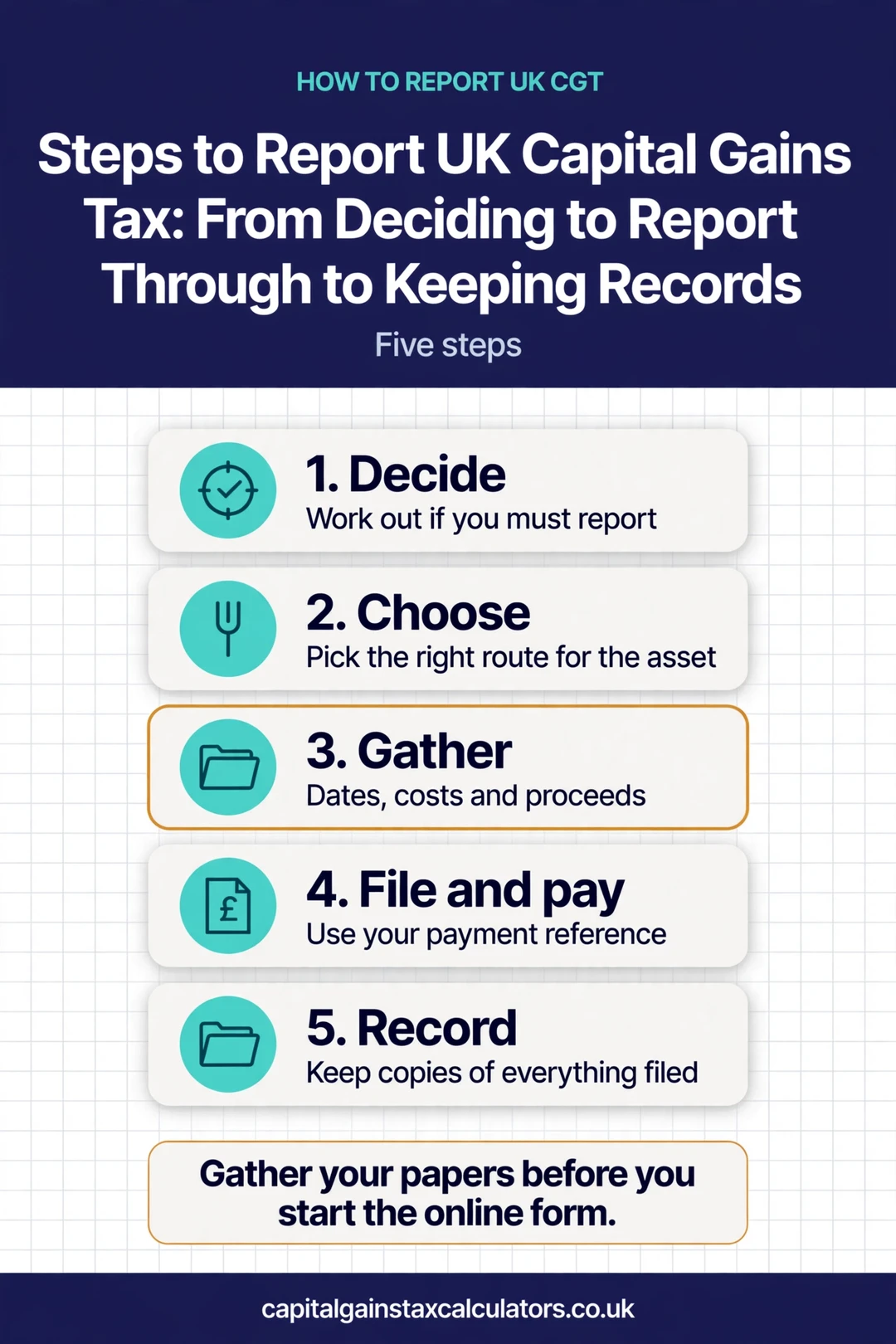
Step 1: Decide whether you must report
You do not need to report every sale. A UK resident usually needs to report in four cases. The first is when your total gains for the year, after losses, are above the £3,000 allowance. The second is when your total proceeds from all disposals are above £50,000, even if the gains are below the allowance. The third is when you want to claim a loss to use later. The fourth is when you are claiming a relief that needs to be shown on a return. If none of these apply, nothing needs to be reported. Check whether the asset is exempt first, using our exemptions guide.
Step 2: Pick the right route
For UK residential property with tax to pay, you must use the 60-day return. You still show the gain on your Self Assessment return if you file one, and the tax you paid on account is credited. For other assets, choose between the real-time service and Self Assessment. If you already complete a return each year, put the gain on it. If you do not, the real-time service lets you report and pay without registering for Self Assessment. Non-residents must report all UK property and land sales within 60 days, as we explain in our non-resident guide.
Step 3: Gather your figures
You need the same figures that go into the calculation. Collect the dates you bought and sold, the sale price, the purchase price, the costs of buying, improving and selling, and any valuations. For shares and crypto, you need the transaction history and the pooled cost. Add details of any losses you have brought forward and any relief you are claiming. Our calculation guide shows how each number is used.
Worked example
Reporting a property sale and a share sale in one year
You sell a second home for £300,000 that cost £190,000, with £5,000 of buying costs and £4,500 of selling costs. The gain is £100,500. On an income of £52,000, the tax is £23,400. That must be reported and paid within 60 days of completion. In the same year you sell shares for £62,000 that cost £58,000. The gain of £4,000 is below the allowance, but because your proceeds are over £50,000, it still needs to be reported on your Self Assessment return.
Step 4: File the return
For the 60-day return, sign in with a Government Gateway account on GOV.UK, enter the figures and submit. You get a payment reference to pay the tax. For Self Assessment, complete the capital gains pages of your return, which ask for each disposal and the totals. For the real-time service, you create a Government Gateway account and report each gain. Nothing is posted to HMRC on paper unless you choose a paper return. Keep a copy of what you file.
Step 5: Pay the tax
Pay by the method shown after you file. You pay the tax in full by the deadline for the route you used. A 60-day return carries its own payment deadline, which is the same as the filing deadline. For Self Assessment, payment is due by 31 January after the tax year, along with any other tax on your return. Paying late adds interest, and filing late can add penalties, so do not leave it to the last day.
| Late action | What can happen |
|---|---|
| Missing the 60-day return | A late filing penalty, with more added the longer it is left |
| Paying late | Interest on the unpaid tax |
| Missing the Self Assessment deadline | A fixed penalty, with daily and percentage penalties added later |
| Not reporting at all | Possible investigation, extra tax and larger penalties |
Step 6: Keep your records
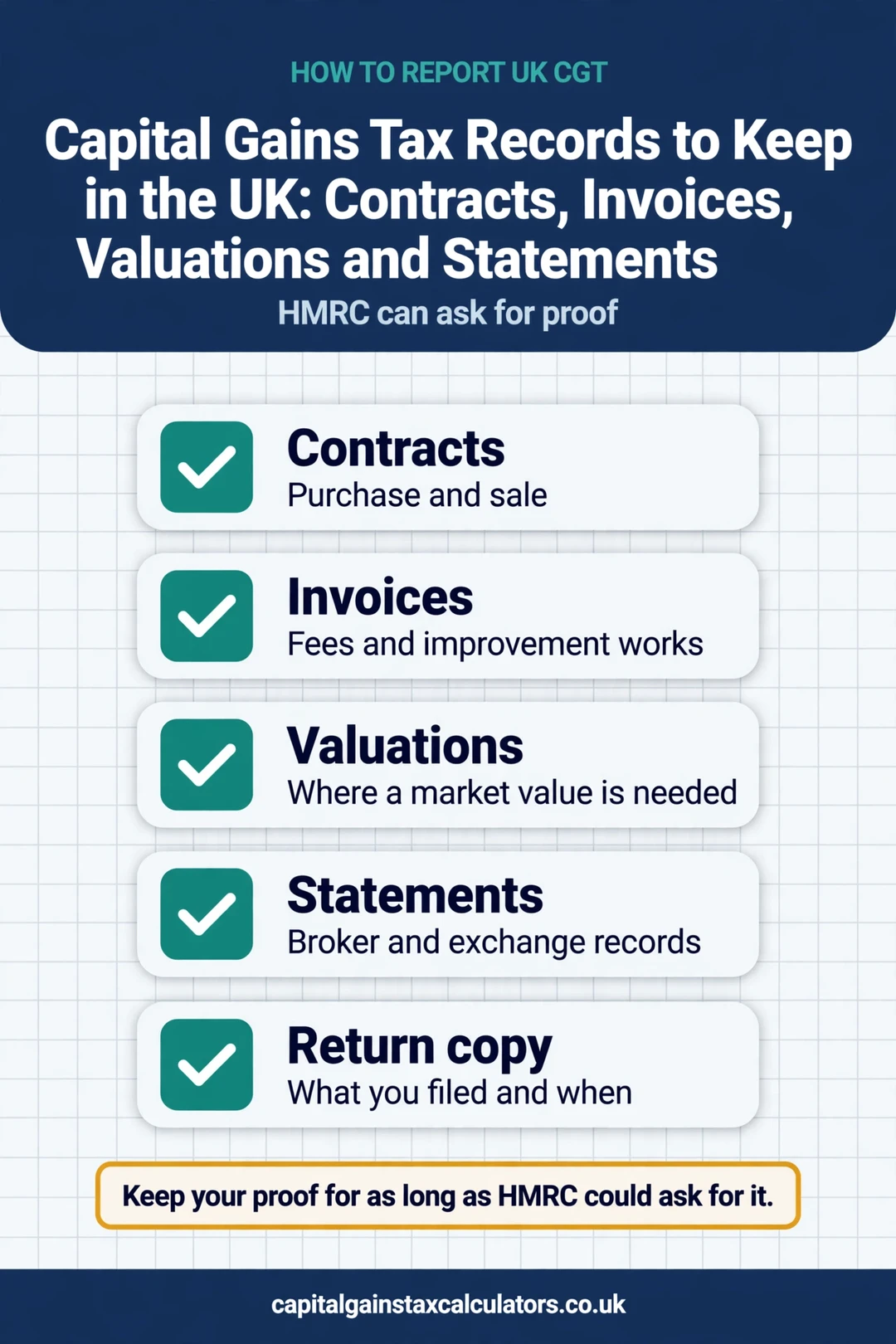
Keep the contracts, invoices, valuations and statements that support your figures. HMRC can ask for them, and you will need them again if you sell the rest of the asset or use a carried-forward loss. Records for a Self Assessment return are normally kept for several years after the filing deadline, so keep your property and investment records at least that long, and longer if you still own the asset.
Reporting losses
A loss is reported in the same way as a gain. Tell HMRC within 4 years of the end of the tax year in which the loss arose, and you can carry it forward without limit. A loss that is not reported in time cannot be used against a later gain. See our losses guide.
Common mistakes when reporting Capital Gains Tax
- Missing the 60-day deadline. It runs from completion, not from when the money arrives.
- Assuming no tax means no report. Proceeds over £50,000, losses and non-resident sales can all need a report.
- Reporting only the gain on the Self Assessment return. If you already paid a 60-day return, show it so the payment is credited.
- Using the wrong tax year. The year follows the contract date.
- Forgetting joint owners. Each owner reports their own share.
- Not keeping records. Costs you cannot prove may be disallowed.
What to do next
- Work out whether your sale needs a report using Step 1.
- Use the deadline calculator if you sold UK property.
- Run your figures through the property or shares calculator.
- File and pay using the route that fits, and keep your records.
Frequently asked questions
How do I report Capital Gains Tax to HMRC?
Use the 60-day return for UK residential property with tax due. For other gains, use your Self Assessment return or HMRC’s real-time Capital Gains Tax service.
Do I have to report a gain below the allowance?
Not usually. You still need to report if your total proceeds are over £50,000 or if you want to claim a loss.
What is the deadline for reporting a property sale?
Within 60 days of completion if you are a UK resident with tax to pay. Non-residents must report every UK property or land sale in the same period.
What is the Self Assessment deadline for Capital Gains Tax?
31 January after the end of the tax year in which you sold the asset.
Can I report shares through the real-time service?
Yes, if you do not already complete a Self Assessment return. It lets you report and pay without registering for Self Assessment.
Do I report on the 60-day return and Self Assessment?
If you file Self Assessment, you must also show the gain there. The tax paid on the 60-day return is credited.
What happens if I report late?
HMRC can charge late filing penalties and interest on unpaid tax. The longer the delay, the higher the cost.
How do I report a capital loss?
Include it on your Self Assessment return or tell HMRC within 4 years of the end of the tax year. It can then be carried forward.
Who reports a jointly owned asset?
Each owner reports their own share of the gain, using their own allowance.
Do I need an accountant to report?
Not for simple sales. For large gains, businesses, trusts or several reliefs, an adviser can help.
Official sources
- GOV.UK: Report and pay your Capital Gains Tax
- GOV.UK: Report and pay Capital Gains Tax on UK property
- GOV.UK: Capital Gains Tax: what you pay it on
- GOV.UK: Self Assessment tax returns
Related guides and calculators
This page gives general information for UK taxpayers and is not tax advice. Capital Gains Tax rules can change and your own circumstances matter. Check the latest rules on GOV.UK or with a qualified tax adviser before you act.