Quick answer
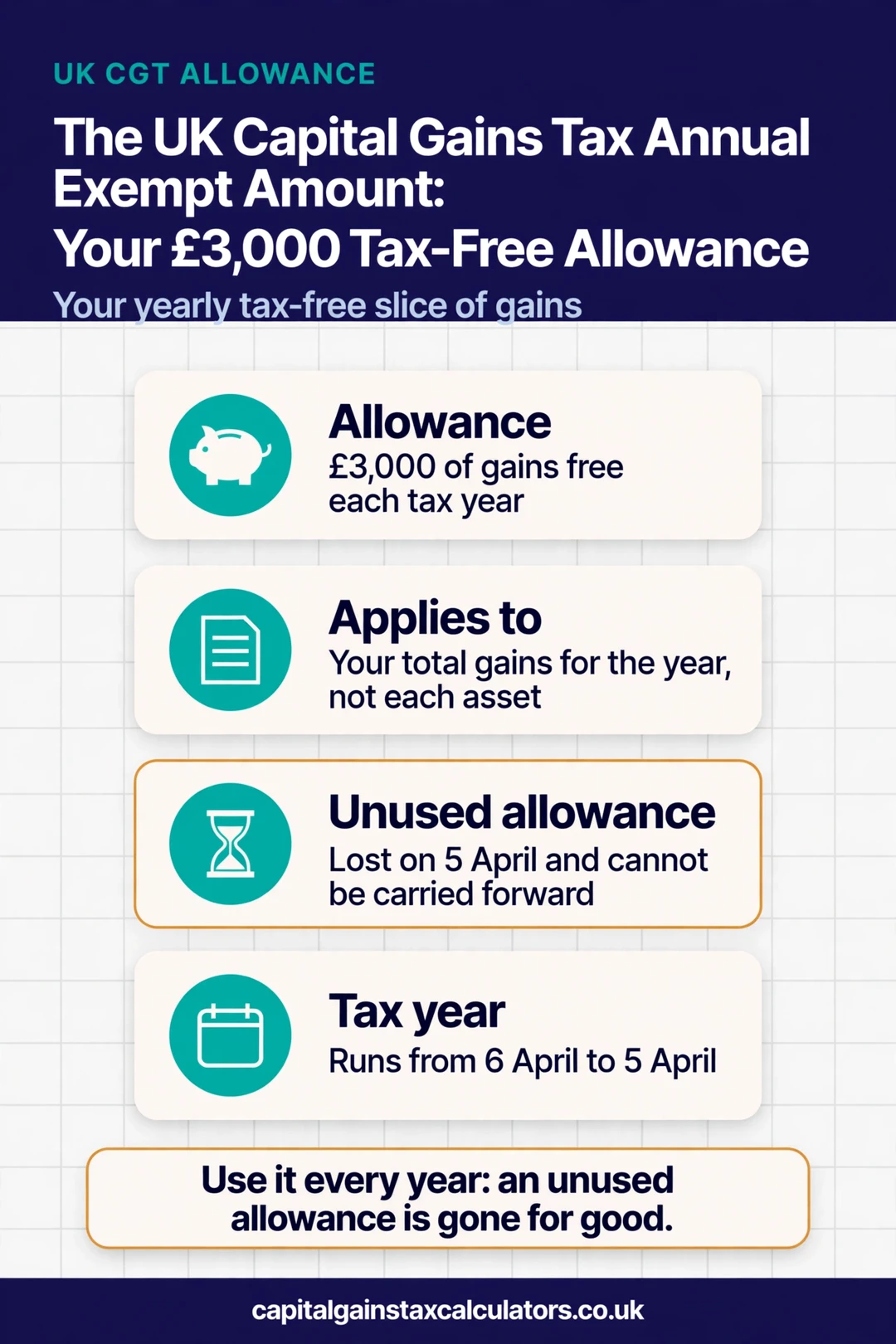
The Capital Gains Tax allowance, called the annual exempt amount, is £3,000 for individuals in 2026/27. It is the amount of total gains you can make in a tax year before you pay any tax. It is a yearly allowance that you cannot carry forward, so unused allowance is lost on 5 April. Most trustees get £1,500, and personal representatives get £3,000 for the tax year of death and the next two.
Key facts
- The allowance is £3,000 for individuals in 2026/27.
- It applies to your total gains for the tax year, not to each asset.
- Unused allowance cannot be carried forward or transferred to a spouse.
- Spouses and civil partners each have their own allowance.
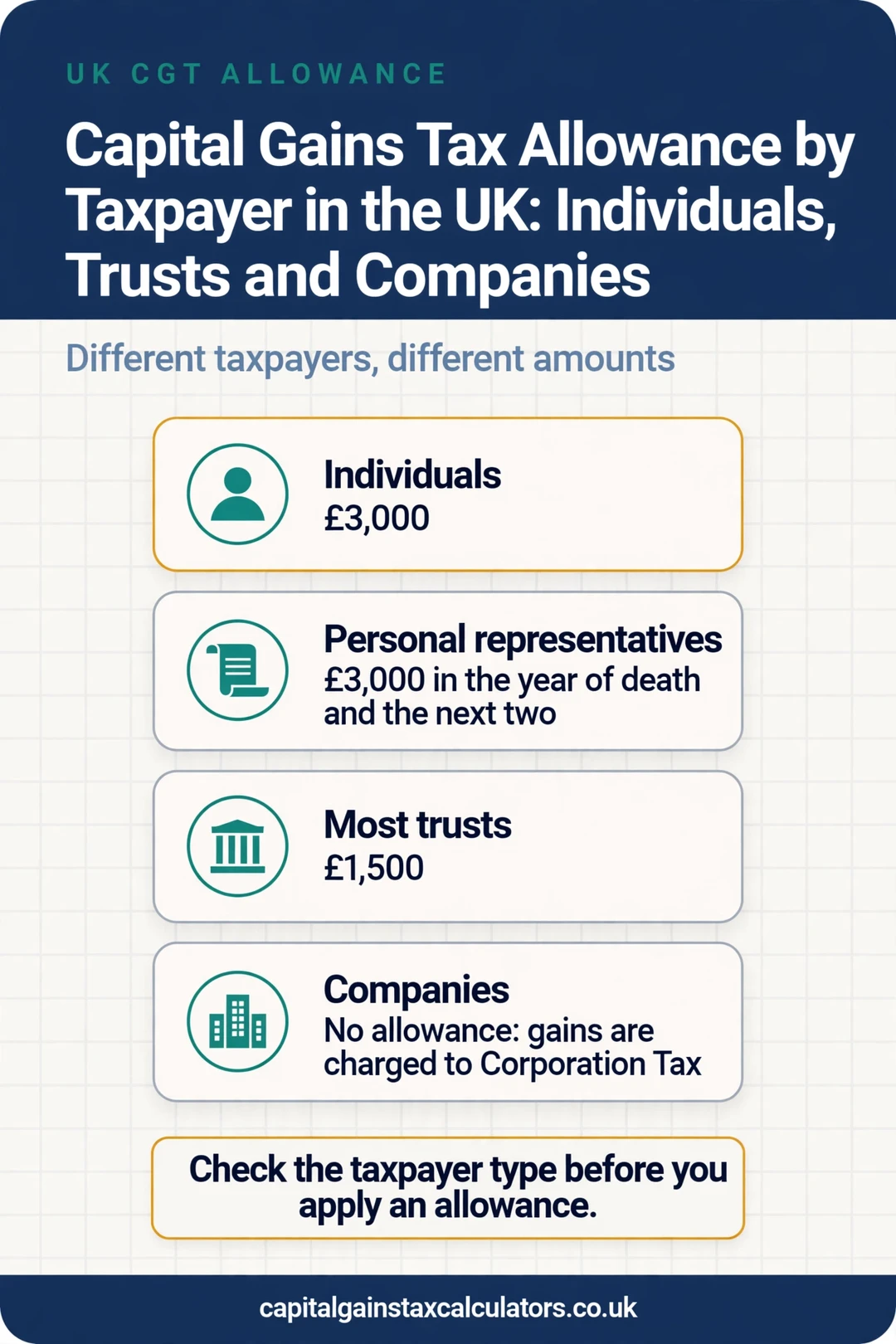
- Most trusts get £1,500, and personal representatives get £3,000 for three tax years.
- Losses are used before the allowance, with special rules for losses from earlier years.
Good to know
See your own figures
Use our Capital Gains Tax calculator to see how much of your gain the allowance covers and what tax is left.
How the allowance works
The annual exempt amount is the first slice of your net gains for the tax year. You add up all your gains and losses for the year, and the first £3,000 of the net total is free of tax. If your total is below £3,000, there is nothing to pay. If it is above, you pay tax only on the excess.
For example, if you sell shares at a gain of £10,000, the allowance covers £3,000, and £7,000 is taxed. With an income of £50,000 the whole taxable gain falls in the 24% band, so the tax is £1,664.
You do not claim the allowance. It is applied automatically if you report your gains correctly. You still need to report if the proceeds from all your disposals are over £50,000, even if the allowance means no tax is due.
Who gets an allowance
| Person | Allowance in 2026/27 | Notes |
|---|---|---|
| Individual | £3,000 | Each person has their own |
| Spouse or civil partner | £3,000 each | Not transferable between you |
| Personal representatives | £3,000 | Tax year of death and next two tax years |
| Most trustees | £1,500 | Half the individual figure |
| Trustees of trusts for vulnerable beneficiaries | £3,000 | Where the special rules apply |
| Non-residents | £3,000 | On UK property and land gains |
| Companies | None | Corporation Tax applies instead |
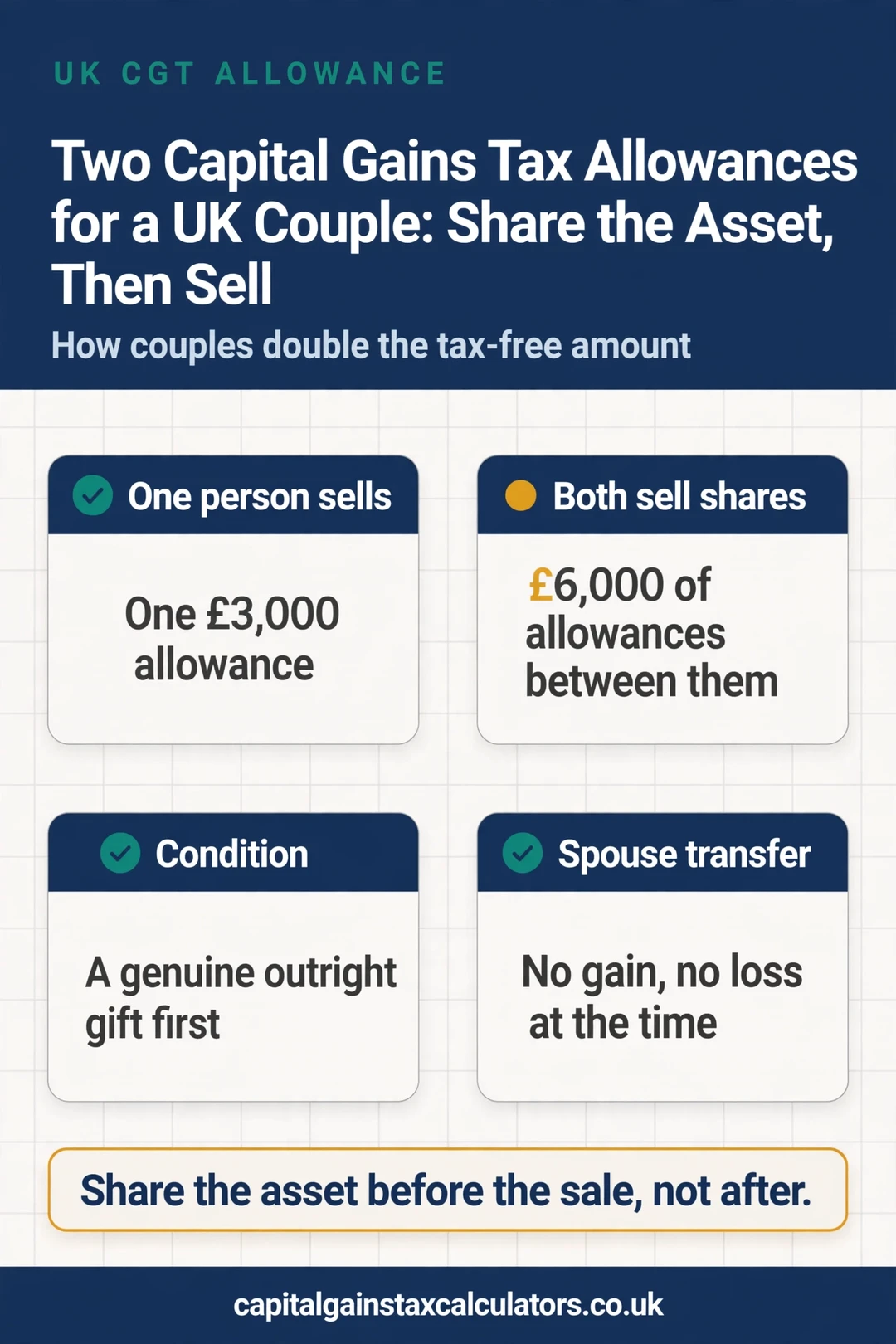
The allowance for a couple is therefore £6,000 if both have gains to use it against. This is why sharing an asset between spouses before a sale can save tax. Our spouse transfer calculator shows how much.
The order of set-off
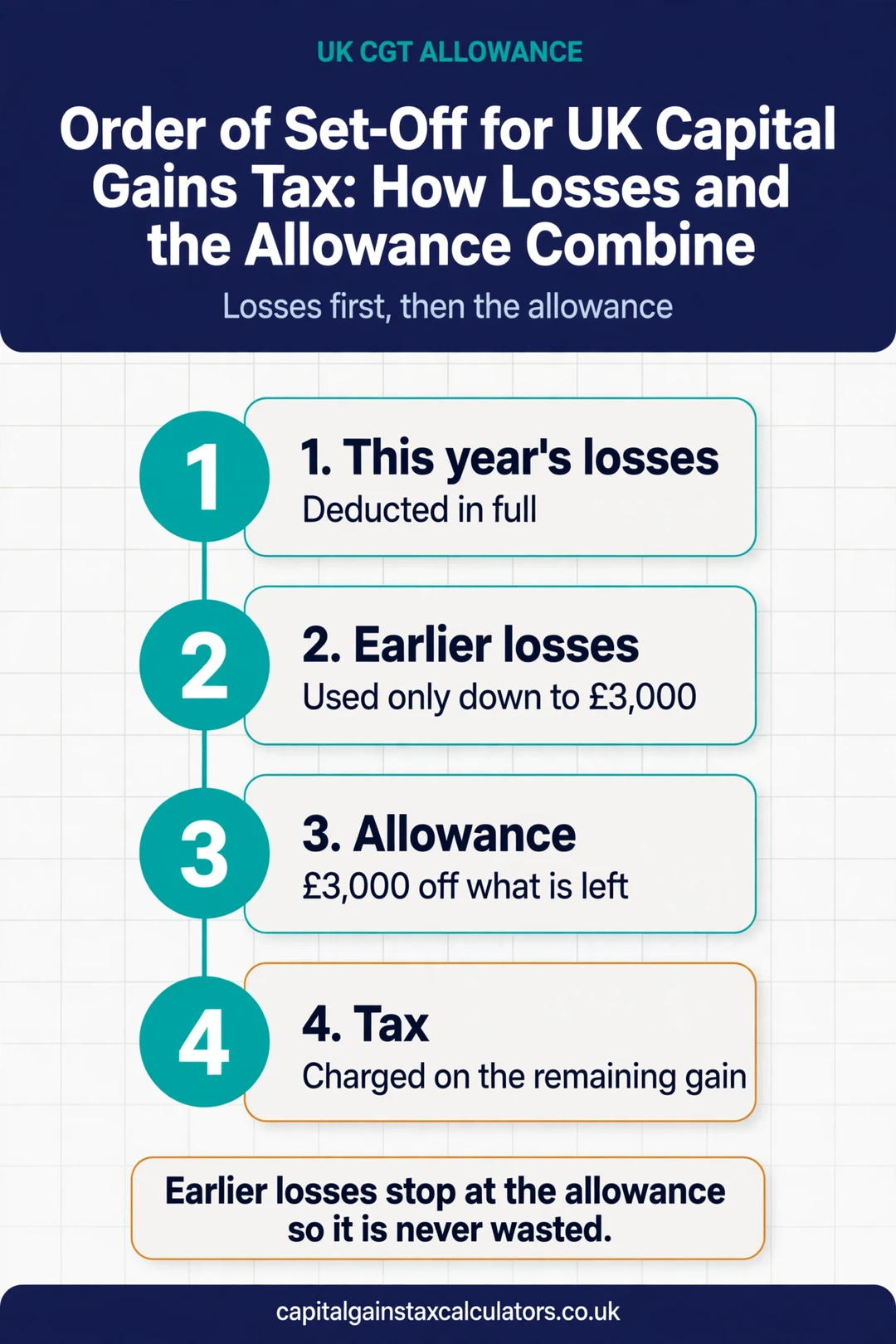
HMRC applies the reductions in a set order. Getting the order right can change your tax bill.
- Current-year losses are set against current-year gains first, in full.
- Brought-forward losses are then used, but only enough to reduce your gain to the allowance, not below it.
- The annual exempt amount is applied to what is left. It goes against gains taxed at the highest rate first.
Worked example
Gains with losses
You make gains of £10,000 this year. You also have a £4,000 loss from this year and £5,000 of losses brought forward.
- Gains less this year’s loss: £6,000.
- Brought-forward losses needed: only £3,000, to reduce the gain to the allowance.
- Allowance: £3,000 covers the rest, so the taxable gain is £0 and the tax is £0.
- Losses carried forward: £2,000 remains for a future year.
The brought-forward rule matters because it means you do not waste your allowance. Losses from earlier years are saved for later when the allowance already covers your gain. Our guide to Capital Gains Tax losses has the full rules.
Allowance and Business Asset Disposal Relief
If you have both ordinary gains and gains eligible for Business Asset Disposal Relief, the allowance is set against the ordinary gains first, because they are taxed at the higher rate. With £8,000 of ordinary gains and £20,000 of relief gains, the allowance takes £3,000 off the ordinary gains, so the total taxable is £25,000. The tax is £4,800 on an income of £80,000. This ordering is automatic in the calculator.
Using two allowances as a couple
Spouses and civil partners can transfer assets to each other without tax, which lets you move a gain into the name of the person who has not used their allowance. On a gain of £12,000 sold by one higher earner, the tax is £2,160. If the asset is shared equally, each has a gain of £6,000, and the combined tax falls to £1,440. This only works if the transfer is a genuine gift made before the sale agreement. See our guide to spouse transfers.
Allowance for trusts and estates
Trustees of most trusts have half the individual allowance, which is £1,500 in 2026/27. If one person sets up several trusts, the allowance is shared between them, subject to a minimum for each. Personal representatives get the full £3,000 for the tax year of death and the following two tax years. After that, an estate has no allowance. On a gain of £8,000, a trust pays £1,560 and a personal representative pays £1,200. See our guide to trusts and estates.
How the allowance has changed
The allowance used to be much higher. It was £12,300 in the 2022/23 tax year, £6,000 in 2023/24, and has been £3,000 since 2024/25. A smaller allowance means more people have to report a gain, and more pay tax on small gains. It also makes planning with both spouses’ allowances worth more than before, because each unused £3,000 is wasted if it is not used in the year.
| Tax year | Individual allowance |
|---|---|
| 2022/23 | £12,300 |
| 2023/24 | £6,000 |
| 2024/25 and later years, including 2026/27 | £3,000 |
Do I need to report gains that are inside the allowance?
A gain that is fully covered by the allowance creates no tax, but it does not always mean you can ignore it. You need to report your gains on a Self Assessment tax return if the total proceeds from all your disposals in the tax year are over £50,000, even when no tax is due. You also need to report if you want to claim a loss, or if you have gains above the allowance. If you are not in Self Assessment and your gains and proceeds are below those limits, you normally have nothing to report. Keep your calculation, because HMRC can ask for it later. Our reporting guide explains the routes.
How to make the most of the allowance
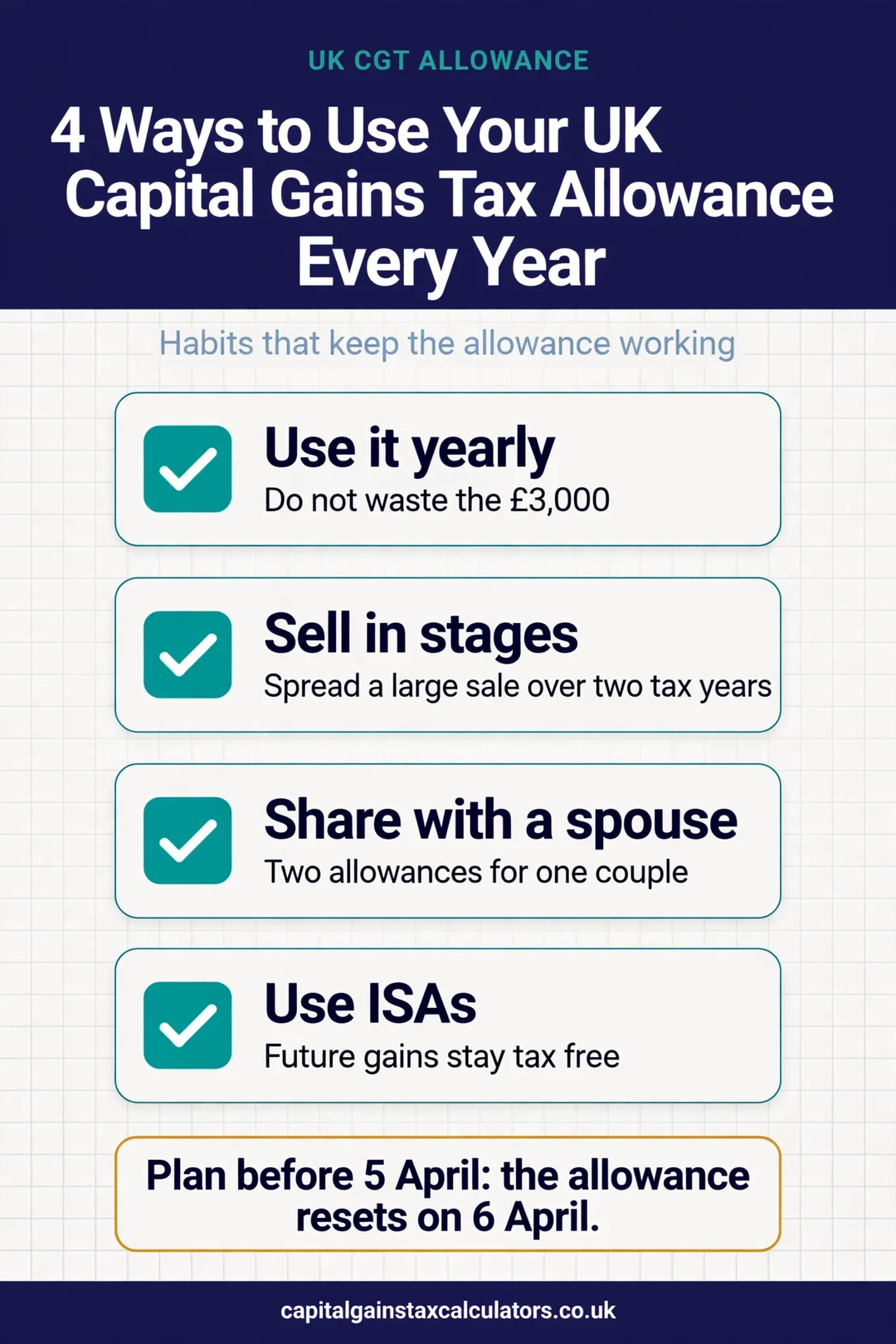
- Use it every year. An unused allowance disappears on 5 April.
- Sell in stages. Spread large gains across tax years to use more than one allowance.
- Share assets with a spouse. Two allowances are better than one.
- Hold investments in ISAs. Gains inside an ISA do not use the allowance at all.
- Watch the 30-day rule. A quick rebuy can undo your planned gain.
- Keep records. You need the figures to show the allowance was applied.
Common mistakes with the allowance
- Applying it to each asset. It applies once to your total net gains.
- Assuming it carries forward. It is lost if unused.
- Counting it twice for a couple. Each person has one, set against their own gains.
- Forgetting it is cut for trusts. Most trusts have £1,500.
- Using losses wrongly. Brought-forward losses are used only down to the allowance.
- Not reporting. Gains under the allowance may still need reporting if proceeds are over £50,000.
What to do next
- Add up all your gains and losses for the tax year.
- Check how much allowance is left.
- Use the calculator to see the tax on any excess.
- Read how to reduce Capital Gains Tax for planning ideas.
Frequently asked questions
What is the Capital Gains Tax allowance for 2026/27?
£3,000 for individuals and personal representatives, and £1,500 for most trustees. It is the amount of net gains you can make in a tax year before paying tax.
Can I carry forward an unused allowance?
No. An unused annual exempt amount is lost at the end of the tax year on 5 April. You cannot add it to the next year’s allowance.
Do I have to claim the allowance?
No. It is applied automatically when your gains are reported. You must still report your gains if your total proceeds are over £50,000 or if you want to claim a loss.
Does my spouse have a separate allowance?
Yes. Spouses and civil partners each have their own allowance, and they cannot transfer it to each other. They can transfer assets, though, to use both.
Is the allowance per asset or per year?
Per tax year. It is set against your total net gains from all disposals in that year.
How do losses affect the allowance?
Current-year losses come off your gains before the allowance. Losses from earlier years are only used to bring your gain down to the allowance, so they are saved if the allowance already covers it.
Do I get an allowance if I live abroad?
Non-residents have an allowance on gains they must pay tax on, which means UK property and land. See our non-resident guide.
Does the allowance apply to gains in an ISA?
Gains in an ISA are exempt and do not use the allowance. You can use the allowance on other investments in the same year.
What if my gain is under the allowance?
You pay no tax. You may still need to report the sale if your total proceeds are over £50,000.
Why has the allowance fallen?
The Government has reduced it in recent years. It was £12,300 in 2022/23 and has been £3,000 since 2024/25. Check GOV.UK for the current figure.
Official sources
- GOV.UK: Capital Gains Tax annual exempt amount
- GOV.UK: Capital Gains Tax rates and allowances
- GOV.UK: Reduce your Capital Gains Tax bill
Related guides and calculators
This page gives general information for UK taxpayers and is not tax advice. Capital Gains Tax rules can change and your own circumstances matter. Check the latest rules on GOV.UK or with a qualified tax adviser before you act.