Quick answer
You pay Capital Gains Tax when you sell a UK property that is not your main home, such as a second home, buy-to-let or land. The gain is the sale price less what you paid and your allowable costs. After the £3,000 allowance, it is taxed at 18% or 24% for 2026/27. If tax is due, you must report it and pay within 60 days of completion.
Key facts
- Your main home is usually exempt under Private Residence Relief. Second homes and buy-to-lets are not.
- The gain is the sale price less the purchase price, buying and selling costs and capital improvements.
- Rates are 18% and 24% in 2026/27, after the £3,000 allowance.
- UK residential property sales with tax due must be reported and paid within 60 days of completion.
- Joint owners each report and pay on their own share.
Good to know
Estimate your property tax
Use our property Capital Gains Tax calculator to enter your price, costs and income and see the tax and the 60-day deadline.
When Capital Gains Tax applies to property
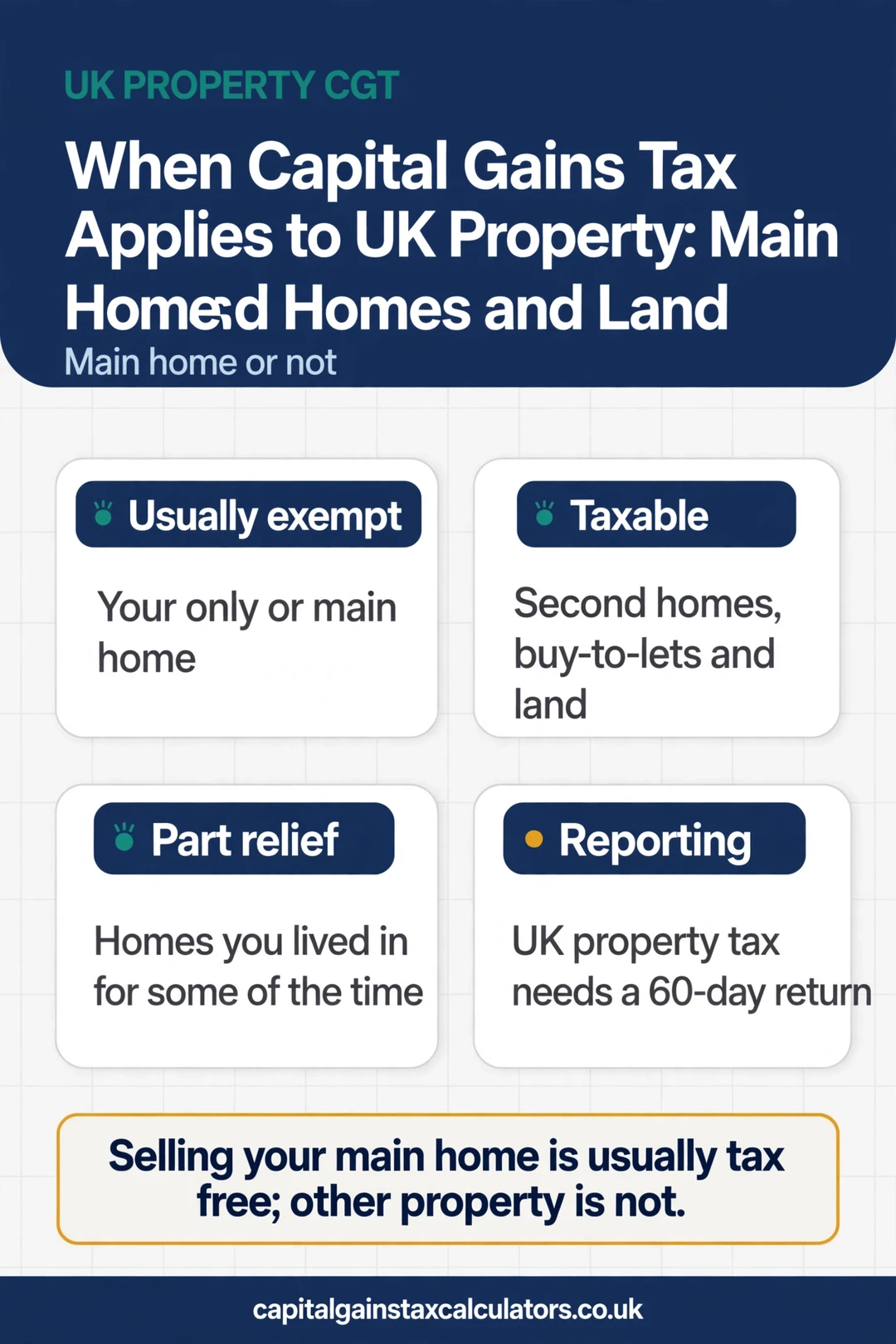
Selling a property triggers Capital Gains Tax if it was not your only or main home for the whole time you owned it. The most common taxable cases are:
- A second home or holiday home.
- A buy-to-let or other rental property.
- A home you inherited and did not live in.
- A property you gifted or sold below market value to someone else.
- Land and non-residential property, such as commercial buildings.
- A home that you let out, or used partly for business.
You do not pay when you sell a home that has been your main residence throughout, as long as the garden is within 5,000 square metres and you did not use the property mainly for business. Part-use as your home can still give part relief. Read the Private Residence Relief guide.
How the gain on a property is worked out
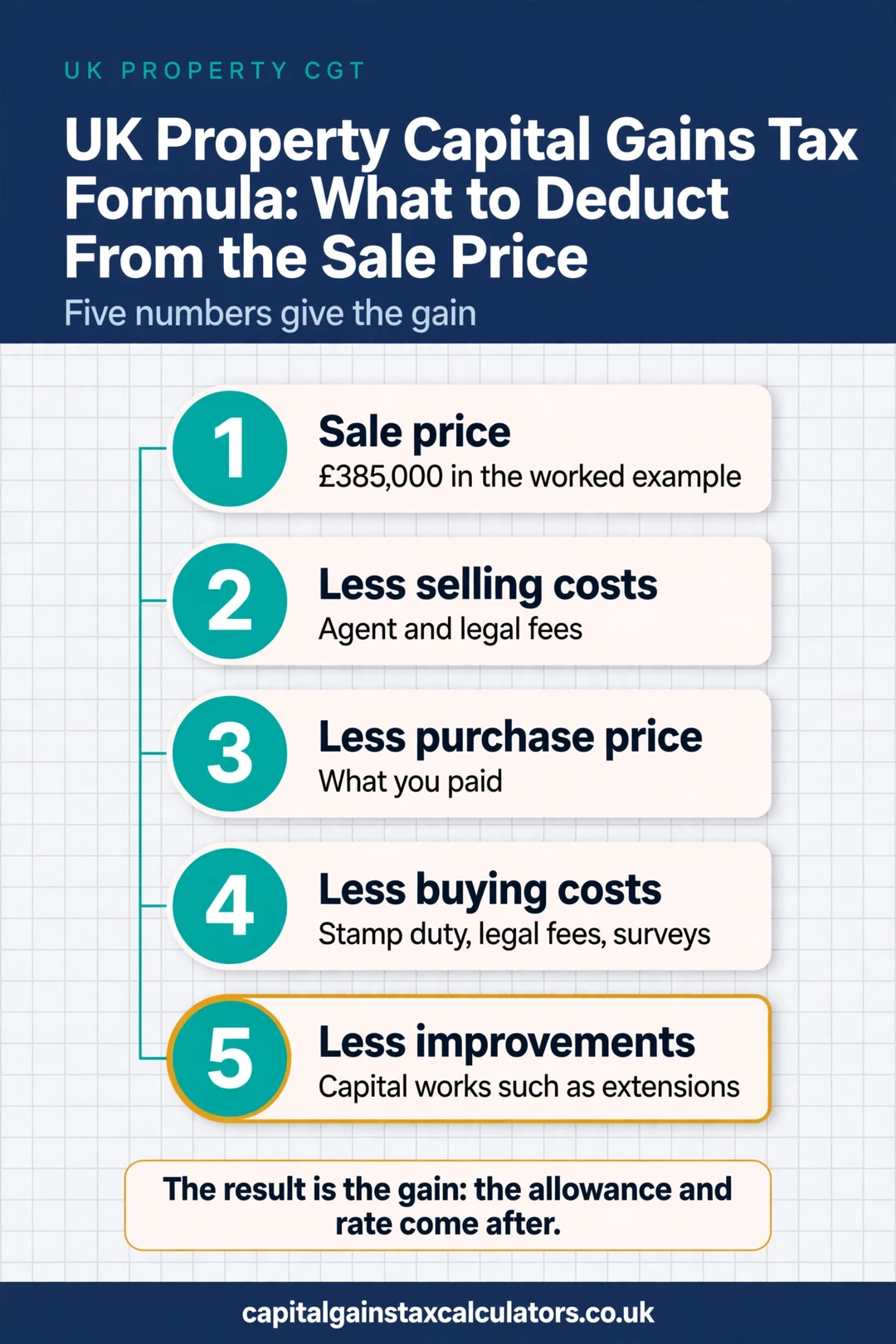
Work out the gain in four steps. Take the sale price, deduct the selling costs, deduct the original purchase price, and deduct the buying costs and capital improvements. If you owned the property jointly, split the gain by ownership share.
Worked example
Selling a second home
- Sale price: £385,000.
- Less selling costs: £6,900 for agent and legal fees.
- Less purchase price: £240,000.
- Less buying costs: £8,200 for Stamp Duty Land Tax and fees.
- Less improvements: £18,000 for an extension.
- Gain: £111,900.
- After the allowance: £108,900 taxable. With an income of £48,000, £2,270 is at 18% and £106,630 at 24%.
- Tax: £26,000.
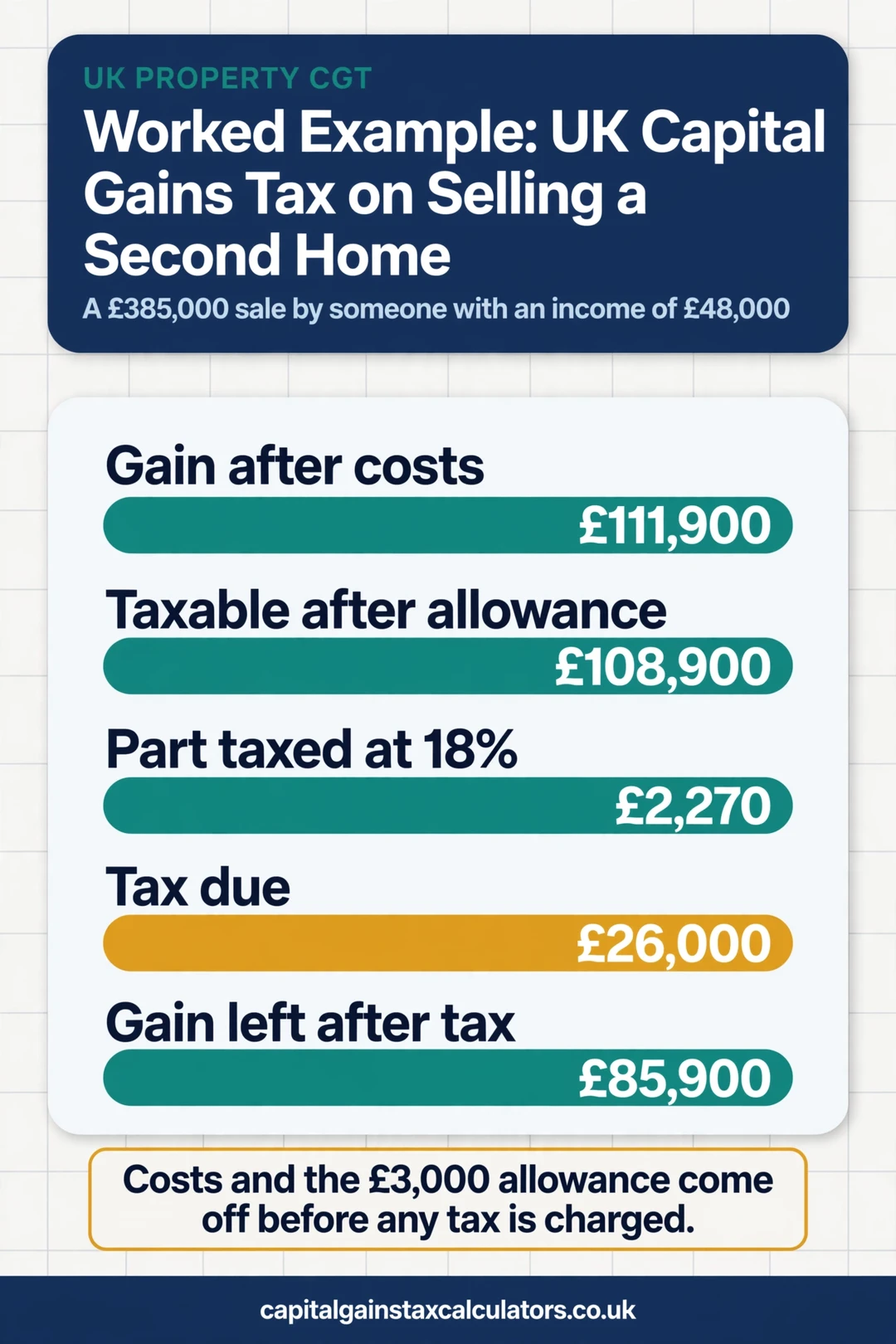
Without the improvement costs, the gain would be £129,900 and the tax £30,320. For a higher earner on £110,000, the whole taxable gain would be at 24%, and the tax would be £26,136. If the property is owned equally with a partner, each has a gain of £55,950, and each uses an allowance.
Costs you can deduct
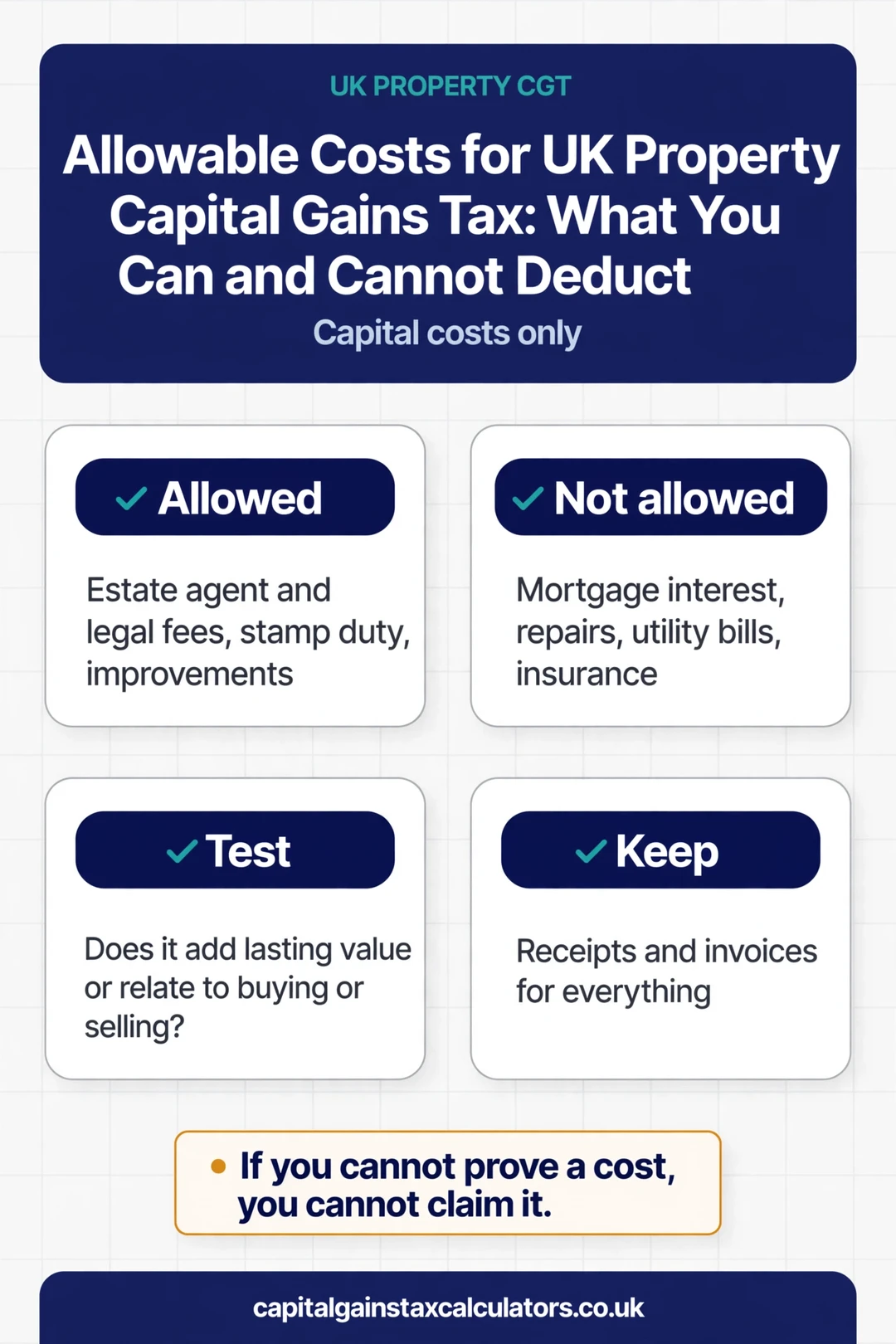
Only costs that relate to the property itself count. Keep the evidence for each one.
| Cost | Deductible? | Notes |
|---|---|---|
| Purchase price | Yes | The base of the calculation |
| Stamp Duty Land Tax paid on buying | Yes | Added to the cost |
| Solicitor and surveyor fees when buying | Yes | Include conveyancing costs |
| Estate agent and legal fees when selling | Yes | Reduce the sale price |
| Capital improvements such as an extension | Yes | Must still be reflected in the property when you sell |
| Mortgage interest | No | Not a capital cost |
| Repairs and redecoration | No | Treated as running costs |
| Council tax, insurance and utilities | No | Running costs |
| Capital Gains Tax advice fees | No | Not an allowable cost |
Repairs return a property to its earlier condition and are not deductible against the gain. Improvements add something new, such as an extension or a new conservatory, and are deductible if they are still reflected in the property at the time of sale. Replacing a kitchen that is similar in quality is usually a repair.
Second homes, buy-to-lets and inherited homes
The tax is worked out in the same way for all non-main homes, but the starting point can be different.
| Type | What counts as the cost | Reliefs to check |
|---|---|---|
| Second or holiday home | Purchase price plus costs | Private Residence Relief for any period it was your main home |
| Buy-to-let | Purchase price plus costs | Relief for periods lived in, plus the final 9 months if it was once your main home |
| Inherited property | Value at the date of death | Relief if you lived there as your main home |
| Gifted property | Market value on the day, if you received it as a gift | Hold-over relief if available |
| Property transferred by your spouse in their lifetime | Their original cost | No gain, no loss rule |
Our guides cover buy-to-let and inherited property in more detail.
Reporting and paying: the 60-day rule
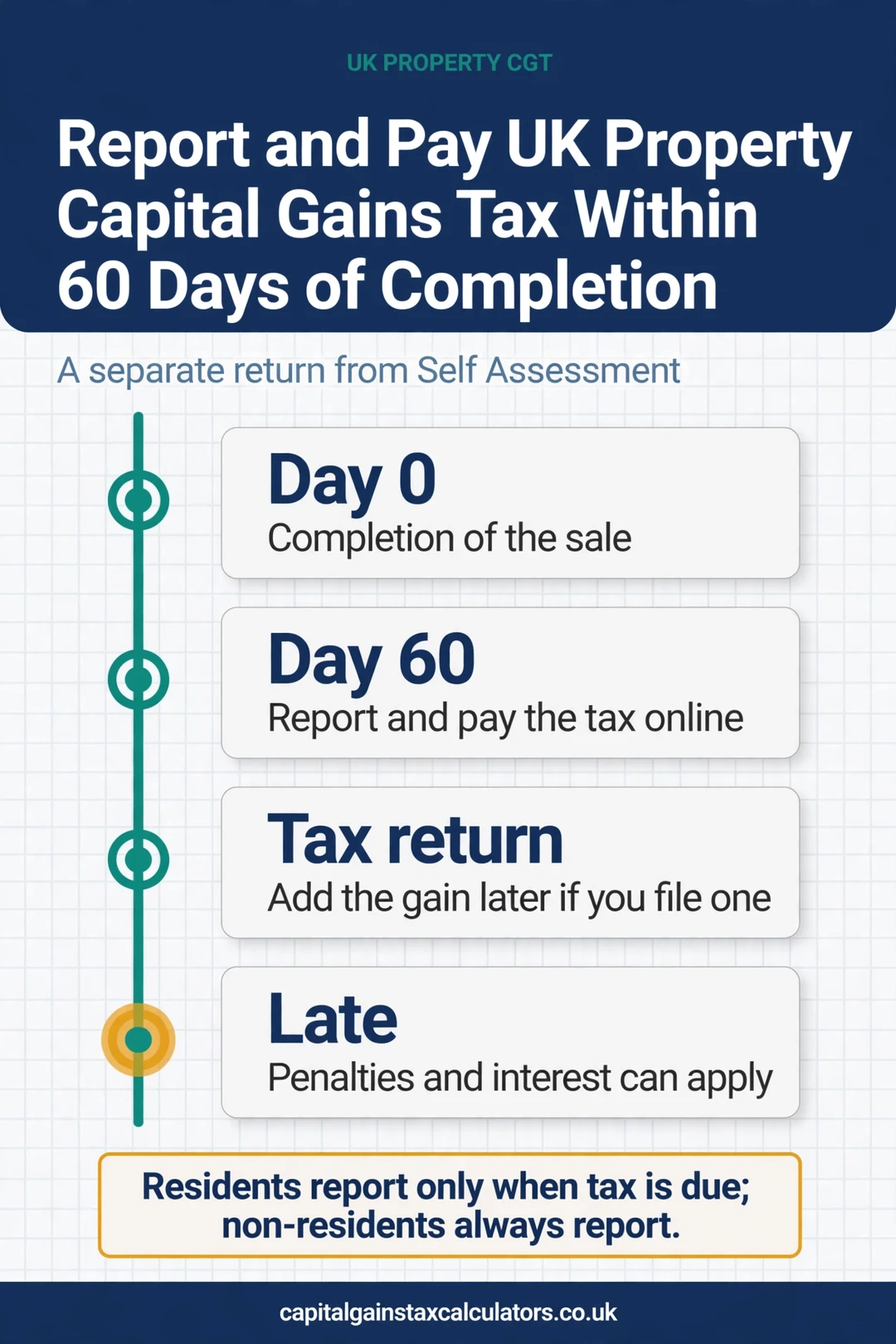
If you are a UK resident and sell UK residential property with a gain that creates tax, you must report and pay within 60 days of completion. The tax is paid through a Capital Gains Tax on UK property account. Non-residents must report all UK property disposals, with or without tax. If you file Self Assessment, you must also include the gain on your return. See our step-by-step guide to reporting a property sale and the 60-day deadline calculator.
Homes that are partly let or used for business
If you let out a room to a lodger who lives with you as part of your household, your home is usually still fully covered by Private Residence Relief. If you let a separate part of the property, or use a room only for your business, the part you use for that purpose does not qualify, and the gain on that part is taxable. For example, if one of five equal rooms is used only as an office, about one fifth of the gain may be chargeable, although this depends on how the room was used and for how long. Keep a record of how each part of the home was used and for what periods. For a whole property that you let, see our buy-to-let guide.
Joint ownership
Each owner reports and pays tax on their own share of the gain, using their own allowance and rate. For married couples and civil partners, ownership is split equally unless you hold the property in unequal shares. Unmarried co-owners are treated as owning the shares recorded on the title deeds or in a declaration of trust. If you each own half, you can often use two allowances and two basic rate bands, which can reduce the tax.
Ways to reduce the tax on a property sale
- Claim every allowable cost, including improvements.
- Check whether Private Residence Relief covers part of the period.
- Use both spouses’ allowances by sharing the property early enough.
- Time the sale around 5 April to use two tax years where possible.
- Offset losses from other disposals.
- Increase your basic rate band through pension contributions and Gift Aid.
Our guide to reducing Capital Gains Tax explains each in detail.
Common mistakes with property gains
- Forgetting the deadline. The 60 days run from completion.
- Deducting mortgage interest. It is not allowed.
- Losing improvement receipts. Keep invoices.
- Assuming a second home is exempt. Only your main home qualifies.
- Ignoring a spouse’s share. Each owner reports their own share.
- Using the wrong date. Use completion for the deadline and the contract date for the tax year.
What to do next
- Gather the purchase and sale documents and receipts for improvements.
- Run the property calculator.
- Check Private Residence Relief for any periods you lived there.
- Report and pay within 60 days using the step-by-step guide.
Frequently asked questions
Do I pay Capital Gains Tax when I sell a second home?
Yes, on the gain above your £3,000 allowance, at 18% or 24% depending on your income. Relief may cover periods when it was your main home.
How is the gain on a property calculated?
Sale price, less selling costs, purchase price, buying costs and capital improvements. The gain is then reduced by losses and your allowance before the rate is applied.
Can I deduct mortgage interest?
No. Mortgage interest is a financing cost, not a cost of the property. It may be relevant for Income Tax if you let the property.
Do I need to report a property sale if I make no gain?
A UK resident with no tax to pay does not need to send the 60-day return. You may still need to report it on Self Assessment if your total proceeds are over £50,000.
When do I pay the tax on a property sale?
Within 60 days of completion, if the property is UK residential property and you owe tax.
Does Stamp Duty Land Tax count as a cost?
Yes. Stamp Duty Land Tax you paid when you bought the property is added to your cost and reduces the gain.
What if I lived in the property for part of the time?
Private Residence Relief can cover the months you lived there, plus the last 9 months of ownership, which reduces the taxable gain.
Do I pay Capital Gains Tax on a gifted property?
A gift is treated as a sale at market value, so the giver may pay tax. A gift to a spouse or civil partner is not taxed.
How do joint owners pay the tax?
Each owner reports their own share of the gain, uses their own allowance and pays at their own rate.
Is there Capital Gains Tax on land and commercial property?
Yes. Land and commercial property are chargeable assets. Residential property has the 60-day reporting rule, and other property is reported through Self Assessment.
Official sources
- GOV.UK: Tax when you sell property
- GOV.UK: Tax when you sell your home
- GOV.UK: Report and pay Capital Gains Tax on UK property
- GOV.UK: Capital Gains Tax rates
Related guides and calculators
This page gives general information for UK taxpayers and is not tax advice. Capital Gains Tax rules can change and your own circumstances matter. Check the latest rules on GOV.UK or with a qualified tax adviser before you act.