Quick answer
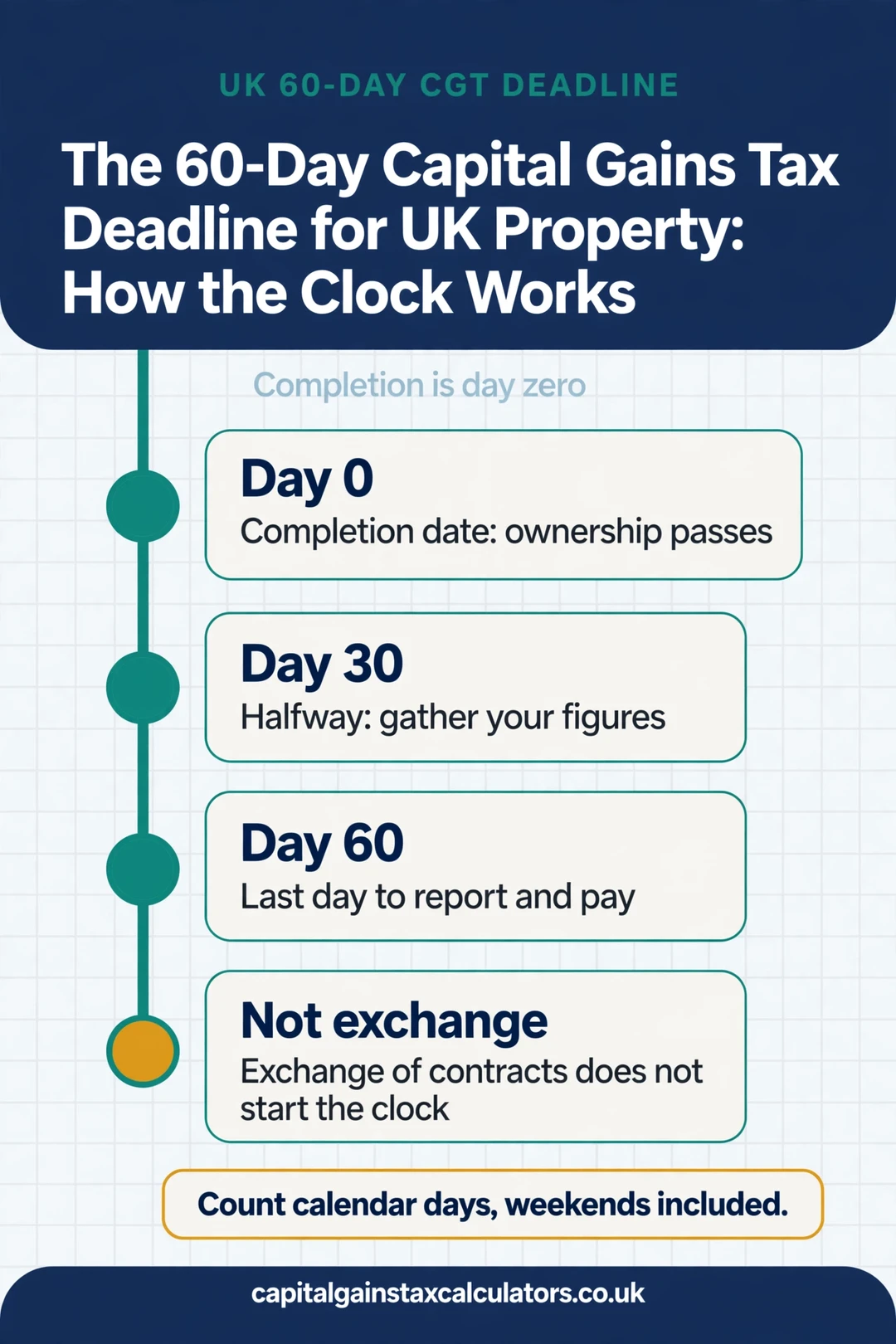
If you sell UK residential property and owe Capital Gains Tax, you must report the gain and pay the tax within 60 days of completion. Count 60 days from the completion date, not from exchange of contracts. Enter your completion date above to see the exact deadline, and the days left. Non-residents must report every UK property sale within the same time, even when no tax is due.
Key facts
- The deadline is 60 days from completion, not exchange of contracts.
- It applies to UK residential property sales that have tax to pay, including gifts and some transfers.
- Non-residents must report all disposals of UK property or land, whether or not there is tax to pay.
- UK residents with no tax to pay do not need to send the 60-day return.
- Late reporting or payment can lead to a penalty and interest.
How this calculator works
Enter the completion date of your sale and tell the calculator whether you are UK resident and whether any tax is due. It adds 60 days to the completion date and shows the final date for reporting and paying. It also shows the tax year of the sale, the number of days left from today and what you need to file.
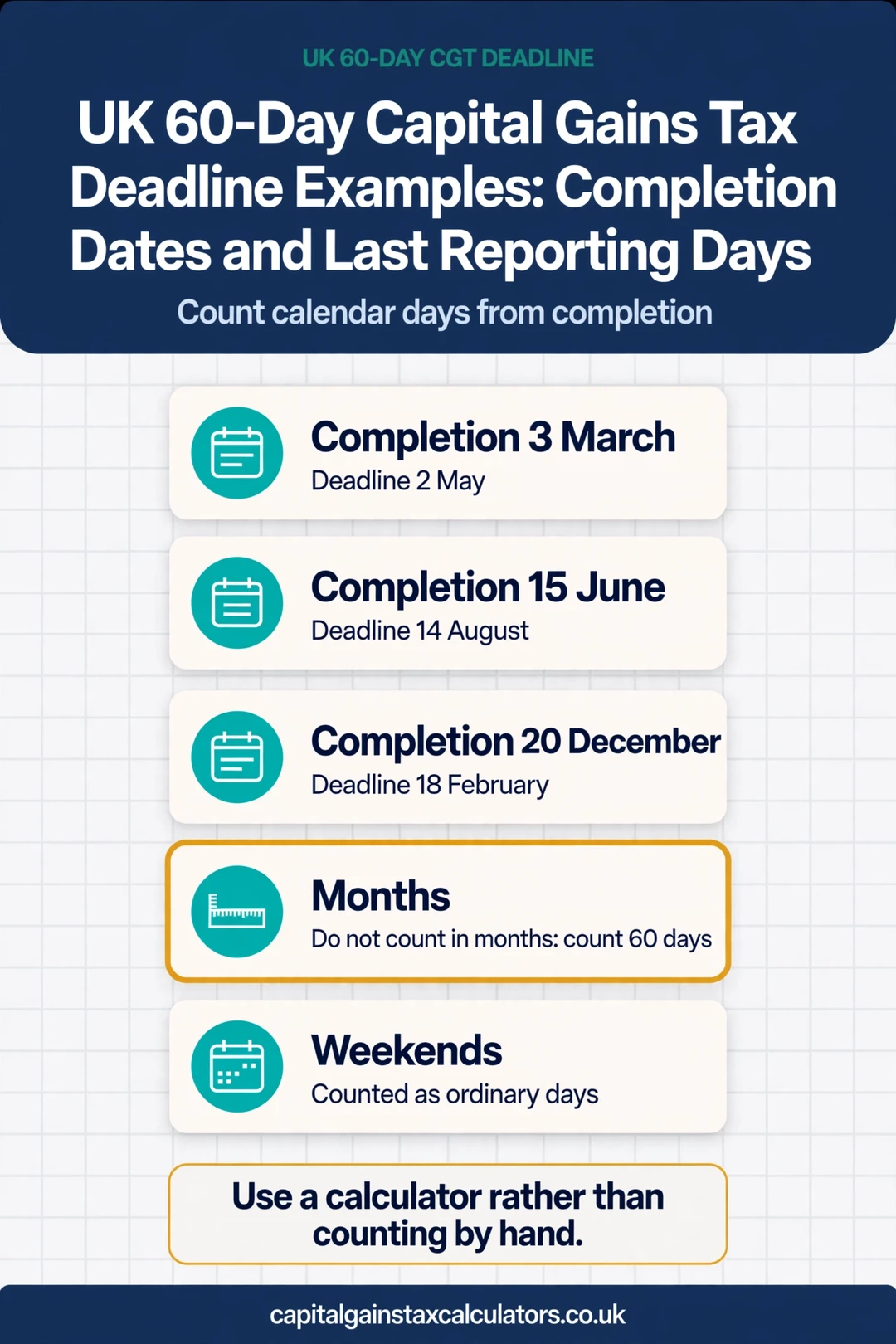
The calculator counts calendar days, including weekends and bank holidays. HMRC does not extend the deadline for weekends, so aim to file well before the last day.
| Input | What to enter | Tip |
|---|---|---|
| Completion date | The day the sale legally completed | Use the date on the completion statement |
| UK resident | Whether you were UK resident for the tax year | Non-residents always report |
| Tax due | Whether you expect any Capital Gains Tax | Residents with no tax due need no return |
Worked examples of the 60-day deadline
The deadline is easiest to understand by counting. Here are three examples with different completion dates.
| Completion date | Day 60 | Tax year of the sale |
|---|---|---|
| 3 March | 2 May | The tax year that ends on the next 5 April |
| 15 June | 14 August | The tax year that began on the previous 6 April |
| 20 December | 18 February | The tax year that ends on the next 5 April |
Worked example
Completing on 15 June
- Day 0: 15 June, the day of completion.
- Day 16: 1 July.
- Day 47: 1 August.
- Day 60: 14 August, the last day to report and pay.
- Tip: Aim to file by the end of July so that a mistake does not cost you the deadline.
The deadline is a hard limit that applies in the tax year of the sale. A sale in March still has a 60-day deadline that falls after the end of the tax year, even though the gain is part of the earlier tax year for Self Assessment.
Who must report within 60 days
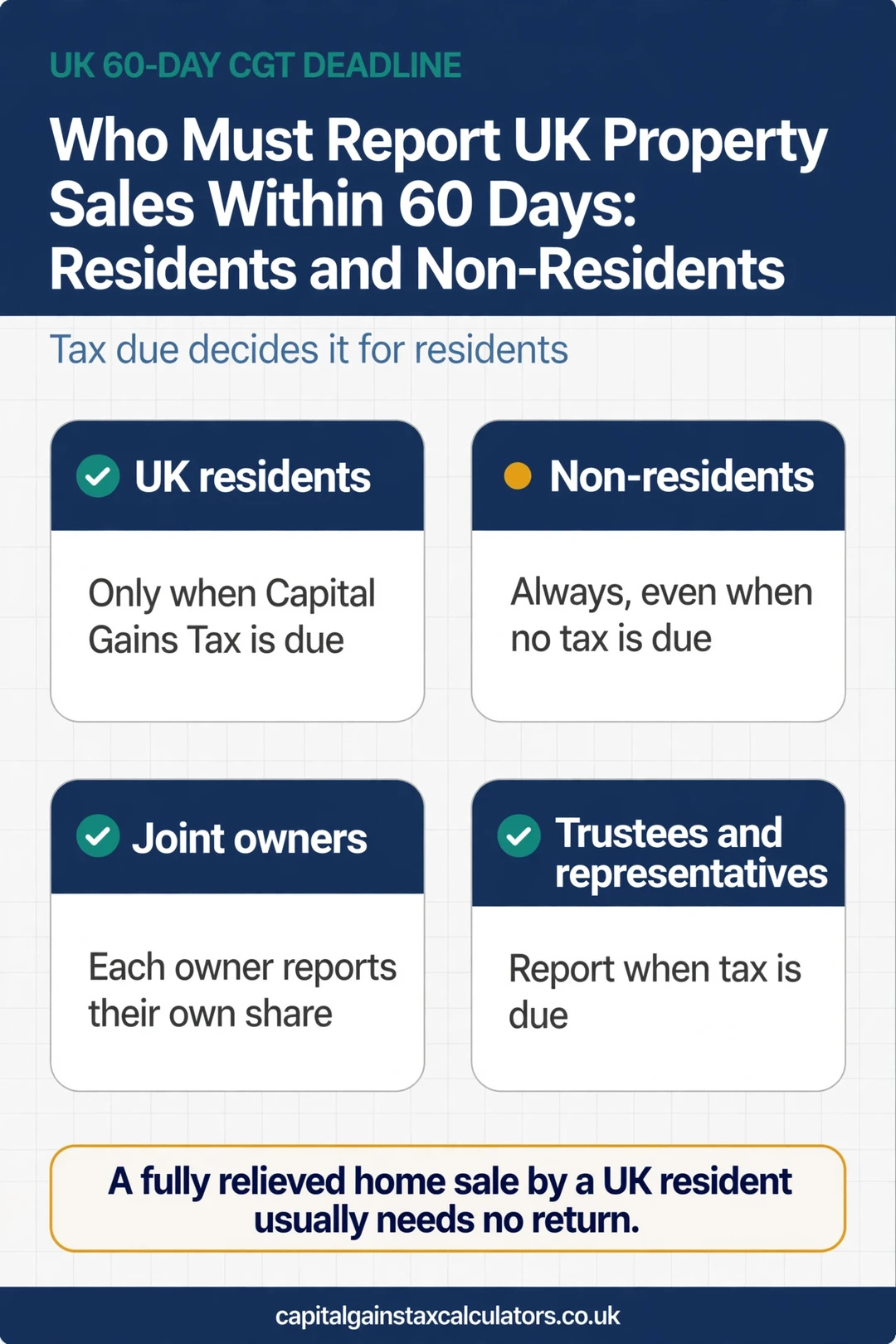
| Situation | Must report within 60 days? | Notes |
|---|---|---|
| UK resident selling UK residential property with tax to pay | Yes | Report and pay |
| UK resident selling UK residential property with no tax to pay | No | Still report on Self Assessment if required |
| Non-resident selling any UK property or land | Yes | Report even with no tax |
| Joint owners | Yes, each for their own share | Each owner files separately |
| Personal representatives | Yes, report for the estate | Estates cannot pay through the account |
| Gift of UK residential property with a gain | Yes | Date of the gift counts |
What you need to file
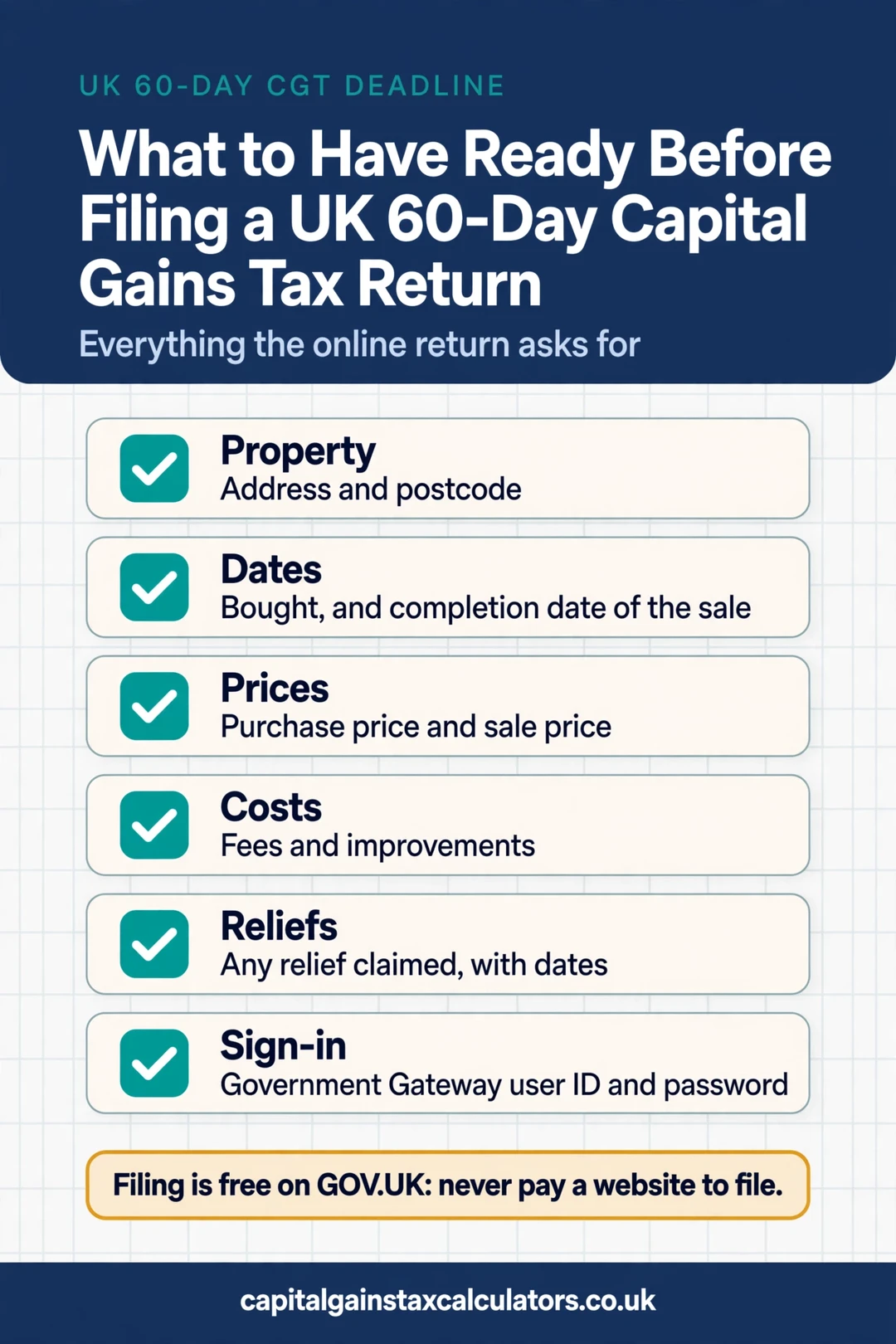
You report through a Capital Gains Tax on UK property account on GOV.UK. Have the following ready:
- The address of the property and its postcode.
- The date you acquired it and the date of completion.
- The sale price and the market value if it was a gift.
- Your allowable costs, such as buying fees, improvements and selling costs.
- Any reliefs you claim, such as Private Residence Relief.
- Your income details, so the tax can be calculated.
You must pay the tax at the same time. The report gives you a payment reference. Our step-by-step reporting guide explains each screen.
Self Assessment still matters
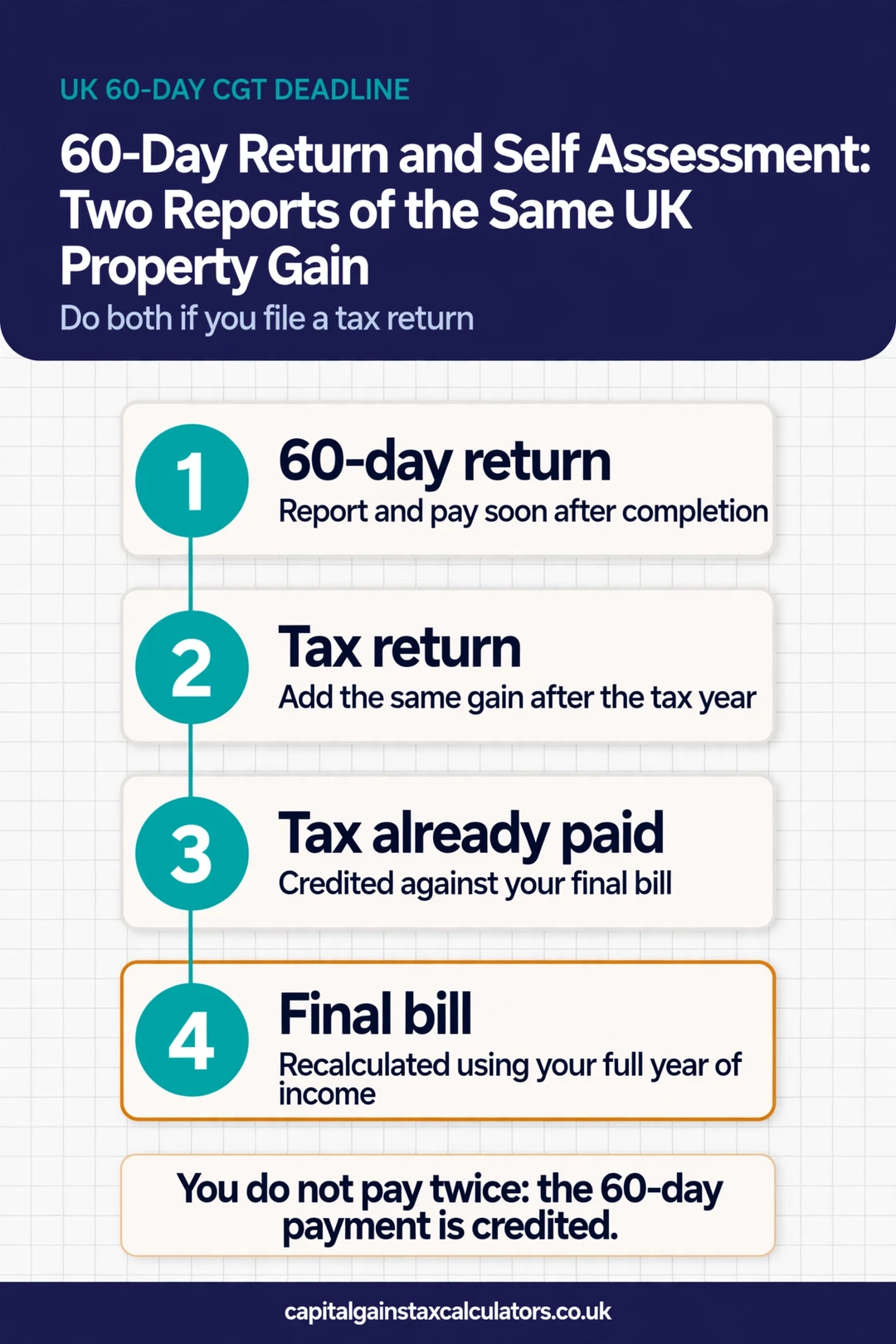
Reporting through the 60-day return does not replace Self Assessment. If you are in Self Assessment, you must also include the gain on your tax return for that year, and you can deduct the tax already paid. If you are not in Self Assessment, the 60-day return is normally enough, unless HMRC asks you to complete a return. The deadline for the tax return is 31 January after the end of the tax year.
What happens if you miss the deadline
Report and pay as soon as you can. HMRC charges interest from the date the tax was due, and a penalty that depends on how late the report and payment are. Penalties rise the longer you wait. If you have a reasonable excuse, such as a serious illness, explain it when you report. Our reporting guide has the steps for a late report.
What this calculator does not cover
- The amount of tax. Use the property calculator for that.
- Sales of shares, crypto or other assets, which follow the general reporting routes.
- Estates and trusts, which have their own reporting rules.
- Disposals with no completion date, such as some gifts, where you use the date the asset passes.
- Rule changes that HMRC announces after the figures on this page were set.
Common mistakes with the deadline
- Counting from exchange. The clock starts at completion.
- Waiting for the tax return. The 60-day return is separate.
- Assuming no tax means no report for non-residents. They must report.
- Leaving joint owners to share one report. Each owner reports their own share.
- Not paying at the same time. The tax is due by the same date.
- Ignoring gifts. A gift with a gain has a deadline too.
What to do next
- Enter your completion date above and note the final date.
- Work out the gain and tax with the property calculator.
- Set up your Capital Gains Tax on UK property account.
- File and pay using our step-by-step guide.
- Add the gain to your tax return if you are in Self Assessment, as shown in our general reporting guide.
Frequently asked questions
What is the 60-day Capital Gains Tax rule?
If you sell UK residential property and owe Capital Gains Tax, you must report the gain and pay the tax within 60 days of completion. Non-residents must report every UK property disposal in the same time.
When do the 60 days start?
On the completion date of the sale, not on exchange of contracts. For a gift, the clock starts on the date of the gift.
Do I need to report if there is no tax to pay?
UK residents with no tax to pay do not need to send the 60-day return. Non-residents always do. You may still need to report on Self Assessment if your total proceeds are over £50,000.
Is the 60-day deadline extended at weekends?
No. HMRC counts calendar days, so a weekend or bank holiday on day 60 does not move the date. File before the deadline to be safe.
Does it apply to shares or crypto?
No. The 60-day rule only applies to UK property. Gains on shares, crypto and other assets are reported through Self Assessment or the real-time service.
What if I own the property with someone else?
Each joint owner reports their own share and pays their own tax within the deadline. One report does not cover both owners.
What if I miss the deadline?
Report and pay as soon as possible. HMRC charges interest and a penalty that depends on how late you are. A reasonable excuse can reduce or remove the penalty.
Does the 60-day return replace my tax return?
No. If you are in Self Assessment, you must also include the gain on your tax return and deduct the tax you already paid.
Can personal representatives pay through the account?
Personal representatives must report for the estate, but they cannot pay through the online account. They use the payment details provided by HMRC.
Is the date this calculator shows legally binding?
It is an estimate based on a simple count of 60 days. Check it against your completion statement and file early.
Official sources
- GOV.UK: Report and pay your Capital Gains Tax
- GOV.UK: Report and pay Capital Gains Tax on UK property
- GOV.UK: Capital Gains Tax penalties
Related guides and calculators
This page gives general information for UK taxpayers and is not tax advice. Capital Gains Tax rules can change and your own circumstances matter. Check the latest rules on GOV.UK or with a qualified tax adviser before you act.