Quick answer
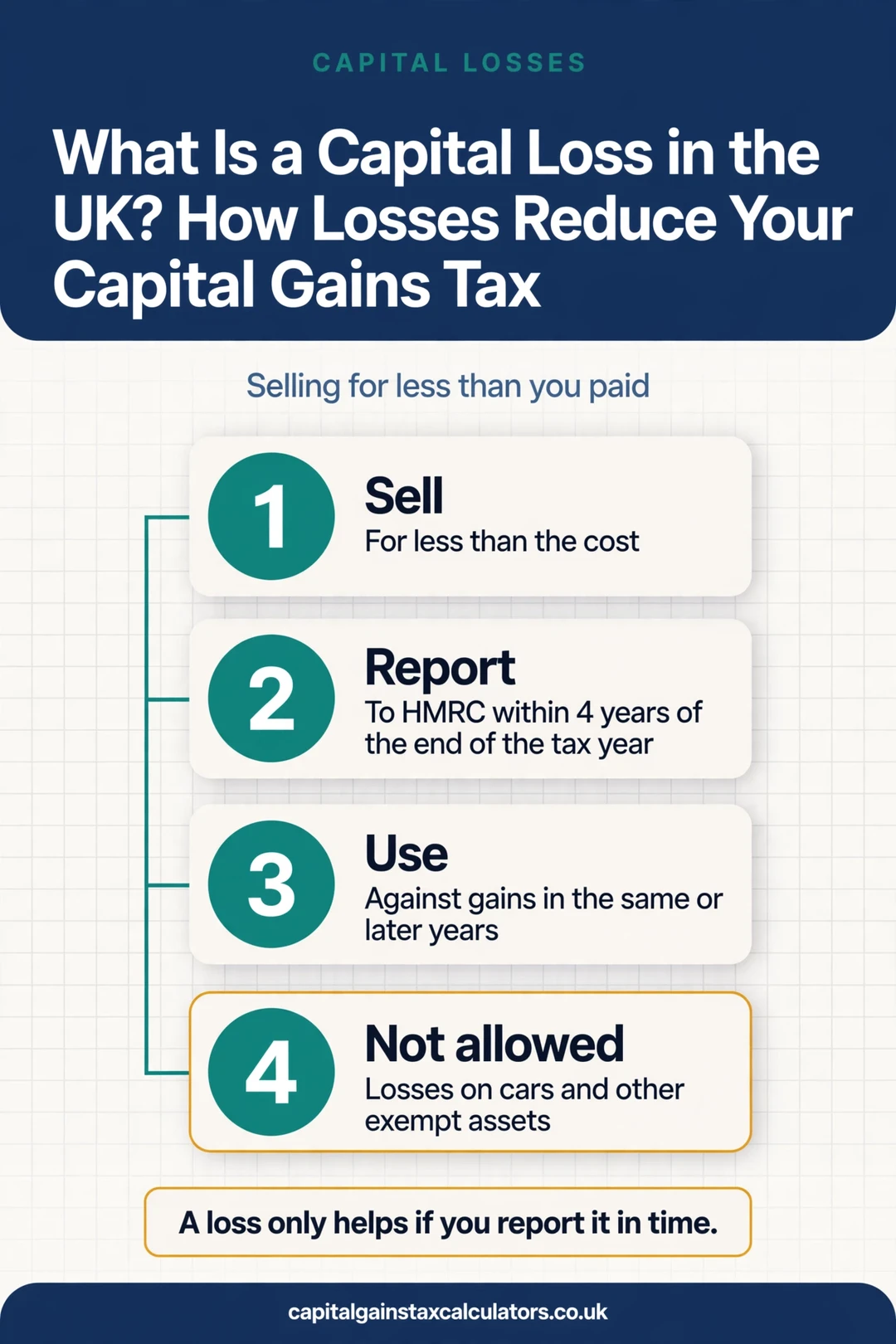
A Capital Gains Tax loss arises when you sell an asset for less than it cost. You can set the loss against gains in the same tax year, and carry any unused amount forward to future years. To keep a loss for future use, you must report it to HMRC within four years of the end of the tax year in which you made it. Losses brought forward are used only to reduce your gains to the £3,000 allowance, not below it.
Key facts
- Losses on assets you sold are set against gains in the same tax year first, in full.
- Unused losses carry forward without limit, but you must report them within 4 years of the end of the tax year.
- Losses brought forward are used only to bring your gains down to the £3,000 allowance.
- You cannot use a capital loss against your income, except in a few special cases.
- Losses on a sale to a connected person, such as a relative or your company, are restricted.
- Losses on exempt assets, such as a car, an ISA or your main home, are not allowable.
Good to know
Use the calculators
Enter your losses under “More options” in our Capital Gains Tax calculator to see how they reduce your tax bill.
What counts as a capital loss
A loss arises when the disposal proceeds, after your selling costs, are less than the cost of the asset, including buying costs and improvements. The same rules that apply to a gain also apply to a loss, including the use of market value for gifts and sales to connected persons.
Common sources of losses include:
- Selling shares or funds for less than the pooled cost.
- Selling crypto at a loss.
- Selling a buy-to-let or second home for less than it cost.
- Selling an inherited property for less than its probate value.
- Shares that have become worthless, through a negligible value claim.
Not all losses are allowable. A loss on an asset that is exempt from Capital Gains Tax cannot be used. That includes your main home, a car, assets in an ISA or pension, and personal belongings worth less than £6,000. A loss on a home that was your main residence is also not allowable.
How losses are set against gains
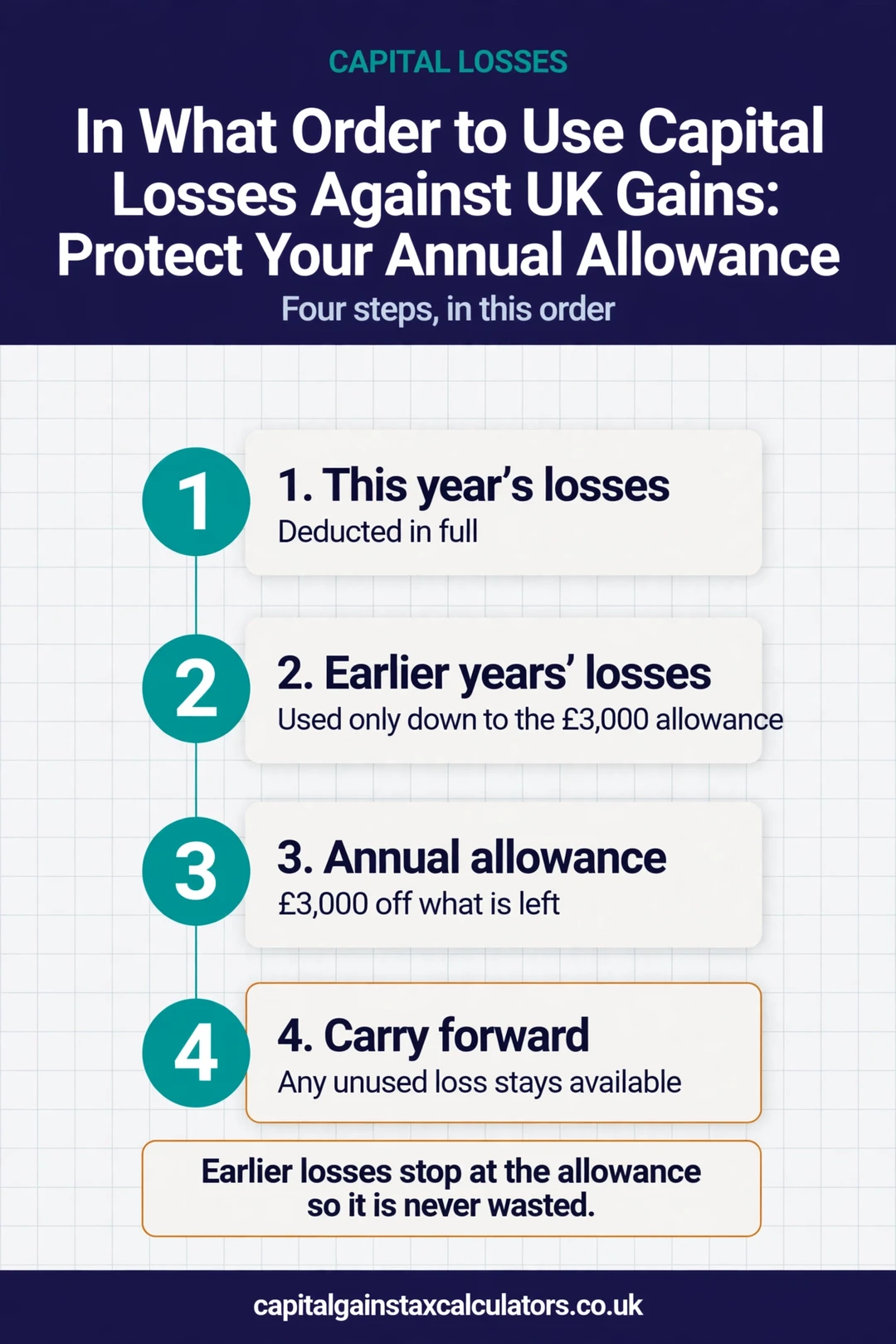
HMRC applies losses in a set order, and it is important to understand it, because it affects both your tax and your carried-forward balance.
| Step | What is applied | How much |
|---|---|---|
| 1 | Current-year losses | In full, against current-year gains |
| 2 | Brought-forward losses | Only enough to reduce the gain to the annual exempt amount |
| 3 | Annual exempt amount | £3,000 |
| 4 | Remaining gain | Taxed at 18% or 24% |
Worked example
Using this year’s loss
You make a gain of £12,000 on shares and a loss of £5,000 on a fund in the same tax year. Your income is £50,000.
- Net gain: £12,000 less £5,000 = £7,000.
- After the allowance: £4,000 is taxable.
- Tax: £944.
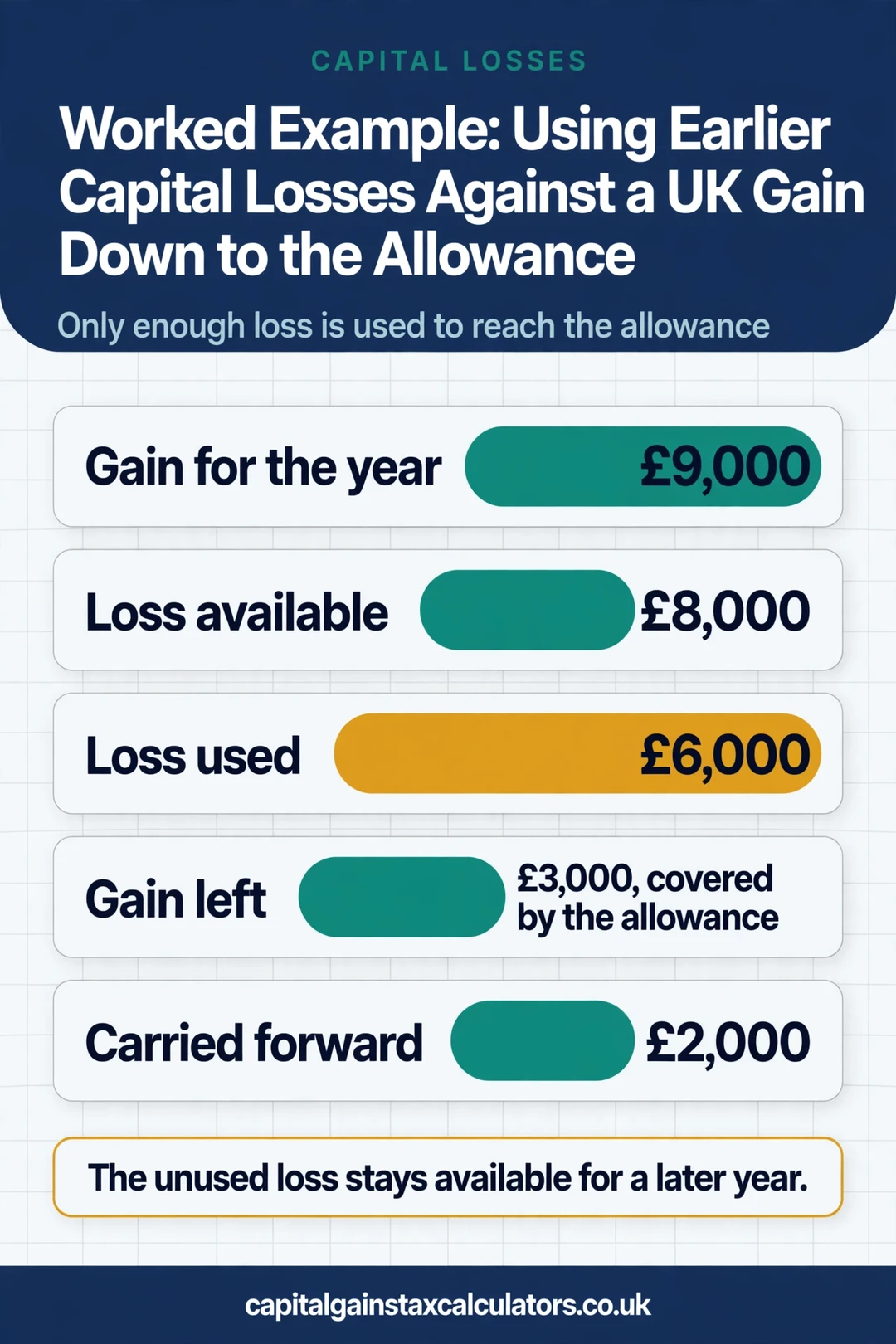
If you have a gain of £9,000 and losses of £8,000 brought forward, you do not use all the losses. You use £6,000, enough to bring the gain down to the allowance, and the tax is £0. The remaining £2,000 stays for a future year. Without any losses, the tax on that gain would be £1,424.
Using current-year and carried-forward losses together
The two kinds of loss are treated differently because current-year losses must be used in full, while carried-forward losses are protected so that you do not waste your allowance. With a gain of £10,000, a current-year loss of £4,000 and a carried-forward loss of £5,000, the current-year loss reduces the gain to £6,000. Then only £3,000 of the brought-forward loss is needed to get down to the allowance. The tax is £0, and £2,000 is carried forward.
Reporting a loss in time
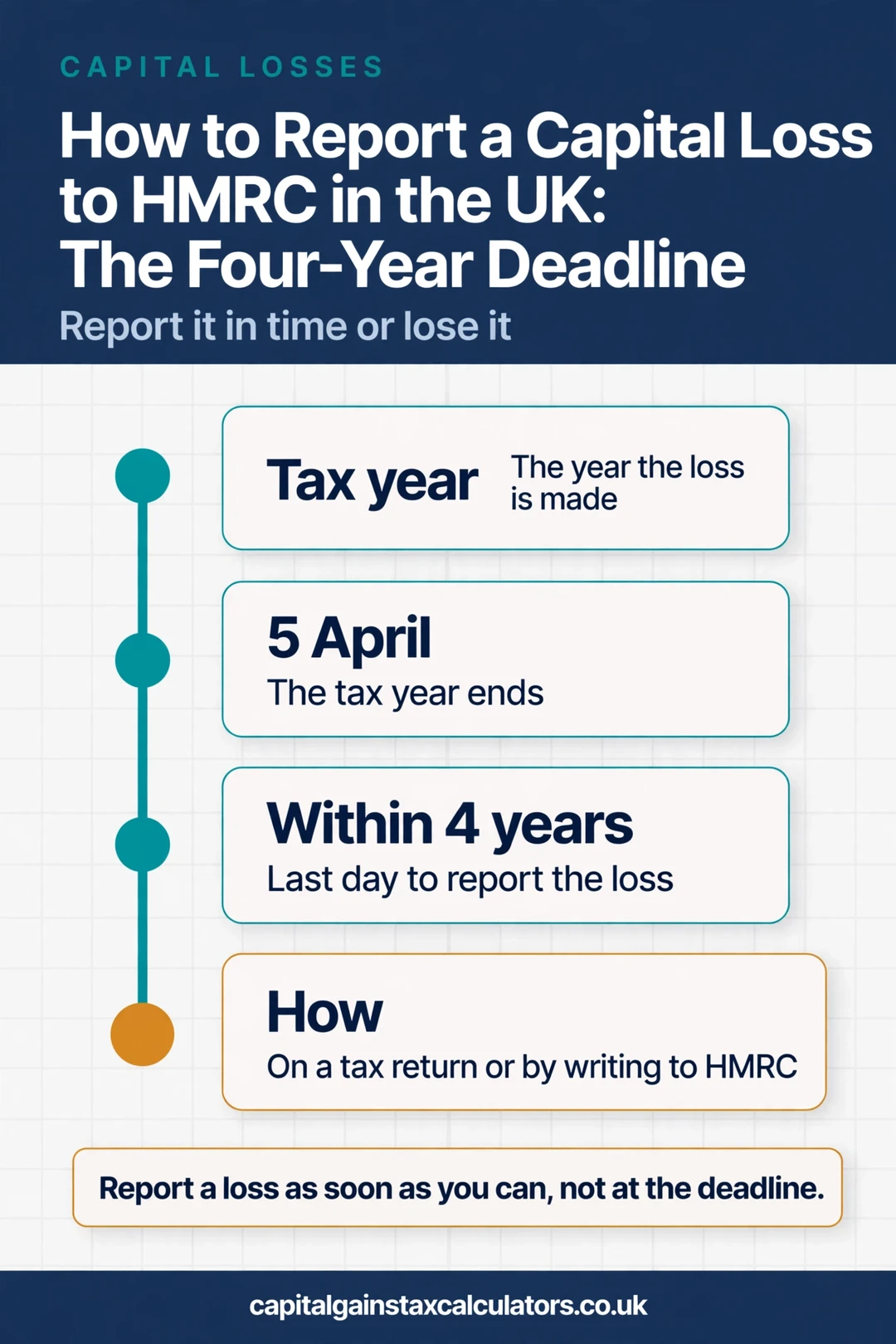
To carry a loss forward, you must report it to HMRC. The time limit is four years from the end of the tax year in which you made the loss. If you miss it, you lose the right to use the loss. You report the loss in the Capital Gains Tax section of your Self Assessment tax return. If you are not in Self Assessment, you can write to HMRC with the details. You should keep the calculation, the dates and the evidence of the costs and proceeds.
Losses that arise in a tax year in which you have no gains still need to be reported. That is the situation where people most often forget to report, because there is no tax due and no obvious reason to file. Read our guide to reporting Capital Gains Tax.
Losses on sales to connected persons
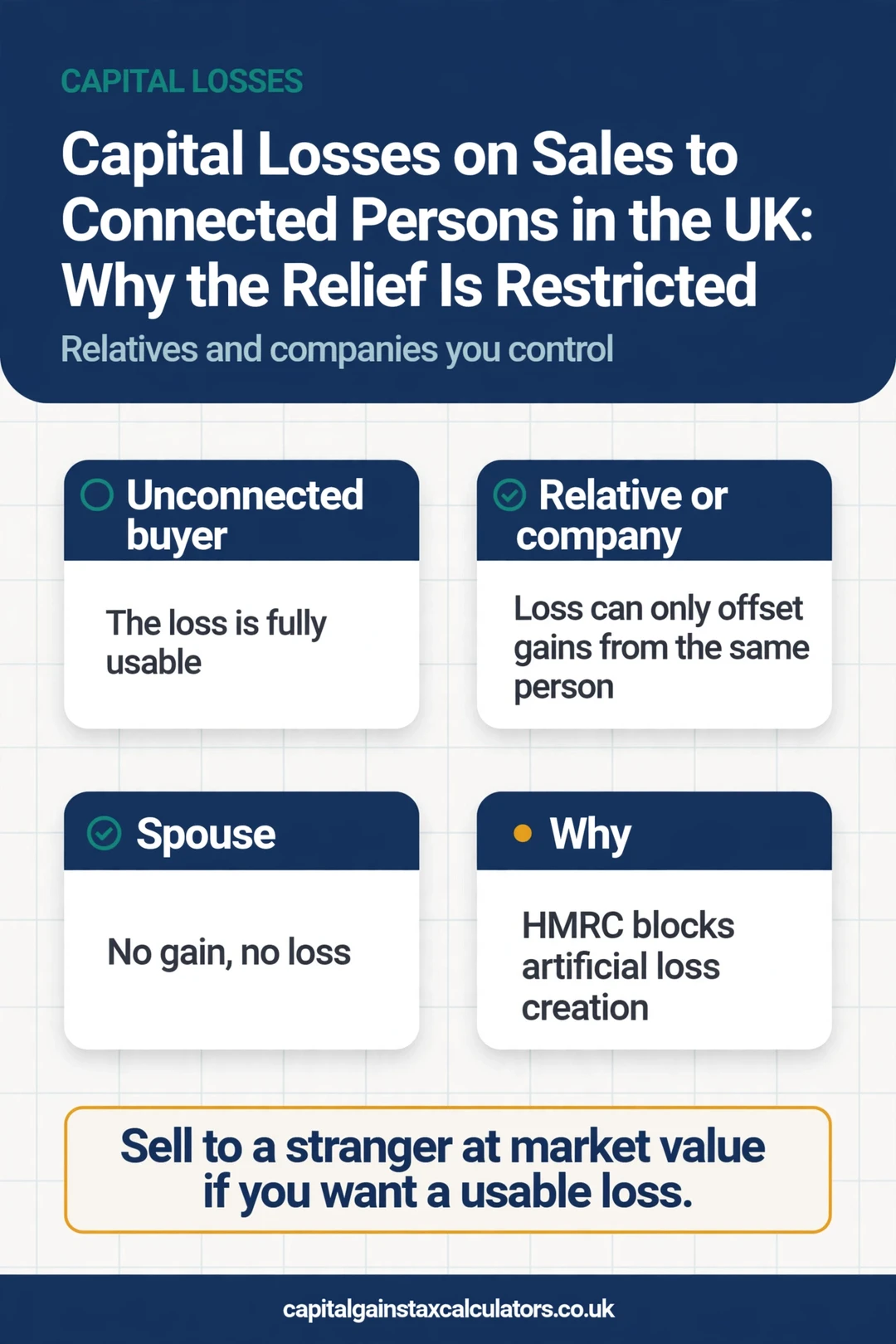
If you sell an asset to a connected person at a loss, the loss is restricted. A connected person includes your spouse or civil partner, relatives, a business partner and a company you control. The loss can only be set against gains on later sales to the same connected person, not against your other gains. This rule stops people selling to a relative at a low price just to create a loss. If you gift an asset that has fallen in value, the loss on the gift is also restricted in the same way.
| Seller and buyer | Loss available against other gains? |
|---|---|
| You sell to an unconnected buyer | Yes |
| You sell to your spouse | No, a spouse sale is no gain, no loss |
| You sell to a child or other relative | Only against gains on sales to that same person |
| You sell to a company you control | Only against gains on sales to that company |
| You give an asset away | Treated as a sale at market value, restricted if connected |
Negligible value claims
If shares or other assets have become worthless but you still own them, you can make a negligible value claim to HMRC. If HMRC accepts it, you are treated as having sold and reacquired the asset at its negligible value on a date you choose, within limits. This creates a loss you can use. The claim is useful for shares in a company that has failed but has not been formally dissolved. You must show the asset is of negligible value, not merely that its value has fallen. If the company is liquidated and removed from the register, there is a disposal for no proceeds.
Losses in the year of death
If a loss arises in the tax year in which a person dies, it can be set against gains in the three tax years before the year of death, starting with the latest. The personal representatives make the claim. This can lead to a refund of tax paid in earlier years. Normally, Capital Gains Tax losses cannot be carried back in this way.
Special cases
- Chattels: A loss on personal possessions is limited by treating the proceeds as at least £6,000.
- Crypto: Losses on crypto are allowable and subject to the same share matching rules.
- Buy-back within 30 days: A rebuy can cancel a loss. See the bed and breakfast rule.
- Non-residents: Losses on UK property or land are allowable but only against UK property gains.
- Spouses: Losses cannot be transferred between spouses.
Common mistakes with losses
- Not reporting. An unreported loss is lost after four years.
- Using a loss against income. Capital losses cannot reduce income.
- Wasting the allowance. Brought-forward losses are only used down to the allowance.
- Ignoring connected persons. The loss can be trapped.
- Claiming a loss on an exempt asset. It is not allowable.
- Rebuying within 30 days. The loss can disappear.
What to do next
- List all your disposals for the tax year, including those at a loss.
- Use the calculator to see how losses reduce your tax.
- Report the loss on your tax return, or write to HMRC.
- Keep a running record of your carried-forward losses.
Frequently asked questions
Can I offset a Capital Gains Tax loss against a gain?
Yes. A loss in the same tax year is set against your gains first. Any unused loss can be carried forward to later years if you report it.
How long do I have to report a loss?
Within 4 years of the end of the tax year in which the loss arose. If you miss the deadline, you cannot use it.
Do I use all of my brought-forward losses each year?
No. You only use enough to reduce your gain to the £3,000 allowance. The rest is carried forward.
Can I offset a capital loss against my income?
No. Capital losses can only be used against capital gains, with a few narrow exceptions.
Can I claim a loss on my main home?
No. A loss on your main home is not allowable because gains on it are exempt.
What if I sell to a relative at a loss?
The loss is restricted. It can only be set against gains on later sales to that same relative.
Can my spouse use my loss?
No. Losses cannot be transferred between spouses. Each person’s loss can only be used against their own gains.
What is a negligible value claim?
A claim that shares or assets you still own have become worthless. If accepted, you are treated as having sold them, which creates a loss.
Do I need to report a loss if I have no gains?
Yes, if you want to carry it forward. Report it within 4 years of the end of the tax year.
Can losses be carried back?
Not normally. The exception is the tax year in which a person dies, where losses can be set against gains in the three previous tax years.
Official sources
- GOV.UK: Capital Gains Tax: losses
- GOV.UK: Report and pay your Capital Gains Tax
- HMRC Capital Gains Manual: Losses
Related guides and calculators
This page gives general information for UK taxpayers and is not tax advice. Capital Gains Tax rules can change and your own circumstances matter. Check the latest rules on GOV.UK or with a qualified tax adviser before you act.