Quick answer
Selling land is a disposal for Capital Gains Tax, so you pay tax on the gain above your £3,000 allowance at 18% or 24% for 2026/27. If you sell only part of a plot, you can only deduct a share of the original cost, worked out by a formula. A garden sold as part of your main home is usually exempt if the whole plot is within 5,000 square metres. Land with a development value can create a large gain.
Key facts
- Land is a chargeable asset. The gain is taxed at 18% or 24% after the £3,000 allowance.
- If you sell only part of your land, you can deduct only a proportion of the original cost.
- Your main home’s garden or grounds is usually covered by Private Residence Relief up to 5,000 square metres.
- Farmland, woodland and building plots can have extra reliefs, such as rollover relief for business land.
- The 60-day rule applies to residential property. Other land is reported through Self Assessment or the real-time service for residents.
Good to know
Estimate the gain
Use the Capital Gains Tax calculator with the asset type set to “Other asset” to work out the gain and tax on a land sale.
When Capital Gains Tax applies to land
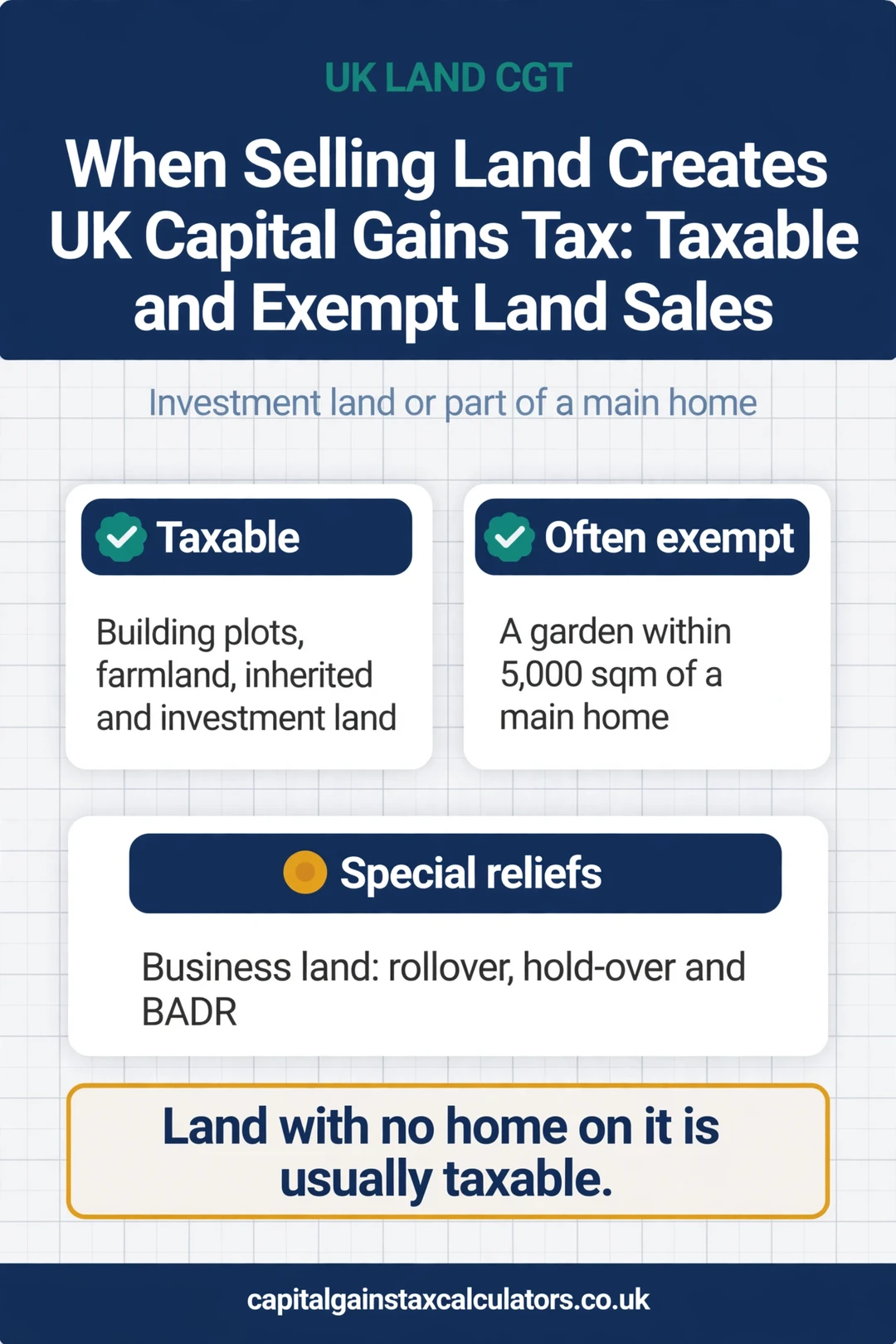
Land that you own as an investment, or that is not part of your main home, is a chargeable asset. The common cases are:
- Selling a building plot or land with planning permission.
- Selling an area of land you inherited and did not live on.
- Selling farmland, paddocks or woodland.
- Selling part of a large garden, outside the main home’s permitted area.
- Selling land that you hold through a trust or an estate.
The gain is the sale proceeds less the cost of the land and the costs of buying, selling and improving it. Improvements for land can include drainage, fencing that adds value and the cost of getting planning permission. Day-to-day upkeep, such as grass cutting, is not deductible.
Selling part of a plot: the part-disposal formula
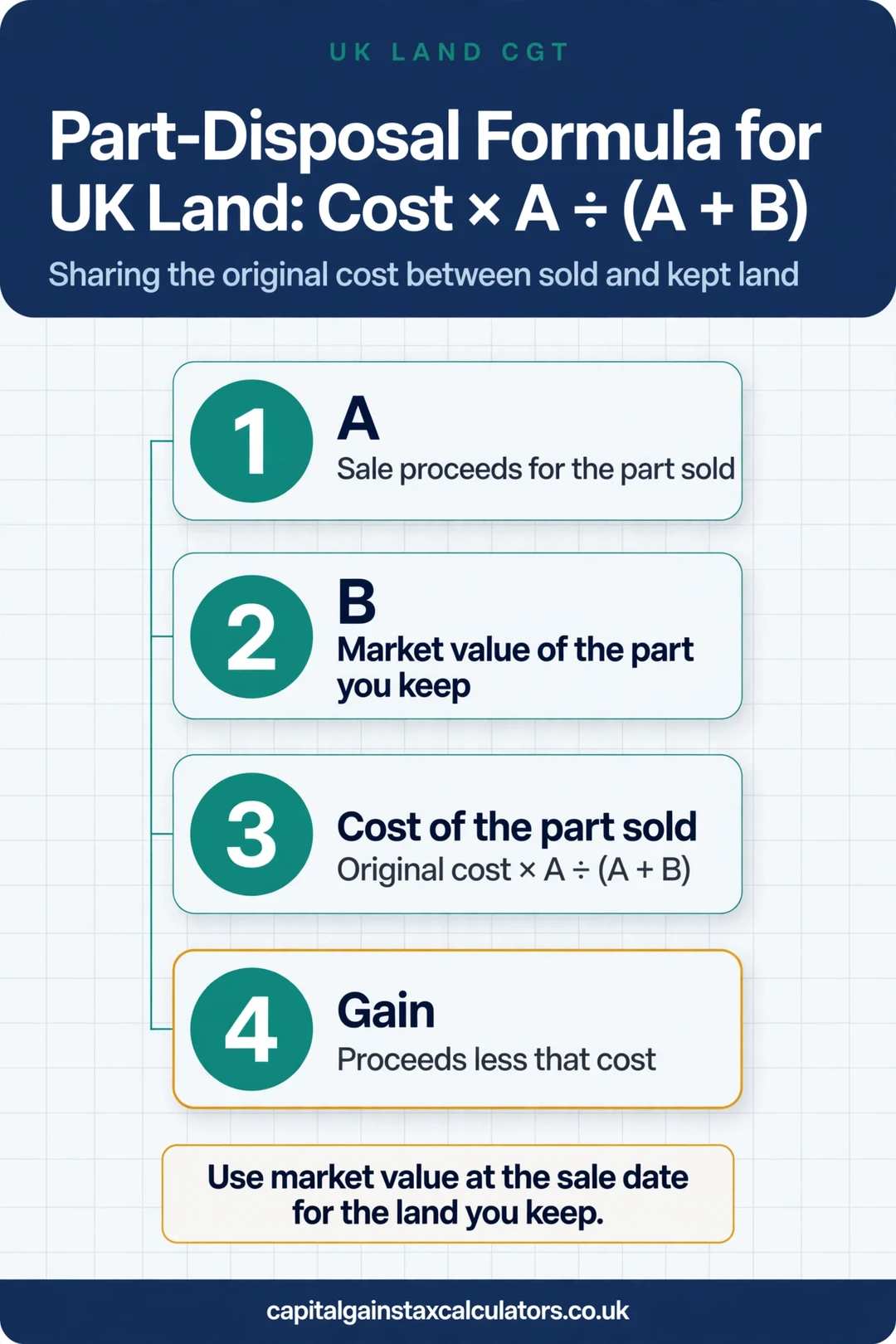
When you sell only part of your land, you cannot deduct the whole original cost against the part you sold. HMRC uses a formula based on the value of the part sold and the value of the part you keep.
The cost you can deduct is the original cost multiplied by A and divided by (A plus B), where A is the proceeds from the part sold and B is the market value of the part you keep on the date of the sale.
Worked example
Selling a field out of a larger plot
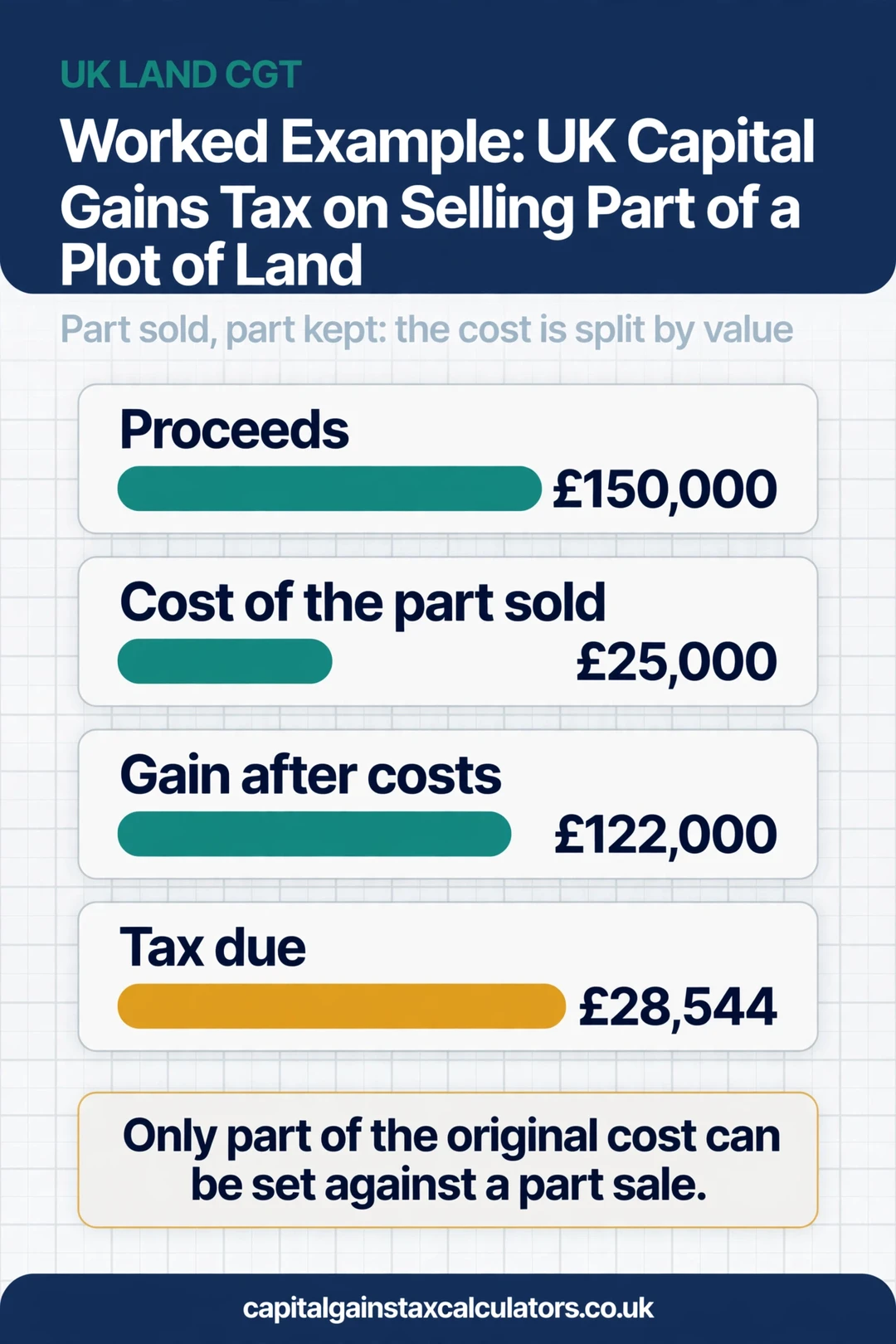
You bought land for £100,000. You sell one part for £150,000. The remaining land is worth £450,000 on the day of sale. You pay £3,000 in selling costs. Your income is £50,000.
- Cost of the part sold: £100,000 x £150,000 / (£150,000 + £450,000) = £25,000.
- Gain: £150,000 less £3,000 less £25,000 = £122,000.
- After the allowance: £119,000 is taxable.
- Tax: £28,544.
With a lower income of £20,000, part of the gain is taxed at 18%, and the tax falls to £26,744. If you sold the whole plot for £600,000, the gain would be larger, because the whole cost is deducted, and the tax would be £117,824. The remaining land keeps the rest of the original cost, which is £75,000 in this case, and you use it when you sell the rest.
Selling part of your garden
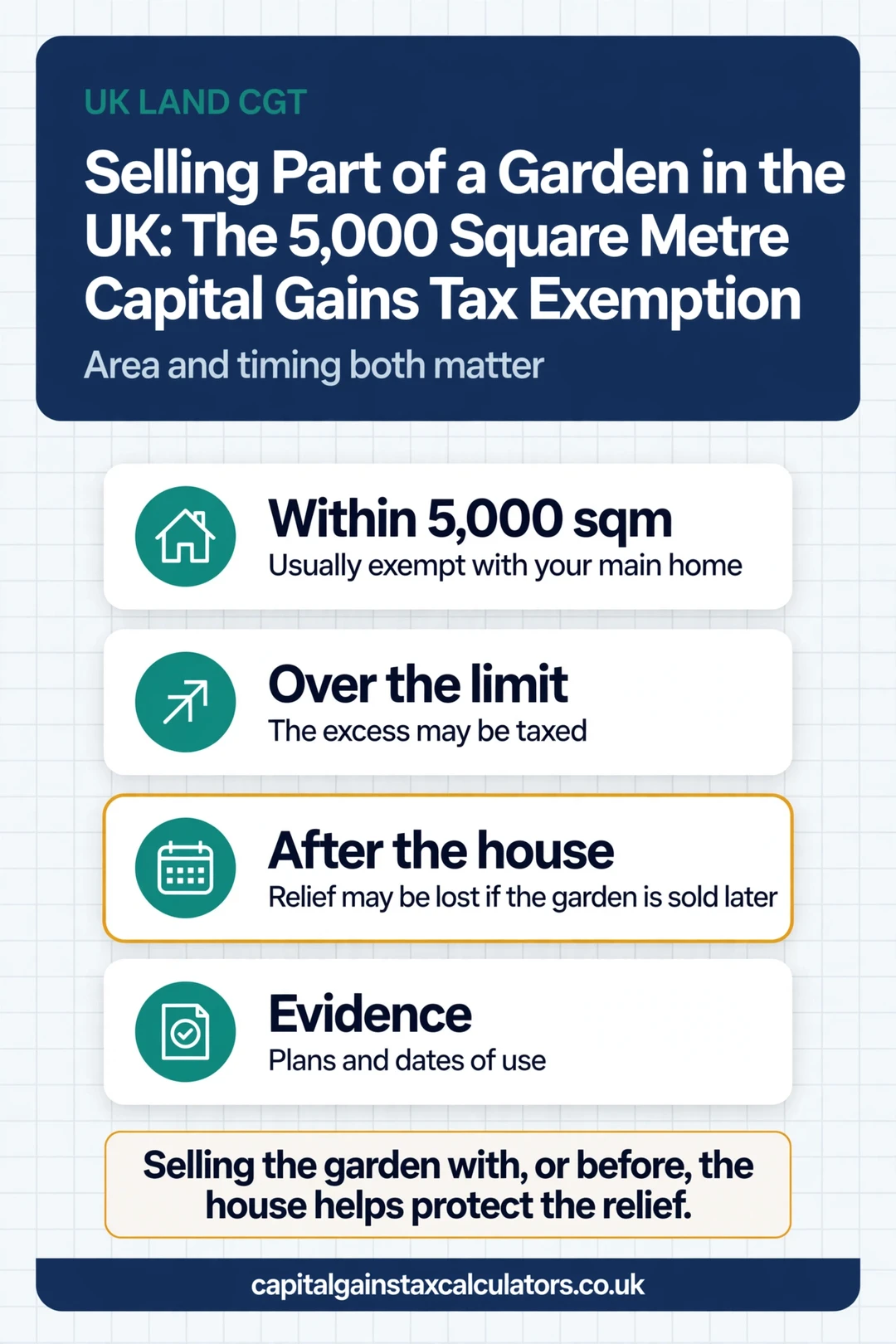
If your home is your main residence, the garden and grounds are covered by Private Residence Relief up to the permitted area. The permitted area is 5,000 square metres, including the building, or larger if the size is reasonable for the type of property. If you sell a plot from your garden and the total area stays within the permitted area, the gain is usually exempt. If the garden is larger, the extra land may be taxable.
| Situation | Gain taxable? | Notes |
|---|---|---|
| Sale of part of a garden, total plot under 5,000 sqm | Usually no | Main home relief covers it |
| Sale of part of a larger garden over 5,000 sqm | Possibly for the excess | Check whether the larger area is reasonable |
| Land sold after the house has been sold | Yes | It may no longer be part of your main home |
| Garden sold to a developer for a building plot | Depends on the area and use | Value of the plot is usually not exempt if over the limit |
| Paddock or field next to the house | Usually yes | Unless used as part of the garden |
Sell the garden before, or at the same time as, the house to keep the relief. If you sell the garden after the house, the relief usually does not apply. Our Private Residence Relief guide covers the permitted area in more detail.
Farmland, woodland and business land
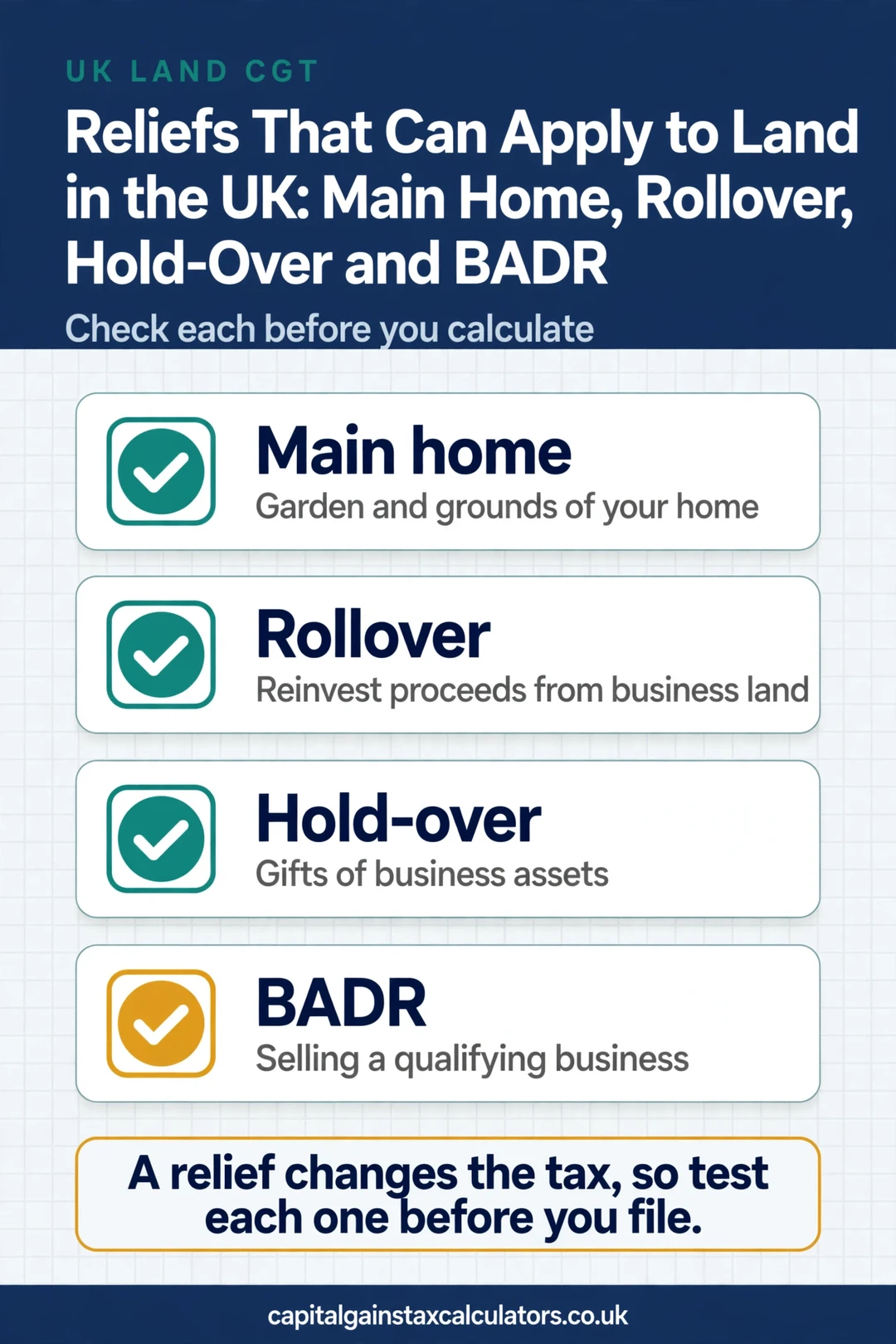
Farmland and land used in a business can qualify for extra reliefs. Rollover relief lets you defer the gain if you reinvest the proceeds in other qualifying business assets within a set time. Hold-over relief can postpone the gain if you gift business assets. Business Asset Disposal Relief may apply if you sell a business that includes the land. Commercial woodland may have its own rules for timber and land. Each relief has conditions and time limits, so check them before you sell. Our guide to Capital Gains Tax reliefs lists them.
| Relief | What it does | Main condition |
|---|---|---|
| Private Residence Relief | Exempts the garden and grounds of your main home | Within the permitted area, sold with or before the house |
| Rollover relief | Defers the gain on business land | Reinvest in qualifying business assets within the time limit |
| Hold-over relief | Postpones the gain on a gift | Business assets or certain trust transfers, claimed jointly |
| Business Asset Disposal Relief | Charges 18% on qualifying gains | Selling a qualifying business, with a claim |
Reporting a land sale
The 60-day return applies to UK residential property. Land with no home on it usually falls outside that rule, so a UK resident reports the gain on a Self Assessment tax return, or through the real-time Capital Gains Tax service if it is available for the asset. If you are not UK resident, you must report every sale of UK land or property to HMRC within 60 days, even if there is no tax. See our guides for non-residents and reporting. If you sold a plot that includes a house or other residential building, check whether the 60-day rule applies.
Records to keep for a land sale
- The purchase documents showing the price and the date you bought the land.
- Invoices for improvements, such as drainage and planning applications.
- Valuations showing the market value of the part you kept, if you sold part.
- Legal and agent invoices for the sale.
- Plans showing the boundaries of the land sold and retained.
Common mistakes with land sales
- Deducting the whole cost for a part sale. Use the part-disposal formula.
- Assuming the garden is always exempt. The area and use matter.
- Selling the garden after the house. That can lose the relief.
- Forgetting the value of the retained land. The formula needs it.
- Using the wrong reporting route. The 60-day rule is for residential property.
- Not claiming reliefs for business land. Rollover and hold-over relief need a claim.
What to do next
- Collect the purchase documents and the valuation of the part you keep.
- Work out the cost of the part sold with the formula above.
- Estimate the tax with the calculator.
- Check reliefs and the reporting routes.
Frequently asked questions
Do I pay Capital Gains Tax when I sell land?
Yes, on the gain above your £3,000 allowance, at 18% or 24% depending on your income. Land that is part of your main home may be exempt.
How do I work out the cost when I sell only part of the land?
Multiply the original cost by the proceeds from the part sold, divided by the proceeds plus the market value of the part you keep.
Is selling part of my garden taxable?
Usually not if the garden is within the 5,000 square metre permitted area of your main home and you sell it before or with the house. Larger gardens or later sales can be taxable.
Do I need to report a land sale within 60 days?
The 60-day rule applies to UK residential property. Other land is reported on Self Assessment. Non-residents must report all UK land sales within 60 days.
Does planning permission change the tax?
It does not change the rules, but it often raises the sale price, which increases the gain. The cost of obtaining planning permission can be deducted.
Can I defer the gain on farmland?
Rollover relief can defer a gain if you reinvest in qualifying business assets within the time limit. Hold-over relief may apply to gifts of business assets.
Is inherited land taxed differently?
Your cost is the market value at the date of death. The gain is measured from that value, so growth before death is not taxed.
Can I deduct the costs of selling land?
Yes. Agent, legal and advertising costs of the sale are deductible, together with the costs of buying and improving the land.
Do I need a valuation for the part I keep?
Yes, for a part sale. The formula uses the market value of the remaining land on the date of sale, and a written valuation is the safest evidence.
Is land held by a company treated the same?
No. A company pays Corporation Tax on gains, not Capital Gains Tax.
Official sources
- GOV.UK: Tax when you sell property
- GOV.UK: Tax when you sell your home
- HMRC helpsheet HS283: Private Residence Relief
- HMRC Capital Gains Manual: Part disposals
Related guides and calculators
This page gives general information for UK taxpayers and is not tax advice. Capital Gains Tax rules can change and your own circumstances matter. Check the latest rules on GOV.UK or with a qualified tax adviser before you act.