Quick answer
You can legally reduce Capital Gains Tax by using your £3,000 allowance every year, claiming all allowable costs, offsetting losses, sharing assets with a spouse, timing a sale across tax years, using ISAs and pensions, widening your basic rate band and claiming reliefs such as Private Residence Relief. The rates for 2026/27 are 18% and 24%. Hiding gains is evasion and is illegal. Everything on this page is standard, open tax planning.
Key facts
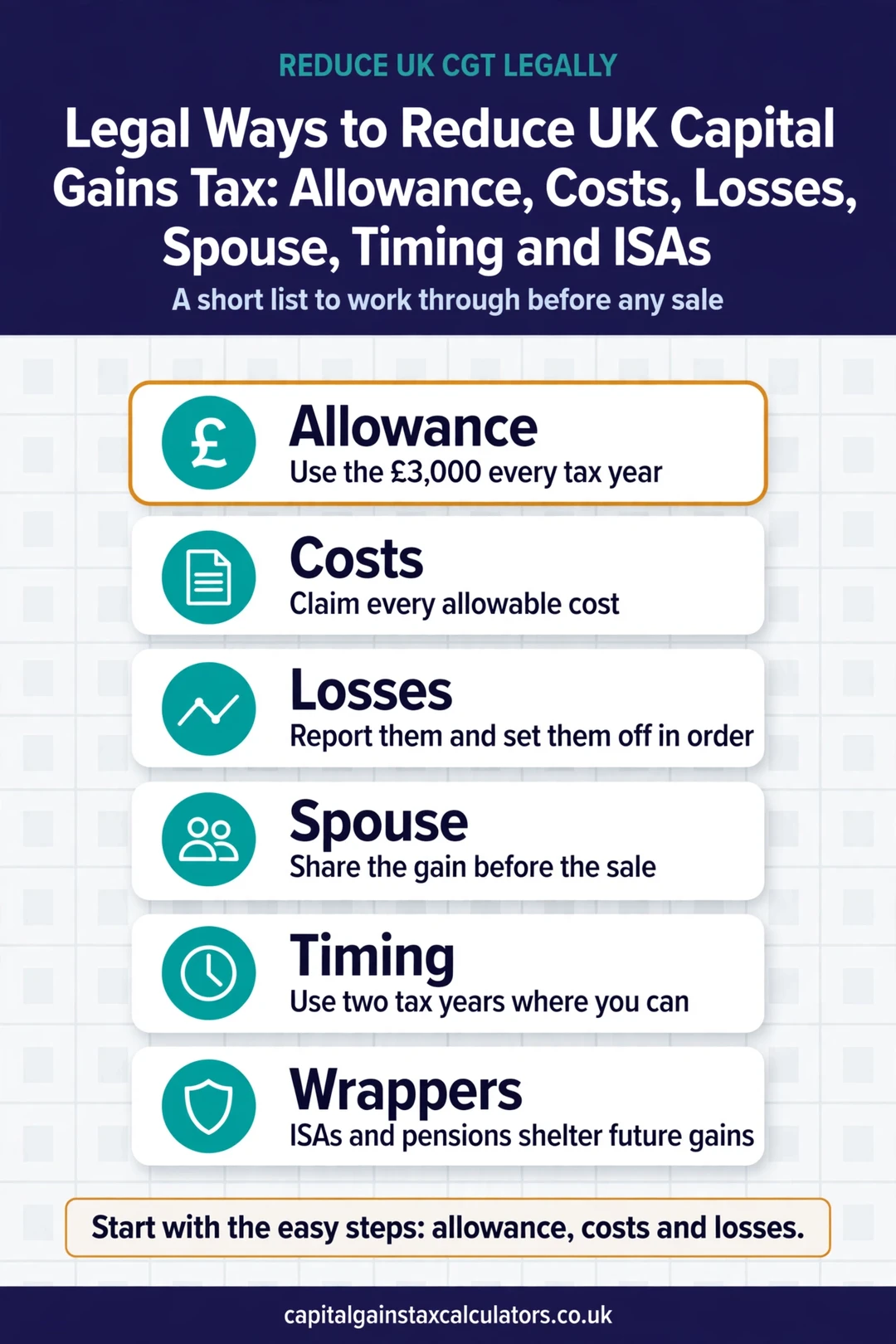
- Use the £3,000 allowance every year. Unused allowance is lost.
- Claim every allowable cost, including buying fees and improvements.
- Offset losses against gains and report them within 4 years.
- A spouse transfer before a sale can use two allowances and two rate bands.
- ISAs and pensions shelter gains from Capital Gains Tax altogether.
- Pension contributions and Gift Aid widen the basic rate band, moving more gain to 18%.
Good to know
Test your plan
Use our spouse transfer calculator and sell now or wait calculator to see the effect of a plan before you act.
Avoidance, planning and evasion
Reducing tax by using allowances, reliefs and exemptions in the way Parliament intended is legal tax planning. Artificial arrangements designed to get a tax advantage that Parliament did not intend can be challenged under anti-avoidance rules. Hiding gains or not reporting them is evasion, which is a crime. The twelve steps below are the first kind. They use the rules as they stand, and each one has limits that we explain.
Step 1: Use your annual allowance every year
The first £3,000 of your gains in 2026/27 is tax free, but only if you use it in the tax year. If you hold shares or funds with gains, selling a little each year can use the allowance and avoid a large taxable gain later. The saving is up to £720 a year for a higher rate taxpayer. See our allowance guide.
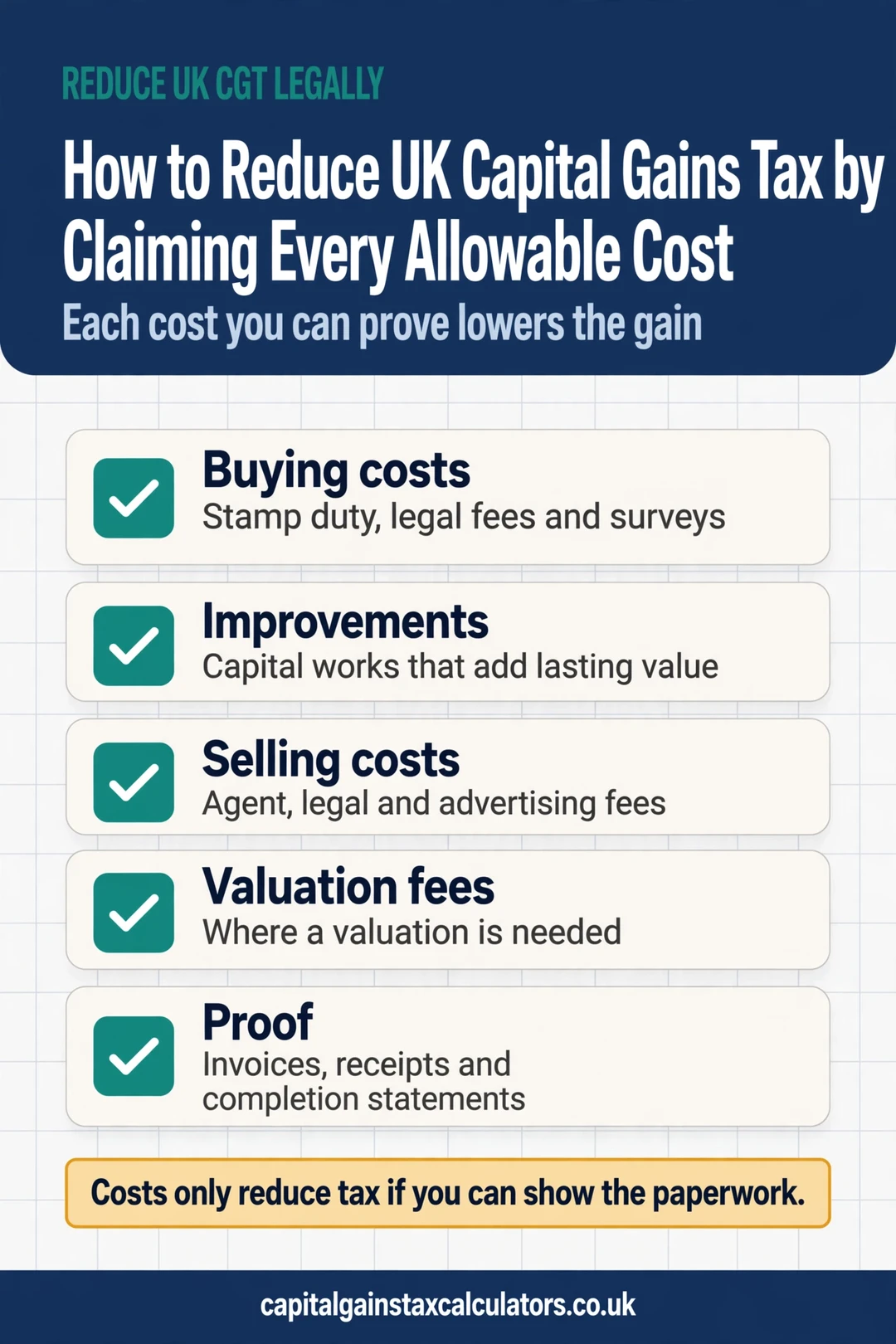
Step 2: Claim every allowable cost
The gain is the sale price less all allowable costs. Many people forget some of them. For a property, claim the buying costs, Stamp Duty Land Tax, legal and survey fees, the cost of improvements and the costs of selling. On a sale of £350,000 that cost £220,000, the gain without costs is £130,000 and the tax is £30,480. Adding £9,000 of buying costs, £7,000 of selling costs and £15,000 of improvements gives a gain of £99,000 and a tax of £23,040, a saving of £7,440.
Step 3: Offset your losses
Losses on other disposals in the same tax year reduce your gains. Losses from earlier years can be carried forward if you reported them. A £6,000 loss against a gain of £20,000 changes the tax from £4,080 to £2,640 for a higher rate taxpayer. Remember the 30-day rule if you sell at a loss and want to buy back. See the losses guide.
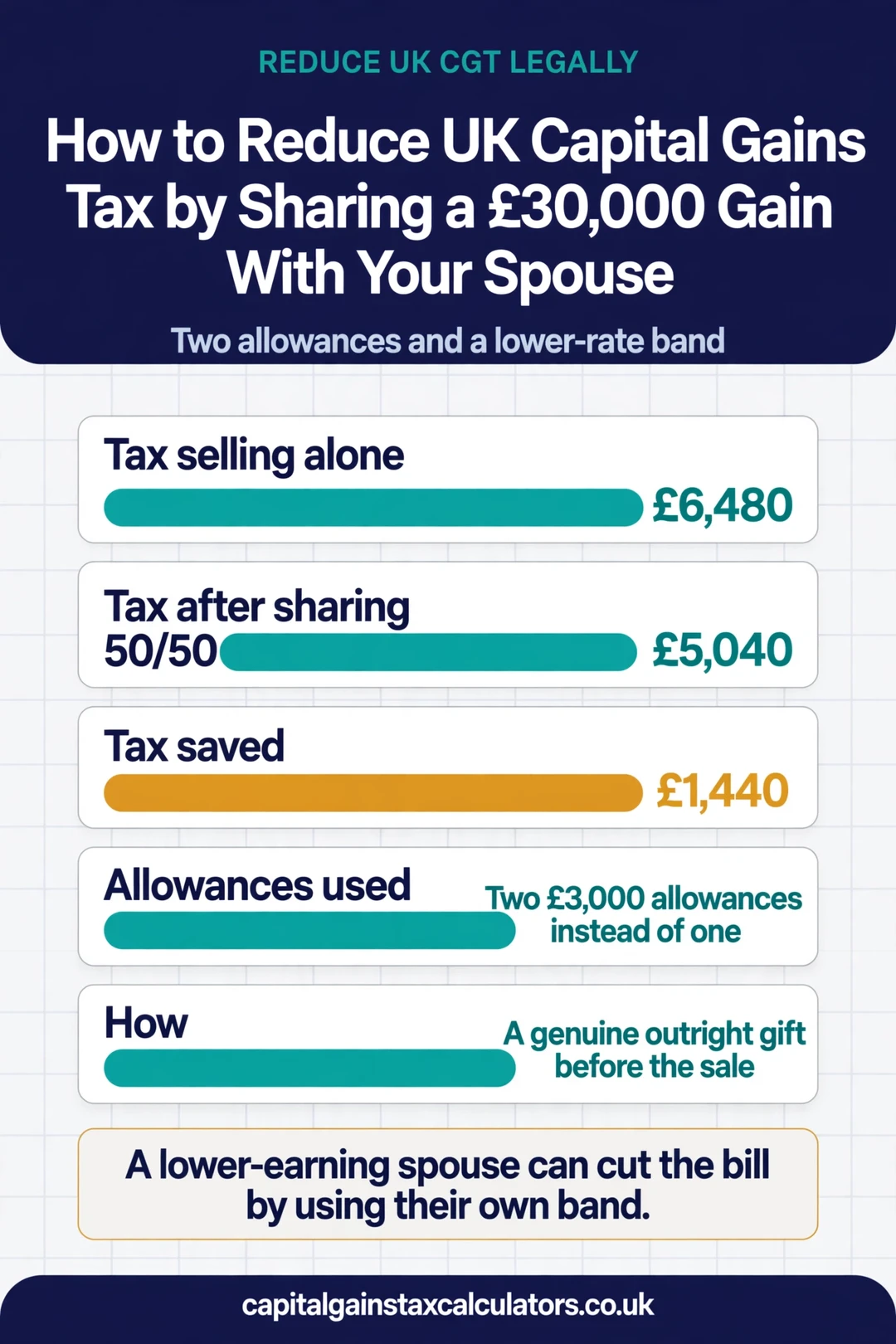
Step 4: Share assets with your spouse
A transfer between spouses is no gain, no loss, so you can move part of an asset into the name of the spouse with the lower income or unused allowance before you sell. On a gain of £30,000, with incomes of £80,000 and £10,000, selling alone costs £6,480, and sharing equally costs £5,040. The transfer must be a genuine gift. See our spouse transfer guide.
Step 5: Time your sale
Splitting a sale across two tax years uses two allowances. On a gain of £24,000, selling all at once costs £5,040, and the best split costs £4,320. Timing can also move a gain into a year when your income is lower. The date of the contract decides the year. Weigh the saving against the risk of the price moving. Use our sell now or wait calculator.
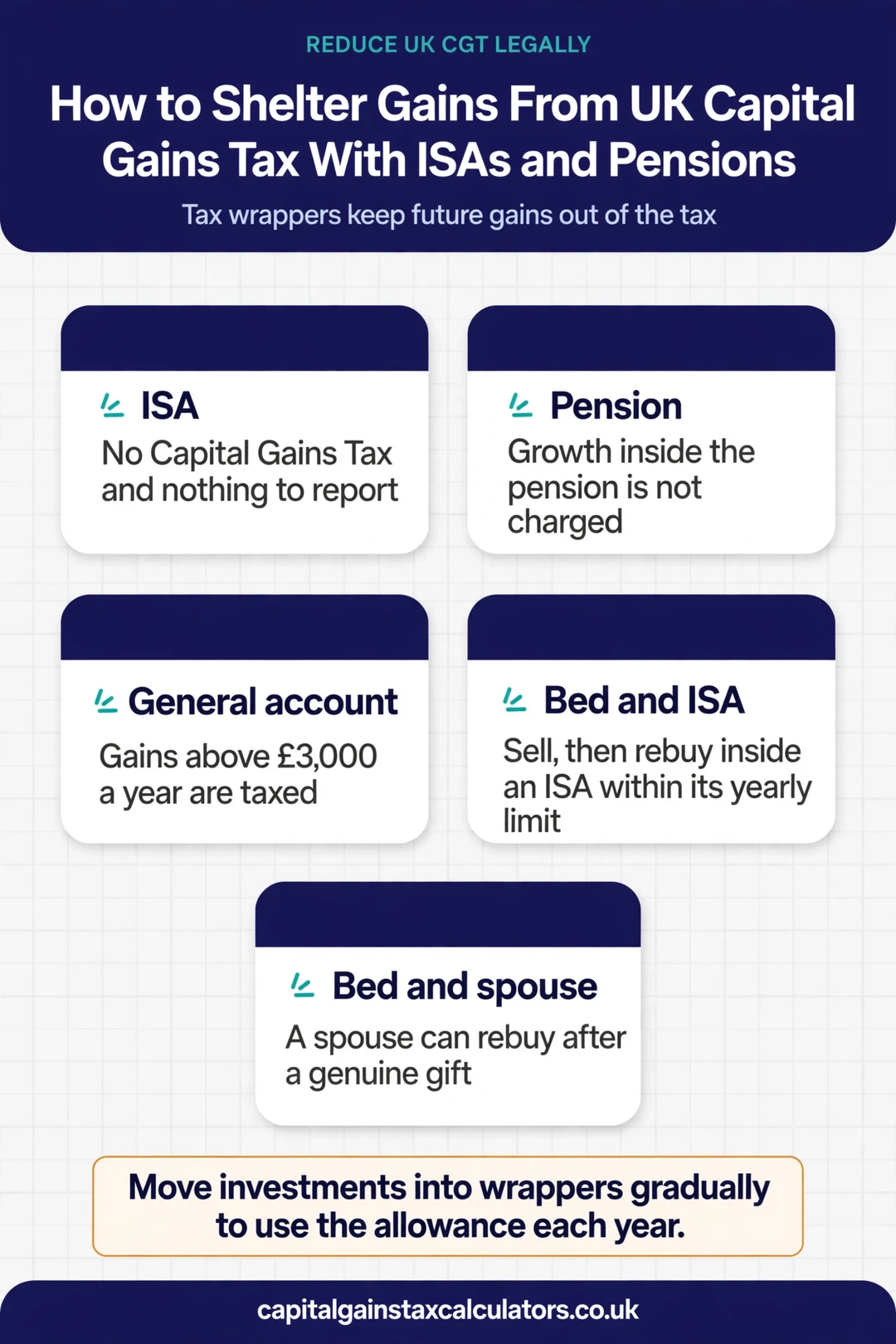
Step 6: Use ISAs and pensions
Gains inside an ISA or a pension are free of Capital Gains Tax. Moving investments into an ISA each year, through “bed and ISA”, shelters future growth. The ISA allowance is set each tax year. Pension contributions also shelter growth, and receive tax relief on the way in. Both come with limits and rules on access, so they are not suitable for every sum of money.
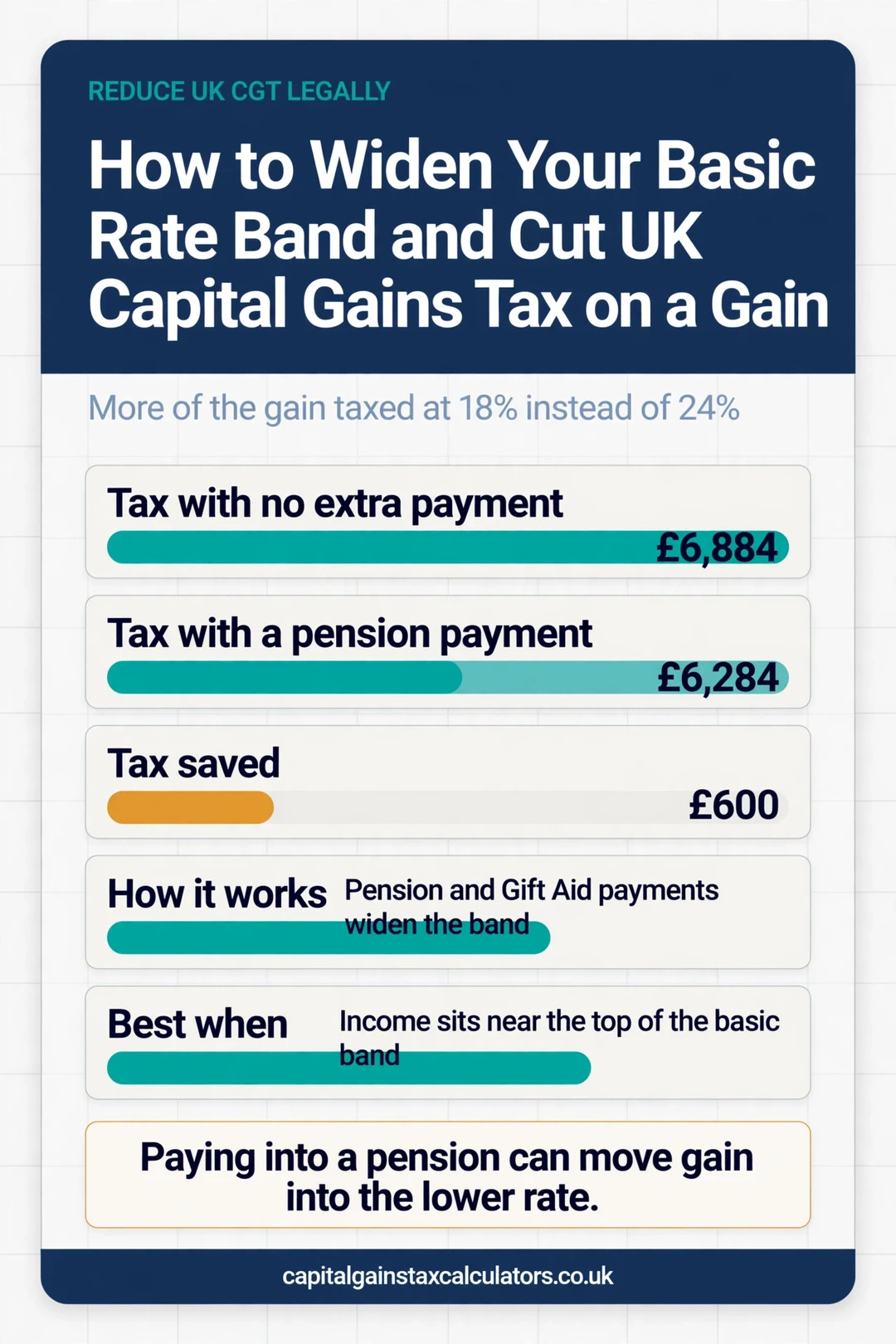
Step 7: Widen your basic rate band
Your gain is added on top of your income to decide the rate. If you make personal pension contributions through a relief at source scheme, or Gift Aid donations, your basic rate band is increased by the grossed-up amount. This can move more of the gain into the 18% band. On a gain of £33,000 and an income of £45,000, the tax is £6,884. With £10,000 of grossed-up pension or Gift Aid payments, the tax falls to £6,284. The payment itself costs money, so this is only worth it if you intended to make it anyway.
Step 8: Claim Private Residence Relief
If the property was ever your main home, relief can cover the months you lived there and the last 9 months. Check your dates in our Private Residence Relief calculator. See the guide for absences and gardens.
Step 9: Use Business Asset Disposal Relief
If you sell a qualifying business or your shares in a personal company, the relief charges 18% on gains up to £1,000,000. It needs a claim and the two-year tests. See the BADR guide.
Step 10: Gift to charity or hold over the gain
A gift of assets to a registered charity is exempt from Capital Gains Tax. Gift Hold-Over Relief can postpone the gain on gifts of business assets. These reliefs have conditions and some of them defer the tax rather than remove it. See reliefs.
Step 11: Defer the gain with a reinvestment relief
Rollover relief for business assets and Enterprise Investment Scheme deferral allow you to defer a gain by reinvesting. They carry commercial risk, and the gain comes back later, so treat them as a deferral and not as a permanent saving.
Step 12: Keep records and report correctly
Good records protect your costs and your claims. Keep contract notes, invoices, valuations and statements. Report losses within 4 years. A claim that you cannot evidence is a claim you may lose.
| Step | Typical saving | Main limit |
|---|---|---|
| Use the allowance yearly | Up to £720 a year | Must sell in the year |
| Claim all costs | Hundreds to thousands of pounds | Need evidence |
| Offset losses | Rate times the loss | Must report in time |
| Spouse transfer | Allowance plus lower rate | Genuine gift before a sale |
| Time the sale | Up to a second allowance | Market risk |
| ISAs and pensions | All future gains | Annual limits and access rules |
| Widen the band | Up to the rate gap on the moved gain | Only if the payment is wanted anyway |
Worked example: three steps together
Worked example
Priya sells shares with a gain of £33,000
Priya earns £45,000 and sells shares with a gain of £33,000. Selling alone, the tax is £6,884. If she makes £10,000 of grossed-up pension or Gift Aid payments she was planning anyway, the tax falls to £6,284. She could also split the sale across two tax years, or transfer some shares to a spouse first. Each step is legal and uses a different rule.
| Position | Tax on the gain |
|---|---|
| Sell with no planning | £6,884 |
| With grossed-up pension or Gift Aid payments | £6,284 |
| Saving from the band change | £600 |
Common mistakes that cost tax or cause trouble
- Moving abroad for a short time. Temporary non-residence rules can catch gains on return.
- Selling to a relative at a low price. The market value is used.
- Not reporting. It is evasion.
- Selling and buying back the next day. The 30-day rule matches them.
- Splitting a set of valuables. Sets are treated as one item.
What to do next
- List your gains, losses and likely sales for the year.
- Try the calculators with and without each step.
- Make any transfers or contributions before you agree to sell.
- Report correctly and keep your records.
Frequently asked questions
How can I reduce Capital Gains Tax legally?
Use your £3,000 allowance, claim all costs, offset losses, share assets with a spouse, time the sale, use ISAs and pensions, widen your basic band and claim reliefs.
Can I avoid Capital Gains Tax on a second home?
You cannot avoid it, but you can reduce it by claiming all costs, using reliefs for time lived there, sharing ownership with a spouse and timing the sale.
Is it legal to transfer assets to my spouse before selling?
Yes, if the transfer is a genuine, outright gift made before you agree the sale. It uses both allowances and rate bands.
Does moving abroad avoid Capital Gains Tax?
Not for UK property, which stays chargeable. Temporary non-residence rules can also tax gains on your return.
Do pension contributions reduce Capital Gains Tax?
They can, by widening your basic rate band so more of the gain is taxed at 18%. The contribution must be one you want to make anyway.
Can losses reduce my bill?
Yes. Losses in the same year come off first, and earlier losses reduce the gain to the allowance. Report them within 4 years.
Are ISAs really free of Capital Gains Tax?
Yes. Gains on investments inside an ISA are exempt and are not reported.
What is the difference between avoidance and evasion?
Avoidance is using the law’s rules to reduce tax. Evasion is hiding income or gains and is a crime. Aggressive avoidance can still be challenged.
Does waiting reduce the tax?
It can, if you use two allowances or sell in a year with lower income. Market risk can outweigh the saving.
Should I take advice?
For large gains, trusts, businesses or complex reliefs, yes. A tax adviser can model your own facts.
Official sources
- GOV.UK: Reduce your Capital Gains Tax bill
- GOV.UK: Capital Gains Tax rates and allowances
- GOV.UK: Tax relief on pension contributions
- GOV.UK: Individual Savings Accounts
Related guides and calculators
This page gives general information for UK taxpayers and is not tax advice. Capital Gains Tax rules can change and your own circumstances matter. Check the latest rules on GOV.UK or with a qualified tax adviser before you act.