Quick answer
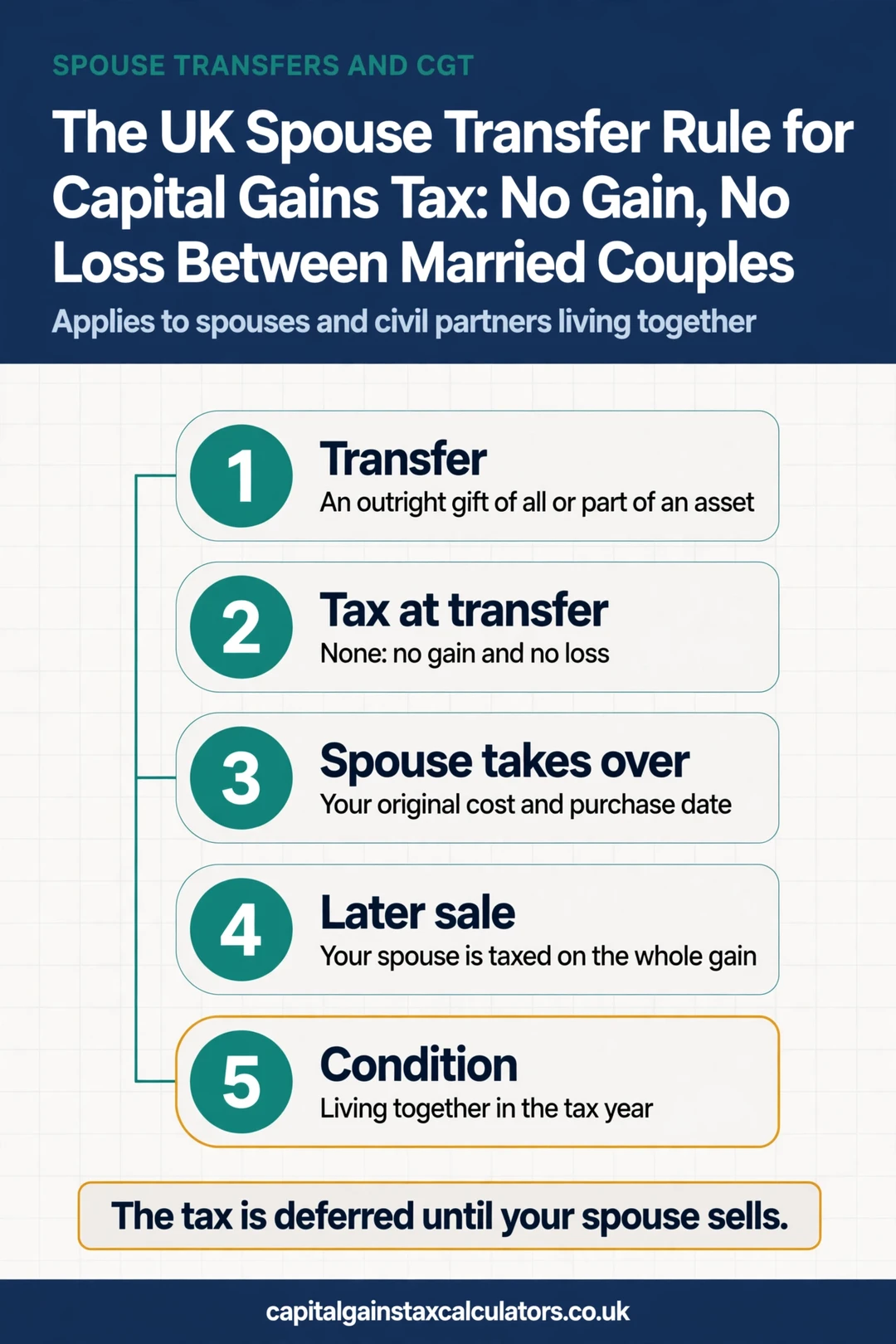
Transfers of assets between spouses or civil partners who live together are treated as no gain, no loss for Capital Gains Tax. The receiving spouse takes over the original cost and acquisition date, so no tax is due on the transfer. Each spouse has their own £3,000 allowance and rate band, so moving some of an asset to the spouse with the lower income before a sale can reduce the combined tax. The transfer must be a genuine, outright gift.
Key facts
- No Capital Gains Tax arises when you transfer an asset to a spouse or civil partner you live with.
- The receiving spouse takes over your original cost and the date you acquired the asset.
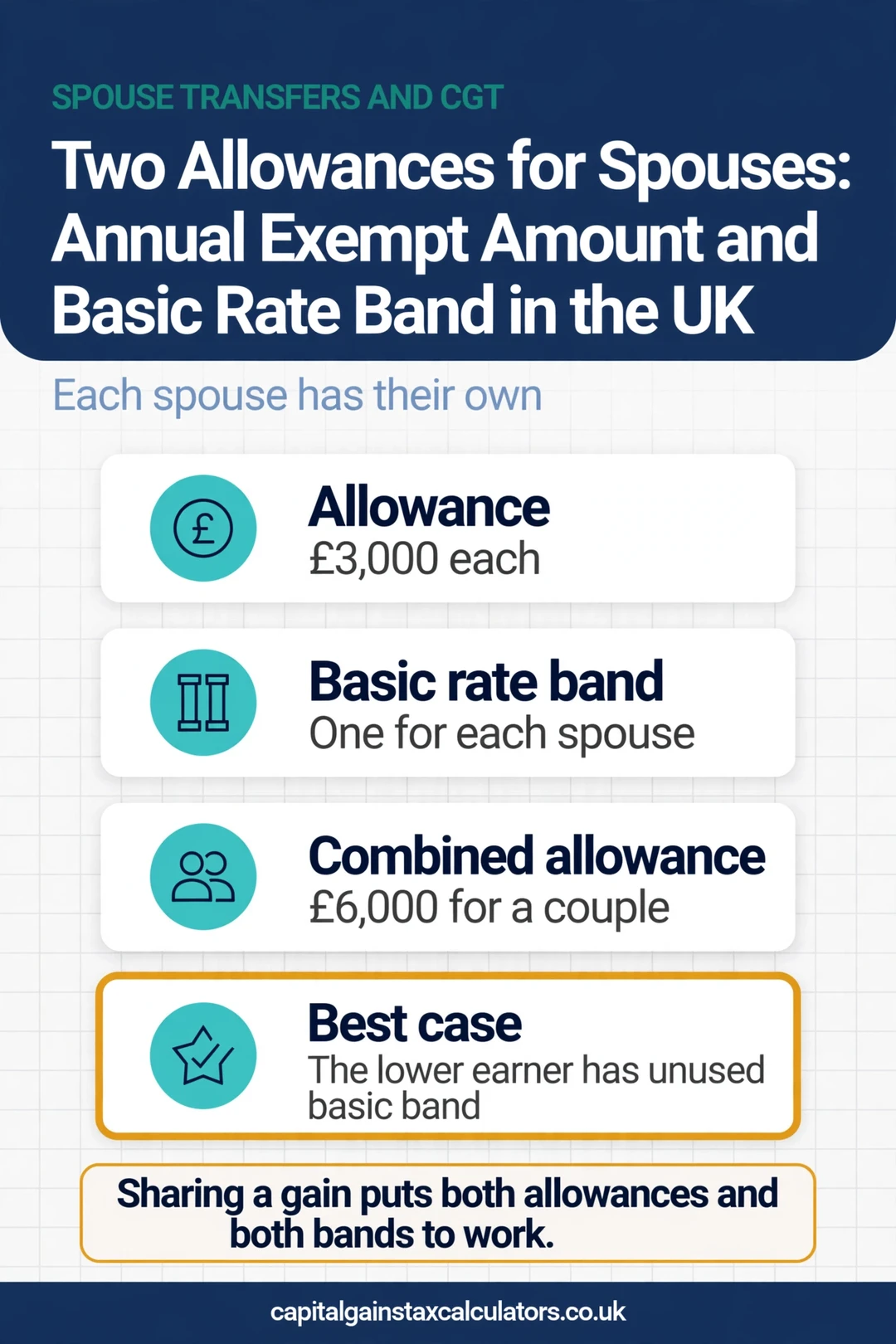
- Each spouse has a separate £3,000 allowance and basic rate band, and neither can transfer unused amounts.
- The gift must be outright and unconditional. You cannot keep the benefit.
- Transfer the asset before you agree a sale.
- The rules apply to married couples and civil partners, not to unmarried partners.
Good to know
Compare the tax
Use our spouse transfer calculator to find the share to give your spouse that minimises the combined tax.
The no gain, no loss rule
Normally, giving away an asset is a disposal at market value. For spouses and civil partners who live together, the law takes a different approach. The transfer is treated as taking place at a price that gives neither a gain nor a loss. The giver therefore has no tax to pay at the time. The receiving spouse steps into the giver’s shoes. They are treated as having acquired the asset at the giver’s original cost and on the date the giver acquired it.
The consequences are far-reaching. If the receiving spouse later sells, the gain is measured from the original cost, not from the value at the date of transfer. If the asset is a property that was a main home at some point, the history of ownership carries over for the purposes of Private Residence Relief. If the asset is a share in a company, the acquisition date also matters for reliefs that require a holding period.
Who qualifies
| Couple | No gain, no loss rule? | Notes |
|---|---|---|
| Married couple living together | Yes | In the tax year of the transfer |
| Civil partners living together | Yes | Same treatment |
| Spouses separated in the tax year of separation | Yes | Until the end of that tax year |
| Separated spouses later | Yes, in some cases | Up to 3 tax years after separation, or longer under a formal agreement |
| Unmarried partners | No | A gift is a disposal at market value |
| Divorced after the decree | No, unless under a court order | See the divorce guide |
“Living together” means you are not separated under a court order or a deed of separation, and the separation is not likely to be permanent. The test applies to the tax year of the transfer as a whole. Our divorce guide explains how long the rule continues after you separate.
Using two allowances and two bands
Because each spouse has their own annual exempt amount and basic rate band, a couple can pay less tax by sharing a gain than by realising it all in one name.
Worked example
Sharing a gain
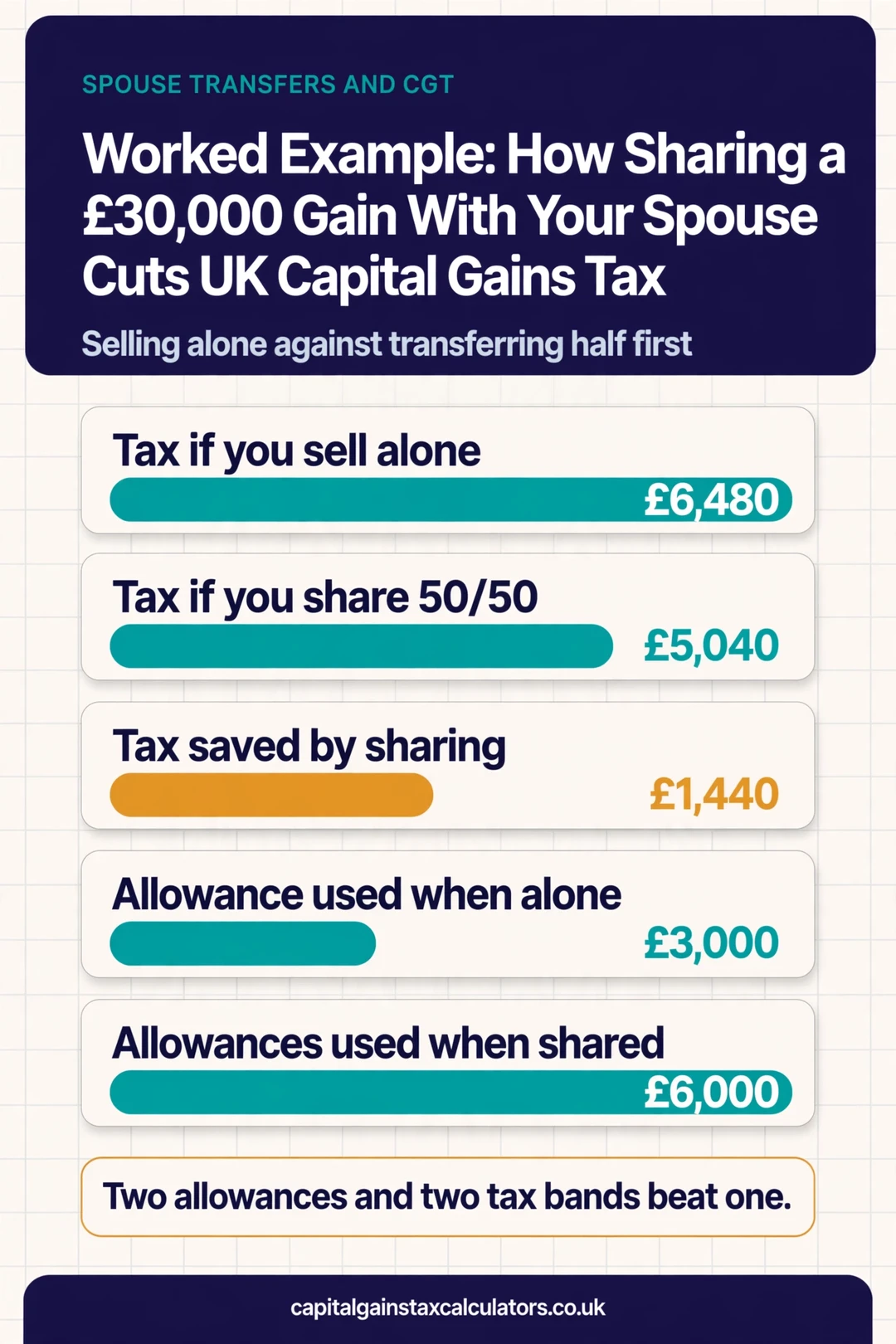
A couple expects a gain of £30,000 on shares. One spouse earns £80,000, and the other £10,000.
- Selling in the higher earner’s name: £6,480 of tax, all at 24%.
- Splitting 50/50: each has £15,000, each uses a £3,000 allowance, and the lower earner uses the 18% band. The tax is £5,040.
- Saving: £1,440.
- Best split: 10% to the higher earner and 90% to the lower earner, with tax of £4,320.
If both spouses earn £80,000, the saving falls to £720, which is the second allowance. If one has no income, sharing a gain of £100,000 could save £2,982. The result depends on how much of the lower earner’s basic rate band is available.
Conditions HMRC looks at
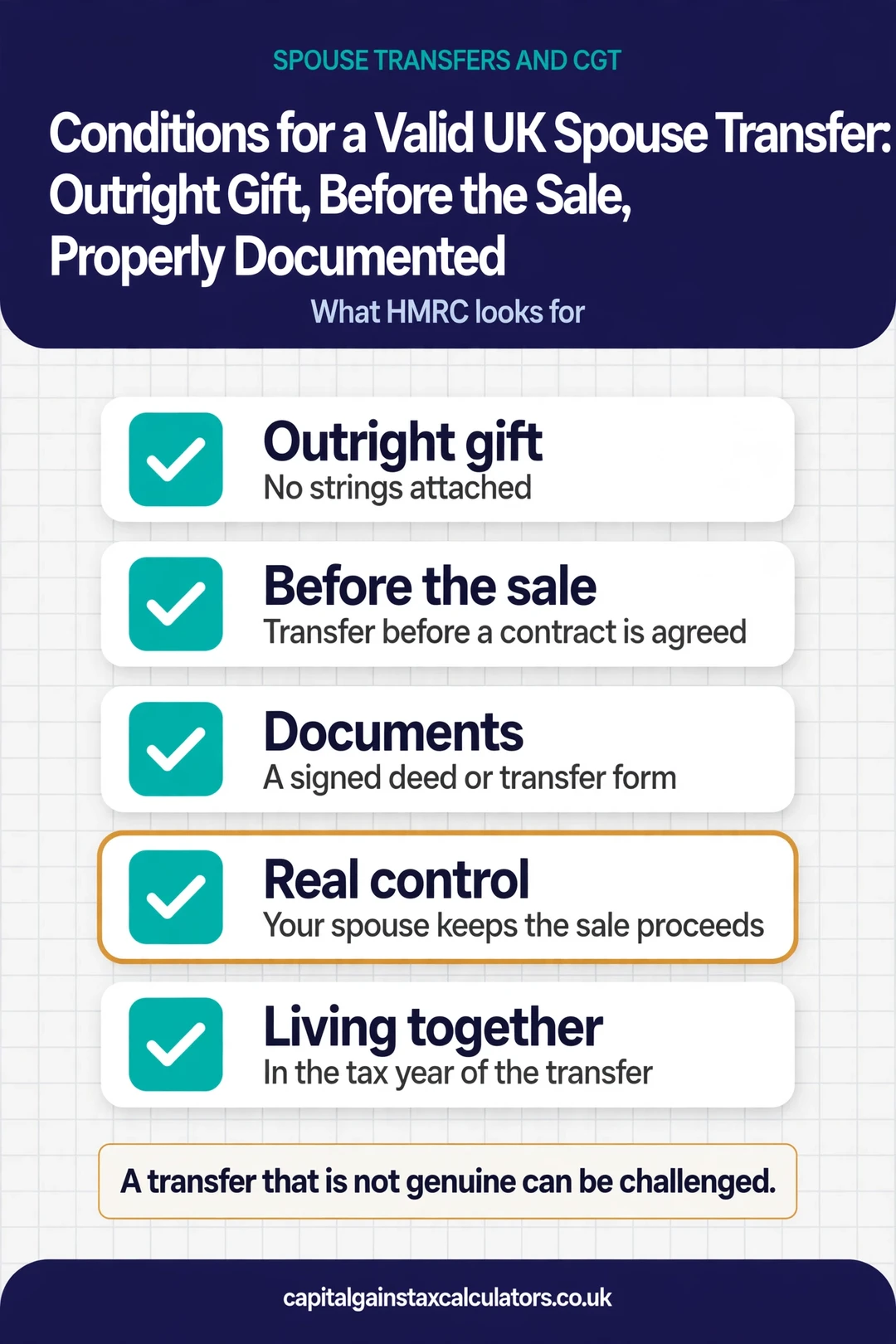
HMRC accepts these transfers, but it can challenge them if they are not genuine. The main conditions are as follows:
- An outright gift. The receiving spouse must become the full owner. They should be free to keep the asset or the money from its sale.
- No conditions. You cannot make the transfer conditional on a later sale, or on the spouse paying you the proceeds.
- Before the contract. The transfer should happen before you agree the terms of a sale. A transfer after a binding contract may not be effective for tax.
- Proper documents. Use a deed of gift for land and property, or a stock transfer form for shares. Keep them.
- Real change in ownership. The spouse should take control, for example by receiving the sale proceeds into their own account.
Practical points for different assets
| Asset | How to transfer | Points to watch |
|---|---|---|
| Shares | Stock transfer form or broker transfer | Check the broker’s process and the pooled cost |
| Joint property | Deed or declaration of trust | Mortgage lender consent and Stamp Duty Land Tax if the spouse takes on debt |
| Rental property | Deed of gift | Rental income also moves to the new owner |
| Crypto | Record the transfer | Keep the pooled cost and dates |
| Business shares | Transfer to the spouse | Can affect reliefs such as Business Asset Disposal Relief |
Transfers of rental property move both the gain and the rental income. If you own the property jointly, the default is that income is split equally between married couples, regardless of who pays the mortgage. You can declare unequal shares to HMRC if the beneficial ownership is unequal. Check the effect on Income Tax before you move a rental property.
Losses and spouses
You cannot transfer a loss to your spouse. Each person’s losses can only be set against their own gains. A spouse can, however, take over an asset that has a built-in loss and sell it themselves, which gives them a loss against their own gains. Because the cost passes at the original figure, the loss is measured from the original cost, not from the value at transfer. See our losses guide.
When transferring does not help
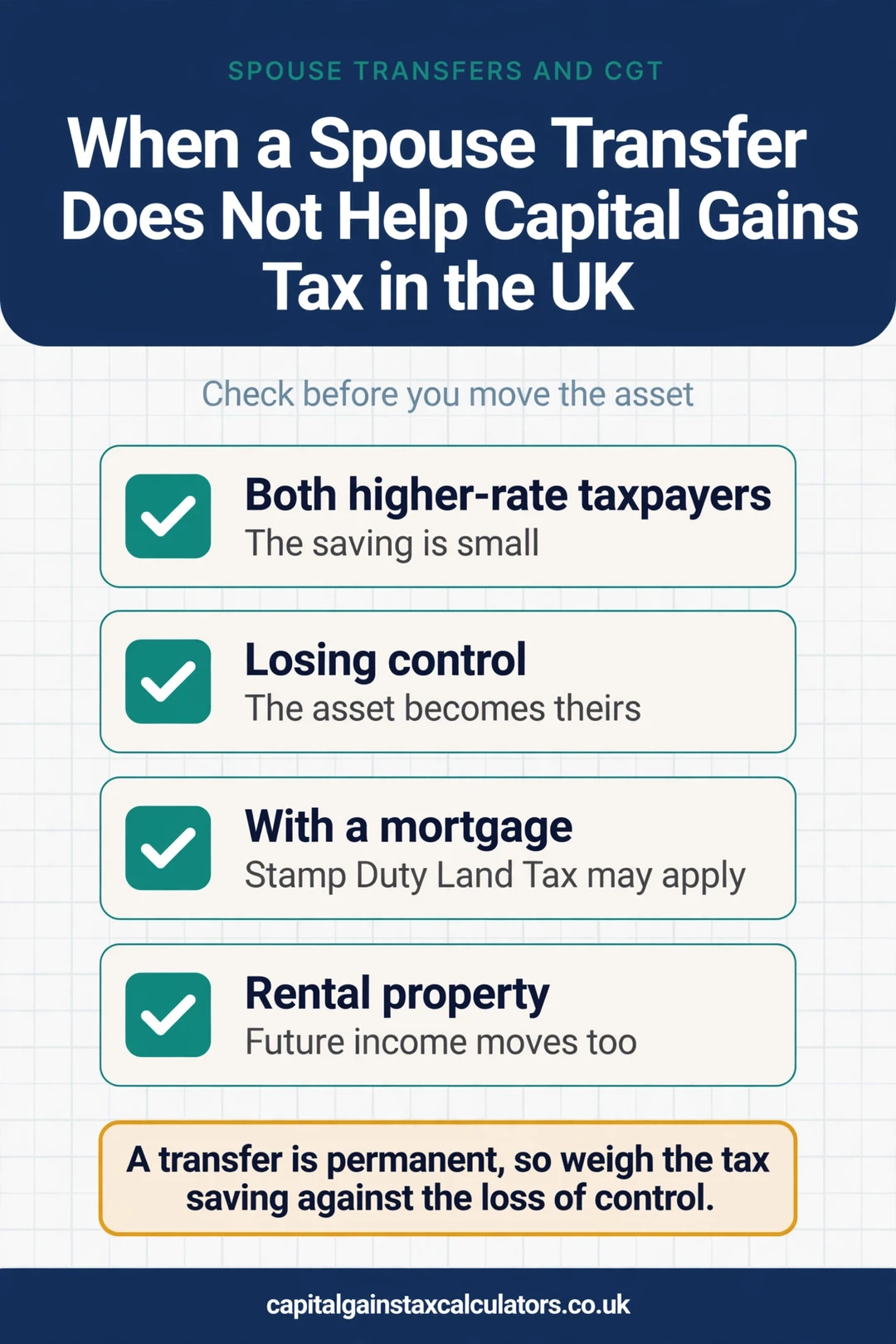
Moving an asset to a spouse is not always wise. It gives up control, and it may not suit you if the relationship ends. The saving may be small if you both pay the higher rate. A transfer can cause other tax effects, such as moving dividend income, or affecting benefits that depend on income. Stamp Duty Land Tax may apply to a mortgaged property. HMRC’s anti-avoidance rules can also deny the benefit if the arrangement is artificial. If you are separating, see the divorce rules.
Common mistakes with spouse transfers
- Transferring after agreeing a sale. The transfer may not be effective.
- Keeping the proceeds. The spouse must keep the money.
- Forgetting the cost carries over. The gain is measured from your original cost.
- Applying the rule to unmarried partners. It does not apply.
- Ignoring Income Tax. The asset’s income moves too.
- No paperwork. Use a deed or transfer form.
What to do next
- Work out the gain and each spouse’s income.
- Use the spouse transfer calculator to find the best split.
- Complete the transfer with the proper documents before you agree a sale.
- Each spouse reports their own share, as set out in our reporting guide.
Frequently asked questions
Is it tax free to transfer assets to my spouse?
Yes for Capital Gains Tax, if you are married or in a civil partnership and living together. The transfer is no gain, no loss.
What cost does my spouse use?
Your original cost and your acquisition date. The gain on a later sale is measured from those, not from the value at the transfer.
Can we use both allowances on one sale?
Yes, if each of you owns a share when it is sold. Each has a £3,000 allowance for 2026/27.
Can I transfer my unused allowance to my spouse?
No. The allowance cannot be transferred. You can transfer the asset so that the gain arises in your spouse’s name.
Does the rule apply to unmarried partners?
No. A gift to an unmarried partner is a disposal at market value.
Do we need documents for the transfer?
Yes. Use a deed of gift for property and a stock transfer form for shares. Keep them with your tax records.
When must the transfer be made?
Before you agree to sell. A transfer made after a binding contract may be disregarded.
Can I keep control of the asset after the transfer?
No. The gift must be outright. If you keep the benefit, HMRC may treat the transfer as ineffective.
What happens to Stamp Duty Land Tax on a property transfer?
A transfer where the spouse takes on a mortgage can be treated as a purchase for the amount of the debt. Check this before you transfer.
Is this tax avoidance?
Using the spouse rule and both allowances is standard tax planning when the transfer is genuine. HMRC can challenge artificial arrangements.
Official sources
- GOV.UK: Capital Gains Tax: gifts
- HMRC Capital Gains Manual: Transfers between spouses
- GOV.UK: Capital Gains Tax rates
- GOV.UK: Tax when transferring assets on divorce or separation
Related guides and calculators
This page gives general information for UK taxpayers and is not tax advice. Capital Gains Tax rules can change and your own circumstances matter. Check the latest rules on GOV.UK or with a qualified tax adviser before you act.