Quick answer
Private Residence Relief (PRR) stops you paying Capital Gains Tax on the home you live in as your only or main residence. If you lived there for the whole time you owned it, the gain is fully exempt. If not, the relief covers the months you lived there, certain periods away, and always the last 9 months of ownership. The rest of the gain is taxed at 18% or 24%.
Key facts
- Relief applies to the home that was your only or main residence for some or all of your ownership.
- The final 9 months of ownership always count, or 36 months if you are disabled or in long-term care.
- Absences of up to 3 years for any reason, 4 years for work in the UK and any length for work abroad can count.
- Gardens and grounds of up to 5,000 square metres are included.
- Letting relief now needs you to have shared the home with your tenant, and is capped at £40,000.
Good to know
Test your dates
Use our Private Residence Relief calculator to enter your dates and see how much of your gain is covered.
What Private Residence Relief is
Private Residence Relief is the reason most people do not pay Capital Gains Tax when they sell their home. The relief applies automatically in the simplest case: if the property was your only or main home throughout your ownership, you do not need to claim anything or report the sale for Capital Gains Tax. It becomes more complex when you did not live there all the time, when you own two homes, or when you let the property out.
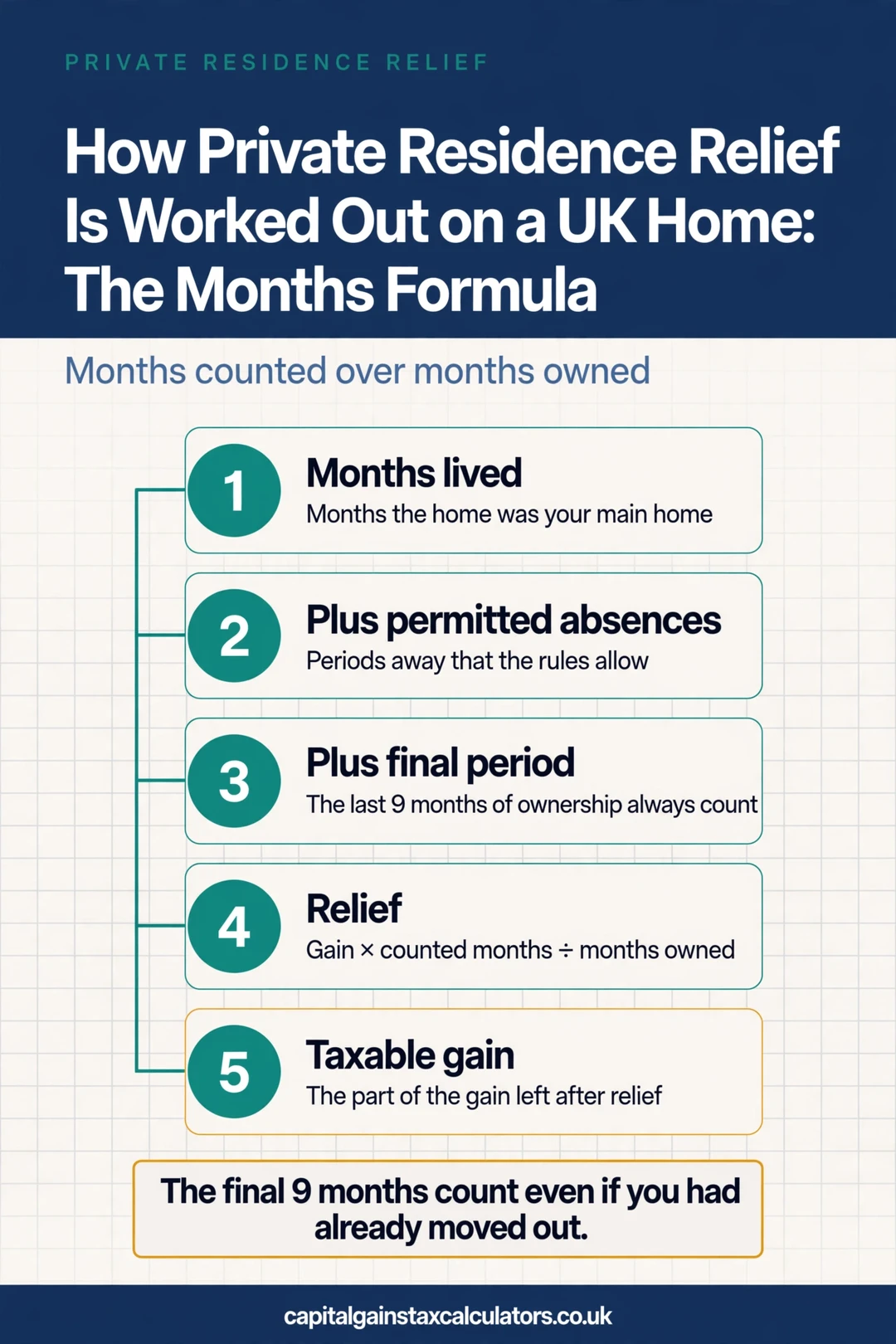
The key idea is that the relief is time-based. The gain is spread evenly over the months you owned the property. The months that count as your main home are covered, and the others are taxable. The relief is the gain multiplied by the months that count, divided by the total months owned.
What counts as your main home
Your main home is the place you live as your home. There is no set minimum period, but you need to show a degree of permanence and continuity, not a brief stay. Evidence includes where you are registered to vote, where your bills and bank statements go, your GP registration and your council tax. A property you live in only for a short time before selling may not qualify if the pattern suggests it was never a real home.
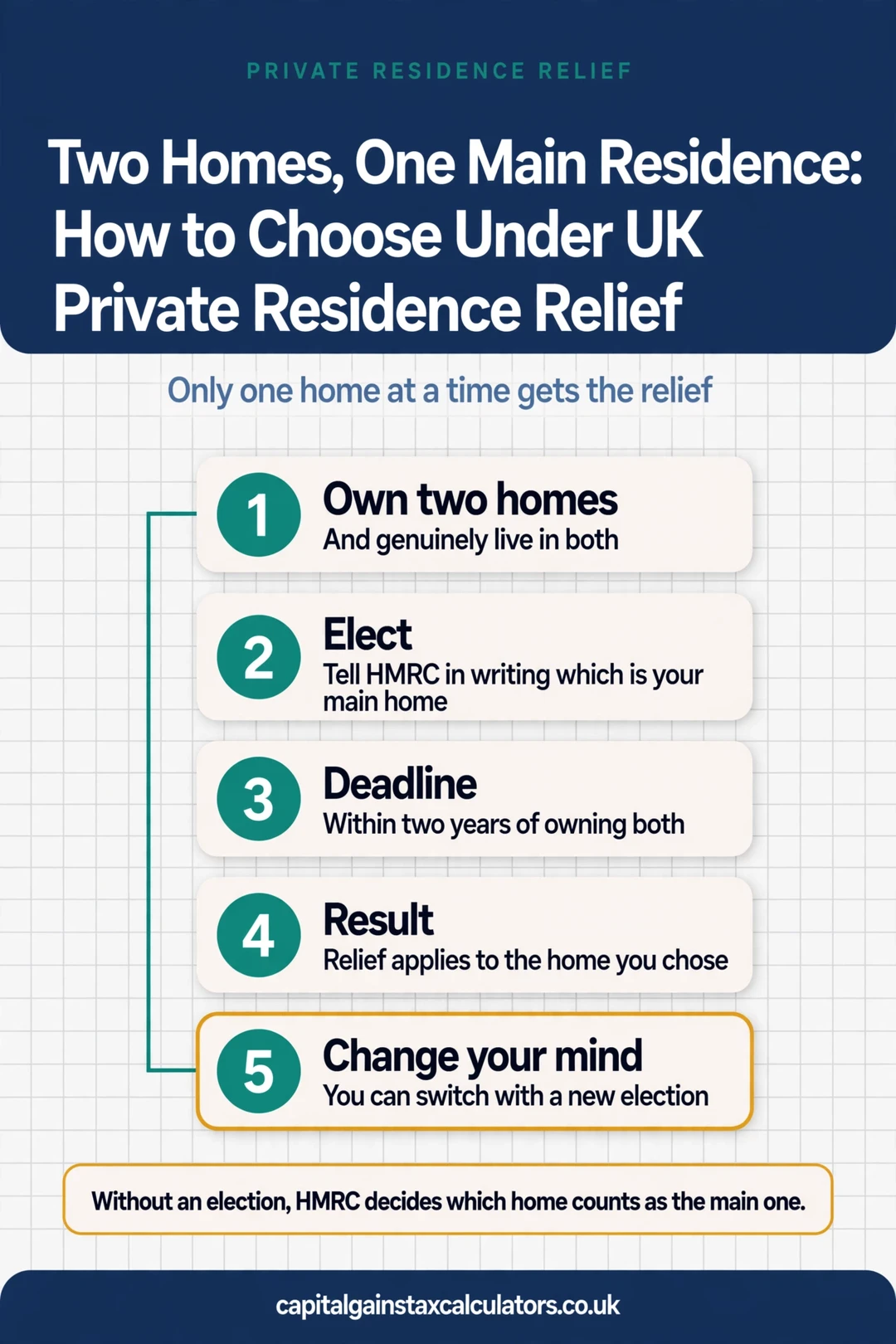
If you own two or more homes, you can choose which one is your main home for tax. You should make the election in writing to HMRC within two years of the date you first had two homes. If you do not, HMRC decides based on the facts. You can change the election later with notice, and a change usually takes effect from the date you give it, or up to two years earlier. A married couple or civil partners can only have one main residence between them.
The final period
The last 9 months of ownership are always treated as time you lived there, provided the property was your main home at some point. The rule helps if you move out and take time to sell. It is 36 months if you are disabled or in long-term residential care and meet the conditions. It applies even if you have bought a new main home in the meantime.
Worked example
Lived there for 40 of 100 months
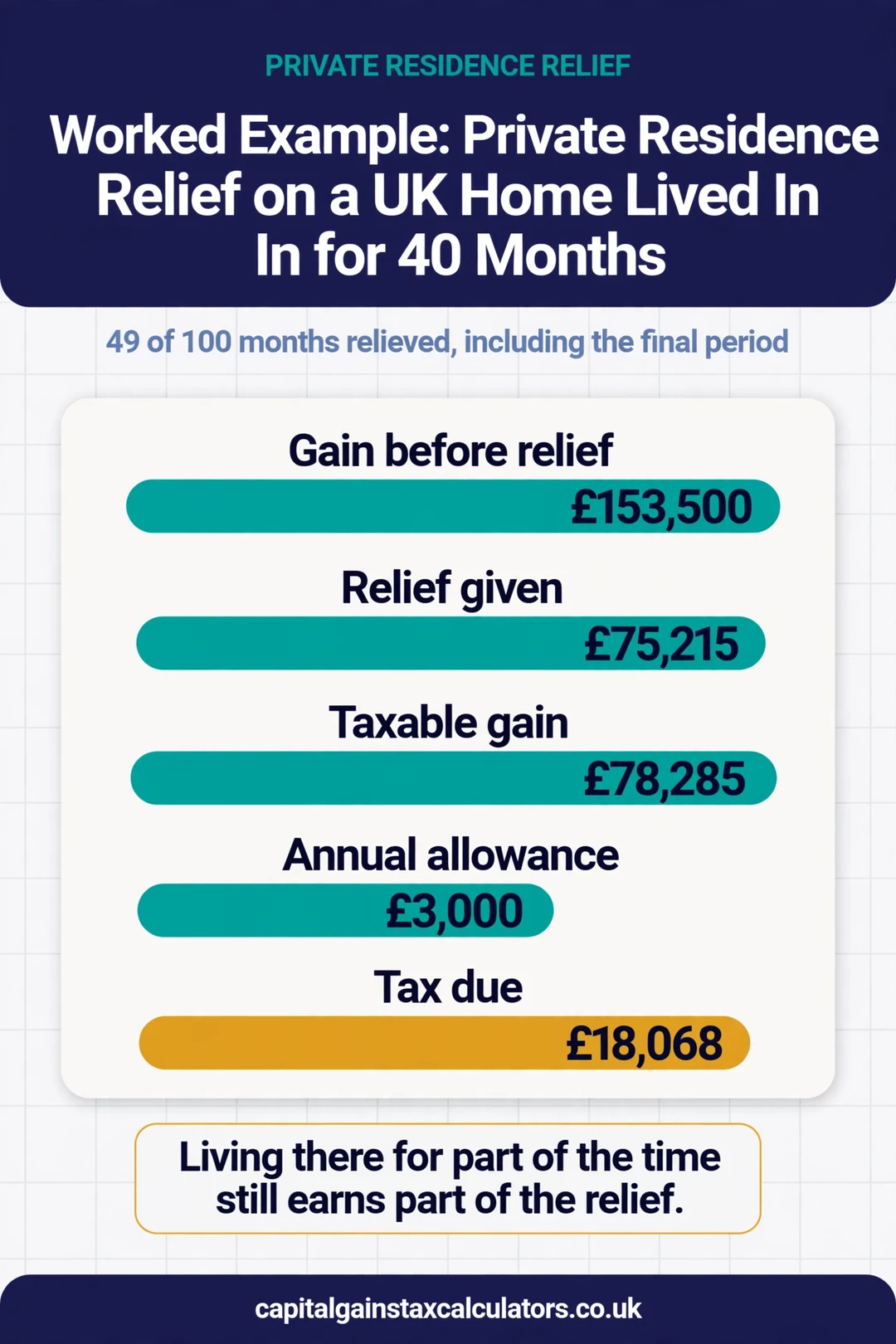
You own a house for 100 months. The gain after costs is £153,500. You lived there for 40 months, then moved out and sold 60 months later.
- Months that count: 40 lived in plus 9 for the final period = 49 of 100.
- Relief: £153,500 x 49 / 100 = £75,215.
- Taxable gain before the allowance: £78,285.
- Tax on an income of £60,000: £18,068, compared with £36,120 without relief.
With the longer 36-month final period, the months that count rise to 76 and the tax falls to £8,122. If you had lived there for the full 100 months, the tax would be £0.
Periods of absence that still count
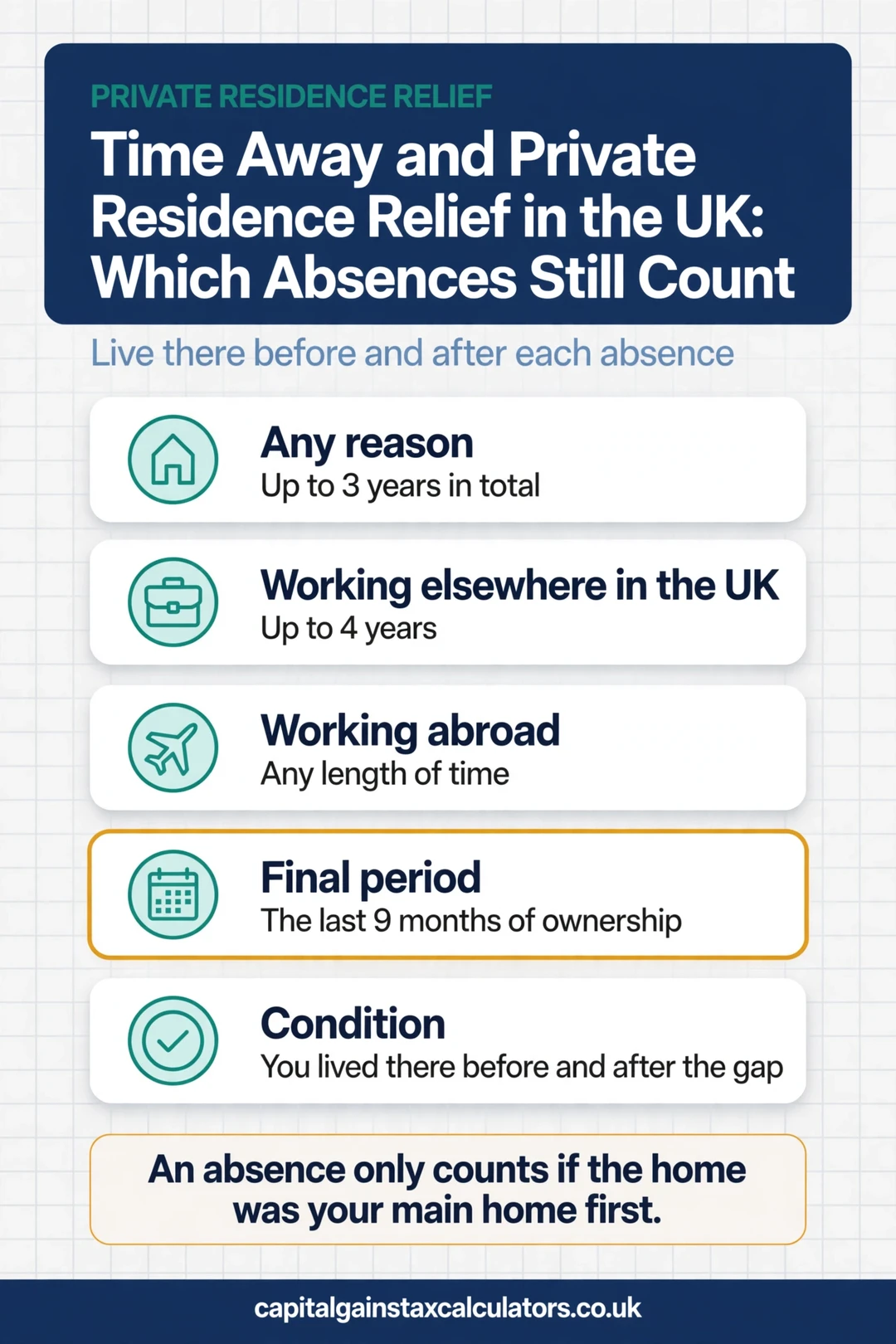
You can be away and still count the months as your main home, if you lived in the property before and after the absence and nobody else’s home counted as your main one meanwhile.
| Reason for absence | Maximum time | Conditions |
|---|---|---|
| Any reason | 3 years in total | Can be one period or several |
| Working elsewhere in the UK | 4 years in total | You must be employed or self-employed |
| Working abroad | Any length | You must be an employee, and live in the home before and after |
| Final period of ownership | 9 months | Automatic, regardless of other rules |
Adding 24 months of permitted absence in the example takes the months that count to 73 and lowers the tax to £9,227. If work prevented you from moving back, HMRC may still allow the absence. Moving out for a different reason, such as moving to a new home, usually means the property stops being your main home from that date.
Gardens and grounds
The garden, grounds and outbuildings are part of your home, up to 5,000 square metres including the house. A larger area can qualify if it is reasonably required for the enjoyment of the home, given its size and character. If you sell part of the garden separately, the gain on the garden is usually exempt if the sale is before or at the same time as the house and the total area stays within the limit. Our guide to Capital Gains Tax on land covers garden plot sales.
Letting, lodgers and business use
| Situation | Effect on relief |
|---|---|
| One lodger who lives with you as part of the household | No effect on your relief |
| Renting out a room in your home as a business | The part used may lose relief |
| Letting the whole property while you live elsewhere | Months let do not count unless covered by an absence rule |
| Using a room only for business | The business part may be taxable |
| Shared occupation with a tenant | Letting relief up to £40,000 may apply |
Letting relief is now limited to cases where you lived in the property with your tenant. It is the lowest of the relief you already have, £40,000, or the gain from the letting. A buy-to-let that you let as a whole does not qualify. See our guide to buy-to-let.
Reporting a sale where only part is relieved
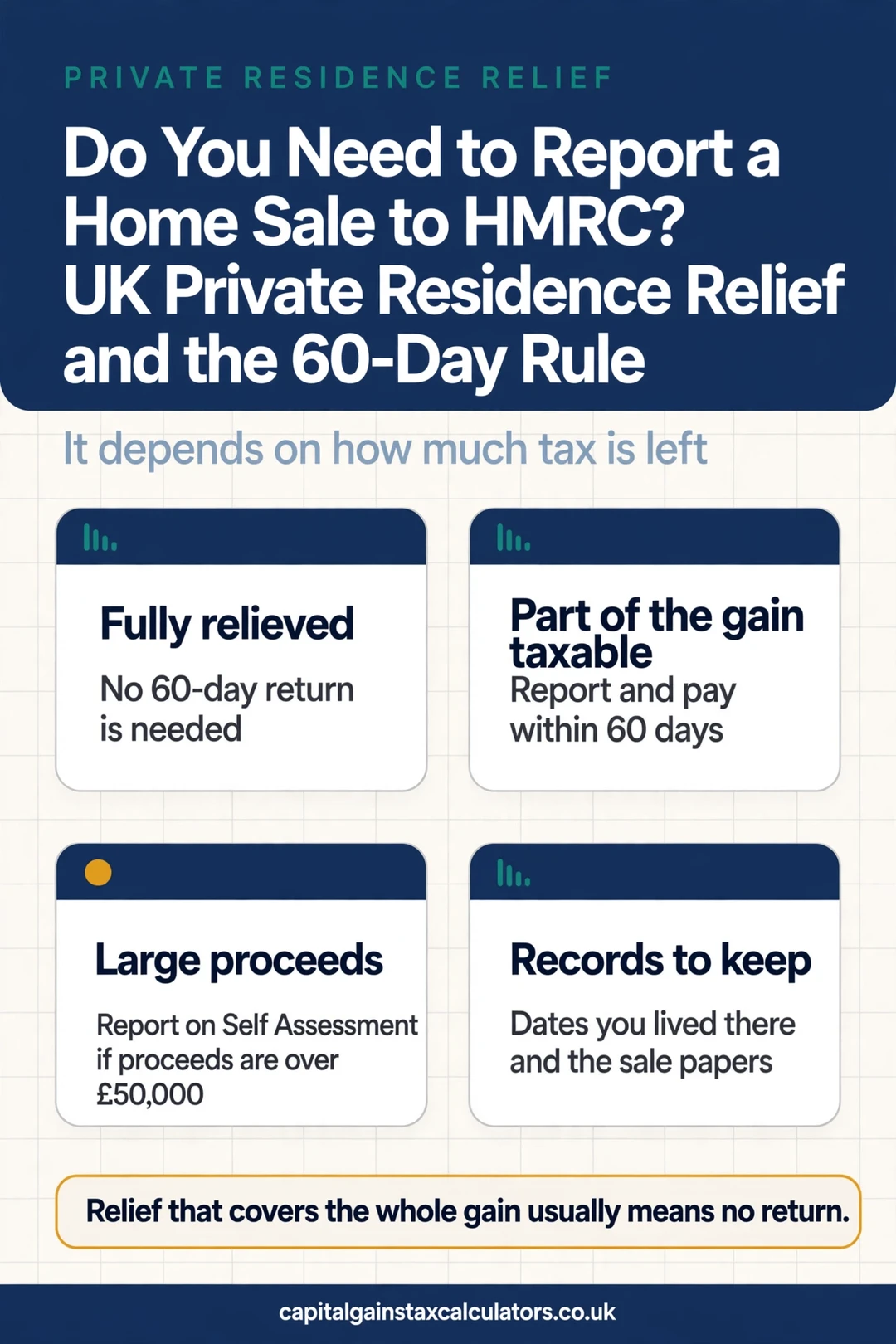
If the whole gain is covered by relief, there is nothing to report to HMRC for Capital Gains Tax. If part of the gain is taxable and you are a UK resident selling UK residential property, you must report and pay within 60 days of completion. For a gain of £157,700 with 69 of 120 months covered, the tax is £15,365 on an income of £55,000. Our reporting guide shows how.
Common mistakes with Private Residence Relief
- Assuming relief covers a second home. Only your main home qualifies.
- Forgetting to elect. With two homes, choose in writing within two years.
- Overcounting absence. The reason and the length matter.
- Believing a lodger ends relief. One lodger does not.
- Selling the garden after the house. It can lose its relief.
- Not reporting. A taxable part within 60 days still needs reporting.
What to do next
- Write a timeline of when you bought, lived in, left and sold the property.
- Enter the dates in the calculator.
- Check the reliefs guide for other reliefs that might apply.
- Report and pay within 60 days if tax is due.
Frequently asked questions
What is Private Residence Relief?
It is a Capital Gains Tax relief that exempts all or part of the gain on a property that was your only or main home. The relief depends on how many months it counted as your main home.
Do I pay Capital Gains Tax when I sell my main home?
Not if it was your main home for the whole time you owned it and the garden is within 5,000 square metres. Part-time use as a home gives part relief.
What is the final period exemption?
The last 9 months of ownership count as time living in the home, even if you had moved out. It is 36 months for disabled owners or those in long-term care.
How long can I be away and keep the relief?
Up to 3 years for any reason, up to 4 years for work elsewhere in the UK, and any length for work abroad as an employee. You must live there before and after.
What if I own two homes?
Choose one as your main home and tell HMRC in writing within two years of owning both. You can change the election later.
Does a lodger affect my relief?
A single lodger who lives with you as part of the household does not usually affect it. Letting rooms as a business can.
Is letting relief still available?
Only if you shared the home with your tenant. It is limited to the lowest of your relief, £40,000 and the gain from the letting.
Does relief apply if I never lived in the property?
No. The property must have been your main home at some point. Without that, there is no relief and no final period.
Do I have to report the sale if there is no tax?
A UK resident does not need the 60-day return if there is no tax. You may still need to report on Self Assessment if your total proceeds are over £50,000.
Does it apply to a home inherited from a relative?
Only if you lived there as your main home. The cost is the value at the date of death, and relief covers the months you lived there.
Official sources
- GOV.UK: Tax when you sell your home
- HMRC helpsheet HS283: Private Residence Relief
- GOV.UK: Tax when you sell property
- HMRC Capital Gains Manual: Private residence relief
Related guides and calculators
This page gives general information for UK taxpayers and is not tax advice. Capital Gains Tax rules can change and your own circumstances matter. Check the latest rules on GOV.UK or with a qualified tax adviser before you act.