Quick answer
To calculate Capital Gains Tax, take the sale price, deduct what you paid and the allowable costs to find the gain, subtract any reliefs and losses, then subtract your £3,000 annual allowance. The rest is taxed at 18% or 24% for 2026/27, depending on how much of your basic rate band your income and the gain use. On a gain of £97,000 and an income of £55,000, the tax is £22,560.
Key facts
- Gain = sale price (or market value) minus cost minus allowable costs.
- Deduct reliefs first, then losses, then the £3,000 annual allowance.
- Rates are 18% and 24%, set by your income and the size of the gain.
- Shares, funds and crypto use pooling and matching rules to decide the cost.
- The tax year runs from 6 April to 5 April.
- You report property gains within 60 days and other gains through Self Assessment.
Good to know
Skip the sum
Our property calculator and shares calculator do all seven steps for you and show every line.
The formula in one line
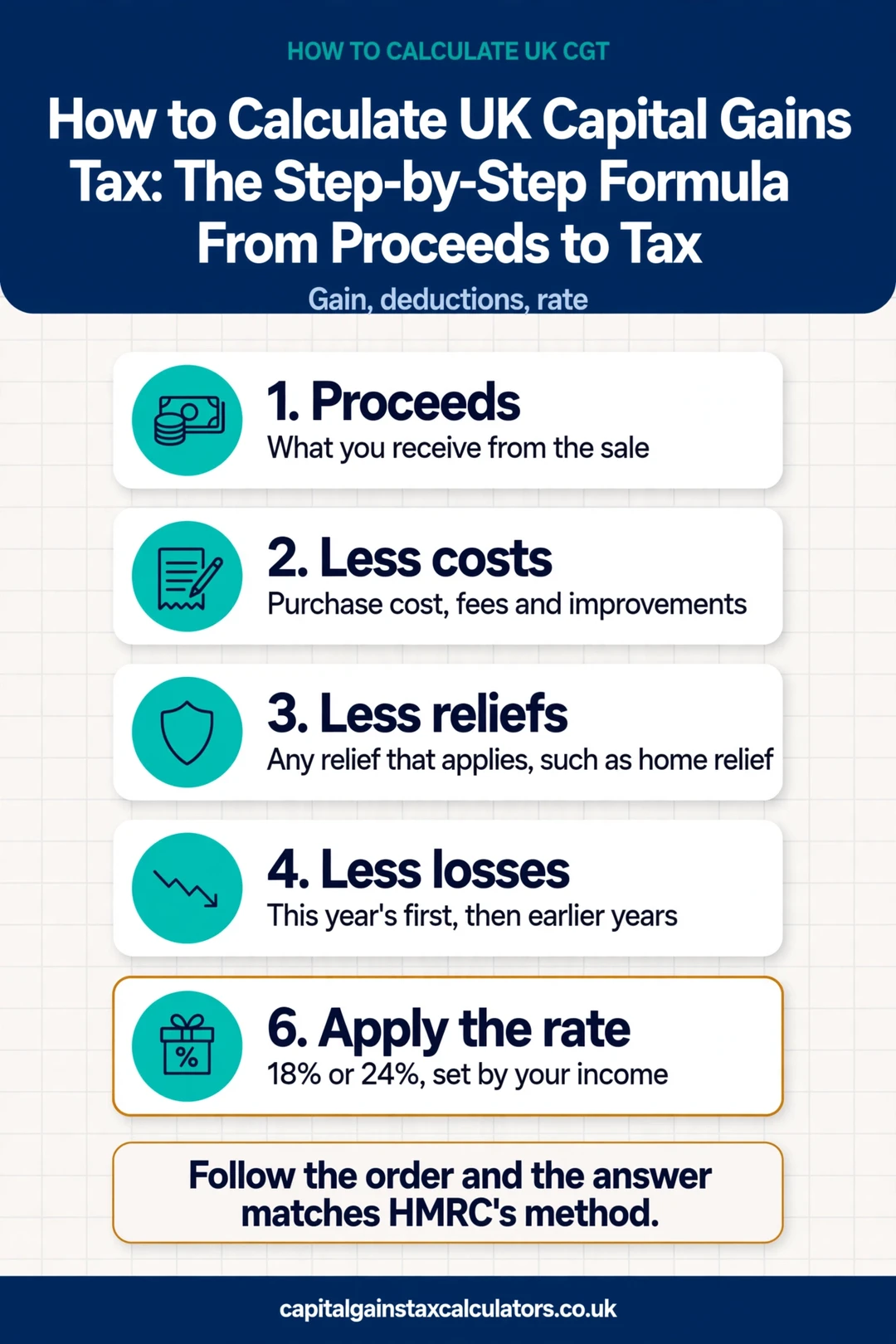
The tax is the taxable gain multiplied by the rate. The taxable gain is the proceeds, less the costs, less reliefs, less losses, less the allowance. Each step below adds one of those parts. The order matters, because reliefs come before losses and losses come before the allowance. Doing them in the wrong order is the most common reason a hand calculation is wrong.
Step 1: Decide whether you have a disposal
A disposal is a sale, a gift, a swap or the loss of an asset. A transfer to a spouse or civil partner is a disposal with no gain and no loss. Giving something to charity is also free of the tax. You only calculate a gain when the asset is chargeable, so check the exemptions guide first. Your main home, ISAs, pensions, cars and British government gilts are exempt.
Step 2: Find the proceeds
The proceeds are the amount you receive. For a gift, or a sale to a connected person at less than its value, you use the market value instead. For a sale, deduct nothing yet. Selling costs come in step 4. Write down the date of the contract, because that decides the tax year, not the date the money arrives.
Step 3: Find the cost
The cost is what you paid. For an inherited asset, it is the value at the date of death, found from the probate value. For a gifted asset, it is the market value when you received it, unless a relief held the gain over. For shares and crypto, the cost comes from the pooling and matching rules, not from the most recent purchase. See the Section 104 guide.
Step 4: Add the allowable costs
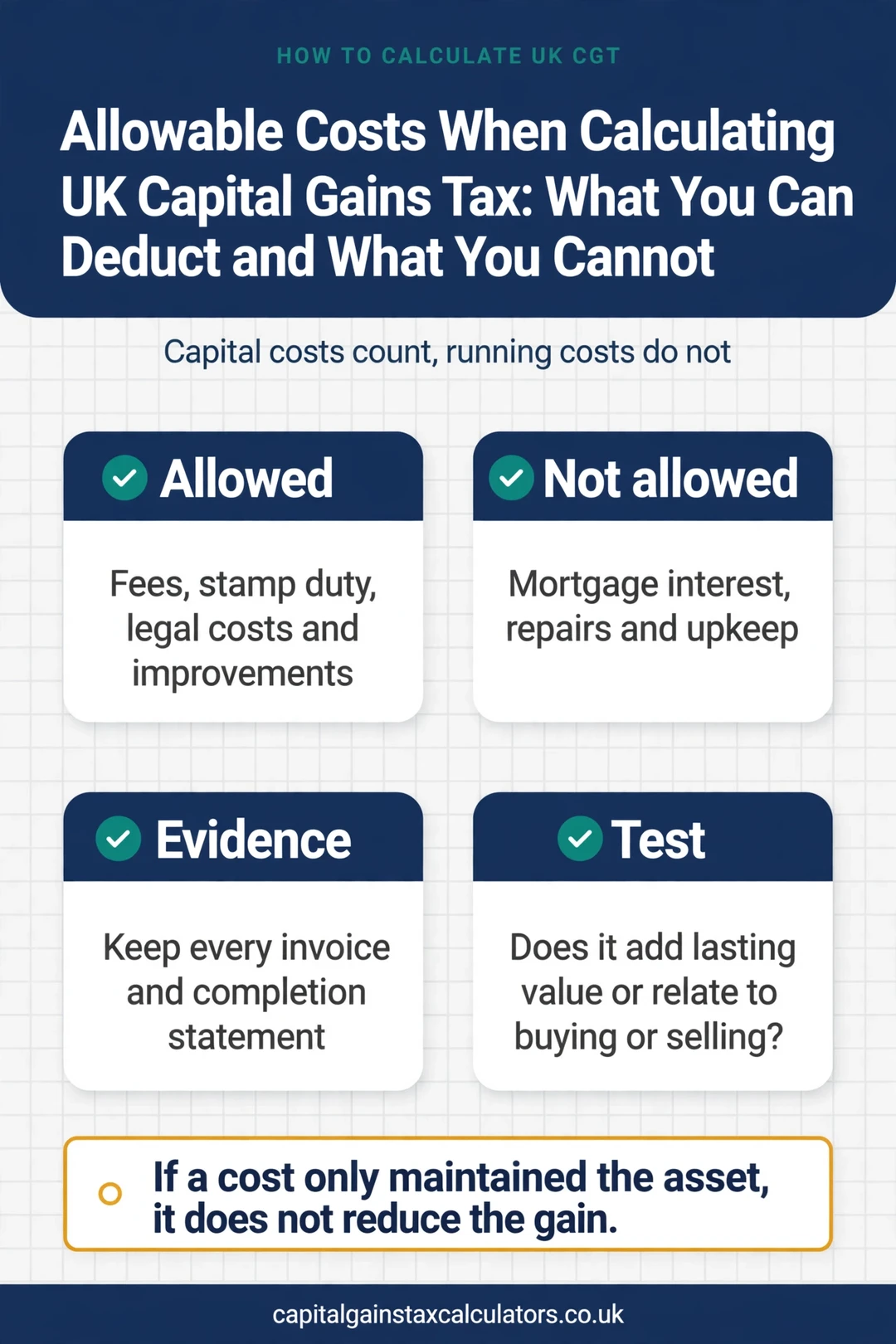
Allowable costs reduce the gain. For a property, include the buying costs, Stamp Duty Land Tax, legal and survey fees, the cost of improvements that are still reflected in the property, and the selling costs, such as agent and legal fees. Repairs and maintenance are not allowable. Mortgage interest is never allowable.
| Allowable | Not allowable |
|---|---|
| Stamp Duty Land Tax | Mortgage interest |
| Solicitor and survey fees | Routine repairs |
| Estate agent fees on sale | Decoration and upkeep |
| Extensions and new bathrooms | Insurance and council tax |
| Cost of valuing the asset | Your own time or labour |
Step 5: Work out the gain and apply reliefs
The gain is proceeds less cost less allowable costs. In our property example, a sale at £320,000 of a house bought for £200,000, with £6,000 of buying costs, £5,000 of selling costs and £12,000 of improvements, gives a gain of £97,000. If the property was ever your home, deduct Private Residence Relief now. If it was a business, check Business Asset Disposal Relief. Reliefs reduce the gain or the rate, so they come before losses.
Worked example
A property sale, line by line
Sale price £320,000, less cost £200,000, less buying costs £6,000, less selling costs £5,000, less improvements £12,000, equals a gain of £97,000. Less the £3,000 allowance leaves £94,000 to tax. With an income of £55,000, the taxable gain is charged at the property rates, so £22,560 is due.
Step 6: Deduct losses, then the allowance
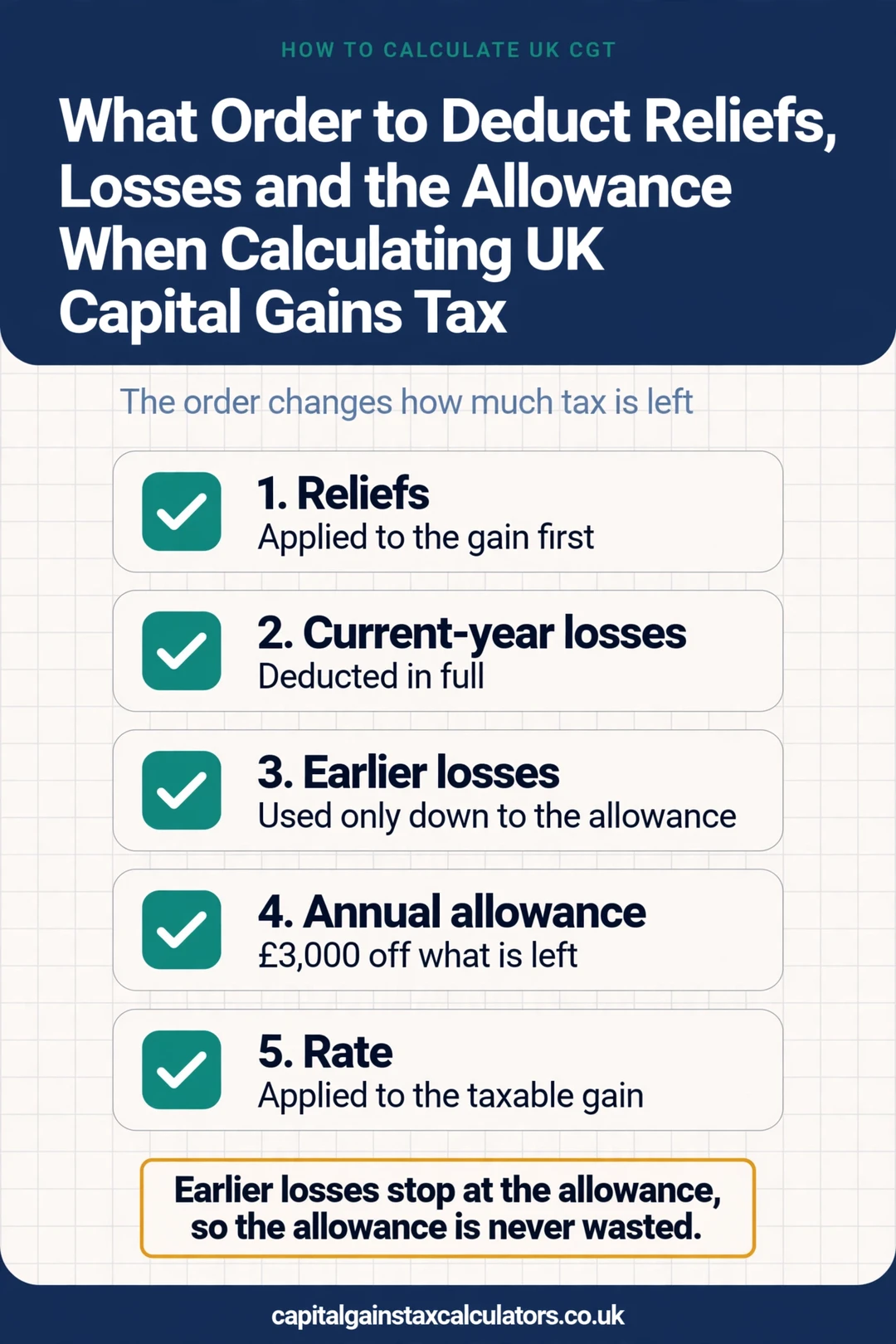
Capital losses from the same year come off first. They are deducted in full, even if the gain would have been covered by the allowance. Losses from earlier years are only used to bring the gain down to the allowance, and no further. Then the £3,000 allowance comes off. On a share sale with a gain of £12,800, the allowance leaves £9,800 taxable. With a £4,000 loss in the same year, the tax falls to £1,044. With a £6,000 loss from an earlier year, it falls to £684. The whole £6,000 can be used here because the gain is well above the allowance, but the loss would never be used to take the gain below it. Read more in the losses guide.
| Order | What you deduct | Why it matters |
|---|---|---|
| 1 | Reliefs | They reduce the gain or the rate |
| 2 | Losses from the same year | Always used in full |
| 3 | Annual allowance (£3,000) | Applied after current-year losses |
| 4 | Losses from earlier years | Only down to the allowance |
Step 7: Apply the rate
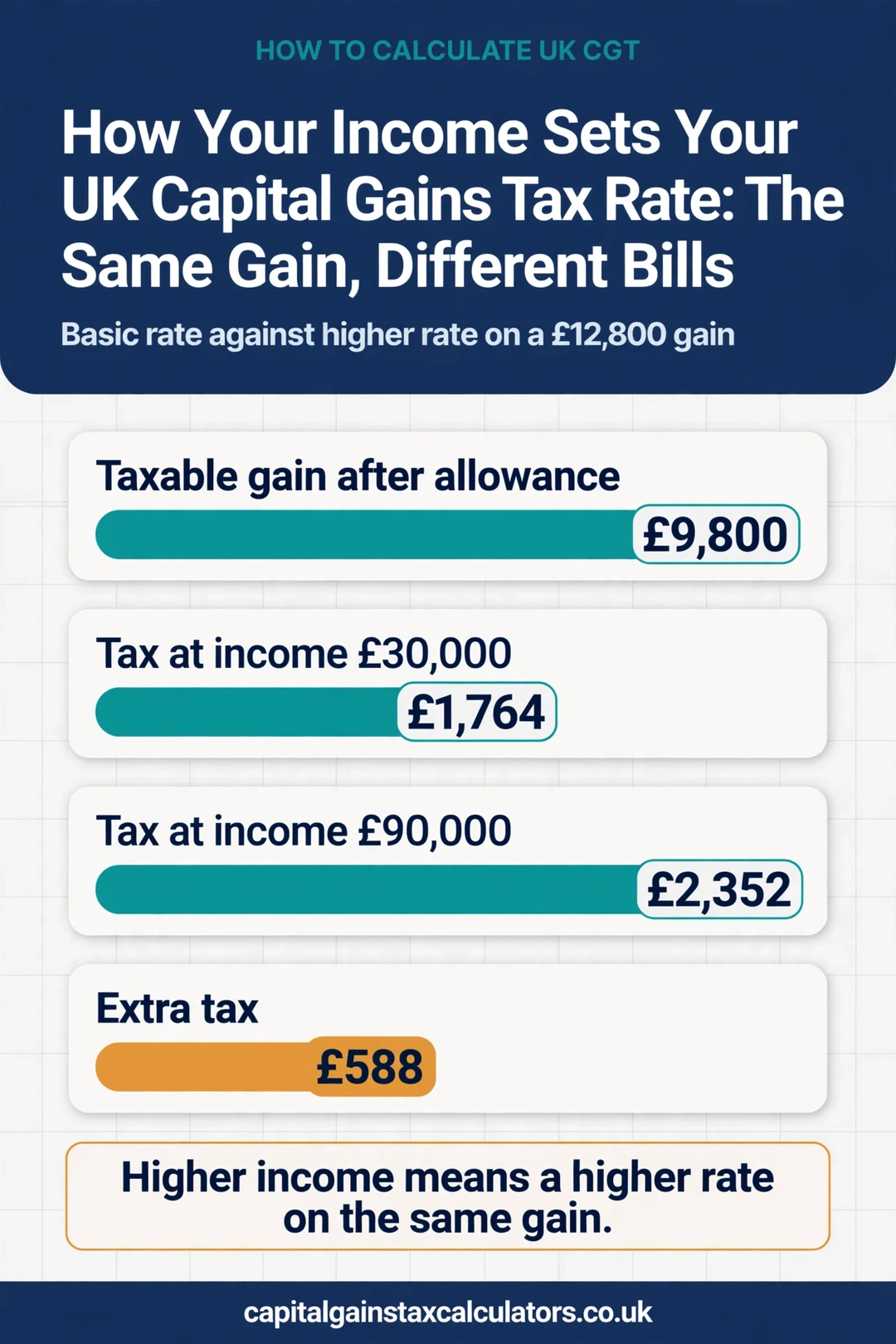
The taxable gain is added on top of your taxable income. The part that falls in your basic rate band is taxed at 18%, and the part above it at 24%. The basic band is £37,700 above your personal allowance of £12,570. With an income of £30,000, the share gain is all taxed at the lower rate and the bill is £1,764. With an income of £90,000, all of it is taxed at 24% and the bill is £2,352. Trustees and personal representatives pay 24% on everything. See the rates guide.
Worked example
Shares with a gain of £12,800
You sell shares for £28,000 that cost £15,000, with £100 of dealing costs each way. The gain is £12,800. The allowance leaves £9,800. On an income of £30,000, the basic rate applies, so the tax is £1,764. If your income were £90,000, it would be £2,352.
Step 8: Report and pay
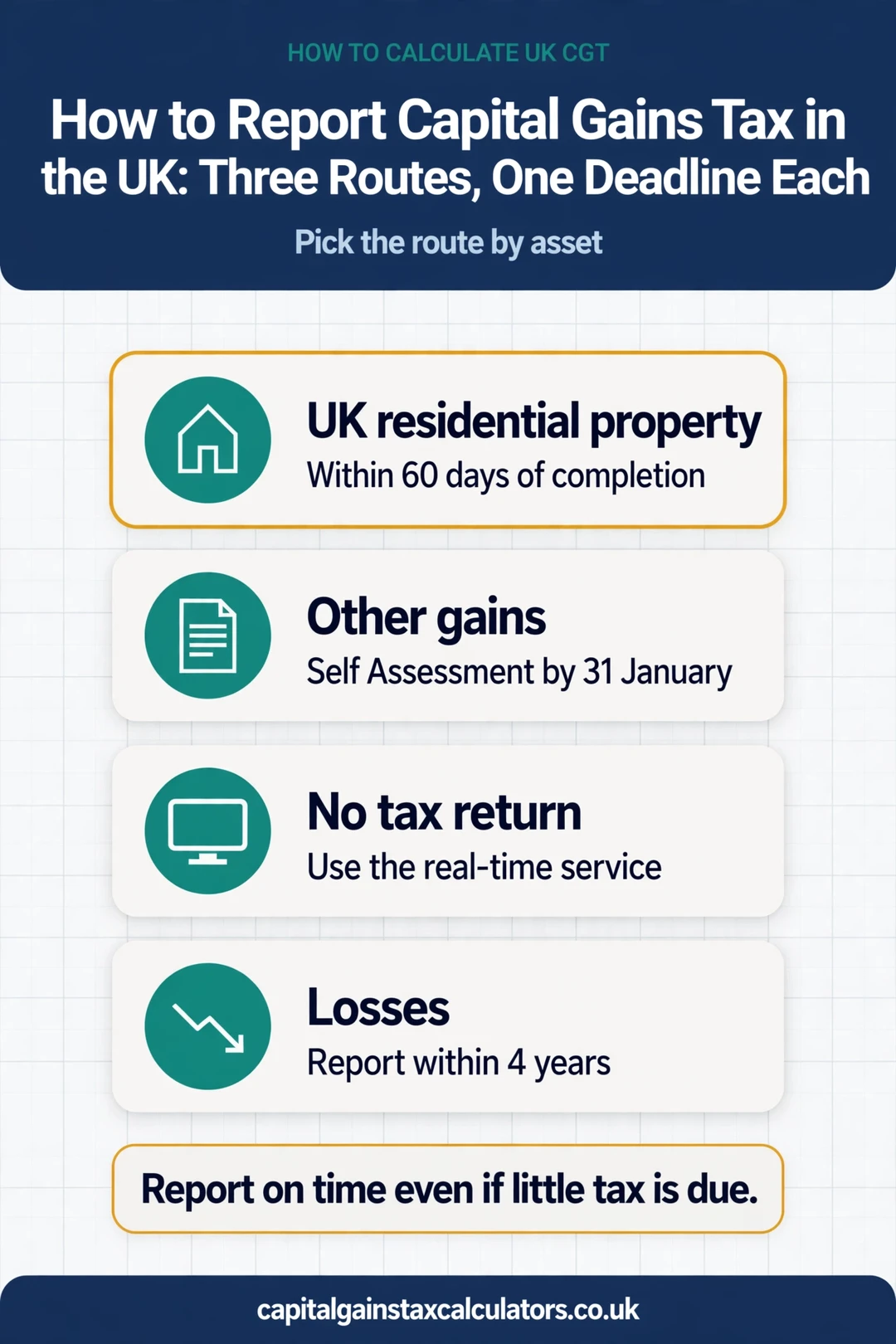
Property gains must be reported within 60 days. Other gains go on your Self Assessment return, or into the real-time service if you do not usually file one. If the proceeds are more than £50,000, report even if no tax is due. Find the routes in how to report Capital Gains Tax.
Common mistakes when calculating Capital Gains Tax
- Deducting repairs or mortgage interest. Neither is allowable.
- Forgetting the buying and selling costs. They can lower the gain by thousands of pounds.
- Using the wrong order. Reliefs, then losses, then the allowance.
- Using the last purchase price for shares. The pool average or the matching rules decide the cost.
- Using the date money arrives. The contract date sets the tax year.
- Forgetting the £50,000 reporting rule. You may need to report with no tax due.
- Ignoring other gains in the year. The allowance is shared across all disposals.
What to do next
- Gather the contract, the purchase price, the invoices and the dates.
- Run the figures through the property or shares calculator.
- Check for reliefs you could claim.
- Report within the deadline and keep your workings and records in case HMRC asks for them.
Frequently asked questions
How is Capital Gains Tax calculated?
Subtract the cost and allowable costs from the proceeds to get the gain. Deduct reliefs, losses and the £3,000 allowance, then tax the rest at 18% or 24%.
What is the formula for Capital Gains Tax?
Tax = (proceeds – cost – allowable costs – reliefs – losses – allowance) x rate. The rate depends on your income and the size of the gain.
Do I deduct the allowance before or after losses?
Current-year losses come off first. The allowance then comes off. Losses from earlier years are only used to bring the gain down to the allowance.
Can I deduct mortgage interest?
No. Mortgage interest is never an allowable cost for Capital Gains Tax.
What counts as an allowable cost?
Buying and selling fees, Stamp Duty Land Tax, legal and survey fees, valuation costs and the cost of lasting improvements.
Which rate do I pay?
18% on the part of the gain inside your basic rate band and 24% above it. Trustees and personal representatives pay 24%.
How do I calculate the gain on shares?
Match each sale to the same-day purchases, then purchases in the next 30 days, then the Section 104 pool average cost. The difference is the gain.
What if I made a loss?
A loss can be reported and carried forward, as long as you tell HMRC within 4 years of the end of the tax year.
Which tax year does the gain fall in?
The year that includes the date of the contract. Years run from 6 April to 5 April.
Is there a quicker way to work it out?
Yes. Use the calculators on this site. They show every step so you can check the sum.
Official sources
- GOV.UK: Work out your Capital Gains Tax
- GOV.UK: Capital Gains Tax rates and allowances
- GOV.UK: Capital Gains Tax: what you pay it on
- GOV.UK: Report and pay Capital Gains Tax
Related guides and calculators
This page gives general information for UK taxpayers and is not tax advice. Capital Gains Tax rules can change and your own circumstances matter. Check the latest rules on GOV.UK or with a qualified tax adviser before you act.