Quick answer
When you separate or divorce, transfers of assets between you are free of Capital Gains Tax in the tax year you separate and for up to three more tax years after it, because they are treated as no gain, no loss. Transfers made under a formal agreement or court order can be made after that on the same terms. Selling the family home can still create a gain for the spouse who moved out, but Private Residence Relief often covers most or all of it.
Key facts
- Transfers between spouses are no gain, no loss in the tax year of separation and for up to three tax years after.
- Transfers under a formal divorce agreement or court order are no gain, no loss without a time limit.
- The spouse who moves out can often keep Private Residence Relief for the family home, within limits.
- A sale of the home to a third party creates a gain split between the owners, usually with relief.
- If tax is due on UK residential property, the report and payment are due within 60 days.
- Transfers on divorce also have separate Stamp Duty Land Tax rules.
Good to know
Check the relief on the family home
Use our Private Residence Relief calculator to see how much of a gain is covered if one spouse has moved out.
Why divorce has special rules
Separating couples often have to transfer property, shares and businesses. If the normal rules applied, one spouse could face a tax bill simply because the law or a court order required them to hand over an asset. To prevent that, the law gives a window in which transfers are treated as no gain, no loss, even after the couple stop living together. The spouse who receives the asset takes over the original cost and date, and any gain is only charged later, when they sell.
The rules look at the tax year in which you separated, not the date of the decree. Separation means you are living apart permanently, or are separated under a court order or a deed of separation. The tax year in which you separate is the one that counts. Our guide to spouse transfers explains the basic rule that applies while you live together.
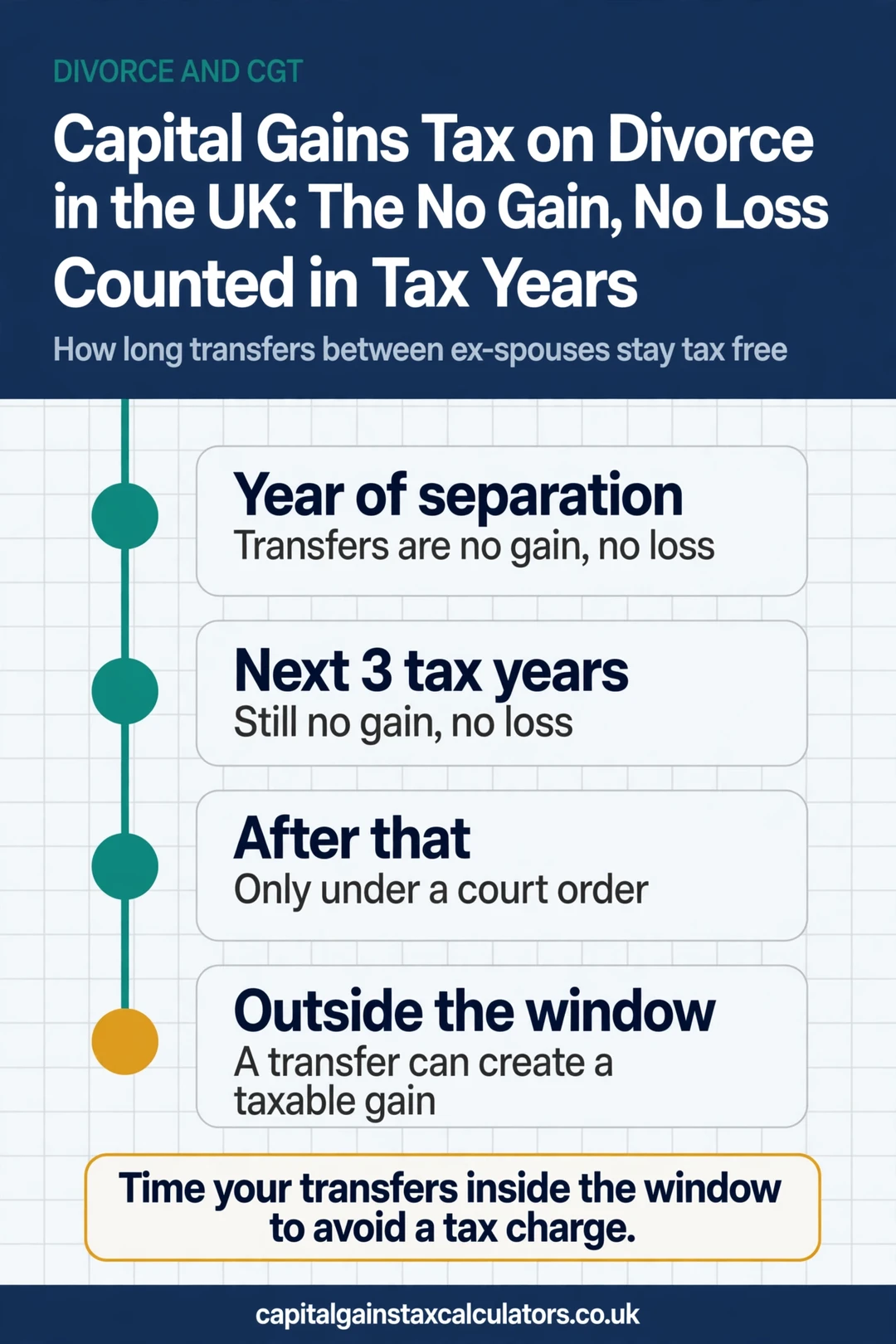
The no gain, no loss window
| When the transfer is made | Capital Gains Tax treatment |
|---|---|
| While you are living together | No gain, no loss |
| In the tax year you separate | No gain, no loss |
| In the three tax years after the year of separation | No gain, no loss |
| Later, under a court order or formal agreement | No gain, no loss |
| Later, without a formal agreement | A disposal at market value |
The time limit is counted from the end of the tax year in which you separated. A transfer outside the limit is treated like a gift to a stranger, with a gain worked out at market value, unless it is made under a court order or a formal agreement. It is therefore useful to document the transfers as part of the divorce settlement. You will also need to consider Stamp Duty Land Tax. Transfers between spouses on divorce under an order are generally exempt, but you should confirm that.
What happens to the family home
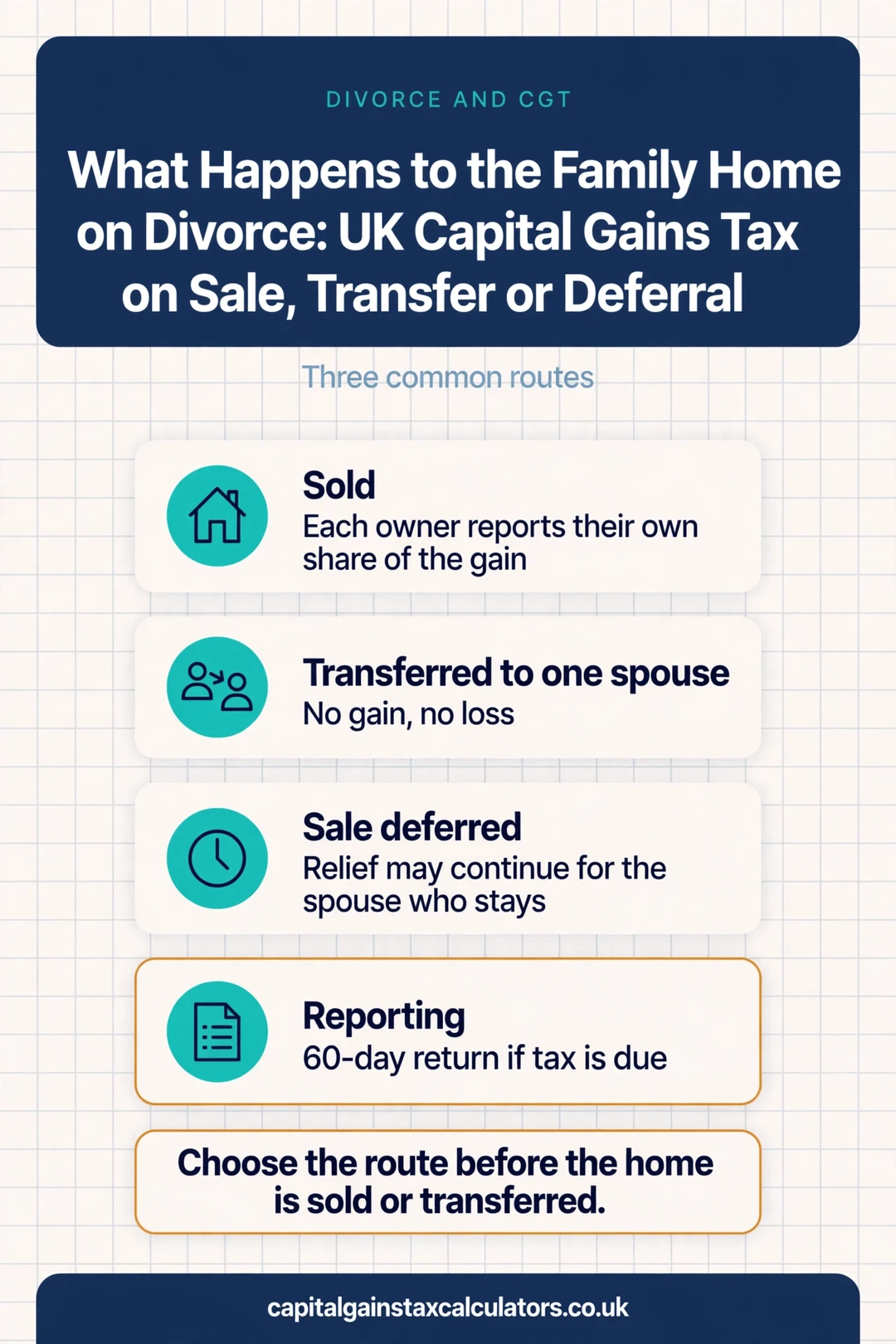
The family home is usually the biggest asset. Several things can happen to it. It can be sold and the proceeds divided, transferred to one spouse, or kept in joint names with a plan to sell later.
Selling the home to a third party
If you sell to a buyer, each owner reports their own share of the gain. If both of you lived in the home as your main residence, Private Residence Relief covers the gain in full. If one spouse moved out before the sale, their relief covers the months they lived there plus the final 9 months of ownership, and any months they were absent that qualify.
Worked example
A spouse who moved out before the sale
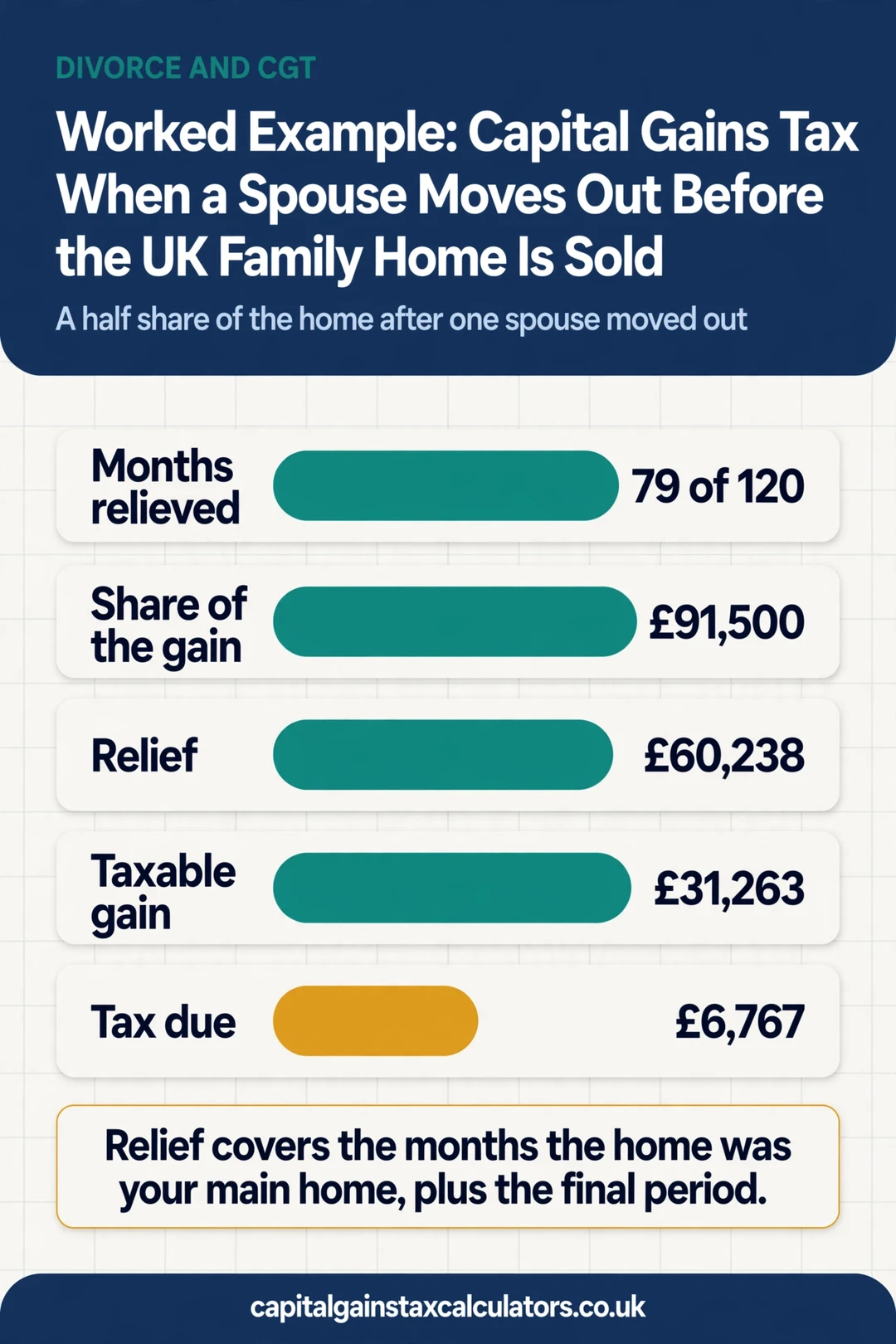
A couple bought a home 120 months before the sale. One spouse, who owns half, lived there for 70 months and then moved out. The gain after costs is £183,000, so the spouse’s half is £91,500.
- Months that count: 70 lived in plus 9 for the final period = 79 of 120.
- Relief: £60,238.
- Gain left: £31,263.
- Tax on an income of £50,000: £6,767, compared with £0 if they had lived there throughout.
Transferring the home to your spouse
If you transfer your share to your spouse under a court order or within the window, the transfer is no gain, no loss, and you pay no tax at that time. The receiving spouse takes over your share at your original cost. A later sale by them is measured from that cost. For the spouse who stays, Private Residence Relief covers the time they live there. For the spouse who moves out and later transfers their share, HMRC may allow relief for the period after they left, if the other spouse stayed and the transfer was made under the divorce arrangements, and the spouse who moved out has not claimed another home as their main home.
Deferred sale arrangements
Some orders let one spouse stay in the home until a future event, such as the children finishing school, and then sell it. The spouse who moved out keeps a share. In general, they can continue to claim relief for the home for the period until the sale, as long as they have not nominated another property as their main residence. It is important to take advice because the detail is technical, and the wording of the order matters.
Other assets: shares, rental property and businesses
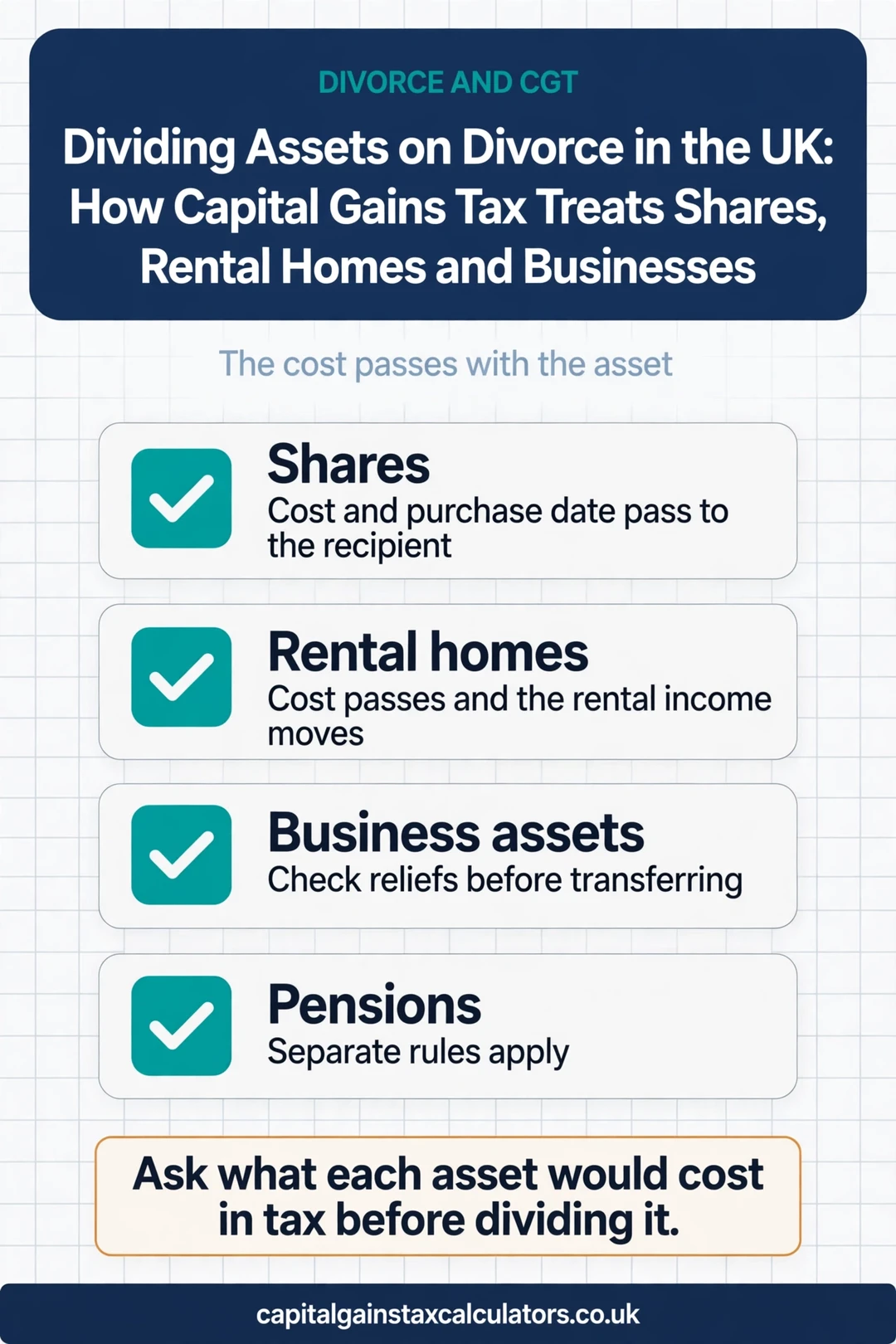
The same rule covers other assets. Shares transferred to your former spouse as part of the settlement are no gain, no loss, and the receiving spouse takes over the cost. Rental properties follow the property rules, and the new owner is liable for tax on the later sale. For a business, check how any transfer affects reliefs such as Business Asset Disposal Relief, which have ownership-period tests. The cost and date are inherited, but the qualifying conditions may be reset in some cases, so check them before the transfer. A transfer of the family business to a spouse who has not been involved may also change the tax treatment of the business.
| Asset | What happens on transfer | Points to check |
|---|---|---|
| Family home | No gain, no loss within the window or under an order | Private Residence Relief for the spouse who moved out |
| Shares | Cost and date pass to the receiving spouse | Pooled cost and dealing records |
| Rental property | Cost and date pass | Income Tax on rent moves too |
| Business interests | Cost and date pass | Reliefs may have time tests |
| Pensions | Not a Capital Gains Tax matter | Pension sharing has its own rules |
Reporting and paying
If you sell the family home and there is a gain after relief, you must report and pay the tax within 60 days of completion, if it is UK residential property. Each owner reports their own share, even if they are no longer living together. If the gain is fully covered by relief, there is nothing to report to HMRC for Capital Gains Tax, though you may need to keep the evidence. A transfer under the window needs no report to HMRC, but you should keep the order or agreement and the dates. See our reporting guide.
Common mistakes on divorce
- Missing the window. A transfer after it, without an order, is a disposal.
- Forgetting the cost carries over. The receiving spouse inherits the original cost.
- Choosing another main home too early. It can end relief for the old home.
- Not documenting the transfers. Keep the agreement or order.
- Assuming no tax at all. The later sale can still create a gain.
- Ignoring Stamp Duty Land Tax. It has its own rules on divorce.
What to do next
- Write down the date you separated and the tax year it falls in.
- List the assets to be transferred or sold.
- Check the Private Residence Relief position for the home.
- Get the transfers into a formal agreement or court order, and take advice from a family law solicitor and a tax adviser.
Frequently asked questions
Do I pay Capital Gains Tax when I transfer assets to my ex-spouse?
Not in the tax year of separation or the next three tax years, or later if the transfer is under a court order or formal agreement. These transfers are no gain, no loss.
What cost does my former spouse use?
Your original cost and acquisition date. The gain on a later sale is measured from those figures.
Do I pay tax on the family home if I moved out?
You may have a gain if you sell, but Private Residence Relief often covers most of it. It covers the months you lived there, the final 9 months and any qualifying absence.
Can I keep relief if my ex stays in the home?
In many cases, yes, until the home is sold or transferred, if you have not elected another main residence and the arrangement is part of the divorce.
What if we sell the home and split the money?
Each owner reports their own share of the gain. Relief may cover all or part of it.
Is there a time limit for transfers?
For transfers without an order, the limit is the end of the third tax year after the year of separation. Under a court order or formal agreement there is no time limit.
Do I need to report a transfer on divorce?
Not for Capital Gains Tax if it is no gain, no loss. Keep the agreement and the dates in case HMRC asks.
Does Stamp Duty Land Tax apply to transfers on divorce?
Transfers between spouses on divorce under an order or agreement are usually exempt, but you should check the current rules.
What about pensions and savings?
Pensions and cash are not Capital Gains Tax matters. Pension sharing has its own rules, and cash has no gain.
Should I take advice?
Yes. The rules interact with family law, property law and Stamp Duty Land Tax, and a mistake can be costly.
Official sources
- GOV.UK: Tax when transferring assets on divorce or separation
- GOV.UK: Capital Gains Tax: gifts
- GOV.UK: Tax when you sell your home
- HMRC helpsheet HS283: Private Residence Relief
- HMRC helpsheet HS281: Capital Gains Tax, civil partners and spouses
Related guides and calculators
This page gives general information for UK taxpayers and is not tax advice. Capital Gains Tax rules can change and your own circumstances matter. Check the latest rules on GOV.UK or with a qualified tax adviser before you act.